
Descript Overdub revolutionizes voice cloning for creators. Generate lifelike AI voices from text instantly, saving time and boosting production. Start cloning voices today!
Here’s How Descript Overdub Solved My Biggest Voice Cloning Issue
Alright, let’s be real.
The world of voice and music generation is exploding.
It’s not just for tech gurus anymore.
Everyone, from content creators to indie filmmakers, is looking for an edge.
And if you’re not thinking about AI, you’re already behind.
Specifically, how AI can handle your voice needs.
That brings us to Descript Overdub.
This isn’t just another shiny new toy.
It’s a serious player in the voice game, especially when it comes to voice cloning.
I’ve seen the struggle firsthand.
Hours spent re-recording, trying to fix a single word.
Or worse, having to pay top dollar for a voice actor to redo a line.
It’s painful. It’s inefficient. It’s a waste of resources.
What if you could just type the words and have them spoken in your own voice, or a voice you’ve created?
That’s the promise of Descript Overdub.
It’s not magic, but it’s close enough for most.
This tool changes the game for anyone creating audio or video content.
It streamlines workflows, cuts costs, and unlocks creative possibilities you didn’t even know existed.
Let’s break down how Descript Overdub works and why it’s become a critical tool for so many.
You want results, right?
This article is about how to get them.
No BS, just the facts.
Let’s get into it.
Table of Contents
- What is Descript Overdub?
- Key Features of Descript Overdub for Voice Cloning
- Benefits of Using Descript Overdub for Voice and Music Generation
- Pricing & Plans
- Hands-On Experience / Use Cases
- Who Should Use Descript Overdub?
- How to Make Money Using Descript Overdub
- Limitations and Considerations
- Final Thoughts
- Frequently Asked Questions
What is Descript Overdub?
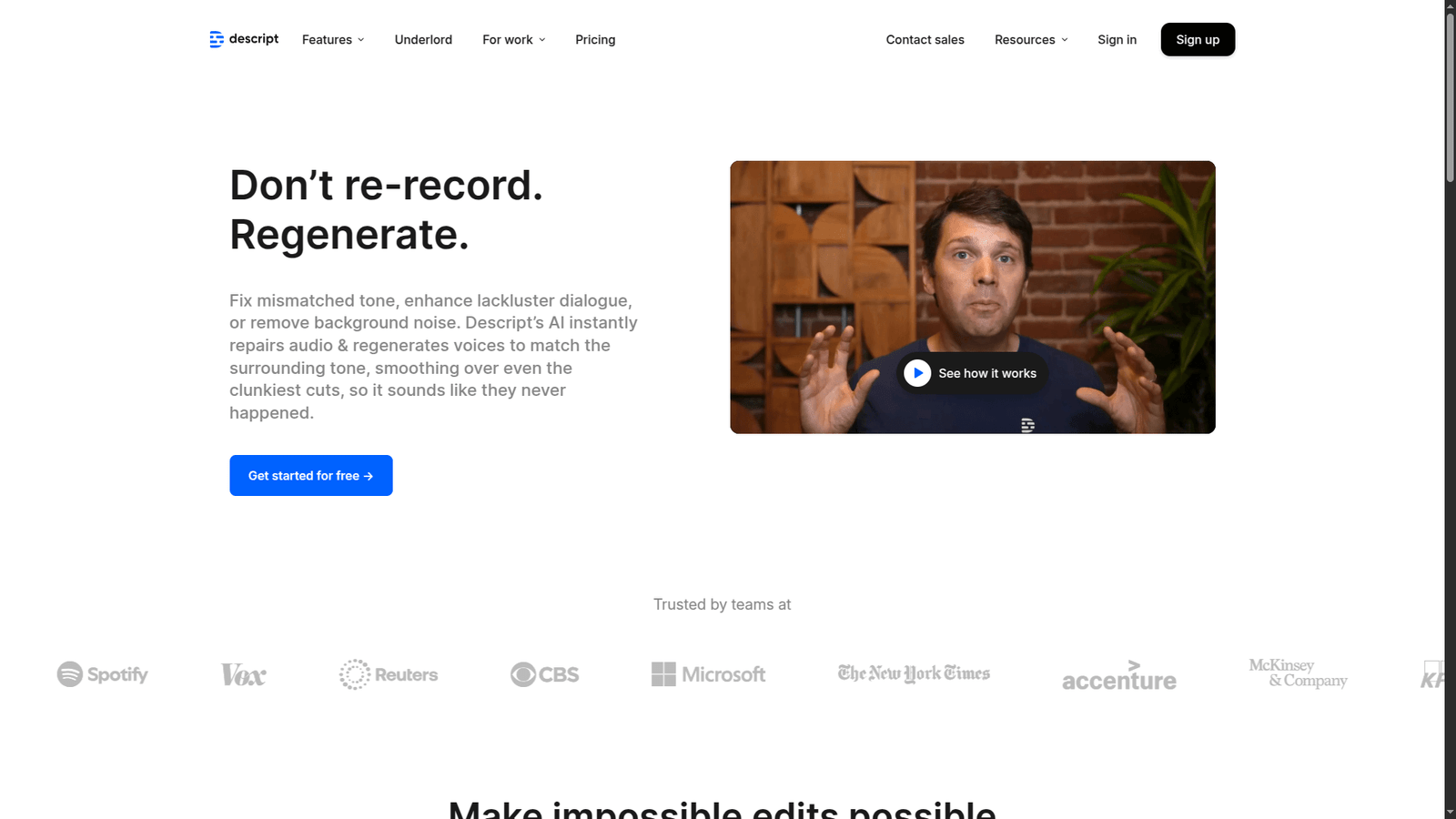
Descript Overdub is a groundbreaking AI feature within the Descript audio and video editing software.
Think of it like this: you type words, and those words are spoken aloud in a voice that sounds like you, or any voice you’ve ‘cloned’.
It’s not just a text-to-speech engine.
It’s an intelligent system that learns the nuances of a voice.
Your voice, or a trained voice.
The core function of Descript Overdub is to create realistic, synthetic speech.
This speech is based on a recorded voice model.
You record about 10-30 minutes of your voice, or someone else’s with permission.
Descript then builds a digital clone of that voice.
From that point on, you can type any script.
Overdub generates the audio in that cloned voice.
It’s designed for anyone who works with audio.
This includes podcasters, video editors, marketers, content creators, and even musicians.
Anyone who needs consistent voiceover or dialogue.
It saves an insane amount of time.
Imagine you’re editing a podcast.
You misspeak a single word.
Normally, you’d have to go back to the recording studio.
Or try to find a similar take.
With Overdub, you simply edit the text in the transcript.
Then you type the corrected word.
Descript Overdub generates the new audio, perfectly matched to the voice.
It’s seamless. It’s powerful.
And it changes how you approach voice work.
No more waiting on voice talent for small edits.
No more scheduling conflicts.
You have instant access to your voice.
Or the voice of your brand.
It’s about efficiency.
It’s about control.
And it’s about making your content production smoother.
This tool removes friction.
That’s what you want in any business.
It cuts out the unnecessary steps.
And lets you focus on creating great content.
Not fixing tiny errors.
That’s the essence of Descript Overdub.
A tool that works for you.
Not the other way around.
It’s a huge leap for anyone doing audio work.
Especially for voice cloning.
Key Features of Descript Overdub for Voice Cloning
- Instant Voice Generation from Text:
This is the core. You type. Descript Overdub speaks.
It’s not just basic text-to-speech; it’s about generating words in a voice you’ve specifically trained.
Imagine you’re scripting a podcast. You realize you need to add a sentence or rephrase a line.
Instead of re-recording the entire section, you just type the new words into the transcript.
Descript Overdub generates the audio in your cloned voice, seamlessly integrated.
This saves immense time. It cuts down on production headaches.
And it means you can iterate on your script without penalty.
It makes editing as easy as editing a document.
For content creators, this is a game-changer.
You can refine your message until it’s perfect, without worrying about the voiceover process.
It’s about speed and precision.
This is critical for anyone in voice and music generation.
No more delays. Just instant results.
- High-Fidelity Voice Cloning:
Overdub doesn’t just make a robotic voice. It creates a high-quality clone.
You provide a recording of your voice – typically 10 to 30 minutes of clear speech.
Descript’s AI analyzes your pitch, tone, cadence, and unique vocal characteristics.
It then builds a model that can replicate your voice with surprising accuracy.
The goal is for listeners to not tell the difference between your real voice and the Overdub version.
While it’s not always 100% perfect, especially with extreme emotions, for standard narration and dialogue, it’s remarkably good.
This means consistent brand voice.
It means professional-sounding audio, even when you can’t be in front of a microphone.
The quality of the voice clone is paramount for professional use.
Descript Overdub delivers on this.
It’s a significant investment in technology to get this right.
And it shows in the output.
- Error Correction and Retakes Without Re-recording:
This is where the real power for editing comes in.
Imagine you’ve recorded an hour-long interview.
Then you hear it back and realize you stumbled on a word, or said something incorrectly.
Traditionally, you’d have to go back, set up the mic, and re-record that segment.
Or try to patch it with an external edit.
With Descript Overdub, you simply edit the transcript.
You highlight the error. You type the correction.
Overdub instantly replaces the audio with the correct words, spoken in your cloned voice.
It’s like magic.
This capability reduces post-production time dramatically.
It allows for more fluid editing.
It removes the fear of making mistakes during recording.
You can focus on content delivery, knowing that minor errors are easily fixed.
This is a huge stress reliever for podcasters, YouTubers, and anyone creating spoken content.
It gives you control you never had before.
And control means more productivity.
More finished projects.
Benefits of Using Descript Overdub for Voice and Music Generation

Look, time is money.
And if you’re spending hours on re-records or fiddling with audio, you’re losing money.
Descript Overdub addresses this head-on.
Massive Time Savings: This is probably the biggest benefit.
No more waiting for perfect takes.
No more scheduling voice talent for minor revisions.
If you need to add a new line, correct a typo, or expand on a thought, you just type it.
The audio is generated instantly.
For podcasters and video creators, this means going from recording to publishing much faster.
Think about the iterative process of content creation.
You can draft, record, then refine the script.
Then simply let Overdub handle the audio updates.
It drastically cuts down on post-production time.
Consistent Audio Quality and Branding: Your voice is your brand.
Or the voice you use for your content is part of your brand identity.
Overdub ensures that voice is always available and always consistent.
No more worrying about different recording environments.
Or the subtle changes in your voice due to illness or fatigue.
The cloned voice maintains the same pitch, tone, and quality every time.
This is crucial for professional content.
It builds trust and recognition with your audience.
It’s an important part of your overall content strategy.
Overcoming Creative Blocks and Enhancing Agility: Sometimes, the sheer effort of recording can be a barrier.
Especially if you’re trying out new ideas.
With Overdub, you can experiment with scripts and dialogue without having to perform them perfectly each time.
You can write, generate, listen, and revise.
This speeds up the creative process.
It allows for more iterations.
It makes you more agile.
You can test out different narratives or voiceovers rapidly.
Before committing to a final recording.
This reduces the fear of failure.
And encourages more experimentation.
Which leads to better content.
Cost Efficiency: For businesses that regularly need voiceovers, Overdub can save a fortune.
Hiring professional voice actors for every small update or new project adds up fast.
With a cloned voice, you have an “in-house” voice actor available 24/7.
No hourly rates, no studio fees, no booking hassles.
This is a direct impact on your bottom line.
It frees up budget for other aspects of your production.
For small businesses and individual creators, this is huge.
It democratizes high-quality audio production.
Making it accessible to everyone.
Pricing & Plans
Let’s talk money.
You want to know what it costs to get these benefits.
Descript offers a tiered pricing structure.
This makes it accessible for different users, from hobbyists to professional teams.
The good news?
There is a free plan.
This free tier gives you a taste of Descript’s core features.
It lets you transcribe a limited amount of audio.
And it allows for a short trial of Overdub.
This is perfect for testing the waters.
You can see if the voice cloning technology lives up to the hype.
Before you commit any cash.
For serious users, you’ll need to step up to a paid plan.
The Creator plan is usually the first paid tier.
This plan typically includes more transcription hours.
And more extensive use of Overdub.
This is where the true value of voice cloning kicks in.
You get dedicated minutes for Overdub generation each month.
The exact number of minutes can vary, so check their site for current details.
The Pro plan is for teams and high-volume creators.
It offers even more transcription and Overdub minutes.
Plus advanced features like Studio Sound, multi-track editing, and priority support.
For enterprises, there are custom plans.
These are tailored to very specific needs, often with dedicated account managers.
How does this compare to alternatives?
Many standalone voice cloning tools can be quite expensive.
They often charge per minute of generated audio.
Or require a hefty upfront fee for voice model training.
Descript’s integrated approach often provides better value.
You’re not just buying voice cloning.
You’re getting a full-featured audio and video editor.
With transcription, screen recording, and more.
It’s an all-in-one solution.
This makes the overall cost more efficient.
Especially if you’re already using separate tools for editing and transcription.
Always check their official website for the most up-to-date pricing.
They sometimes offer deals or adjust their tiers.
But generally, Descript Overdub represents a strong return on investment.
Especially when you consider the time saved and the quality gained.
It’s an asset, not just an expense.
Hands-On Experience / Use Cases
Alright, let’s get into the trenches.
How does Descript Overdub actually work in practice?
And where does it shine?
My first experience with Overdub was for a podcast.
I had a guest interview, and I realized I needed to add a quick intro and outro.
But I was on the road.
No studio setup, just my laptop.
Normally, this would mean a delay.
Or a lower-quality recording from my phone mic.
Instead, I opened Descript.
My voice clone was already set up (a quick 15-minute training session a while back).
I typed out the intro script.
Hit generate.
Boom.
My voice, perfectly articulated, instantly appeared in the timeline.
It was surreal. And incredibly efficient.
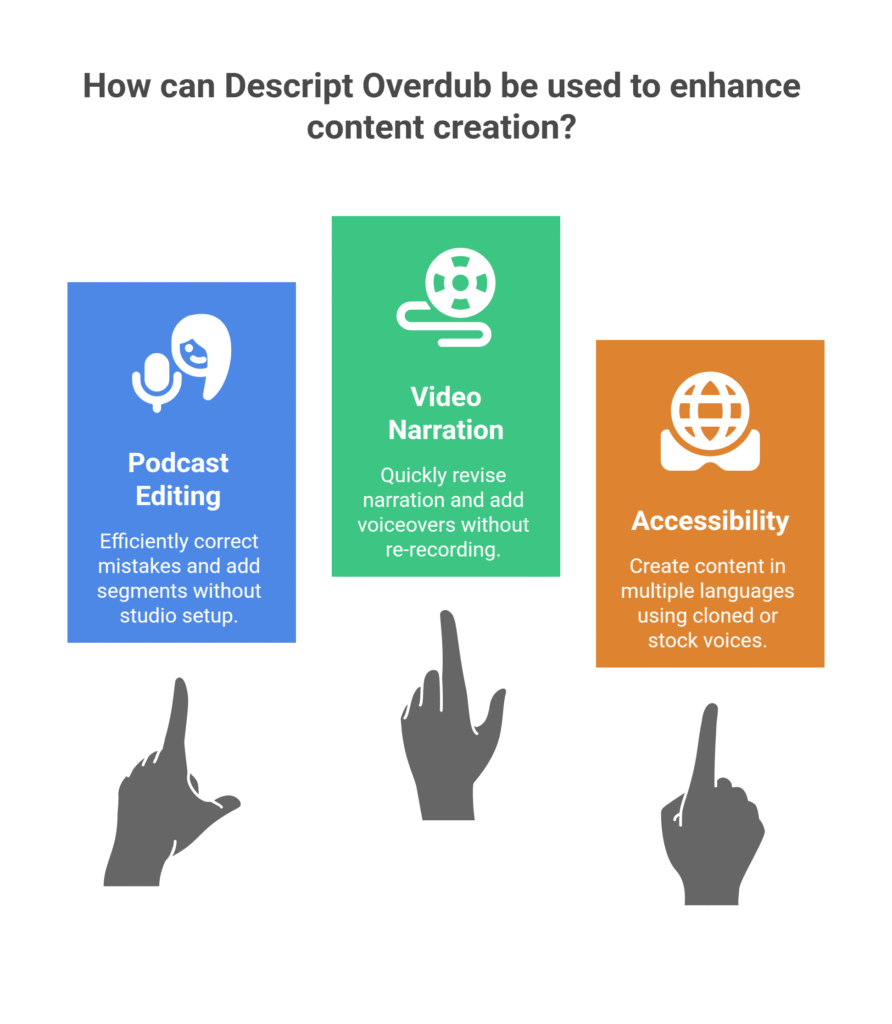
Use Case 1: Podcast Editing and Corrections
This is a prime example.
You record a long interview.
You stumble on a word.
Or mispronounce something.
With Overdub, you simply select the mistake in the transcript.
Type the correction.
The audio updates instantly.
No need to cut, paste, or find an alternative take.
This drastically reduces editing time.
And ensures a clean, polished final product.
Use Case 2: Video Narration and Explainer Videos
Creating explainer videos often involves script changes.
Or adding last-minute voiceover segments.
Imagine you’re animating a video.
You realize a sentence could be clearer.
Instead of bringing your voice talent back to the studio.
Or re-recording yourself.
You can just type the revised narration.
Overdub generates the new audio.
This allows for rapid iteration on video projects.
It keeps your production pipeline flowing smoothly.
Use Case 3: Accessibility and Localization
While Overdub isn’t a direct translation tool.
It can be used in conjunction with translation services.
You could translate your script.
Then use Overdub to generate audio in different cloned voices (if you have them).
Or in Descript’s stock voices, which are quite good.
This helps create content for wider audiences.
It makes your content more accessible.
For usability, Descript’s interface is intuitive.
It’s built around the transcript.
So if you can edit text, you can edit audio and video.
The learning curve for basic functions is minimal.
For Overdub specifically, training your voice model is straightforward.
You read a script for 10-30 minutes.
Descript handles the rest.
The results are impressive.
The generated audio sounds natural.
It matches the rhythm and intonation of the original voice.
It’s not perfect every single time, but it’s very close.
And for corrections or additions, it saves an incredible amount of effort.
It delivers on its promise.
That’s the real test.
Who Should Use Descript Overdub?
This isn’t just a niche tool.
Descript Overdub has a wide appeal.
It solves problems for many different types of creators and businesses.
Podcasters: This is a no-brainer.
If you record regularly, you know the pain of flubs, stumbles, and the need for retakes.
Overdub lets you correct errors in seconds.
It allows you to add new segments.
Or even record an entire episode from a script using your cloned voice.
Perfect for solo shows.
It boosts your production speed and consistency.
YouTubers and Video Creators: Narration is key for many video formats.
From educational content to product reviews.
Overdub provides a consistent, high-quality voiceover.
You can write your script.
Generate the audio.
Then sync it with your visuals.
Any script changes are quick and easy.
No more waiting on a voice actor for a tiny update.
Marketers and Content Agencies: If you produce a lot of video or audio ads.
Or explainer videos.
Overdub can be a game-changer.
You can maintain a consistent brand voice across all your campaigns.
Rapidly generate new versions of ads for A/B testing.
Or create custom voiceovers for client projects.
It reduces production costs and speeds up delivery.
Small Businesses and Entrepreneurs: You wear many hats.
Marketing, sales, customer service.
Creating professional audio for your website, social media, or online courses can be a huge lift.
Overdub puts professional voice creation within reach.
You can produce high-quality audio content.
Without investing in expensive recording equipment or hiring talent.
Educators and Course Creators: Developing online courses often involves extensive narration.
Overdub allows for easy updates to course material.
Or the addition of new lessons.
Without having to re-record entire modules.
It ensures your voice is always there, even if you can’t be.
Audiobook Narrators and Publishers: While it won’t replace a full human narration.
Overdub can be used for corrections, small additions, or even testing scripts.
It can smooth out the post-production process.
Making it faster to get audiobooks to market.
Essentially, anyone who deals with spoken audio.
And wants to save time, reduce costs, and improve efficiency.
Should consider Descript Overdub.
It’s about working smarter, not harder.
How to Make Money Using Descript Overdub

Alright, let’s get down to brass tacks.
How do you turn this tool into actual cash?
Descript Overdub isn’t just about saving money; it’s about making it.
By increasing your output, improving your efficiency, and offering new services.
Service 1: Premium Podcast Editing Services
Offer specialized podcast editing.
Highlight the unique benefit of “instant voice corrections” or “scripted additions.”
Many podcasters struggle with post-production.
They hate re-recording.
You can charge a premium for faster turnaround times.
And for cleaner audio.
Thanks to Overdub, you can fix client mistakes without them having to re-record.
This is a huge value proposition.
Think about a client who misspoke a product name.
You just type the correction.
And send them the polished audio.
They’ll see the value immediately.
You get paid for that efficiency.
Service 2: Voiceover Production for Marketing Agencies
Marketing agencies constantly need voiceovers.
For ads, explainer videos, social media content.
Position yourself as the go-to provider for rapid voiceover creation.
Especially if you have a unique voice cloned with Overdub.
Or can leverage Descript’s stock voices for quick drafts.
You can offer quick revisions.
And consistent voice branding.
This means you can take on more projects.
And deliver faster than traditional voice actors or studios.
Charge per project, per minute, or monthly retainer for ongoing voiceover needs.
Your speed is your selling point here.
Service 3: Creating Audio Content for Businesses (e.g., E-Learning, IVR Systems)
Businesses need audio.
Think e-learning modules.
Internal training videos.
Or interactive voice response (IVR) phone systems.
These often require a professional, consistent voice.
And frequent updates.
You can offer to create these audio assets.
Using your own Overdub voice.
Or a client’s voice, if they provide the initial recording.
The ability to quickly update scripts for compliance or new information is highly valuable.
This reduces their operational costs.
And gives you a steady stream of work.
Example: How Sarah M. makes $3,000/month with Descript Overdub.
Sarah is a freelance video editor.
She noticed her clients often needed small voiceover tweaks after the video was mostly done.
This would delay projects and frustrate clients.
She invested in Descript and trained her own Overdub voice.
Now, for any minor voiceover change, she uses her cloned voice.
Or offers to train the client’s voice (for a fee).
She charges an extra “rapid revision” fee per project.
Or includes it as a premium service.
Clients are happy to pay for the speed.
This has allowed her to take on more clients.
And complete projects faster.
Adding an estimated $3,000 to her monthly income just by optimizing this one aspect of her workflow.
It’s about leverage.
Using a tool to do more, in less time.
And charging for that efficiency.
Limitations and Considerations
No tool is perfect.
And Descript Overdub is no exception.
It’s powerful, but it has its boundaries.
Knowing them helps you use it effectively.
Accuracy and Naturalness: While incredibly good, Overdub isn’t always 100% indistinguishable from real human speech.
Sometimes, intonation can be slightly off.
Or certain words might sound a little less natural.
It performs best with straightforward, conversational speech.
It struggles with strong emotions.
Or very specific vocal inflections needed for acting.
For standard narration, it’s excellent.
But for nuanced character voices or highly expressive performances, a human is still superior.
You might need to do some light editing on the generated audio.
To ensure it blends perfectly.
Editing Needs Post-Generation: Even with Overdub, editing isn’t completely eliminated.
You might need to adjust timing.
Add pauses.
Or manually correct small vocal artifacts.
Descript provides tools for this, like shortening or lengthening words.
But it’s not always a set-it-and-forget-it solution.
Especially if the generated content is part of a longer, existing recording.
You still need an ear for audio.
Learning Curve (Initial Setup): While Descript itself is user-friendly.
Getting your Overdub voice set up requires a bit of effort.
You need to record a clean, 10-30 minute script for training.
This means finding a quiet space.
And speaking clearly.
If the initial recording is poor quality, your cloned voice will also be poor quality.
So there’s an upfront investment of time and quality control.
It’s not hard. But it’s a necessary step.
Ethical Considerations and Misuse: This is a big one.
Voice cloning technology raises ethical questions.
Descript has strong policies against misuse.
You can only clone your own voice.
Or a voice where you have explicit permission.
And you must declare that the audio is AI-generated if it’s for public consumption.
This is crucial.
Using someone’s voice without consent is illegal and unethical.
Be transparent.
Always consider the implications of using AI voices.
Especially for sensitive content.
Resource Usage: Generating Overdub audio requires processing power.
While Descript handles this on their servers, it does use up your allocated Overdub minutes.
For very long scripts, you need to manage your plan limits.
And ensure you have enough minutes.
These limitations aren’t deal-breakers.
They are just realities to be aware of.
Understanding them helps you leverage Descript Overdub to its fullest.
And avoid potential pitfalls.
Final Thoughts
So, what’s the verdict on Descript Overdub?
It’s not just hype. It’s the real deal.
For anyone serious about voice cloning.
And efficient audio production.
This tool changes the game.
It simplifies complex tasks.
It saves a phenomenal amount of time.
And it empowers creators to produce high-quality content faster than ever before.
The core value proposition is clear: instant, editable audio in your own voice.
Imagine correcting a single word in a 30-minute podcast.
Without re-recording.
Or generating an entire voiceover script.
All from typed text.
That’s the power of Descript Overdub.
It addresses the biggest pain points in audio production.
From reducing post-production time to ensuring consistent audio quality.
It frees you up to focus on the creative aspects.
Not the mundane, time-consuming fixes.
For podcasters, YouTubers, marketers, and businesses.
It’s an invaluable asset.
It allows for rapid iteration.
More content.
And ultimately, better results.
While it has its limitations—mainly around emotional range and the need for initial voice training—these are minor compared to the benefits.
It’s a powerful step forward in AI-assisted content creation.
If you’re on the fence, I recommend starting with Descript’s free plan.
Experiment with the transcription features.
And see if the workflow clicks for you.
Then, if you’re creating enough content, consider training your Overdub voice.
It’s an investment that pays off quickly.
In saved time, reduced stress, and higher output.
It’s about working smarter, not harder.
And that’s how you win in today’s content game.
Descript Overdub isn’t just a tool; it’s a competitive advantage.
Visit the official Descript Overdub website
Frequently Asked Questions
1. What is Descript Overdub used for?
Descript Overdub is used to generate realistic, synthetic speech from typed text. It creates an AI clone of a voice (your own or a licensed one) and lets you type words, which are then spoken in that cloned voice. It’s perfect for corrections in podcasts, adding narration to videos, or creating entirely new voiceovers without re-recording.
2. Is Descript Overdub free?
Descript offers a free plan that includes a limited trial of Overdub, allowing you to experience its capabilities. For more extensive use, including full voice cloning and more generated minutes, you’ll need to subscribe to one of their paid plans, such as the Creator or Pro plan.
3. How does Descript Overdub compare to other AI tools?
Descript Overdub stands out because it’s integrated within a full-featured audio and video editing platform. While other AI tools might offer voice cloning, Descript provides a comprehensive workspace that includes transcription, screen recording, and traditional editing, making it an all-in-one solution for content creators.
4. Can beginners use Descript Overdub?
Yes, Descript is designed with a user-friendly interface centered around a text transcript, making it easy for beginners to learn. The process of setting up your Overdub voice is straightforward, requiring a short recording session, and generating audio from text is as simple as typing.
5. Does the content created by Descript Overdub meet quality and optimization standards?
Yes, the audio generated by Descript Overdub is generally high-quality and natural-sounding, suitable for professional use in podcasts, videos, and other media. While it might sometimes require minor manual adjustments for perfect intonation or emotion, it significantly helps maintain consistent audio quality and streamline the production process, contributing to overall content optimization.
6. Can I make money with Descript Overdub?
Absolutely. You can leverage Descript Overdub to offer premium services like rapid podcast editing with instant corrections, quick voiceover production for marketing agencies, or creating audio content for businesses (e.g., e-learning, IVR systems). Its efficiency allows you to take on more clients and deliver faster, boosting your revenue.