
Discover the top 9 powerful AI Image Moderation Tools you can trust to safeguard your brand and users. Learn how these AI Image Moderation Tools can protect your platform from harmful content.
The 9 Most Powerful AI Image Moderation Tools You Can Trust
I get it. You’re building something great. You’ve got users, you’ve got content, and you’ve got a problem. That problem? Bad images. Nasty stuff that can tank your brand faster than you can say “community guidelines.” This isn’t just about PR; it’s about legal risk, user trust, and keeping your platform safe.
That’s why we’re talking about AI Image Moderation Tools. These aren’t some flimsy filters; these are serious pieces of kit designed to catch what humans miss, 24/7. We’re going to break down the nine best options out there, so you can stop worrying about every uploaded photo and start focusing on growth. If you’re serious about your platform’s integrity, paying attention here could save you a world of pain.
The stakes are high. One inappropriate image can lead to outrage, boycotts, and even legal action. Manual moderation is a losing battle – it’s slow, expensive, and frankly, soul-destroying for your team. That’s where AI Image Moderation Tools come in, providing a scalable, consistent, and remarkably accurate solution. These tools aren’t just about blocking nudity; they’re about identifying hate speech, graphic violence, illicit activities, and even subtle brand infringements. Think of them as your tireless, unbiased guardians, sifting through millions of images so you don’t have to. Let’s dive into how these powerhouses operate and which ones deserve a spot in your tech stack. It’s time to get surgical about your content safety.
Table of Contents
- What Are the Best Visual Content Filtering Tools?
- Top 9 Visual Content Filtering Tools (Detailed Reviews)
- Feature Comparison
- Pricing Breakdown
- Real-World Use Cases
- Who Should Use Each Tool?
- How to Choose the Right Tool
- Making Money with These Tools
- Common Limitations
- Final Verdict and Recommendations
- Frequently Asked Questions
What Are the Best Visual Content Filtering Tools?
Look, the digital world is a wild place. Users upload millions of images every day, and a good chunk of them are, frankly, problematic. Manual moderation just doesn’t scale. You’d need an army of people working round the clock, and even then, human error is inevitable. This is where AI Image Moderation Tools become non-negotiable. They’re designed to catch the stuff that slips through the cracks, from explicit content and hate symbols to graphic violence and illegal goods.
These aren’t just simple filters; they’re sophisticated engines trained on vast datasets to identify nuanced threats and ensure your platform remains compliant and safe. We’re talking about cutting-edge Security and Moderation solutions that can save your business from reputational disaster and legal headaches.
The “best” visual content filtering tools aren’t just about high accuracy; they’re about speed, scalability, and adaptability. Your needs today might be different tomorrow, and the tool you choose needs to keep up. We’re looking for AI Image Moderation Tools that offer real-time processing, so offensive content doesn’t linger on your site for even a second. We also need tools with robust APIs, making integration seamless, regardless of your existing infrastructure.
Beyond just identifying explicit content, the top-tier solutions also offer advanced features like text-in-image detection, logo recognition for brand safety, and even sentiment analysis to pick up on subtle cues of harassment or bullying. It’s a comprehensive approach to Visual Content Filtering that separates the contenders from the pretenders. Don’t settle for less when your brand’s reputation is on the line.
When I talk about powerful AI Image Moderation Tools, I’m talking about systems that learn and improve over time. They aren’t static. The internet is constantly evolving, and so are the ways people try to bypass moderation. Your chosen solution needs to be dynamic, with frequent model updates and the ability to adapt to new threats. Think about customisation – can you train the AI to recognise specific types of content relevant to your niche?
Can you adjust sensitivity levels to reduce false positives without missing critical violations? These granular controls are what give you true power over your content environment. The best tools offer detailed reporting and analytics, giving you insights into the types of content being uploaded and where your risks lie. This data is invaluable for refining your moderation strategy and proving compliance to stakeholders. It’s not just about blocking; it’s about understanding and preventing. We want AI Image Moderation Tools that give us clarity and control.
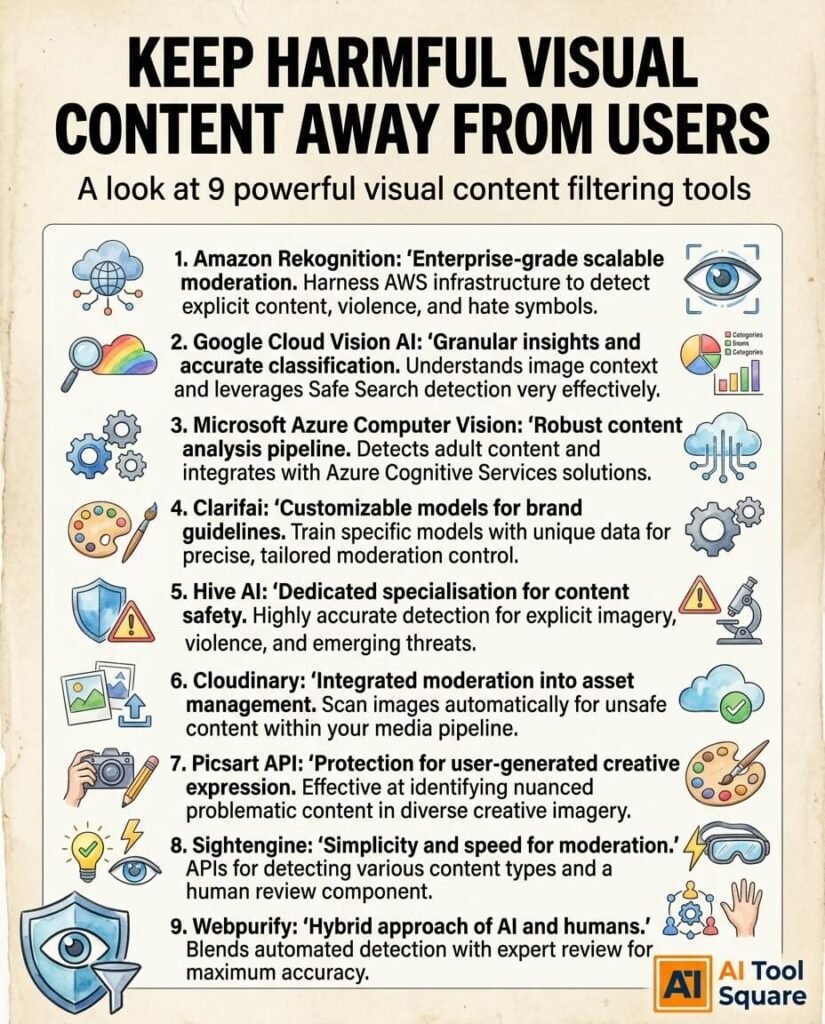
Top 9 Visual Content Filtering Tools (Detailed Reviews)
Amazon Rekognition – AI Image Moderation Tools Review
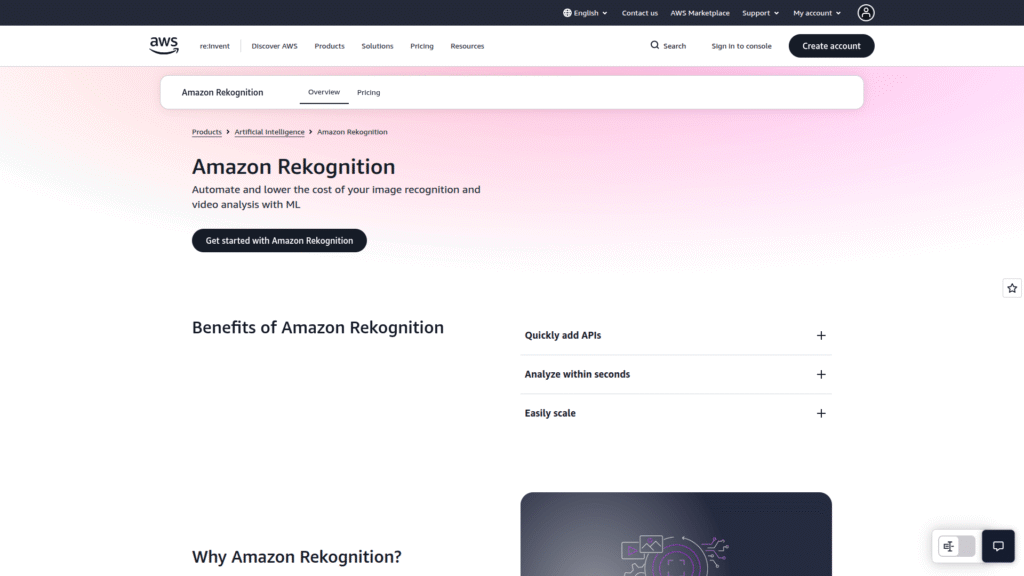
Amazon Rekognition is a heavy hitter in the AI Image Moderation Tools space, leveraging AWS’s formidable machine learning infrastructure. It offers powerful image and video analysis, with capabilities including object and scene detection, facial analysis, and, crucially for us, content moderation. Rekognition is excellent at identifying explicit content, suggestive content, graphic violence, hate symbols, and even drug-related imagery.
Its deep integration with other AWS services makes it a natural fit for businesses already operating within the Amazon ecosystem. I’ve seen it handle massive volumes with impressive speed. The API is robust, allowing for highly customisable moderation workflows, whether you’re scanning live streams or massive image archives. For businesses that need enterprise-grade scalability and reliability, Rekognition is a serious contender among AI Image Moderation Tools.
- Features: Highly accurate content moderation for explicit, suggestive, violent, and hateful content; object and scene detection; facial analysis; celebrity recognition; text in image detection; custom labels for specific object/scene detection.
- Pricing: Pay-as-you-go model, with charges based on the number of images and video minutes processed, and for custom labels storage and training. Tiered pricing for higher volumes.
- Pros: Extremely scalable and reliable due to AWS infrastructure; highly accurate; broad range of detection capabilities beyond just moderation; flexible API for custom integrations; good for businesses already on AWS.
- Cons: Can be more complex to set up for those unfamiliar with AWS; pricing can become significant at very high volumes if not managed carefully; may require some developer expertise for full customisation.
Visit official Amazon Rekognition website
Google Cloud Vision AI – AI Image Moderation Tools Review
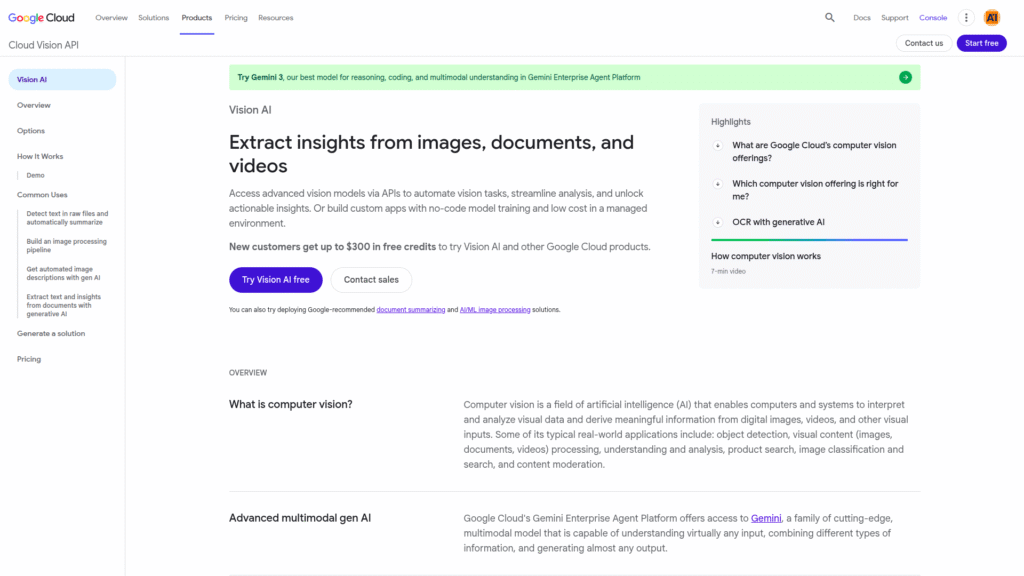
Google Cloud Vision AI is another titan among AI Image Moderation Tools, bringing Google’s vast AI research to the forefront of content safety. It’s particularly strong in detecting a wide range of content attributes, from explicit and violent imagery to culturally sensitive content and even specific objects within an image. Vision AI excels at understanding context, which is critical for accurate moderation.
Its Safe Search Detection feature is incredibly effective at classifying images into categories like adult, spoof, medical, violence, and racy. If you’re looking for a tool that can provide granular insights into your image content, Google Cloud Vision AI is a top choice. Its API is well-documented and easy to integrate, making it accessible for developers. This is an AI Image Moderation Tool that continually gets smarter as Google’s own models improve.
- Features: Safe Search Detection for adult, violent, racy, medical, and spoof content; object localisation; landmark detection; optical character recognition (OCR); web entity detection; custom Vision models for specific use cases.
- Pricing: Pay-as-you-go, based on the number of images processed and specific features used (e.g., Safe Search Detection has its own pricing tier). Free tier available for initial usage.
- Pros: Extremely powerful and accurate moderation; excellent at understanding context; comprehensive range of vision capabilities; well-documented API; suitable for businesses needing robust, nuanced moderation.
- Cons: Can be slightly more expensive for certain features at scale; some advanced features might require deeper technical understanding to implement effectively; integration can be more involved than some out-of-the-box solutions.
Visit official Google Cloud Vision AI website
Microsoft Azure Computer Vision – AI Image Moderation Tools Review

Microsoft Azure Computer Vision offers a comprehensive suite of AI Image Moderation Tools, designed to integrate seamlessly into Azure environments. Its content moderation capabilities are robust, focusing on detecting adult, racy, and gory content with adjustable confidence thresholds. What sets Azure apart is its focus on enterprise solutions and its ability to combine with other Azure Cognitive Services for a truly holistic content analysis pipeline.
For example, you can combine its image moderation with text analytics for a complete content safety solution. If your organisation is already invested in Microsoft’s cloud ecosystem, Azure Computer Vision provides a powerful and familiar set of AI Image Moderation Tools to manage your visual content. It’s built for enterprise, meaning reliability and security are baked in. I’ve seen this tool deliver consistent results for large organisations.
- Features: Content moderation for adult, racy, and gory images; object detection; OCR; celebrity and landmark recognition; image analysis for categorisation and tag generation; custom vision for tailored image recognition models.
- Pricing: Transaction-based pricing, with different costs for image analysis and specific moderation features. Free tier available for limited usage.
- Pros: Strong content moderation features; deep integration with other Azure services; enterprise-grade security and reliability; flexible for customisation; good for organisations already using Azure.
- Cons: Best leveraged within the Azure ecosystem, which might be a barrier for some; pricing can vary significantly based on feature usage; may require some technical proficiency for optimal setup.
Visit official Microsoft Azure Computer Vision website
Clarifai – AI Image Moderation Tools Review
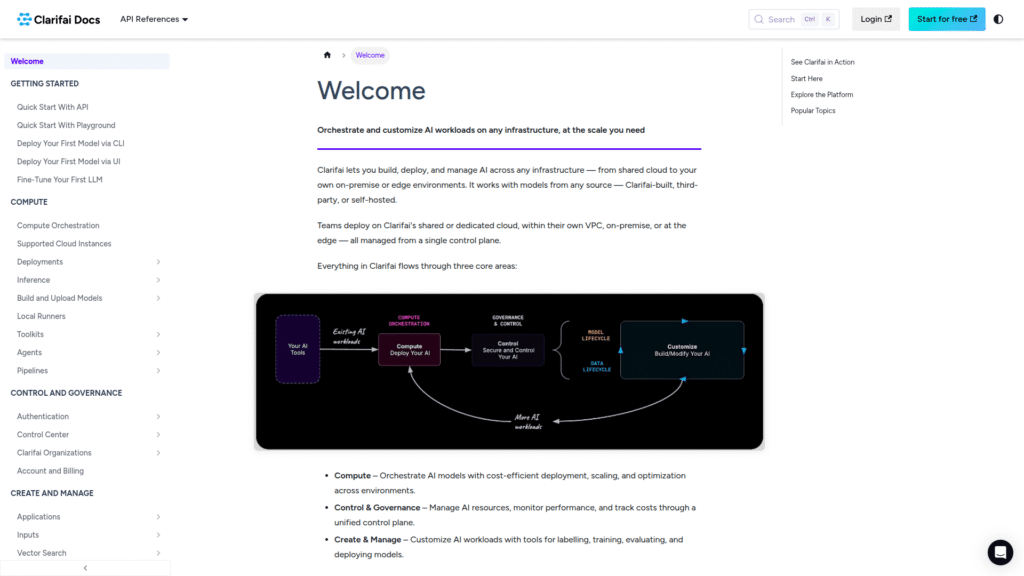
Clarifai stands out among AI Image Moderation Tools for its focus on providing a complete AI platform, not just individual models. While it offers powerful pre-built moderation models for nudity, violence, and hate speech, its real strength lies in its customisation capabilities. You can train your own models with your specific data, allowing for incredibly precise moderation tailored to your brand’s unique guidelines. This is a game-changer for businesses with niche content or specific brand safety requirements.
Clarifai provides a user-friendly interface alongside its powerful API, making it accessible for both developers and non-technical users to manage their AI Image Moderation Tools. Their visual search capabilities also add another layer of content understanding, helping you identify problematic images through similarity. For those who need highly customisable and trainable AI Image Moderation Tools, Clarifai is a compelling option.
- Features: Pre-built content moderation models (e.g., NSFW, Gore, Hate Speech); custom model training; visual search; object detection; facial recognition; customisable workflows and APIs.
- Pricing: Tiered pricing based on operations (e.g., number of predictions), storage, and model training. Offers a generous free tier for developers.
- Pros: Exceptional customisation and model training capabilities; powerful visual search; user-friendly interface alongside robust API; good for niche content moderation needs; constantly updated models.
- Cons: Can become complex when building highly custom workflows; pricing can escalate for very high custom model training and usage; steep learning curve for advanced features if new to AI platforms.
Visit official Clarifai website
Hive AI – AI Image Moderation Tools Review
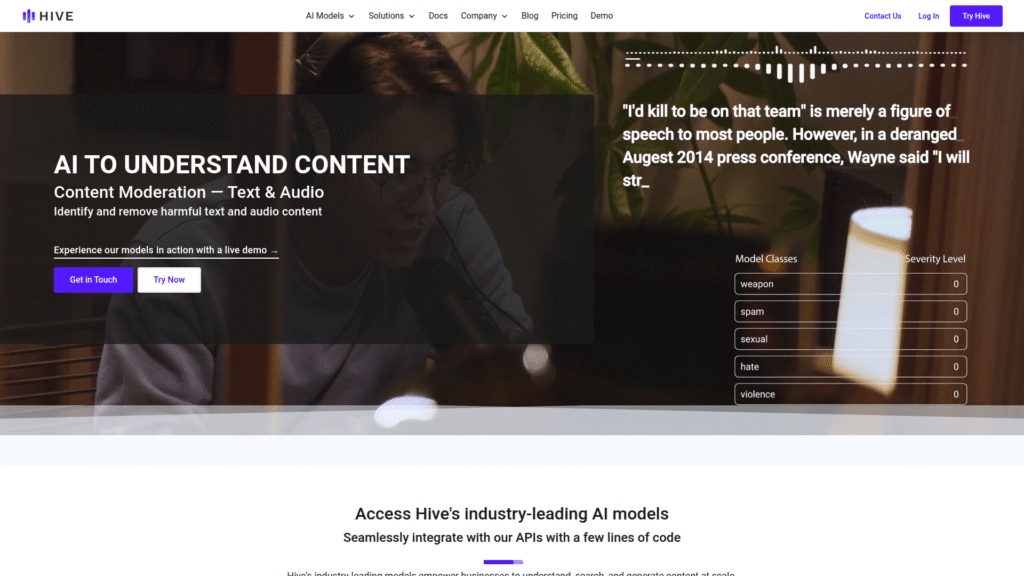
Hive AI is laser-focused on content moderation, positioning itself as a leader in applying AI to solve the problem of harmful and unwanted content. Unlike some general-purpose AI Image Moderation Tools, Hive’s expertise is specifically honed for this challenge. They offer a vast array of models capable of detecting everything from explicit imagery and graphic violence to hate speech, self-harm, and illegal content like child abuse material (CSAM) with extremely high accuracy.
Their models are constantly updated and trained on massive, curated datasets, making them incredibly effective at catching emerging threats. Hive provides both an API and a moderation platform, giving businesses flexibility in how they integrate and manage their content safety. If you need dedicated, highly accurate AI Image Moderation Tools with a deep specialisation in content safety, Hive AI is definitely one to consider. They eat, sleep, and breathe moderation.
- Features: Highly accurate detection of explicit content, violence, hate speech, self-harm, drug use, illegal content (e.g., CSAM); brand safety; custom moderation rules; human review queue integration; real-time processing.
- Pricing: Typically enterprise-focused pricing, often based on volume and specific models used. Best to contact them directly for a quote.
- Pros: Extremely high accuracy and specialisation in content moderation; covers a very wide range of harmful content categories; constantly updated models; enterprise-grade solution; often includes human review integration.
- Cons: Potentially higher cost due to specialisation and accuracy; less emphasis on general vision AI features compared to others; might be overkill for very basic moderation needs.
Visit official Hive AI website
Cloudinary – AI Image Moderation Tools Review
Cloudinary is renowned for its comprehensive image and video management solutions, and its AI Image Moderation Tools are an integral part of that offering. While it might not be a dedicated moderation-only platform like Hive, Cloudinary leverages partnerships with leading AI providers (like Rekognition or Google Vision AI) to offer powerful content moderation features directly within its asset management workflow.
This is incredibly convenient for businesses that already rely on Cloudinary for image delivery, manipulation, and storage. You can automatically scan uploaded images for explicit or unsafe content as part of your asset pipeline, preventing problematic media from ever reaching your users. It simplifies the moderation process by integrating it into a platform many businesses already use daily. If you’re looking for AI Image Moderation Tools that live where your images live, Cloudinary is a strong contender.
- Features: Integrated content moderation (via partnerships) for adult, violent, and other inappropriate content; extensive image and video manipulation tools; asset management; smart cropping; object detection; facial detection; AI-powered tagging.
- Pricing: Tiered plans based on usage (storage, transformations, bandwidth). Moderation features are often included or available as add-ons, with costs varying based on the underlying AI service used.
- Pros: Seamless integration with a powerful image and video management platform; automates moderation as part of the upload workflow; simplifies content pipeline; robust API and SDKs; ideal for businesses already using Cloudinary.
- Cons: Moderation capabilities are often dependent on third-party AI services; may not offer the same depth of customisation as dedicated moderation platforms; cost can add up when combining with other Cloudinary features.
Visit official Cloudinary website
Picsart API – AI Image Moderation Tools Review
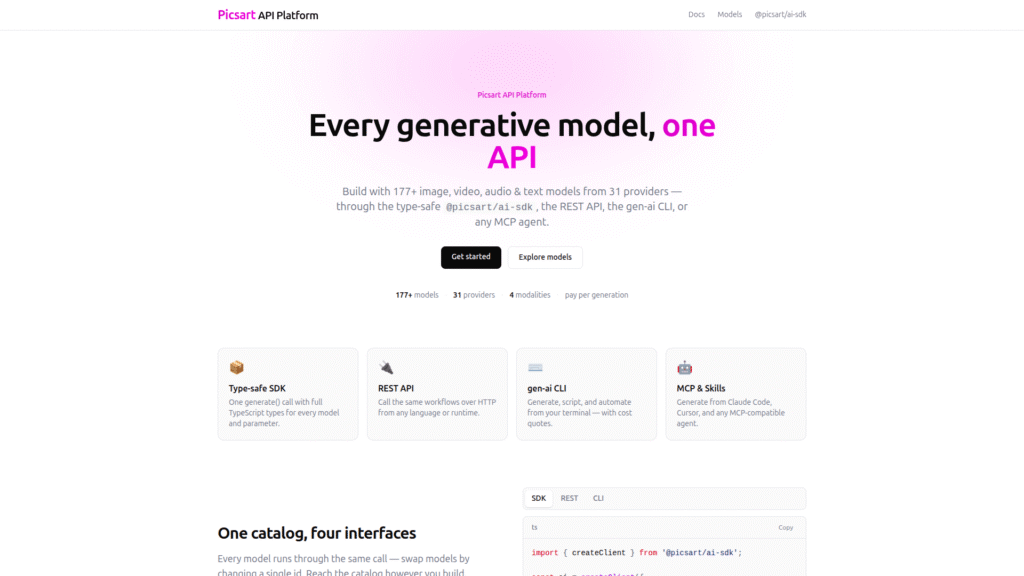
Picsart API, known for its extensive creative editing tools, also offers potent AI Image Moderation Tools for developers. Given Picsart’s focus on user-generated content and creative expression, it’s no surprise they’ve developed robust solutions for ensuring content safety. Their moderation API can detect a range of inappropriate content, including explicit imagery, graphic violence, and other harmful elements, allowing platforms to protect their users and maintain brand integrity.
What’s interesting here is that their AI has been trained on a massive and diverse dataset of user-generated images, which can make it particularly effective at identifying nuanced problematic content that might appear in creative contexts. For platforms that involve a lot of user creativity, Picsart’s AI Image Moderation Tools provide a valuable layer of protection. They understand the nuances of creative content better than some general-purpose tools.
- Features: Content moderation for explicit, violent, and other harmful content; background removal; object removal; image enhancement; styling filters; text-to-image API.
- Pricing: API plans are typically tiered based on the number of calls, with different pricing for various features. Contact for specific moderation API pricing.
- Pros: Moderation trained on diverse user-generated content; integrates well with creative platforms; good for platforms with high volumes of user-submitted images; combines moderation with other useful image processing APIs.
- Cons: May not be as specialised in pure content moderation as dedicated solutions like Hive; primary focus is often creative tools, with moderation as an important add-on; documentation might be geared more towards creative use cases.
Visit official Picsart API website
Sightengine – AI Image Moderation Tools Review
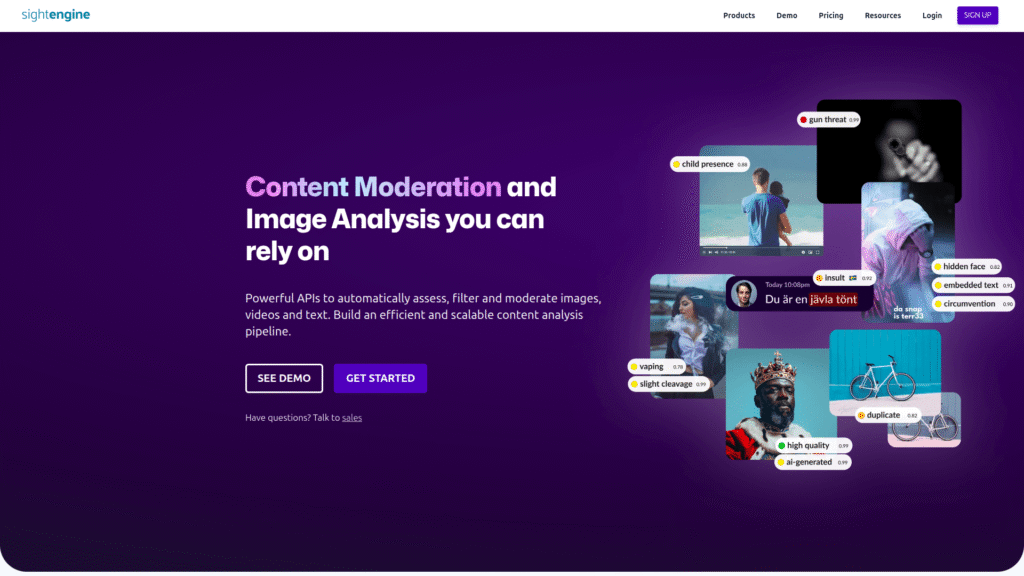
Sightengine is another highly focused player in the AI Image Moderation Tools arena, offering a suite of APIs specifically designed for content safety. They provide highly accurate detection for adult content, violence, drugs, alcohol, and even spam and text-based hate speech within images. What I like about Sightengine is its simplicity and clear focus. It’s built to do one job extremely well: moderate content.
They also offer a human review component, allowing you to seamlessly escalate borderline cases to human moderators for a final decision, which is crucial for reducing false positives and ensuring maximum accuracy. Their API is straightforward to integrate, making it a good choice for businesses that need to quickly implement reliable AI Image Moderation Tools without a lot of overhead. They understand the need for speed and accuracy in moderation.
- Features: AI moderation for adult content, violence, drugs, alcohol, weapons, hate speech, explicit text; custom moderation rules; human review integration; real-time processing; face detection.
- Pricing: Usage-based pricing (per image/video processed), with different tiers and features impacting the cost. Free trial available.
- Pros: Highly accurate and dedicated content moderation; easy-to-integrate API; human review integration built-in; good for real-time moderation; strong focus on content safety.
- Cons: Less general-purpose vision AI capabilities compared to AWS or Google; pricing can become significant at very high volumes if not carefully managed; some features might require additional configuration.
Visit official Sightengine website
Webpurify – AI Image Moderation Tools Review
Webpurify has been in the content moderation game for a long time, evolving from purely human moderation to incorporating powerful AI Image Moderation Tools. This blend of AI and human expertise is their unique selling proposition. They offer AI-powered detection for explicit content, violence, hate speech, and other harmful categories, with the crucial option to seamlessly integrate human review for challenging cases.
This hybrid approach often provides the best of both worlds: the speed and scalability of AI with the accuracy and nuanced understanding of human moderators. Their services are designed to be flexible, supporting both image and video moderation. For businesses that want to ensure absolute accuracy and reduce false positives while still leveraging AI for efficiency, Webpurify’s AI Image Moderation Tools provide a robust, proven solution. They understand that sometimes, you need a human touch.
- Features: AI moderation for explicit content, violence, hate speech, and other harmful categories; optional human moderation for review; profanity filtering for text; custom blacklists/whitelists; real-time processing.
- Pricing: Often custom quotes based on volume and specific services (AI, human review, or hybrid). Contact them for detailed pricing.
- Pros: Excellent hybrid AI + human moderation approach; highly accurate for challenging content; comprehensive content safety solutions beyond just images (e.g., text); experienced in the moderation space.
- Cons: Can be more expensive than pure AI-only solutions due to human review component; less focus on general vision AI features; may require more direct engagement for setup and customisation.
Visit official Webpurify website
Feature Comparison
When you’re sifting through AI Image Moderation Tools, it’s not just about who blocks the most. It’s about what features truly matter for your specific operation. Some tools are generalists, offering a broad spectrum of vision AI capabilities, while others are specialists, honed for deep content safety. Take Amazon Rekognition and Google Cloud Vision AI, for instance. They’re like Swiss Army knives – incredibly versatile. They don’t just detect nudity; they can identify objects, recognise celebrities, and even read text within images.
This broad capability is fantastic if you need a multi-purpose vision AI solution. However, if your sole focus is bulletproof content safety, you might find that specialist AI Image Moderation Tools like Hive AI or Sightengine offer unparalleled accuracy in specific problematic categories because that’s all they do, and they do it exceptionally well. They’ve trained their models on massive datasets specifically curated for harmful content, making them incredibly precise.
Then there’s the question of customisation. If your brand has unique content guidelines or operates in a niche where generic models might fall short, tools like Clarifai shine. They allow you to train your own models, feeding them your specific data to identify content that’s problematic for your audience. This level of granular control over your AI Image Moderation Tools is a massive advantage. On the other hand, platforms like Cloudinary offer integrated moderation as part of a larger image and video management system.
This is incredibly convenient if you’re already using them for asset delivery, as moderation becomes an automated step in your existing workflow. It’s about fitting the tool into your current operations, not completely overhauling them. The best AI Image Moderation Tools aren’t just about what they can do, but how seamlessly they fit into your overall tech stack and workflows.
Consider the human element, too. Some AI Image Moderation Tools, such as Sightengine and Webpurify, offer integrated human review queues. This hybrid approach is a critical feature for reducing false positives and handling ambiguous cases where AI alone might struggle. AI is incredibly powerful, but it’s not infallible, especially with evolving content trends and nuanced cultural contexts. Having a human in the loop for edge cases provides an essential layer of accuracy and accountability.
For businesses with zero-tolerance policies or those operating under strict regulatory frameworks, this hybrid model can be a lifesaver. Finally, think about reporting and analytics. The best AI Image Moderation Tools don’t just block content; they provide data. Insights into the types of problematic content, frequency of violations, and user behaviour can help you refine your community guidelines and proactively address emerging threats. It’s about making informed decisions, not just reactive ones, with your AI Image Moderation Tools.
Pricing Breakdown
Let’s talk brass tacks: what’s this going to cost you? Pricing for AI Image Moderation Tools isn’t one-size-fits-all, and it primarily revolves around a pay-as-you-go model. You’re typically charged per image or per video minute processed. This means the more content you moderate, the higher your bill. However, most providers offer tiered pricing, so as your volume increases, the per-unit cost often decreases. For example, AWS Rekognition and Google Cloud Vision AI follow this model, with a free tier to get you started.
This is fantastic for startups or smaller businesses who can scale their costs with their growth. But be warned: for truly massive platforms processing millions of images daily, those per-unit costs can quickly add up, so understanding your anticipated volume is absolutely critical when evaluating AI Image Moderation Tools.
Some AI Image Moderation Tools, especially those with advanced features or custom model training, might have more complex pricing structures. Clarifai, for instance, charges for operations, storage, and custom model training hours. If you need highly specialised moderation for niche content, investing in custom models can be incredibly effective, but it does come with an additional cost for development and maintenance.
Then there are the enterprise-focused solutions like Hive AI and Webpurify, which often provide custom quotes. This usually means a discussion about your specific needs, volume, and the level of service required (e.g., hybrid human review). While these might seem more opaque, they often reflect a more tailored solution, potentially including dedicated support and service level agreements (SLAs), which are invaluable for large organisations where downtime isn’t an option. The value you get from these AI Image Moderation Tools often justifies the investment.
It’s also important to factor in any additional costs beyond just the moderation itself. Are there charges for data egress if you’re pulling images from one cloud provider and sending them to another for moderation? Are there costs associated with storing flagged content for review? What about the cost of integrating the API into your existing systems – will you need developer hours? These hidden costs can sometimes inflate the overall spend on your AI Image Moderation Tools.
Always look for free trials or generous free tiers to test the waters before committing. Run a representative sample of your content through a few different tools to get a realistic estimate of both performance and cost. Don’t just look at the advertised price per image; understand the full cost of ownership. Your choice of AI Image Moderation Tools needs to align with both your operational needs and your budget, without any nasty surprises.
Real-World Use Cases
Alright, so you know these AI Image Moderation Tools exist, but where do they actually get put to work? Everywhere, frankly. Think about social media platforms. From Instagram to TikTok, the sheer volume of user-generated content is mind-boggling. Without sophisticated AI Image Moderation Tools, these platforms would quickly drown in inappropriate imagery – everything from explicit content and hate speech to graphic violence and cyberbullying.
The AI acts as the first line of defence, flagging and often automatically removing problematic content before a human ever sees it, protecting users and maintaining brand safety at scale. It’s an impossible task for humans alone, making AI moderation an absolute necessity for community health and legal compliance. These tools are the unseen heroes keeping your feed (mostly) clean.
Then consider e-commerce marketplaces. Platforms like eBay or Etsy need to ensure that products listed aren’t illegal, offensive, or counterfeit. AI Image Moderation Tools scan product photos for banned items (weapons, drugs, explicit materials), copyrighted logos, or even misleading imagery. This not only protects the platform from legal liabilities but also builds trust with consumers. Nobody wants to stumble upon illegal goods while shopping for handcrafted items. These AI Image Moderation Tools safeguard both buyers and sellers, ensuring a fair and safe trading environment. It’s not just about content; it’s about commerce and reputation. Failing to moderate effectively can lead to severe consequences, from payment processor bans to widespread user abandonment. It’s a critical component for legitimate online businesses.
Dating apps are another prime example. User profiles often feature personal photos, and the potential for inappropriate or harassing imagery is high. AI Image Moderation Tools are deployed to prevent the upload of explicit photos, ensure profile pictures meet certain standards, and detect potential scams or fake profiles through image analysis.
This creates a safer, more welcoming environment for users genuinely looking for connections. Beyond dating, educational platforms and children’s apps use these AI Image Moderation Tools to ensure all visual content is age-appropriate and free from harmful elements, safeguarding younger audiences.
Finally, think about enterprise content management or even internal corporate communication. Preventing the accidental or intentional sharing of sensitive, inappropriate, or non-compliant images is crucial. AI Image Moderation Tools provide an essential layer of internal security, ensuring employees adhere to company policies and preventing data breaches through visual content. The applications are truly endless for these AI Image Moderation Tools.
Who Should Use Each Tool?
Choosing the right AI Image Moderation Tools is less about finding the “best” overall and more about finding the “best for you.” If you’re a large enterprise already deeply embedded in the AWS ecosystem, Amazon Rekognition is a no-brainer. Its scalability, reliability, and seamless integration with other AWS services make it a natural fit. Similarly, for those on Google Cloud, Vision AI offers unparalleled accuracy and deep contextual understanding, making it ideal for companies that need cutting-edge AI insights. Microsoft Azure Computer Vision caters perfectly to organisations already leveraging Azure, providing enterprise-grade moderation within a familiar environment. These giants offer broad capabilities that extend beyond just moderation, which can be a huge plus for comprehensive AI strategies.
Now, if your business thrives on user-generated content with unique nuances – think creative platforms, niche communities, or highly specific brand guidelines – Clarifai is your go-to. Its custom model training capabilities mean you can literally teach the AI what’s acceptable and what’s not for your audience, providing unparalleled control.
For platforms where content moderation is the primary and most critical concern, such as social networks, gaming communities, or dating apps dealing with high volumes of explicit or violent content, Hive AI and Sightengine are exceptionally strong contenders. They are specialists in content safety, offering highly accurate models specifically honed for detecting harmful imagery, often with built-in human review options. These are the AI Image Moderation Tools designed for the frontline of content defence.
Cloudinary is perfect for businesses that are already using them for image and video management and want to seamlessly integrate moderation into their existing asset pipeline. It’s about efficiency and convenience. Picsart API is a strong choice for creative platforms or apps that deal with user-edited images, as their AI is trained on a vast dataset of artistic and user-generated content, giving it a unique perspective on moderation within creative contexts.
Finally, Webpurify appeals to those who need the absolute highest level of accuracy and safety, especially when dealing with extremely sensitive content or strict regulatory requirements. Their hybrid AI and human moderation model provides an essential safety net, ensuring that even the most ambiguous cases are handled correctly. Ultimately, the best AI Image Moderation Tools are the ones that solve your specific problems most effectively and efficiently.
How to Choose the Right Tool
Picking the right AI Image Moderation Tools isn’t a casual decision; it’s a strategic one. First, you need to be brutally honest about your content. What kind of images are your users uploading? Is it just general user-generated content, or are you dealing with niche, potentially sensitive material?
The depth and breadth of problematic content you anticipate will dictate whether you need a generalist like Google Vision AI or a specialist like Hive AI. Don’t overpay for features you won’t use, but also don’t underinvest and expose your platform to unnecessary risk. Understand your specific risks: are you worried about nudity, violence, hate symbols, illegal goods, or a combination? Your AI Image Moderation Tools need to match these threats head-on.
Next, consider your volume. How many images do you process daily, weekly, monthly? This directly impacts pricing and scalability. A tool that performs well at 1,000 images a day might buckle or become prohibitively expensive at 10 million. Test, test, test. Take a representative sample of your actual content – both good and bad – and run it through a few contenders. Look at their accuracy rates, false positive rates, and processing speed.
A high false positive rate means more human review, which means more cost and delays. Equally, a high false negative rate means problematic content slips through, which can be devastating for your brand. The best AI Image Moderation Tools are those that strike the right balance between these metrics for your particular workload.
Finally, think about integration and workflow. How easily does the tool’s API connect with your existing infrastructure? Do you have the development resources to implement it? Does it offer pre-built integrations with platforms you already use, like Cloudinary? Will you need human review, and if so, how seamlessly does the AI tool integrate with a human moderation queue? The user interface for managing your moderation rules and viewing analytics is also important – will your team be able to use it effectively?
Don’t forget about ongoing support and documentation. You want a partner, not just a vendor. The long-term success of your content safety strategy hinges on selecting AI Image Moderation Tools that are not only powerful but also practical and manageable for your team. This isn’t a one-and-done purchase; it’s an ongoing operational commitment.
Making Money with These Tools
You might be thinking, “This sounds great for security, but how do AI Image Moderation Tools help me make money?” It’s not always a direct line, but the impact on your bottom line is undeniable. First, reducing risk saves you a fortune. Legal battles, regulatory fines, and brand boycotts due to unmoderated content can cost millions. Preventing these disasters is essentially found money.
By ensuring a safe, clean platform, you protect your reputation, which is arguably your most valuable asset. A trusted brand attracts more users, retains them longer, and ultimately, drives higher engagement and revenue. People want to be where they feel safe, and AI Image Moderation Tools provide that assurance. It’s about building an environment where users are comfortable spending their time and money.
Beyond risk mitigation, efficient AI Image Moderation Tools free up valuable human resources. Instead of paying an army of moderators to sift through mountains of inappropriate content, your team can focus on growth initiatives, product development, or customer support – activities that directly generate revenue. The automation provided by AI means faster processing times, which translates to quicker content approval for legitimate users, improving their experience and reducing churn. Imagine a user uploading a profile picture; if it’s instantly approved because AI cleared it, they’re more likely to engage. If it sits in a queue for hours, they might just leave. That speed, driven by AI Image Moderation Tools, directly impacts user retention and monetisation opportunities.
Finally, for some businesses, offering advanced content safety as a service can be a revenue stream in itself. If you’ve built a robust moderation system powered by top-tier AI Image Moderation Tools for your own platform, you might be able to productise that capability. Imagine offering moderation APIs or white-label solutions to smaller platforms or niche communities that lack the resources to build their own.
Your expertise in deploying and managing these tools can become a valuable asset. Furthermore, the data generated by these tools can provide critical insights into user behaviour and content trends, informing future product decisions and identifying new monetisation opportunities. It’s about turning a necessary expense into a strategic advantage and a potential new income source, all thanks to effective AI Image Moderation Tools.
Common Limitations
As powerful as AI Image Moderation Tools are, they aren’t magic. There are limitations you need to be aware of. One of the biggest is context. AI struggles with nuance, irony, satire, and cultural subtleties. An image that might be perfectly innocent in one context could be offensive in another, and vice-versa. Think about artistic nudity versus explicit pornography – AI can sometimes struggle to differentiate without significant training and human oversight.
This often leads to false positives (flagging innocent content) or false negatives (missing genuinely problematic content). While models are constantly improving, the ability of AI to fully grasp human intent and cultural context remains a significant challenge. This is where the hybrid approach with human review becomes absolutely crucial for many businesses relying on AI Image Moderation Tools.
Another limitation is the constant evolution of harmful content. Bad actors are always finding new ways to bypass moderation systems, whether through new symbols, coded language within images, or increasingly sophisticated forms of visual manipulation. AI models need continuous updating and retraining to keep pace with these emerging threats. A tool that was state-of-the-art six months ago might miss new forms of abuse today if its models haven’t been regularly refreshed. This necessitates an ongoing investment from the tool providers and a commitment from you to ensure your chosen AI Image Moderation Tools are receiving these crucial updates. It’s an arms race, and your tools need to be on the cutting edge.
Finally, there’s the issue of bias. AI models are only as good as the data they are trained on. If a dataset is biased (e.g., overrepresenting certain demographics or content types), the AI model can inadvertently perpetuate or even amplify those biases. This can lead to unfair moderation outcomes, disproportionately affecting certain user groups, or missing content violations from others.
Ensuring that the AI Image Moderation Tools you select are trained on diverse, carefully curated datasets is paramount. While AI offers incredible scalability and efficiency, it requires careful implementation, ongoing monitoring, and a realistic understanding of its inherent limitations to be truly effective. Don’t expect your AI Image Moderation Tools to solve every problem instantly; they are a powerful part of a larger, ongoing moderation strategy.
Final Verdict and Recommendations
After sifting through these powerful contenders, it’s clear there’s no single “best” among AI Image Moderation Tools; there’s only the best fit for your specific needs. If you’re a large enterprise deeply invested in a particular cloud ecosystem, sticking with Amazon Rekognition, Google Cloud Vision AI, or Microsoft Azure Computer Vision makes the most sense. Their broad capabilities, scalability, and seamless integration are unparalleled within their respective environments. These are robust, general-purpose vision AI tools that also happen to offer top-tier moderation, making them ideal for businesses that need a comprehensive solution that extends beyond just content safety.
For those whose primary concern is hyper-accurate, dedicated content safety, especially for platforms with high volumes of user-generated content, I lean towards specialists like Hive AI and Sightengine. Their laser focus on moderation means their models are exceptionally tuned to catch harmful content across a wide spectrum of categories. Clarifai stands out for platforms requiring extensive customisation, allowing you to train models to your precise brand guidelines – invaluable for niche content.
Cloudinary offers a brilliant solution for those already managing their media assets with them, integrating moderation directly into the workflow for maximum efficiency. Picsart API caters well to creative apps with user-generated content, leveraging its unique training data. Finally, for businesses that cannot compromise on accuracy and need the ultimate safety net, Webpurify’s hybrid AI and human moderation approach is the gold standard, particularly for highly sensitive or regulated industries.
My overarching recommendation is this: don’t choose based on hype. Choose based on rigorous testing with your own content, a clear understanding of your budget, and a realistic assessment of your team’s technical capabilities for integration and ongoing management. Start with a free tier or trial, run your typical content through it, and evaluate the false positive and false negative rates.
Consider the long-term cost of not just the tool itself, but also the human review processes it might require. The goal is to build a scalable, reliable, and accurate content safety net that protects your users and your brand without breaking the bank or overwhelming your team. Invest wisely in these AI Image Moderation Tools, and you’ll create a safer, more sustainable platform for growth. Your choice of AI Image Moderation Tools will dictate your peace of mind.
Frequently Asked Questions
Are AI Image Moderation Tools 100% accurate?
No, AI Image Moderation Tools are not 100% accurate. While incredibly powerful and efficient, they can produce false positives (flagging innocent content) and false negatives (missing problematic content). The best tools strive for very high accuracy, but human review is often still necessary for ambiguous cases and to minimise errors.
How quickly do AI Image Moderation Tools process images?
Most AI Image Moderation Tools offer near real-time processing, often capable of analysing images within milliseconds to a few seconds. The exact speed can depend on factors like image size, complexity, network latency, and the specific features being used.
Can I customise AI Image Moderation Tools to my specific needs?
Yes, many advanced AI Image Moderation Tools, such as Clarifai, offer customisation options. You can train the AI with your own datasets to recognise specific objects, brand logos, or nuanced types of content that are relevant to your unique moderation guidelines.
Are AI Image Moderation Tools suitable for small businesses?
Absolutely. Many AI Image Moderation Tools offer tiered pricing structures and free tiers, making them accessible even for small businesses and startups. These tools provide a scalable and cost-effective alternative to manual moderation, which can be prohibitively expensive for smaller operations.
What types of content can AI Image Moderation Tools detect?
AI Image Moderation Tools can detect a wide range of inappropriate content, including explicit nudity, sexually suggestive imagery, graphic violence, hate symbols, drug-related content, self-harm, and even some forms of illegal content like child abuse material (CSAM). Some tools also detect text within images for hate speech or spam.
Do these tools replace human moderators?
AI Image Moderation Tools significantly reduce the workload on human moderators by automating the detection and removal of clear violations. However, they rarely fully replace humans. Many platforms use a hybrid approach where AI handles the bulk of the content, and human moderators review edge cases, provide contextual understanding, and train the AI models.
How do I integrate AI Image Moderation Tools into my platform?
Most AI Image Moderation Tools provide robust APIs (Application Programming Interfaces) and SDKs (Software Development Kits) that allow developers to integrate the moderation capabilities directly into their websites, apps, or content management systems. This usually involves sending images to the AI service for analysis and receiving a moderation verdict in return.
The right AI Image Moderation Tools are essential for safeguarding your platform and ensuring a positive user experience.