

Discover the top 8 AI content moderation tools to safeguard your platform, ensuring a secure environment and efficient inappropriate content flagging. Learn how these AI content moderation tools can protect your brand.
8 Top AI Content Moderation Tools You Need Now
Right, let’s talk brass tacks. You’ve built a platform, it’s growing, and that’s fantastic. But with growth comes a new challenge: managing the sheer volume of user-generated content. You can’t be everywhere at once, manually sifting through every comment, image, or video. That’s a recipe for burnout and a platform riddled with undesirable stuff. This is where AI content moderation tools become your absolute superpower.
They’re not just a luxury; they’re a necessity for anyone serious about maintaining a clean, safe, and brand-compliant online space. These intelligent systems are designed to tackle everything from hate speech to graphic imagery, often before a human even sees it. We’re talking about protecting your users, your brand, and your sanity, all with smart automation. My goal here is to cut through the noise and give you the actionable intel on the best AI content moderation tools out there. No fluff, just facts, so you can pick the right tool and get back to scaling.
Look, the internet is a wild west, and if you’re hosting user content, you’re the sheriff. Without robust AI content moderation tools, your town quickly turns into a free-for-all. Think about the reputational damage, the legal headaches, and the sheer exodus of legitimate users when your platform becomes a dumping ground for inappropriate material. It’s not just about filtering out the obvious stuff; it’s about nuance, context, and scale.
Traditional moderation methods simply can’t keep up. That’s why we’re focusing on AI content moderation tools. They learn, they adapt, and they work around the clock, providing a consistent shield against the unwanted. We’re going to break down exactly what these tools offer, how they stack up against each other, and crucially, how you can leverage them to build a thriving, safe community.
Table of Contents
- What Are the Best Inappropriate Content Flagging Tools?
- Top 8 Inappropriate Content Flagging Tools (Detailed Reviews)
- Feature Comparison
- Pricing Breakdown
- Real-World Use Cases
- Who Should Use Each Tool?
- How to Choose the Right Tool
- Making Money with These Tools
- Common Limitations
- Final Verdict and Recommendations
- Frequently Asked Questions
What Are the Best Inappropriate Content Flagging Tools?
When we talk about the “best” AI content moderation tools, we’re really discussing a combination of accuracy, speed, customisation, and scalability. It’s not a one-size-fits-all situation; what works for a small forum might buckle under the weight of a massive social media platform. The core function of these AI content moderation tools is, of course, inappropriate content flagging. This means automatically identifying and acting upon content that violates your community guidelines – whether that’s hate speech, nudity, violence, spam, or even subtle forms of harassment. The efficiency of these AI content moderation tools can drastically reduce the workload on human moderators, allowing them to focus on the more complex, nuanced cases that require human judgment.
The truly effective inappropriate content flagging tools leverage advanced machine learning models that are constantly being refined. They don’t just look for keywords; they understand context, identify patterns in images and videos, and even detect tone in audio. This level of sophistication is what separates the good from the great among AI content moderation tools. Some tools excel in specific areas, like image recognition, while others offer a broader suite of capabilities covering text, video, and audio.
Understanding your specific needs and the types of content you anticipate will be crucial in determining which of these AI content moderation tools will deliver the most bang for your buck. Remember, the goal is to create a safer environment without stifling legitimate user expression. This is a delicate balance that the best AI content moderation tools help you achieve with precision.
Ultimately, the best AI content moderation tools are those that integrate seamlessly into your existing infrastructure, provide actionable insights, and offer robust reporting. You need to know not just what content is being flagged, but why, and how often. This data is invaluable for refining your policies and understanding your community’s behaviour. Furthermore, the ability to customise detection rules and sensitivity levels is paramount.
Your definition of “inappropriate” might differ slightly from a generic AI model, so having the flexibility to fine-tune is a massive advantage. We’ll be looking at how each of the AI content moderation tools we review addresses these critical aspects, ensuring you’re equipped to make an informed decision for your platform’s Security and Moderation strategy. The right set of AI content moderation tools isn’t just a filter; it’s a strategic asset.
Top 8 Inappropriate Content Flagging Tools (Detailed Reviews)
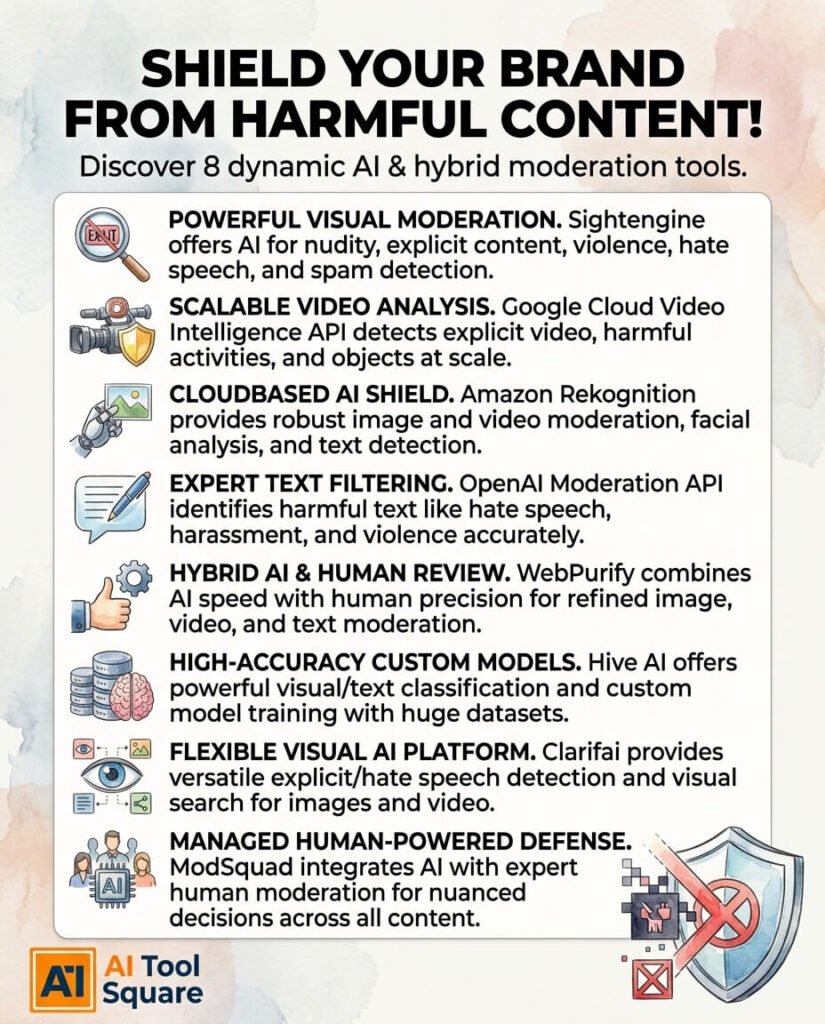
Alright, let’s get into the nitty-gritty. I’ve scoured the market for the top performers in the AI content moderation space. These aren’t just generic solutions; they’re purpose-built AI content moderation tools designed to handle the complexities of user-generated content at scale. Each one brings something unique to the table, from hyper-specialised image analysis to comprehensive multi-modal moderation. When choosing from these AI content moderation tools, consider your primary content types, your budget, and the level of customisation you’ll need.
Don’t just pick the first one you see; think about how it integrates with your existing tech stack and whether its reporting features align with your operational needs. We’re talking about a serious investment in your platform’s integrity, so let’s weigh the options carefully. This section will give you a clear rundown of features, pricing structures, and the undeniable pros and cons of each, helping you identify the optimal AI content moderation tools for your specific challenges.
Sightengine – AI content moderation tools Review
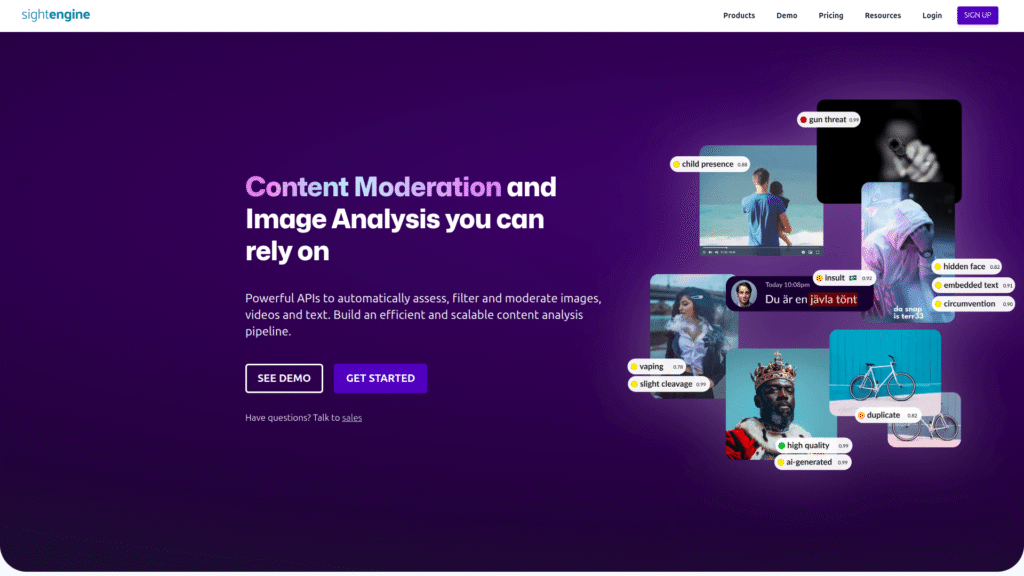
- Features: Sightengine offers powerful AI content moderation tools for images, videos, and text. Key features include nudity and explicit content detection, violence and gore detection, hate speech and racist content identification, weapon detection, and spam text filtering. It also provides celebrity recognition, face recognition, and brand logo detection, offering a comprehensive suite for visual content analysis.
- Pricing: Sightengine operates on a pay-as-you-go model, with pricing tiers based on the volume of content processed. They offer a free tier for testing and smaller volumes. Enterprise solutions are available with custom pricing.
- Pros: High accuracy in visual content analysis, real-time processing, flexible API for easy integration, and a wide range of detection categories. The free tier is excellent for initial evaluation. It’s a robust option among AI content moderation tools.
- Cons: Can be more expensive for very high volumes compared to some competitors, and text moderation features, while present, are not as deeply specialised as some pure text-focused AI content moderation tools.
Visit official Sightengine website
Google Cloud Video Intelligence API – AI content moderation tools Review
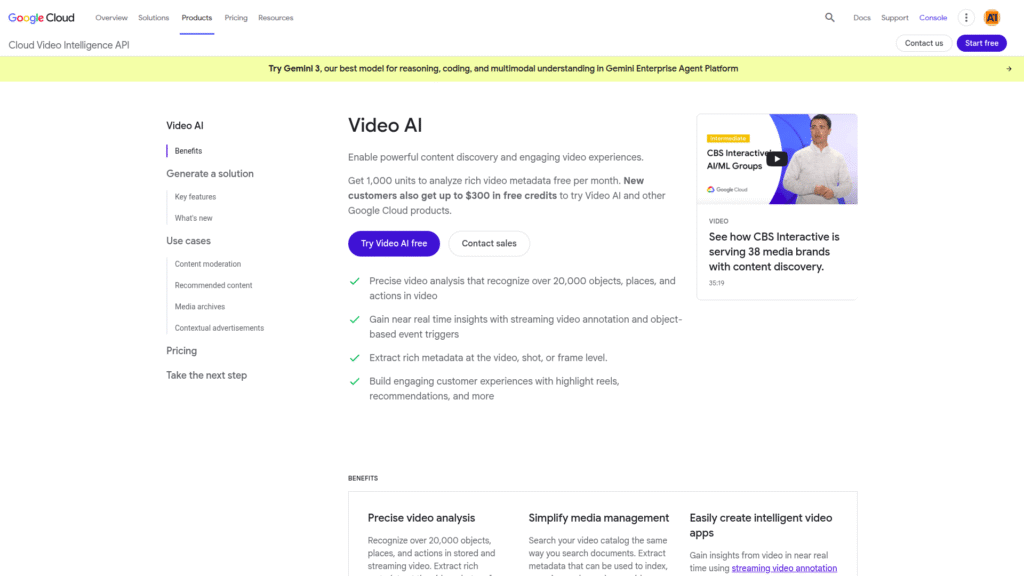
- Features: Part of Google’s suite of AI content moderation tools, the Video Intelligence API offers powerful capabilities for video content analysis. It can detect entities, activities, and objects within videos, identify inappropriate content (explicit, violent, harmful), and extract metadata like labels and shot changes. It’s highly scalable and integrates with other Google Cloud services.
- Pricing: Usage-based pricing, calculating costs per minute of video processed and per feature used. Free tier available for limited usage.
- Pros: Extremely powerful and accurate for video content, backed by Google’s extensive AI research, highly scalable for large platforms, and integrates well within the Google Cloud ecosystem. A top-tier choice for video-heavy AI content moderation tools.
- Cons: Can be complex to set up for those not already familiar with Google Cloud, and pricing can escalate quickly with high video volumes. Not a standalone solution for text or image moderation.
Visit official Google Cloud Video Intelligence API website
Amazon Rekognition – AI content moderation tools Review
- Features: Amazon Rekognition provides a robust set of AI content moderation tools for image and video analysis. It offers content moderation (detecting explicit, suggestive, violent, or generally unsafe content), facial analysis, object and scene detection, celebrity recognition, and text detection in images and videos. It’s part of the AWS ecosystem.
- Pricing: Pay-as-you-go model, billed based on the number of images and video minutes processed and the specific features utilised. A free tier is available for new users.
- Pros: Highly scalable and reliable, deep integration with other AWS services, strong performance in image and video moderation, and continuous improvement from Amazon’s AI teams. A solid choice for cloud-native AI content moderation tools.
- Cons: Similar to Google, can be overwhelming for those not already in the AWS ecosystem, and fine-tuning certain moderation parameters might require more technical expertise.
Visit official Amazon Rekognition website
OpenAI Moderation API – AI content moderation tools Review
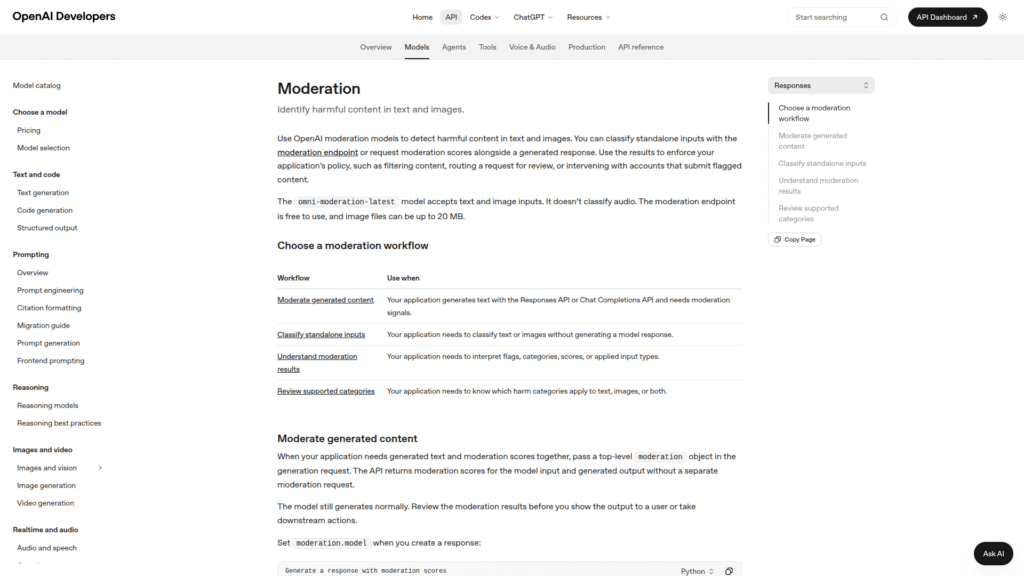
- Features: The OpenAI Moderation API focuses specifically on text content, identifying categories of harmful text, including hate speech, harassment, self-harm, sexual content, violence, and graphic content. It’s designed to flag and filter text that violates community guidelines, making it a critical part of any text-based AI content moderation tools strategy.
- Pricing: Simple, usage-based pricing per 1,000 tokens processed. It’s very accessible and cost-effective for text moderation.
- Pros: Extremely high accuracy for text-based moderation, easy to integrate via API, cost-effective for large volumes of text, and continuously updated by OpenAI. A specialist among AI content moderation tools for text.
- Cons: Exclusively for text content, so you’ll need other AI content moderation tools for images or videos. Lacks customisation options compared to some broader platforms.
Visit official OpenAI Moderation API website
WebPurify – AI content moderation tools Review
- Features: WebPurify offers a hybrid approach, combining AI content moderation tools with human review for images, videos, and text. AI features include profanity filtering, image moderation (nudity, explicit content, weapons), and video moderation. They also provide live human moderation services for an added layer of scrutiny.
- Pricing: Varies based on service type (AI vs. human), volume, and features. They offer custom quotes and tiered pricing.
- Pros: The combination of AI and human review offers extremely high accuracy and handles nuanced cases well. Good for platforms that require a high degree of precision in their inappropriate content flagging. Flexible options for AI content moderation tools.
- Cons: Can be more expensive due to the human review component, and while AI is fast, human review introduces some latency.
Visit official WebPurify website
Hive AI – AI content moderation tools Review
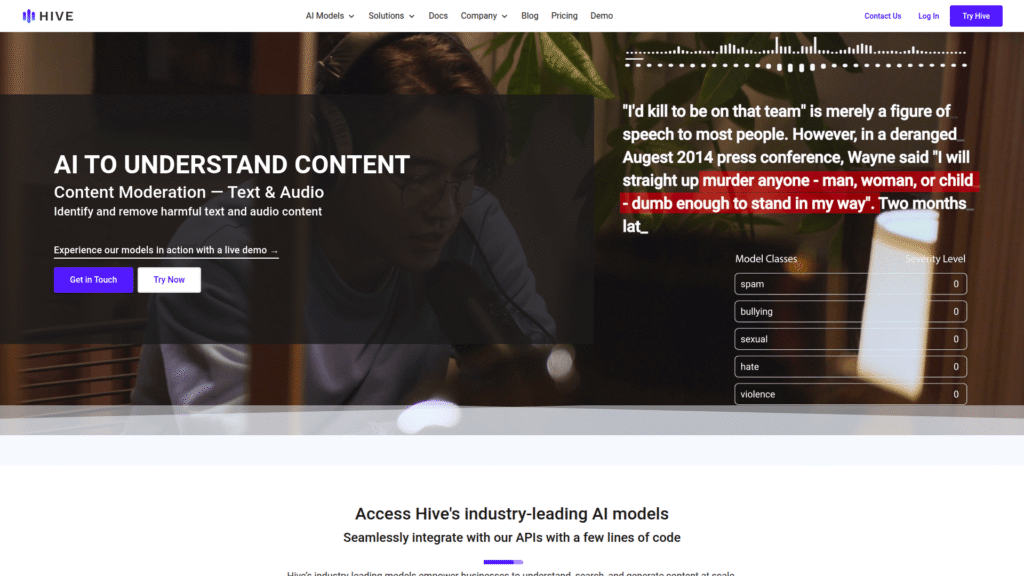
- Features: Hive AI is a powerful platform providing a suite of AI content moderation tools for image, video, and text. Their offerings include content classification (explicit, violent, hate speech, spam), custom model training for specific use cases, and content tagging. They are known for their massive datasets and high-accuracy models.
- Pricing: Custom pricing based on usage, features, and specific model requirements. Contact sales for a quote.
- Pros: Extremely high accuracy across multiple content types, ability to train custom models for unique moderation needs, and robust infrastructure for high-volume processing. A powerhouse among AI content moderation tools.
- Cons: Can be more expensive due to its advanced capabilities and customisation options, potentially overkill for smaller platforms, and requires a technical team for full implementation.
Visit official Hive AI website
Clarifai – AI content moderation tools Review
- Features: Clarifai offers a comprehensive AI platform with strong visual moderation capabilities. Their AI content moderation tools include explicit content detection, hate speech detection (in images and video text), general content moderation for various unsafe categories, and custom model training. They support images, video, and text.
- Pricing: Tiered pricing based on operations (API calls) and data storage. Free trial available.
- Pros: Very flexible and offers extensive customisation options, strong performance in visual content analysis, and a user-friendly interface for building and managing AI models. Versatile AI content moderation tools.
- Cons: Can be complex to master all features, and pricing can become significant for very high volumes or extensive custom model usage.
Visit official Clarifai website
ModSquad – AI content moderation tools Review
- Features: ModSquad is primarily known for its human-powered moderation services, but they effectively integrate AI content moderation tools as a first line of defence. They offer a hybrid solution, combining AI’s speed for initial filtering and high-volume tasks with human review for nuanced decision-making across text, images, and video.
- Pricing: Custom pricing based on the scope of work, volume, and blend of AI/human services.
- Pros: Provides the “best of both worlds” with AI speed and human judgment, highly scalable, and customisable to specific content policies. A managed service leveraging AI content moderation tools.
- Cons: As a managed service, it can be more costly than purely AI-driven solutions, and it involves outsourcing a core function which might not suit all businesses.
Visit official ModSquad website
Feature Comparison
When you’re evaluating AI content moderation tools, simply knowing their names isn’t enough. You need to understand how they stack up against each other on key features. This isn’t just about ticking boxes; it’s about matching the tool’s capabilities with your platform’s specific needs. For instance, if your platform is heavily reliant on video, an AI content moderation tool with robust video analysis, like Google Cloud Video Intelligence or Amazon Rekognition, will be far more valuable than one primarily focused on text.
Conversely, for a text-heavy forum, the OpenAI Moderation API might be your immediate winner, offering incredible precision without the overhead of visual processing. Look beyond the marketing jargon and drill down into the actual mechanisms of inappropriate content flagging each tool employs. Do they offer real-time scanning? How granular are their detection categories? Can they handle multiple languages?
Consider the breadth of content types each of these AI content moderation tools can handle. Some are multi-modal, meaning they can process text, images, and video, offering a unified solution. Others specialise in one area, delivering deep expertise there. For example, Sightengine provides an excellent all-in-one visual moderation suite, while Hive AI boasts impressive accuracy across all formats with custom model capabilities. Think about the level of customisation available. Can you adjust sensitivity thresholds? Can you train the AI content moderation tools on your specific brand guidelines or niche content types?
This is crucial for avoiding false positives and ensuring the moderation aligns perfectly with your community’s values. A one-size-fits-all approach often means a lot of missed calls or, worse, over-moderation that frustrates legitimate users. The ability to fine-tune your AI content moderation tools makes all the difference in achieving that delicate balance between safety and freedom of expression. Remember, no tool is perfect out of the box; the real power comes from how well you can configure it.
Finally, delve into the integration capabilities and reporting functions. How easily do these AI content moderation tools plug into your existing platform? Are there pre-built SDKs or comprehensive APIs? Can you get detailed analytics on what content is being flagged, by whom, and with what confidence score? This data isn’t just for reporting; it’s for continuous improvement. It allows you to identify emerging trends in inappropriate content, adjust your policies, and even provide feedback to the AI models to make them smarter.
Some AI content moderation tools, like WebPurify and ModSquad, offer a human review layer for complex cases, providing an additional safety net that purely automated systems might miss. This hybrid approach is often favoured by platforms that cannot afford any mistakes in their inappropriate content flagging. Each of these aspects plays a vital role in the overall effectiveness and long-term value of your chosen AI content moderation tools.
Pricing Breakdown
Alright, let’s talk money, because even the most powerful AI content moderation tools are useless if they break the bank. Pricing models for these services vary significantly, so you need to understand what you’re actually paying for. Most AI content moderation tools operate on a usage-based model. This typically means you’re charged per image scanned, per minute of video processed, or per 1,000 text tokens analysed.
The good news is that many providers offer a free tier, which is fantastic for testing the waters and validating the tool’s effectiveness before committing serious capital. Don’t just look at the headline price; consider your anticipated volume of content. A tool that looks cheap at low volumes might become prohibitively expensive as your platform scales. Conversely, some of the more premium AI content moderation tools offer significant discounts at higher tiers, making them more cost-effective in the long run.
When you’re comparing the pricing of various AI content moderation tools, factor in hidden costs or additional features. Does the quoted price include all the detection categories you need, or are some considered “premium” add-ons? Are there additional charges for custom model training or enhanced analytics? Tools like Google Cloud Video Intelligence and Amazon Rekognition, while powerful, are part of larger cloud ecosystems, and their pricing can be a bit more intricate, involving data transfer costs and other associated services.
On the other hand, specialists like OpenAI Moderation API offer very straightforward, transparent pricing purely focused on text processing. Understanding these nuances is crucial for budgeting accurately for your AI content moderation tools. It’s not just about the monthly bill; it’s about the total cost of ownership over time, especially as your content volume fluctuates.
Finally, consider the value proposition beyond just the monetary cost. What’s the cost of *not* having effective AI content moderation tools? Think about potential brand damage, user churn, legal ramifications, and the labour costs of manual moderation. Sometimes, investing a bit more in robust inappropriate content flagging can save you a fortune in the long run. Hybrid solutions like WebPurify and ModSquad, which combine AI with human review, will naturally have a higher price point due to the human element.
However, for platforms with extremely high stakes or complex content, that added cost might be a worthwhile insurance policy. Always ask for clear, itemised quotes, and if possible, negotiate for enterprise-level agreements if your volumes warrant it. The right AI content moderation tools should be an investment, not just an expense, delivering tangible ROI by protecting your platform and fostering a healthier community.
Real-World Use Cases
Let’s move from theory to practical application. These AI content moderation tools aren’t just abstract concepts; they’re solving real problems for real businesses every single day. Think about a large social media platform. The sheer volume of user-generated content – millions of posts, comments, images, and videos uploaded hourly – makes manual moderation an impossible task. They deploy sophisticated AI content moderation tools, often a combination of several, to automatically detect and flag everything from hate speech and graphic violence to spam and child exploitation material.
This allows them to maintain a safe environment for their users, comply with legal regulations, and protect their brand image. Without these AI content moderation tools, such platforms would quickly devolve into chaos, losing users and advertisers at an alarming rate. It’s not an option; it’s a fundamental operational requirement for them.
Consider an online dating app. User profiles and direct messages are prime targets for inappropriate content. Without effective AI content moderation tools, users would be inundated with explicit imagery, harassment, and scam attempts. Tools like Sightengine or Amazon Rekognition are employed to scan profile pictures and uploaded images for nudity or suggestive content, while the OpenAI Moderation API can flag abusive or sexually explicit language in messages.
This allows dating apps to create a secure and respectful environment, fostering genuine connections rather than becoming a haven for undesirable behaviour. The ability of AI content moderation tools to work in real-time is crucial here, preventing harmful content from even being seen by the intended recipient, thereby greatly improving the user experience and safeguarding vulnerable individuals. This proactive inappropriate content flagging is a game-changer for user trust.
Another compelling use case involves e-commerce platforms. While not immediately obvious, product reviews, seller listings, and user-uploaded product images can all contain inappropriate content. Fraudulent reviews, misleading product images, or even hate symbols subtly hidden within product descriptions can severely damage trust and reputation. AI content moderation tools can scan millions of such entries, identifying and removing violations at scale.
For example, a tool like Clarifai or Hive AI can be trained to recognise specific types of fraudulent behaviour or restricted items in images, while text-based AI content moderation tools can flag deceptive language in reviews. This ensures a fair marketplace for both buyers and sellers and maintains the integrity of the platform. The versatility of these AI content moderation tools means they can be adapted to almost any online environment where user interaction and content sharing occur, proving their indispensable value across diverse industries.
Who Should Use Each Tool?
Understanding who benefits most from each of these AI content moderation tools is crucial for making an informed decision. It’s about matching the tool’s strengths with your platform’s specific needs and scale. For instance, if you’re running a massive social media platform or a global video-sharing site, you’ll need highly scalable and accurate multi-modal AI content moderation tools.
Google Cloud Video Intelligence and Amazon Rekognition are excellent choices here, given their deep integration with cloud infrastructure and their capacity to handle enormous volumes of visual content. Their advanced AI content moderation tools are built for enterprise-level demands, offering robust inappropriate content flagging across vast datasets. However, they might be overkill for smaller operations, requiring more technical expertise to implement and manage effectively.
For platforms primarily dealing with text-based content, like forums, comment sections, or messaging apps, the OpenAI Moderation API is a clear winner among AI content moderation tools. Its unparalleled accuracy in detecting hate speech, harassment, and other forms of harmful text makes it incredibly efficient and cost-effective for these specific use cases. It’s easy to integrate and requires minimal overhead, making it ideal for developers looking for a straightforward, powerful text moderation solution. While it’s a specialist, it performs its specialisation exceptionally well, making it a key component in a layered approach to AI content moderation tools. You simply won’t find a better dedicated text solution for inappropriate content flagging.
If you’re looking for a comprehensive visual moderation solution that’s also relatively easy to implement, Sightengine is a strong contender. It offers a broad range of image and video detection categories and a user-friendly API, making it suitable for medium to large-sized platforms focused on visual content, such as image boards or specific social apps. For those who require the absolute highest accuracy and can’t risk false negatives, especially in highly regulated industries or for sensitive content, the hybrid solutions offered by WebPurify or ModSquad are often the best fit.
These AI content moderation tools, combining AI with human oversight, provide an unmatched level of precision, albeit at a higher cost. Hive AI and Clarifai, with their custom model training capabilities, are perfect for niche platforms with very specific moderation requirements or for businesses looking to build proprietary content classification systems. Ultimately, the “right” AI content moderation tools depend entirely on your unique context, budget, and the types of content you need to protect against through effective Inappropriate Content Flagging.
How to Choose the Right Tool
Choosing the right AI content moderation tools isn’t a trivial decision; it requires careful consideration and a clear understanding of your platform’s unique ecosystem. First, define your content moderation policy in crystal-clear terms. What exactly constitutes “inappropriate” on your platform? Is it just nudity and violence, or does it extend to specific types of hate speech, spam, or even certain brand mentions? The more precise your policy, the better you can evaluate which AI content moderation tools align with your needs.
A tool’s ability to be customised to your specific guidelines is paramount. Generic AI models are a good starting point, but the power often comes from fine-tuning them to your community’s nuances, otherwise you’ll be dealing with too many false positives or, worse, missed violations. This initial policy definition will dictate the required sophistication of your inappropriate content flagging solution.
Next, consider the types and volume of content you’re dealing with. Is your platform primarily text-based, image-heavy, or video-dominant? Some AI content moderation tools excel in specific modalities, while others offer a broader, multi-modal approach. If you’re processing millions of images daily, you’ll need AI content moderation tools with incredible scalability and real-time processing capabilities, like those offered by Amazon or Google.
For a chat application, the speed and accuracy of a text-focused API are more critical. Don’t pay for features you don’t need, but also don’t underinvest in areas where your content volume is high. An accurate assessment of your content mix will streamline your selection process among the available AI content moderation tools. The wrong tool here means wasted resources and continued moderation headaches, making inappropriate content flagging a manual nightmare.
Finally, evaluate the integration complexity, pricing structure, and ongoing support. How easily can the AI content moderation tools be integrated into your existing tech stack? Are there well-documented APIs and SDKs? What’s the cost at your current and projected content volumes, and are there any hidden fees? Is there good customer support and a community for troubleshooting? A seemingly powerful tool that’s a nightmare to integrate or lacks adequate support will quickly become a burden.
Furthermore, consider the reporting and analytics capabilities. Can you gain actionable insights from the moderation data? This feedback loop is essential for continuous improvement of both your policies and the AI content moderation tools themselves. By methodically addressing these points, you’ll be well-equipped to select the AI content moderation tools that not only meet your current needs but can also scale with your platform’s future growth, ensuring effective inappropriate content flagging.
Making Money with These Tools
You might be thinking, “How do AI content moderation tools help me make money?” It’s not a direct revenue stream, but their impact on your bottom line is significant and often underestimated. First and foremost, robust inappropriate content flagging protects your brand’s reputation. A clean, safe platform attracts and retains users, which directly translates to increased engagement, higher ad impressions, and stronger subscription numbers.
Conversely, a platform rife with abuse, spam, or explicit content will quickly haemorrhage users and drive away advertisers, leading to a direct loss of revenue. Think of these AI content moderation tools as an essential insurance policy for your brand – an investment that prevents potentially catastrophic financial and reputational damage. It’s about maintaining trust, and trust is the currency of the internet.
Secondly, these AI content moderation tools drastically reduce your operational costs. Without automation, moderating large volumes of user-generated content requires a massive team of human moderators. This is incredibly expensive, time-consuming, and prone to human error and burnout.
By offloading the vast majority of routine inappropriate content flagging to AI, you can significantly shrink your moderation team or reallocate human moderators to more complex, nuanced tasks that truly require human judgment. This efficiency gain is a direct cost saving that goes straight back into your profit margins. The scalability of AI content moderation tools means you can handle spikes in content volume without needing to instantly hire and train new staff, further optimising your expenditure. It’s about smart resource allocation.
Finally, by creating a safer and more enjoyable user experience, AI content moderation tools foster a thriving community. Engaged communities are more likely to spend money on your platform, whether through in-app purchases, premium subscriptions, or supporting content creators. When users feel safe and valued, they stick around longer, contribute more, and become advocates for your platform.
This organic growth and user loyalty are invaluable assets that directly impact your long-term profitability. Furthermore, a well-moderated platform is more attractive to partnerships and investors. Demonstrating a commitment to safety and integrity, backed by effective AI content moderation tools, builds confidence and opens up new avenues for growth and revenue generation. It’s not just about stopping the bad stuff; it’s about cultivating an environment where good stuff, and good money, can thrive.
Common Limitations
While AI content moderation tools are incredibly powerful and increasingly sophisticated, it’s crucial to acknowledge their limitations. They aren’t a silver bullet, and understanding where they fall short will help you implement them more effectively. One of the primary limitations is context. AI models, especially for text, can struggle with nuance, sarcasm, irony, and culturally specific idioms. A statement that might be perfectly innocent in one context could be deeply offensive in another, and AI might struggle to differentiate without extensive training on specific datasets.
This can lead to false positives, where legitimate content is flagged, or false negatives, where genuinely inappropriate content slips through. This challenge in inappropriate content flagging necessitates human oversight for complex cases, meaning AI is often best as a first line of defence, not the sole solution.
Another common limitation for AI content moderation tools is dealing with rapidly evolving trends and adversarial attacks. Bad actors are constantly trying to circumvent moderation systems, developing new slang, symbols, or methods to convey harmful messages. AI models, while capable of learning, require continuous training and updates to keep pace with these evolving threats. If your AI content moderation tools aren’t regularly refreshed with new data and patterns, their effectiveness can wane over time.
This ongoing maintenance and vigilance are essential. It’s a continuous arms race between those trying to spread harm and the systems designed to stop them. No AI content moderation tools can be simply “set and forget”; they demand ongoing attention and adaptation to remain effective in the dynamic online environment.
Finally, scalability can sometimes be a double-edged sword. While AI content moderation tools are designed for scale, the computational resources required for processing massive volumes of content, especially high-definition video, can become very expensive. For smaller platforms or startups with limited budgets, the cost of top-tier AI content moderation tools might be prohibitive. Furthermore, integrating these tools effectively into existing systems can require significant technical expertise and development resources.
It’s not always a plug-and-play solution. The quality of the AI model also heavily depends on the training data; biased or insufficient data can lead to biased or ineffective moderation. Over-reliance on AI without human review can also lead to mistakes that alienate users and damage trust. Recognising these limitations means approaching AI content moderation tools with a balanced perspective, augmenting them with human judgment where necessary, and continuously investing in their improvement for robust inappropriate content flagging.
Final Verdict and Recommendations
Alright, so we’ve covered a lot of ground on AI content moderation tools, from their core functions to their nuanced limitations. The clear takeaway here is that these tools are not just a nice-to-have; they are an absolute necessity for any platform hosting user-generated content. The digital landscape is too vast and moves too quickly for manual moderation alone to be effective. Investing in the right AI content moderation tools is investing in your platform’s future, its reputation, and ultimately, its profitability.
My recommendation is to approach this strategically, viewing these tools as a critical component of your overall security and user experience strategy. Don’t cheap out here; the cost of inaction or ineffective moderation far outweighs the investment in quality inappropriate content flagging solutions.
For platforms heavily reliant on visual content – images and videos – Google Cloud Video Intelligence API, Amazon Rekognition, and Sightengine stand out as top-tier AI content moderation tools. Their advanced computer vision capabilities and scalability make them indispensable for high-volume visual moderation. If your primary battleground is text, the OpenAI Moderation API offers unmatched accuracy and ease of integration, making it a powerful specialist among AI content moderation tools.
For those who absolutely cannot compromise on accuracy and need a human touch for complex cases, the hybrid solutions from WebPurify and ModSquad provide an excellent balance of AI speed and human judgment, albeit at a higher price point. These comprehensive AI content moderation tools are designed to catch what purely automated systems might miss.
Ultimately, the “best” AI content moderation tools for you will depend on your specific needs: your content types, volume, budget, and desired level of customisation. Start with a clear understanding of your moderation policy, then choose a tool that can be tailored to those guidelines. Leverage free tiers and trials to thoroughly test potential solutions before making a long-term commitment.
Remember that no AI content moderation tools are perfect on their own; they are most effective when integrated into a broader strategy that includes human review for edge cases and continuous feedback loops for model improvement. By strategically deploying these powerful AI content moderation tools, you can build a safer, cleaner, and more engaging platform for all your users, ensuring effective inappropriate content flagging for years to come.
Frequently Asked Questions
Are AI content moderation tools completely accurate?
No, AI content moderation tools are not completely accurate. While highly effective, they can still produce false positives (flagging innocent content) or false negatives (missing inappropriate content) due to the complexities of context, nuance, and evolving online slang. Human review remains crucial for complex and ambiguous cases, complementing the AI’s speed and scale.
Can AI content moderation tools detect all types of inappropriate content?
Modern AI content moderation tools are designed to detect a wide range of inappropriate content, including nudity, violence, hate speech, harassment, spam, and graphic content across text, images, and videos. However, their effectiveness can vary depending on the tool’s specific training data and algorithms, and they require continuous updates to combat new forms of harmful content. They are not foolproof against all forms of inappropriate content flagging.
How do AI content moderation tools learn what content is inappropriate?
AI content moderation tools learn through machine learning, being trained on massive datasets of labelled content (both appropriate and inappropriate). They identify patterns and features associated with different types of harmful content. Over time, and with continuous feedback, their models are refined to improve accuracy in inappropriate content flagging.
Are AI content moderation tools expensive?
The cost of AI content moderation tools varies significantly based on factors like content volume, features used, and the chosen provider. Many offer usage-based pricing models, with costs increasing with more content processed. Free tiers are often available for testing, and enterprise solutions can be negotiated for large platforms. The investment often pays for itself by reducing manual moderation costs and protecting brand reputation.
Do I still need human moderators if I use AI content moderation tools?
Yes, in most cases, human moderators are still essential, even with the best AI content moderation tools. AI excels at high-volume, clear-cut cases, but human judgment is vital for nuanced situations, understanding cultural context, handling edge cases, and making final decisions on flagged content to ensure accuracy and fairness. AI acts as a powerful first line of defence, allowing humans to focus on complex tasks.
Can AI content moderation tools be customised for specific platform rules?
Many advanced AI content moderation tools offer customisation options. This typically includes adjusting sensitivity thresholds for different content categories, and some platforms, like Hive AI and Clarifai, even allow users to train custom AI models on their specific datasets and community guidelines. This ensures the inappropriate content flagging aligns perfectly with your brand’s unique policies.
What is the benefit of using AI content moderation tools over manual moderation?
The primary benefits of using AI content moderation tools over manual moderation are speed, scalability, and cost efficiency. AI can process vast amounts of content in real-time, 24/7, at a fraction of the cost of a human team. It significantly reduces the burden on human moderators, allowing them to focus on more complex tasks, and ensures consistent application of moderation policies, making inappropriate content flagging far more efficient.