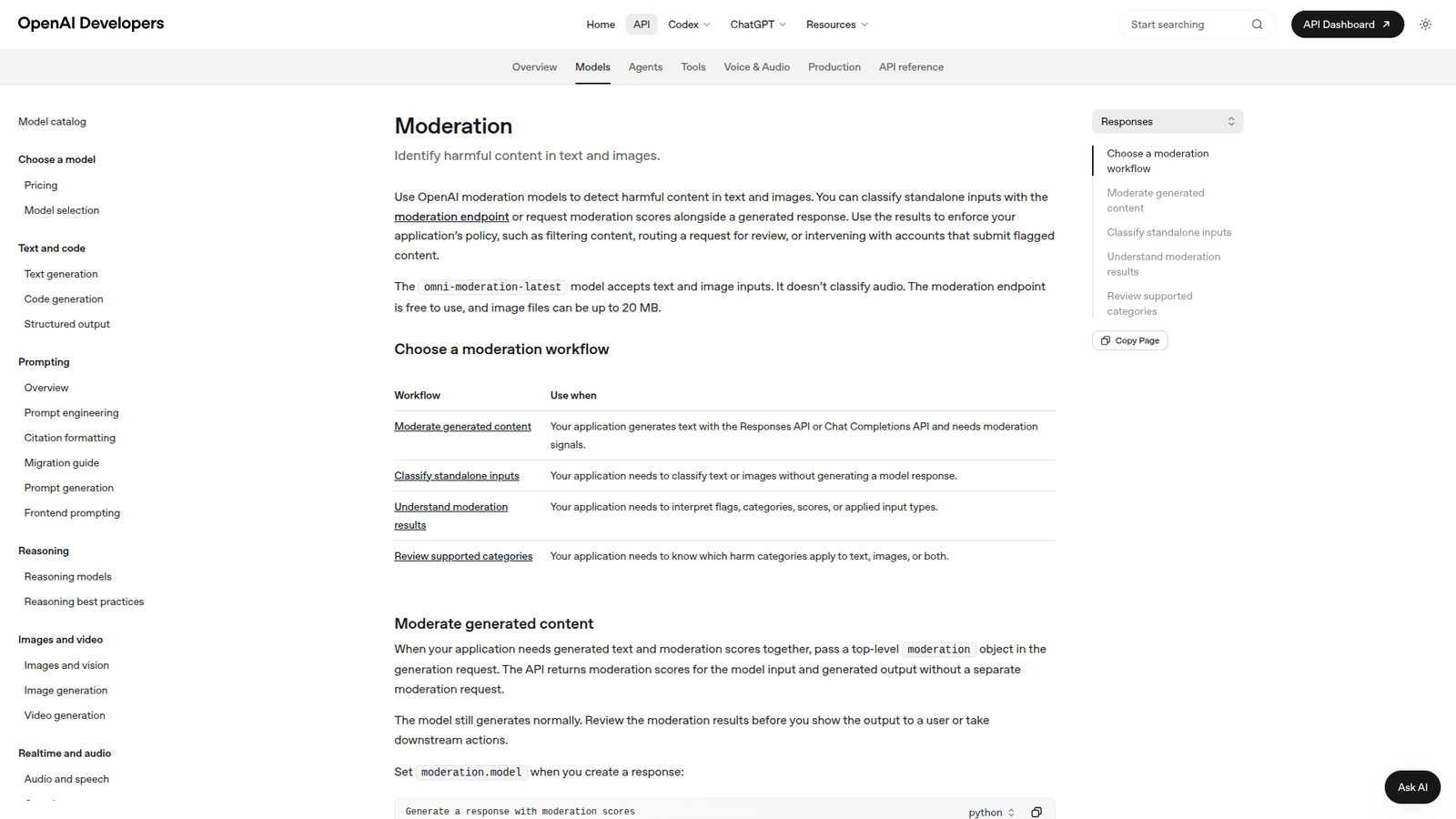

The digital world is expanding at an insane pace. Every second, mountains of content are generated. For businesses and platforms, keeping that space clean and safe isn’t just a nice-to-have; it’s mission-critical. Think about user-generated content, online communities, and even internal communications. The stakes are sky-high for maintaining trust and safety. This is where AI steps in, not as a replacement for human judgment, but as a powerful co-pilot. And at the forefront of this AI revolution in security and moderation is a tool that’s changing the game: the OpenAI Moderation API.
If you’re involved in managing online spaces, ensuring content adheres to guidelines, and protecting your users, you know the sheer volume of work involved. Manually sifting through comments, posts, and user submissions is a Sisyphean task. It’s slow, costly, and frankly, soul-crushing. But what if there was a way to automate a significant chunk of that process, providing an objective, lightning-fast layer of screening for potentially harmful or inappropriate content? That’s precisely what the OpenAI Moderation API is designed to do, especially when it comes to the nuanced challenge of inappropriate content flagging.
This isn’t about getting rid of human moderators. It’s about empowering them. It’s about freeing them from the repetitive, low-level tasks so they can focus on the complex, context-dependent cases that truly require human insight. Let’s cut through the noise and see exactly how this tool can become your secret weapon.
Why OpenAI Moderation API Is a Game-Changer in Inappropriate Content Flagging
What is OpenAI Moderation API?
At its core, the OpenAI Moderation API is an AI-powered service designed to detect and flag potentially harmful or inappropriate content. Think of it as a highly intelligent, automated filter for text. It’s built by OpenAI, the same folks behind ChatGPT, leveraging their advanced natural language understanding capabilities. Its primary function is to analyze text input and categorize it across various “harm categories.”
This isn’t about generating content; it’s about evaluating it. It’s a crucial tool for anyone managing online platforms where user-generated content is a significant factor. The goal is to provide a scalable, efficient, and consistent way to identify content that might violate terms of service, community guidelines, or legal standards. It’s a sophisticated mechanism for pre-screening, enabling platforms to take swift action.
The API is designed to be integrated into existing systems and workflows. This means developers can plug it directly into their applications, websites, or internal tools. This integration allows for real-time analysis of user inputs, such as comments, forum posts, chat messages, or even user profiles. The output is a set of scores for different categories, indicating the likelihood that the text falls into that category.
The target audience is broad. Any organization that deals with large volumes of text content and needs to maintain a safe and appropriate online environment can benefit. This includes social media platforms, online marketplaces, gaming communities, educational platforms, and any business that relies on user interaction. It’s a foundational piece of technology for maintaining digital hygiene.
This API offers a standardized way to approach content moderation. Instead of relying solely on human moderators, which can be slow and prone to bias or burnout, the Moderation API provides an objective, AI-driven first pass. This ensures that even at scale, a baseline level of safety and appropriateness is maintained across the platform. It’s about efficiency, consistency, and peace of mind.
Key Features of OpenAI Moderation API for Inappropriate Content Flagging
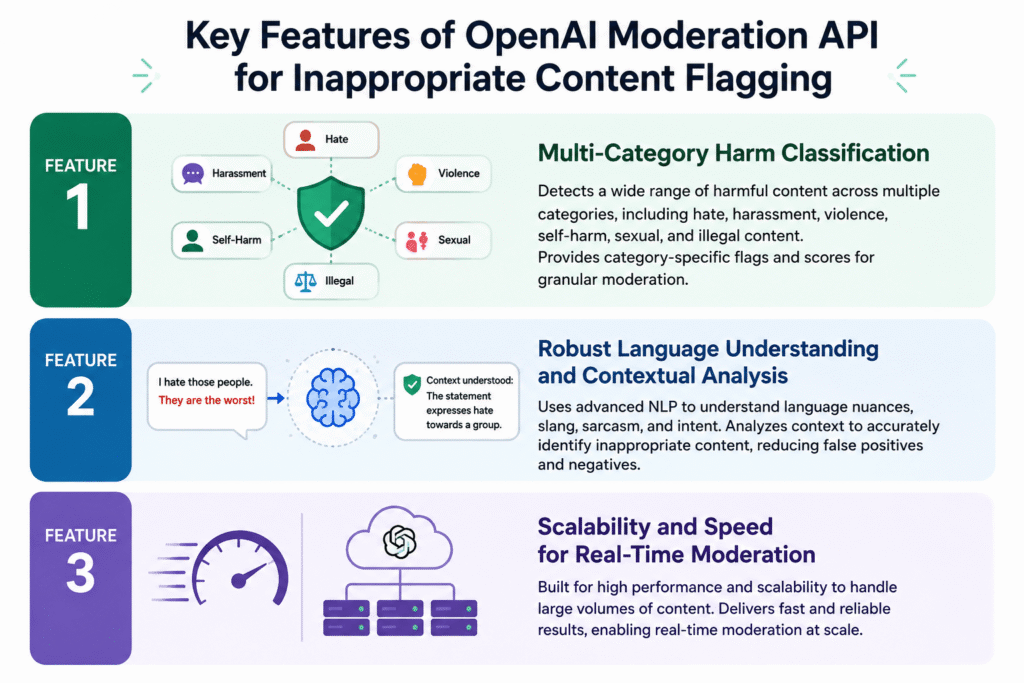
The power of the OpenAI Moderation API for inappropriate content flagging lies in its sophisticated understanding of language and its ability to categorize potential issues with a high degree of accuracy. It’s not just a keyword scanner; it delves deeper into context and intent, which is crucial for effective moderation.
Feature 1: Multi-Category Harm Classification
This feature is fundamental. The API doesn’t just tell you if something is “bad”; it breaks it down. It classifies text across several predefined categories: hate, harassment, self-harm, sexual content, violence, and a general “unsafe” category. This granular approach is invaluable for inappropriate content flagging because it allows for nuanced decision-making. Instead of a binary yes/no, you get scores for each category. This means you can set different thresholds for different types of content. For example, you might want a very low threshold for hate speech but a slightly higher one for potentially offensive but not explicitly violating content. This intelligent categorization means fewer false positives and a more precise identification of problematic text.
Feature 2: Robust Language Understanding and Contextual Analysis
Unlike simpler moderation tools that rely on keyword matching, the OpenAI Moderation API uses advanced natural language processing (NLP) models. This means it can understand nuances, sarcasm, slang, and even coded language to some extent. It doesn’t just look for the word “bomb”; it can understand if it’s used in a literal threat or in a casual, non-harmful context. This deep contextual analysis is a game-changer for inappropriate content flagging, as it significantly reduces the chance of misinterpreting text. For moderation teams, this means less time spent reviewing flagged content that turns out to be harmless, allowing them to focus their efforts where they are most needed.
Feature 3: Scalability and Speed for Real-Time Moderation
One of the biggest challenges in content moderation is scale. As platforms grow, the volume of content explodes, making manual review impossible. The OpenAI Moderation API is built for scale. It can process vast amounts of text data quickly and efficiently. This allows for near real-time analysis of incoming content. Imagine a live chat or a rapidly growing forum – the API can flag problematic messages as they appear, enabling immediate intervention. This speed is critical for preventing the spread of harmful content and maintaining a positive user experience. For inappropriate content flagging, this means issues can be caught and addressed before they gain traction and impact a wider audience.
Benefits of Using OpenAI Moderation API for Security and Moderation
Integrating the OpenAI Moderation API into your security and moderation strategy offers a cascade of advantages that can fundamentally improve your operations. It’s not just about adding another tool; it’s about fundamentally enhancing your capacity to manage content safely and efficiently.
First and foremost, there’s the significant boost in efficiency and reduction in manual workload. Imagine your moderation team spending hours each day scanning through comments, forums, and user submissions. With the OpenAI Moderation API, a substantial portion of this can be automated. The API acts as a highly effective first line of defence, flagging potentially problematic content with remarkable speed. This frees up your human moderators to concentrate on the complex cases that require human judgment, empathy, and an understanding of context that AI can’t fully replicate. This means your moderation team becomes more productive, handling a larger volume of content without increased headcount. It’s about working smarter, not just harder.
Secondly, consistency and objectivity are major wins. Human moderators, despite their best efforts, can be subject to fatigue, personal biases, or varying interpretations of guidelines. The OpenAI Moderation API, on the other hand, applies the same set of rules and classifications to every piece of text it processes. This ensures a uniform standard for inappropriate content flagging across your platform. This consistency builds trust with your users, as they can rely on a fair and predictable moderation process. It removes the subjectivity that can lead to complaints and disputes.
Beyond just efficiency, there’s a tangible improvement in content quality and safety. By catching harmful or inappropriate content early, you significantly reduce the risk of it spreading and causing damage. This protects your brand reputation, prevents legal liabilities, and fosters a more welcoming environment for your users. For platforms that rely on user engagement, maintaining a safe space is paramount to growth and retention. The API’s ability to identify nuanced forms of harmful content, not just blatant violations, contributes to a healthier digital community.
Furthermore, the API can help identify emerging trends in harmful content. By analyzing the types of content being flagged, moderation teams can gain insights into new tactics used by malicious actors. This proactive understanding allows platforms to adapt their policies and moderation strategies accordingly. It’s about staying ahead of the curve rather than constantly reacting to new forms of abuse or inappropriate material.
Finally, integrating advanced AI like the OpenAI Moderation API can position your organization as forward-thinking and committed to user safety. It demonstrates a serious investment in maintaining a high-quality online experience. For businesses looking to attract and retain users in an increasingly crowded digital landscape, this commitment to safety and a positive user experience is a significant competitive advantage.
Pricing & Plans

Understanding the cost structure is vital for any business considering adopting new technology. OpenAI’s pricing for its APIs, including the Moderation API, is generally based on usage. This pay-as-you-go model is designed to be accessible for a wide range of users, from individual developers to large enterprises.
The OpenAI Moderation API is priced per 1,000 requests. This means you only pay for the number of times you send text to the API for analysis. This is a highly scalable pricing model, as it directly correlates with the volume of content you are moderating. For smaller platforms or those just starting out, this means the initial investment can be very low, making it an attractive option compared to fixed-price, high-commitment solutions.
OpenAI often provides a certain amount of free credits or a tiered pricing structure that becomes more cost-effective as your usage increases. For instance, the first tier might offer a certain number of requests at a specific rate, and subsequent tiers offer lower per-request costs for higher volumes. This allows businesses to test the API without significant upfront financial risk and then scale their usage as their needs grow.
While there isn’t a “free plan” in the sense of unlimited usage, the pay-as-you-go structure, coupled with potential free introductory credits, makes it very affordable for many use cases. The cost-effectiveness comes from the efficiency gains and the reduction in manual labour that the API provides. When you weigh the cost of the API against the cost of hiring and training additional moderation staff, or the potential financial and reputational damage from failing to moderate content effectively, the OpenAI Moderation API often presents a compelling economic argument.
Compared to other AI moderation tools or enterprise-level content moderation solutions, OpenAI’s API is generally considered competitive, especially given the power and accuracy of its underlying models. The flexibility of the API means you can build custom moderation workflows without being locked into a proprietary platform. This control over your moderation process, combined with transparent pricing, offers significant value.
Hands-On Experience / Use Cases
Teams and developers have found numerous practical applications for the OpenAI Moderation API in real-world scenarios, showcasing its versatility and effectiveness in inappropriate content flagging and overall security and moderation efforts.
Consider a social media platform. As users post comments and messages, each piece of text can be passed through the Moderation API. The API returns a score for categories like “hate,” “harassment,” and “sexual content.” If the “hate” score exceeds a predefined threshold (e.g., 0.7), the comment can be automatically flagged for human review or even hidden pending review. This prevents potentially harmful content from being widely visible. For example, a comment containing derogatory language targeting a specific group would likely receive a high “hate” score, triggering an alert.
In an online gaming community, player chat can be a breeding ground for toxic behaviour. The OpenAI Moderation API can monitor chat logs in real-time. If a player uses excessive profanity, threats, or discriminatory remarks, the API can identify this. The platform can then be configured to issue warnings, temporarily mute the player, or escalate the case to a community manager. This proactive approach helps maintain a more positive and inclusive gaming environment, reducing the likelihood of players leaving due to harassment.
For an e-commerce platform that allows sellers to write product descriptions and customer reviews, the API plays a critical role. It can scan product descriptions for misleading claims, offensive language, or irrelevant content that violates marketplace policies. Similarly, customer reviews can be analyzed for spam, phishing attempts, or abusive language directed at other users or the seller. This helps ensure the integrity of the marketplace and protects both buyers and sellers.
Online forums and community boards benefit greatly by using the API to screen user-generated posts. Before a new thread or reply becomes publicly visible, it can be sent to the Moderation API. This is particularly useful for forums that don’t have a dedicated, always-on moderation team. The API can catch posts that contain hate speech, personal attacks, or spam links, preventing them from cluttering the forum and deterring legitimate users. A user attempting to post a link to a scam website disguised within a seemingly innocent message would be flagged by the API.
Developers building chatbots or virtual assistants can also leverage the Moderation API. If a user inputs a harmful or inappropriate query into a chatbot, the API can detect this and prevent the chatbot from responding in a way that could be construed as endorsing or facilitating such behaviour. The chatbot can then be programmed to provide a polite refusal or direct the user to appropriate resources.
These examples highlight how the OpenAI Moderation API, when integrated thoughtfully, acts as a powerful, automated assistant in identifying and managing problematic content across a diverse range of online applications. Its ability to handle nuanced language and classify various forms of harm makes it an indispensable tool for maintaining safe digital spaces.
Who Should Use OpenAI Moderation API?

The OpenAI Moderation API is a versatile tool that can benefit a wide array of individuals and organizations involved in managing online content. Its core strength lies in its ability to automate the detection of inappropriate or harmful text, making it invaluable for anyone dealing with user-generated content at scale.
Online Platform Operators: This is perhaps the most obvious group. Social media networks, forums, community websites, and any platform where users can create and share text content can use the API to screen posts, comments, and messages. This includes large corporations with extensive moderation needs and smaller niche communities looking to maintain a positive environment.
E-commerce Businesses: Companies running online marketplaces or platforms that allow customer reviews and seller-generated product descriptions can use the API to filter out spam, misleading information, abusive language, and offensive content. This helps maintain the integrity of their platform and build trust with customers.
Gaming Companies: Online gaming communities often struggle with toxicity in chat and user interactions. The Moderation API can be integrated into game clients or community forums to monitor player communication, flagging harassment, threats, and hate speech to create a more welcoming environment for all players.
SaaS Providers: Software-as-a-service companies that offer communication features, collaboration tools, or any platform involving user text input can utilize the API to ensure their users are adhering to community standards and terms of service. This applies to project management tools, customer support platforms, and more.
Content Creators and Publishers: Bloggers, news sites, and content platforms that enable comments sections can use the API to pre-screen comments for spam, hate speech, or inappropriate discussions. This helps maintain the quality of engagement and protect the creator’s brand.
Developers and Startups: For new platforms or applications that anticipate user-generated content, integrating the Moderation API early on is a proactive step towards building a safe and scalable product. Its pay-as-you-go model makes it accessible for startups with limited budgets.
Agencies and Service Providers: Digital marketing agencies, PR firms, or companies specializing in community management can offer enhanced services to their clients by incorporating AI-powered moderation. This allows them to manage multiple client platforms more efficiently and effectively.
Essentially, if your operation involves reviewing text content submitted by users and you need to ensure it meets certain standards of appropriateness, safety, and adherence to guidelines, the OpenAI Moderation API is a powerful tool worth considering. It scales with your needs and provides an objective layer of content evaluation.
How to Make Money Using OpenAI Moderation API
The OpenAI Moderation API isn’t just about cost savings; it’s a powerful engine that can actively generate revenue. By leveraging its capabilities, individuals and businesses can create new services, enhance existing offerings, and gain a competitive edge that translates directly to profit.
Service 1: Specialized Content Moderation Services
Businesses can establish themselves as specialized inappropriate content flagging and moderation service providers. They can offer tailored solutions to platforms that lack the internal resources or expertise to manage content effectively. This involves integrating the OpenAI Moderation API into a custom workflow, adding human oversight for complex cases, and providing detailed reporting to clients. For instance, a startup could offer a “Community Safety as a Service” package to smaller online forums or gaming communities, charging a monthly retainer based on the volume of content moderated. The API handles the bulk of the initial flagging, drastically increasing the number of clients a small team can support.
Service 2: Enhanced Platform Security and Trust for Clients
Agencies and developers can use the Moderation API to enhance the security and trust of the platforms they build or manage for clients. By offering a robust moderation layer as part of their service package, they can command higher fees. For example, a web development agency can include AI-powered content moderation as a standard feature for all custom-built websites that feature user-generated content, like membership sites or online courses. This premium feature not only justifies a higher project cost but also differentiates the agency from competitors by providing a tangible benefit of a safer user experience.
Service 3: Offering AI-Powered Content Auditing and Compliance Tools
Another lucrative avenue is creating AI-powered tools for content auditing and compliance. Businesses in regulated industries (e.g., finance, healthcare, advertising) often face strict guidelines on the language used in their communications. A developer could build a tool that uses the OpenAI Moderation API to audit marketing copy, social media posts, or customer support scripts for compliance with industry regulations and brand safety standards. This tool could be offered as a subscription service, allowing businesses to ensure their content is always within acceptable parameters, thereby avoiding costly fines or reputational damage.
Case Study Example: Imagine an entrepreneur launching “SafeSpace Moderation.” They identify that many small to medium-sized businesses with online communities struggle with managing comments and user interactions. Using their development skills, they integrate the OpenAI Moderation API into a dashboard. They then market their service to these businesses, offering to set up and manage their content moderation for a monthly fee.
For a client with 10,000 daily comments, manual moderation might cost $5,000-$10,000 per month. With the API, SafeSpace Moderation can process those comments for a fraction of that cost, providing a significantly more affordable and scalable solution for the client. SafeSpace Moderation could potentially earn $2,000-$5,000 per month from this single client, demonstrating how efficiency gained from AI translates directly to profit. By scaling this model to multiple clients, they can build a substantial revenue stream.
Limitations and Considerations
While the OpenAI Moderation API is a powerful tool, it’s not a silver bullet. Like any AI technology, it has its limitations and considerations that users must be aware of to ensure effective implementation and realistic expectations.
One of the primary considerations is the **accuracy and the need for human oversight**. While the API is highly accurate, it is not infallible. There will be instances of false positives (flagging harmless content) and false negatives (missing inappropriate content). This is especially true for nuanced language, sarcasm, cultural references, or rapidly evolving slang. Therefore, it is crucial to view the API as a powerful assistant rather than a complete replacement for human moderators. A well-designed system will incorporate a human review process for flagged content, focusing on the most severe or ambiguous cases identified by the AI.
The **contextual understanding is improving but still has limits**. The API analyzes text, but it doesn’t inherently understand real-world context, intent, or the history of a user’s behaviour on a platform. For example, a statement that might be acceptable in one context could be harmful in another. This is where human judgment becomes indispensable. For example, understanding if a piece of text is part of a satirical piece or a genuine threat requires more than just textual analysis.
**Evolving language and new forms of abuse** present an ongoing challenge. AI models are trained on historical data, and as language evolves and new ways to circumvent moderation emerge, the models need to be updated and retrained. While OpenAI continuously improves its models, there can be a lag between the emergence of new harmful language patterns and the API’s ability to detect them consistently. This means ongoing monitoring and adaptation of moderation policies are essential.
**Potential for bias** is another factor to consider. AI models can inadvertently inherit biases present in their training data. While OpenAI works to mitigate bias, it’s a complex issue. This could lead to disproportionate flagging of content from certain demographics or topics, which can be problematic. Regular audits and diverse human review teams are necessary to identify and address any emergent biases.
Finally, **cost at extreme scale** can be a consideration. While the pay-as-you-go model is generally cost-effective, for platforms with truly massive volumes of daily content (billions of requests), the cumulative cost could become significant. It’s important to model potential costs based on projected usage and compare them against the value derived from improved moderation and reduced risks.
Understanding these limitations allows for a more strategic and effective deployment of the OpenAI Moderation API, ensuring it works in synergy with human efforts to create a safer online environment.
Final Thoughts
The landscape of security and moderation is constantly evolving, and the demand for efficient, accurate, and scalable solutions for inappropriate content flagging has never been higher. The OpenAI Moderation API stands out as a powerful and accessible tool that directly addresses these needs. It’s not just another piece of software; it’s a fundamental shift in how we can approach content safety online.
By providing a sophisticated, AI-driven analysis of text, the API empowers businesses and platforms to identify potentially harmful content with unprecedented speed and consistency. This dramatically reduces the burden on human moderators, allowing them to focus their expertise on the complex, nuanced cases that truly require human empathy and judgment. The result is a more efficient moderation process, a safer online environment for users, and a stronger brand reputation for the platform.
From classifying various types of harm with granular detail to understanding the subtleties of language, the OpenAI Moderation API offers a robust solution for businesses of all sizes. Whether you’re a burgeoning startup looking to build a safe community from the ground up or a large enterprise seeking to optimize your existing moderation workflows, this API can provide significant value. Its pay-as-you-go pricing model makes it an accessible entry point, allowing for scalability without prohibitive upfront costs.
While it’s crucial to acknowledge its limitations and ensure human oversight remains a key component of any moderation strategy, the benefits of integrating the OpenAI Moderation API are undeniable. It’s a tool that helps you work smarter, not harder, and ultimately leads to better outcomes for both your platform and your users.
Ready to transform your content moderation process and bolster your platform’s safety? Explore the capabilities of the OpenAI Moderation API. It’s time to embrace the future of intelligent content evaluation.
Visit the official OpenAI Moderation API website
Frequently Asked Questions
1. What is OpenAI Moderation API used for?
The OpenAI Moderation API is used to detect and flag potentially harmful or inappropriate text content across various categories like hate speech, harassment, sexual content, and violence. It’s designed to help platforms maintain safe online environments by automating the initial screening of user-generated text.
2. Is OpenAI Moderation API free?
The OpenAI Moderation API is not entirely free, but it operates on a pay-as-you-go pricing model based on the number of requests made. OpenAI often provides free credits for new users, making it possible to test and use the API for free up to a certain limit. The cost becomes significant only at very high usage volumes.
3. How does OpenAI Moderation API compare to other AI tools?
The OpenAI Moderation API stands out due to the advanced capabilities of OpenAI’s underlying language models, offering robust context analysis and classification across multiple harm categories. It provides a highly scalable and cost-effective solution, often integrated directly into existing workflows, compared to standalone moderation platforms that might be more costly or less flexible.
4. Can beginners use OpenAI Moderation API?
Yes, beginners can use the OpenAI Moderation API, especially developers. OpenAI’s documentation is comprehensive, and the API is designed to be integrated into applications relatively easily. While some technical knowledge is required for integration, the concept and its application for flagging inappropriate content are straightforward.
5. Does the content created by OpenAI Moderation API meet quality and optimization standards?
The OpenAI Moderation API does not create content; it evaluates existing text for potential harm or inappropriateness. Therefore, questions about content creation quality or optimization standards are not applicable to this specific tool. Its purpose is purely for moderation and safety checks.
6. Can I make money with OpenAI Moderation API?
Yes, you can make money with the OpenAI Moderation API. By offering specialized content moderation services, building AI-powered platform security features for clients, or developing auditing and compliance tools, you can leverage the API’s capabilities to generate revenue.
7. How to make money with OpenAI Moderation API?
To make money with the OpenAI Moderation API, you can offer content moderation services to businesses, develop and integrate enhanced security features for client platforms, or create subscription-based tools for content auditing and compliance. Efficiency gains and the ability to serve more clients with AI automation are key to profitability.