
Discover how PlanetTogether for Production Planning and Scheduling streamlines complex workflows. Boost your efficiency in Manufacturing and Supply Chain today. Get started now.
Why PlanetTogether Is a Game-Changer in Production Planning and Scheduling
Most manufacturers are drowning in spreadsheets. They are guessing when orders will ship. They are hoping machines do not break down. They are losing money every single day.
If you feel like your factory floor is a fire drill that never ends, you are right. You have a planning problem. Manual systems are obsolete. They cannot keep up with current demands.
PlanetTogether changes the math. It brings order to the chaos. It turns guesswork into predictable, profitable output. This is how you win in a market that never stops.
- What is PlanetTogether?
- Key Features of PlanetTogether for Production Planning and Scheduling
- Benefits of Using PlanetTogether for Manufacturing and Supply Chain
- Pricing & Plans
- Hands-On Experience / Use Cases
- Who Should Use PlanetTogether?
- How to Make Money Using PlanetTogether
- Limitations and Considerations
- Final Thoughts
- Frequently Asked Questions
What is PlanetTogether?
PlanetTogether is advanced planning and scheduling software. It sits on top of your existing ERP. It talks to your data. It tells you exactly what to make, when to make it, and which machine should do the work.
Most planners use static tools. They build a schedule on Monday. By Tuesday, it is wrong. Orders change. Materials run out. Machines fail. PlanetTogether updates your plan in real-time.
It handles complex constraints. It looks at labor availability, tool sets, and material lead times simultaneously. It generates an optimised schedule that keeps your shop floor running without bottlenecks.
Key Features of PlanetTogether for Production Planning and Scheduling
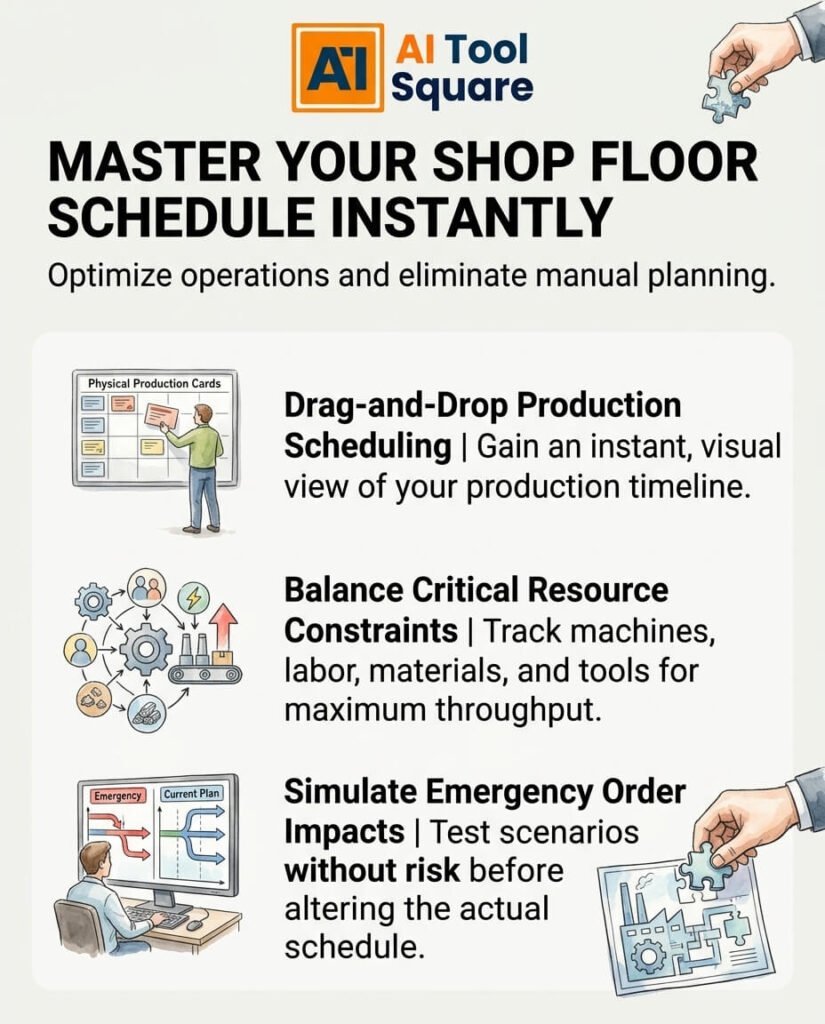
- Visual Drag-and-Drop Scheduling: You get a clear, graphic view of your entire Production Planning and Scheduling timeline. You can move orders around instantly. The system automatically recalculates the impact on every other job. No more manual math.
- Multi-Constraint Optimisation: Machines are not the only factor in your output. You need to track skilled labor, raw material availability, and secondary tools. This tool balances all these constraints to prevent idle time. It ensures your throughput is always at maximum capacity.
- What-If Analysis: You do not have to guess the impact of an emergency order. You run a simulation. See how it affects your current deadlines. If it works, you push it to the shop floor. If it breaks your schedule, you know immediately what to adjust.
Benefits of Using PlanetTogether for Manufacturing and Supply Chain
The primary benefit is time. You stop wasting hours fixing scheduling errors. Your planners get their sanity back. They spend time on high-level strategy instead of data entry.
Your delivery performance improves. When you know exactly when a job will finish, you keep your promises to customers. Reliability leads to repeat business. Repeat business leads to growth.
Operational costs drop. You stop paying for rush shipping to fix missed dates. You stop holding massive amounts of safety stock just in case you mess up the schedule. The savings drop straight to your bottom line.
Pricing & Plans
PlanetTogether uses a custom quote model. It is enterprise software. Small businesses might find the price tag steep, but consider the cost of inefficiency. If you produce high-volume or complex goods, the ROI is usually massive.
They offer different tiers based on the depth of your integration. You get what you pay for. Cheap software usually results in “garbage in, garbage out” scenarios. This tool is for operations that are ready to scale.
Hands-On Experience / Use Cases
Imagine a factory producing custom machinery. The assembly process involves ten different stations. Each station needs specific parts and certified technicians.
When a customer asks for a rush order, the planner uses PlanetTogether to simulate the change. The software shows that Station 4 is the bottleneck.
The system suggests moving a lower-priority job to later in the week. It reallocates the technicians to the rush order. The shop floor knows the new plan in minutes. Production continues without confusion.
Large facilities report higher visibility. Management sees the status of every job. They do not need to walk the floor to know if orders are on time. They check the dashboard.
Teams using this software reduce setup times by grouping similar jobs. The system identifies which jobs share tools. It sequences them together. This simple change adds hours of capacity to the week.
Who Should Use PlanetTogether?
This tool is built for mid-to-large manufacturers. It is for operations with complex workflows. If you make a single product every day, you do not need it.
If you run a high-mix, low-volume shop, you need it. You are the one juggling dozens of different orders. You are the one feeling the constant stress of changing priorities.
Supply chain managers also benefit. They get a clear view of when materials must arrive. It prevents over-ordering. It keeps inventory levels lean and cash flow high.
How to Make Money Using PlanetTogether
Profit comes from speed. If you produce faster than your competitors, you win. This tool gives you the precision to do that.
- Increase Throughput: By reducing downtime and bottlenecks, you fit more jobs into the same workday. More finished goods mean more revenue without increasing your overhead.
- Offer Express Services: Because you have an accurate scheduling system, you can charge a premium for rush orders. You know you can deliver them without breaking your other commitments.
- Lower Operating Costs: Reducing scrap, overtime, and rush shipping adds up. These are direct profits that you were previously throwing away.
Consider a machine shop. Before this tool, they struggled to hit deadlines. They paid excessive overtime. After integration, they optimized their sequence. They increased output by 20% without adding a single machine.
Limitations and Considerations
The system requires good data. If your ERP has bad inventory numbers, the output will be flawed. You must have clean inputs. This is a common stumbling block.
There is a learning curve. Your staff needs training. It is not a “magic button” solution. It is a powerful tool. It requires a professional to run it correctly.
Final Thoughts
Manual scheduling is a liability. It holds your company back. PlanetTogether provides the clarity you need to compete. It is a serious tool for serious manufacturers.
Stop relying on gut feelings. Start relying on data. Stop losing money on inefficiencies. Make the switch and see your throughput increase.
Visit the official PlanetTogether website
Frequently Asked Questions
1. What is PlanetTogether used for?
It is used for advanced production planning and scheduling. It optimizes factory operations by balancing labor, materials, and machine capacity.
2. Is PlanetTogether free?
No. It is professional software designed for enterprise environments. It uses a custom pricing structure based on your specific needs.
3. How does PlanetTogether compare to other AI tools?
Unlike generic AI tools, this is built for specific manufacturing constraints. It handles complex physics and shop floor logic, not just text generation.
4. Can beginners use PlanetTogether?
It is designed for professionals. It requires a solid understanding of manufacturing workflows and your own ERP data to work effectively.
5. Does the content created by PlanetTogether meet quality and optimization standards?
Yes. The output is mathematically optimized for efficiency. It is designed to maximize throughput and minimize waste across your shop floor.
6. Can I make money with PlanetTogether?
Yes. By increasing production capacity and reducing waste, you generate more revenue and lower your costs, which directly boosts your bottom line.
7. How to make money with PlanetTogether?
Focus on reducing downtime and accepting high-margin rush orders. The tool provides the accuracy to hit deadlines that your competitors likely cannot.