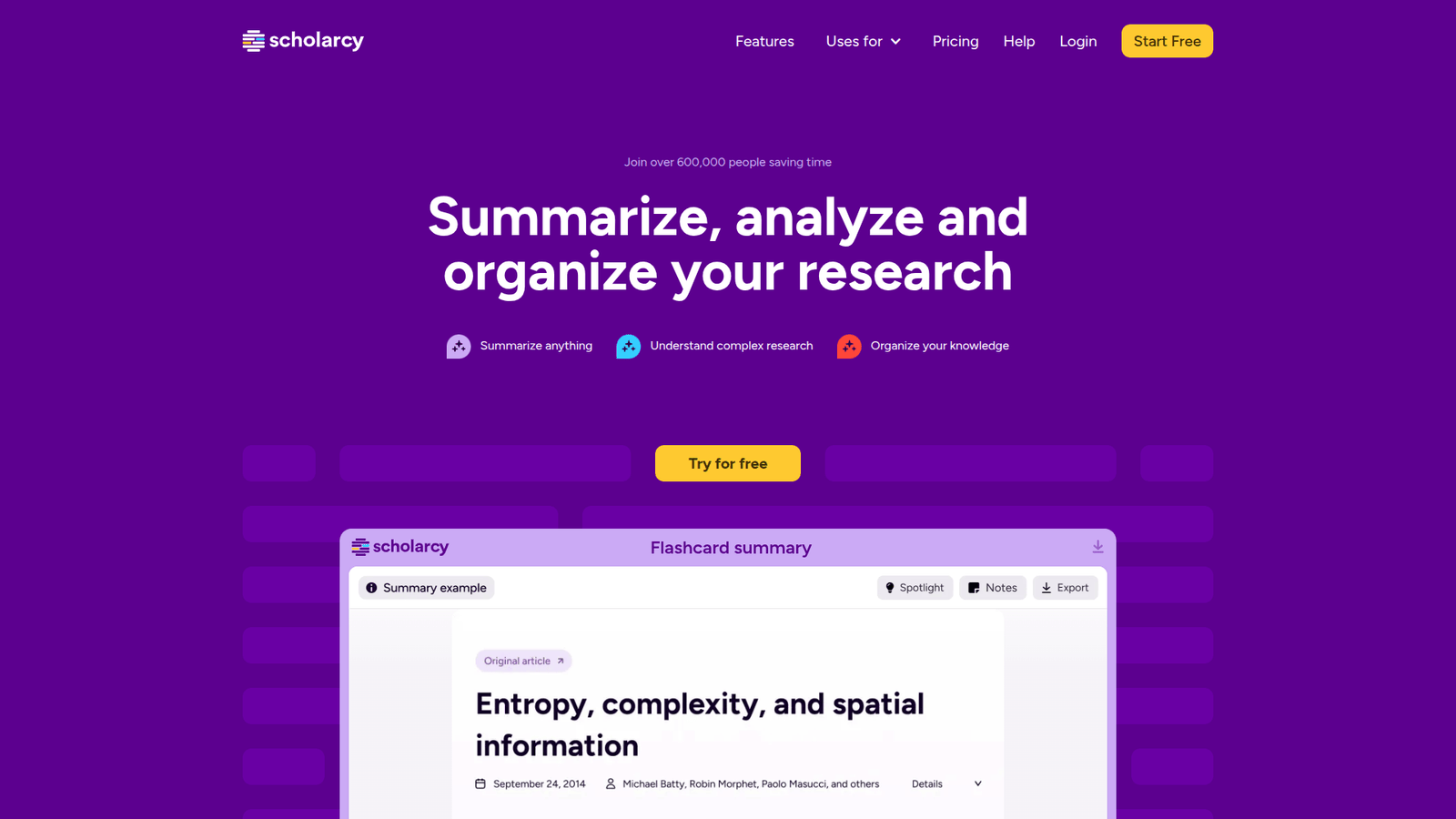

How do you cut through the noise and find what truly matters, without losing days of your precious time? This is where AI steps in, and one tool is making serious waves: Scholarcy.
Scholarcy Transforms Your Article Summarizing Workflow
The education sector is drowning in information. Keeping up with the latest research, industry news, and academic papers is a full-time job on its own. You’re buried under a mountain of articles, and the clock is ticking.
Forget endless hours spent reading, highlighting, and scribbling notes. Imagine getting the core insights of any article, delivered in minutes. That’s not science fiction; it’s what Scholarcy for Article Summarizing does, especially for those in Learning and Education.
If you’re in education, research, or any field that relies on understanding complex information quickly, this AI-powered assistant could be the secret weapon you’ve been missing. Let’s break down how it revolutionizes the way you digest written content, specifically focusing on its power in Article Summarizing.
Unlock faster reading with Scholarcy! Master Article Summarizing in Learning & Education. Get key insights instantly & save hours.
What is Scholarcy?
Scholarcy is an advanced AI-powered tool designed to process and summarise lengthy documents, particularly academic research papers, reports, and articles. Think of it as a super-intelligent research assistant that can read, understand, and extract the most crucial information from text.
Its primary function is to convert dense, complex documents into digestible summaries, bullet points, and structured data. This is a game-changer for anyone who needs to absorb a large volume of information efficiently.
The tool targets professionals, researchers, students, and academics who are constantly engaging with written content. It aims to save them time, reduce cognitive load, and improve their comprehension of complex subjects.
Key Features of Scholarcy for Article Summarizing
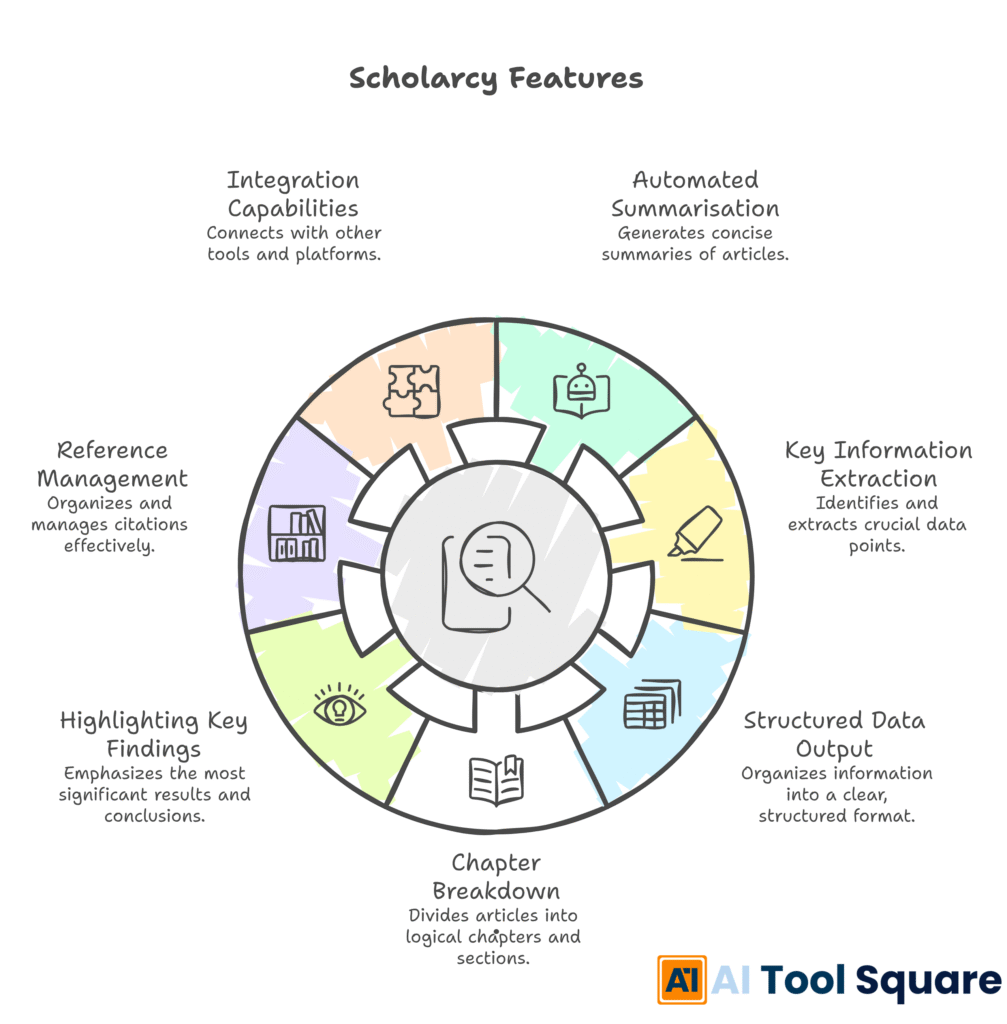
Scholarcy isn’t just a basic summariser; it’s a comprehensive document analysis tool. Here are its standout features for mastering Article Summarizing:
Automated Summarisation: Scholarcy can generate concise summaries of articles in seconds. It identifies the main arguments, findings, and conclusions, presenting them in an easy-to-read format. This dramatically cuts down reading time, allowing users to quickly grasp the essence of a document without getting bogged down in jargon or excessive detail.
Extraction of Key Information: Beyond a simple summary, Scholarcy can pull out specific elements like methods, results, participant details, limitations, and references. This detailed breakdown is invaluable for researchers who need to quickly compare studies or verify specific data points. It’s like having an expert indexer for every paper you feed it.
Structured Data Output: The tool can convert articles into structured data formats, such as CSV files or JSON. This allows for easier analysis, comparison, and integration into other databases or workflows. For educational institutions or research teams, this feature streamlines data management and makes large-scale literature reviews far more manageable.
Chapter and Section Breakdown: Scholarcy can dissect longer documents into their constituent chapters and sections, providing summaries for each. This hierarchical approach helps users navigate complex reports or books, understand the flow of information, and pinpoint areas of particular interest without having to read the entire document.
Highlighting Key Findings: The AI is trained to identify and highlight significant findings, novel contributions, and important data points within an article. This ensures that users don’t miss critical information, even when skimming through summaries. It acts as a smart highlighter, drawing attention to what truly matters.
Reference Management: Scholarcy can extract and format citations, helping users to build bibliographies or easily track down sources. This feature is a lifesaver for academics and students who frequently cite sources in their work. It automates a tedious but essential part of academic writing.
Integration Capabilities: Scholarcy can often integrate with other tools and platforms, allowing for a seamless workflow. This means that the insights gained from article summaries can be directly transferred to note-taking apps, reference managers, or research databases.
Benefits of Using Scholarcy for Learning and Education
In the fast-paced Learning and Education sector, time and accuracy are paramount. Scholarcy offers a compelling array of benefits that directly address these needs.
Massive Time Savings: This is the most immediate and obvious benefit. Imagine reducing the time spent reading and processing a dense academic paper from hours to minutes. Educators can stay current with the latest pedagogical research, students can tackle their reading lists more effectively, and researchers can accelerate their literature reviews.
Enhanced Comprehension: By distilling complex information into its core components, Scholarcy helps users understand the essential points of an article more clearly. This is particularly useful for individuals who struggle with dense academic prose or are new to a particular subject area. It acts as a powerful learning aid.
Overcoming Information Overload: The sheer volume of published research can be overwhelming. Scholarcy provides a filter, enabling users to quickly assess the relevance and key takeaways of numerous articles, allowing them to focus their attention on the most impactful content.
Improved Research Efficiency: For students and researchers, Scholarcy significantly speeds up the process of identifying relevant studies, extracting key data, and building bibliographies. This efficiency gain can lead to faster thesis completion, quicker project development, and more time for critical analysis and original thought.
Supporting Diverse Learning Styles: Some individuals learn best through summaries and key points. Scholarcy caters to these learners by providing structured information that highlights the most important aspects of a text, making content more accessible.
Facilitating Cross-Disciplinary Understanding: When working across different fields, technical jargon can be a significant barrier. Scholarcy’s ability to summarise and extract key information can help bridge these gaps, making it easier to understand research from adjacent or unfamiliar disciplines.
Streamlining Content Creation: Educators and content creators can use Scholarcy to quickly gather information and extract key facts for lectures, presentations, blog posts, or curriculum development. This speeds up the content creation cycle, allowing for more frequent updates and richer educational materials.
Better Knowledge Management: By transforming articles into structured data, Scholarcy aids in building personal or institutional knowledge bases. This makes it easier to retrieve, organise, and share information across teams or departments.
Pricing & Plans

Scholarcy offers a tiered pricing structure to accommodate different user needs, from individual students to large institutions. While specific pricing can change, the general approach includes:
Free Trial: Most AI tools, including Scholarcy, provide a free trial period. This allows potential users to test the core features and see how the tool fits into their workflow before committing financially. It’s a smart way to evaluate its Article Summarizing capabilities.
Individual Plans: For students, academics, and independent researchers, Scholarcy typically offers affordable monthly or annual subscriptions. These plans provide full access to the tool’s features, with limits on the number of documents processed per month.
Team and Institutional Plans: Larger organisations, universities, and research departments can opt for enterprise-level solutions. These plans often come with enhanced features, higher document processing limits, dedicated support, and integration options tailored to institutional needs. This is ideal for a department within Learning and Education.
When comparing Scholarcy to other AI summarising tools, its strength lies in its focus on academic and research content. While some tools offer general summarisation, Scholarcy’s ability to extract specific research elements like methods and results gives it a distinct advantage for serious academic work. Pricing is generally competitive within the market for specialized AI research assistants.
Hands-On Experience / Use Cases
Imagine a university researcher needing to quickly assess dozens of papers for a grant proposal. They upload each PDF into Scholarcy. Within minutes, they receive concise summaries highlighting the methodology, key findings, and impact. This allows them to filter papers rapidly, identifying the most relevant ones for in-depth reading without wasting time on tangential research.
A graduate student working on their thesis faces a daunting reading list. Using Scholarcy, they can generate summaries for each assigned chapter or article. This provides a foundational understanding of each source, enabling them to identify key arguments, supporting evidence, and potential counter-arguments more effectively. They can then use these summaries as an initial layer in their annotated bibliography.
An educator preparing a new module on climate change needs to incorporate the latest findings. They can feed recent scientific reports and journal articles into Scholarcy. The tool extracts the core conclusions, data points, and future projections, which the educator can then use to inform their lecture notes and student assignments, ensuring the content is up-to-date and authoritative.
A team of academics collaborating on a systematic review needs to extract specific data points across multiple studies, such as sample sizes, intervention details, and outcome measures. Scholarcy’s ability to structure this information into data formats means the team can generate a comprehensive table of findings with significantly reduced manual effort. This accelerates the review process and minimises transcription errors.
A student preparing for a presentation on a complex historical event uses Scholarcy to summarise multiple historical analyses. They quickly grasp the different interpretations, key dates, and influential figures presented in each source, allowing them to construct a nuanced and well-supported presentation that reflects diverse scholarly perspectives.
A professional development trainer needs to create a concise overview of a new business strategy report for their trainees. Scholarcy processes the report, providing a summary that highlights the strategic objectives, implementation steps, and expected outcomes. This allows the trainer to deliver a focused and impactful training session without needing to pore over the entire document themselves.
Who Should Use Scholarcy?
Scholarcy is a versatile tool with a broad appeal, especially for anyone who deals with significant volumes of text. Its core strength in processing academic and research papers makes it particularly valuable for:
Students: From undergraduates to PhD candidates, students can leverage Scholarcy to speed up literature reviews, understand complex research, and prepare for essays and theses more efficiently.
Academics and Researchers: Staying abreast of the latest findings in their field is crucial. Scholarcy helps researchers quickly scan new publications, identify relevant studies, and extract key data for their own work.
Educators and Lecturers: To create up-to-date course materials, lectures, and assignments, educators need to access current research. Scholarcy enables them to do this swiftly, ensuring their teaching remains relevant and informed.
Librarians and Information Professionals: These professionals often manage large databases of research. Scholarcy can help them catalog, summarise, and understand the content of newly acquired resources.
Policy Analysts and Government Researchers: They frequently need to synthesise information from a wide range of reports and studies to inform policy decisions. Scholarcy can expedite this process.
Journalists and Science Communicators: To accurately report on scientific breakthroughs or complex topics, they need to understand research papers. Scholarcy provides a shortcut to grasping the core findings.
Content Marketers and Researchers in Specialized Fields: While Scholarcy excels in academic settings, its ability to summarise lengthy documents is also beneficial for marketers who need to research industry trends, competitor analysis, or technical documentation.
Anyone Who Reads a Lot: If your work or studies involve sifting through dense articles, reports, or white papers, Scholarcy can transform your reading and comprehension workflow.
How to Make Money Using Scholarcy
Scholarcy isn’t just a tool for saving time; it’s a powerful asset that can be leveraged to generate income. By enhancing efficiency and producing high-quality summaries, users can offer valuable services to clients or improve their own productivity for greater profit.
Academic Research Assistance Service: Offer specialised assistance to students and researchers. This could involve creating annotated bibliographies, conducting preliminary literature reviews, or generating summaries of research papers for clients who lack the time or expertise. Scholarcy drastically speeds up these tasks, allowing you to take on more clients.
Content Curation and Research for Businesses: Many companies need to stay informed about industry trends, competitor activities, and emerging technologies. You can offer a service where you use Scholarcy to summarise relevant reports, news articles, and white papers, delivering concise intelligence briefs to businesses. This saves them considerable research time.
Summary and Abstract Writing Services: Position yourself as a specialist in crafting high-quality abstracts and summaries for academic papers, reports, or even books. Scholarcy provides the foundational content, and your expertise lies in refining it, ensuring clarity, accuracy, and adherence to specific stylistic requirements. This is particularly valuable for authors who struggle with summarisation.
Knowledge Management Consulting: Help businesses or educational institutions establish efficient knowledge management systems. Use Scholarcy to process existing documents, categorise information, and create structured summaries that can be integrated into their internal wikis or databases. Your service helps them organise their vast amounts of information effectively.
Educational Content Creation: Create valuable educational resources like study guides, lecture notes, or explainer articles based on complex academic texts. Scholarcy’s summaries provide the core content, which you can then expand upon and adapt for different learning levels, selling these resources on platforms or directly to educational providers.
Consider a scenario where a freelance writer uses Scholarcy to speed up their research process for blog posts and articles on niche scientific topics. By reducing their research time by 50%, they can take on twice as many projects or charge a premium for faster turnaround times. If they charge £50 for a blog post and can now produce two in the time it used to take for one, they’ve effectively doubled their hourly rate for that specific task.
Another example: A virtual assistant offers academic research support to graduate students. By using Scholarcy to generate initial summaries and extract key data points, they can offer a comprehensive literature review service at a competitive price, earning a significant hourly rate due to the tool’s efficiency.
Limitations and Considerations
While it is a powerful tool, it’s essential to acknowledge its limitations to use it effectively. Like any AI, it’s not infallible and requires human oversight.
Accuracy and Nuance: AI summarisation is an approximation. While Scholarcy is excellent at identifying core information, it might sometimes miss subtle nuances, complex arguments, or specific implications that a human expert would readily grasp. The AI might prioritise statistically significant findings over conceptually important but less quantifiable ones.
Contextual Understanding: AI’s understanding of context is still developing. For highly specialised or interdisciplinary fields, it might occasionally misinterpret jargon or fail to grasp the full significance of certain statements without additional human context or clarification.
Editing is Crucial: Summaries generated by Scholarcy should always be reviewed and edited by a human. The AI provides a strong draft, but final polishing is necessary to ensure accuracy, flow, and adherence to any specific formatting or stylistic requirements.
Over-reliance Risk: Relying solely on AI summaries without engaging with the full text can lead to a superficial understanding of a topic. For deep learning and critical analysis, reading the original source material remains vital.
Input Format Limitations: While it works well with PDFs and common document formats, it might struggle with image-heavy documents, scanned PDFs with poor optical character recognition (OCR), or highly unusual file types. The quality of the input directly impacts the quality of the output.
Ethical Considerations: When using summaries for academic or professional work, it’s important to properly cite the original sources. Over-reliance on AI-generated summaries without proper attribution could lead to issues of academic integrity.
Learning Curve for Advanced Features: While basic summarisation is straightforward, mastering the more advanced features like structured data extraction and integration might require some time and practice to fully leverage their potential.
Final Thoughts
In the ever-expanding universe of information, it emerges as a vital navigator for professionals and students in Learning and Education. Its prowess in Article Summarizing isn’t just about saving time; it’s about unlocking efficiency, enhancing comprehension, and empowering users to engage with complex knowledge more effectively.
For anyone drowning in research papers, academic journals, or dense reports, Scholarcy offers a clear lifeline. It transforms the daunting task of information processing into a streamlined, manageable activity. The ability to quickly extract key findings, understand core arguments, and even structure data means that less time is spent on tedious reading and more time can be dedicated to critical thinking, analysis, and creation.
While it’s crucial to remember that AI is a tool, not a replacement for human intellect, it significantly augments human capabilities. It provides a powerful starting point, a meticulously organised foundation upon which deeper understanding and original thought can be built. The benefits in terms of time saved, research accelerated, and knowledge gained are substantial.
If you work in learning and education, research, or any field demanding rigorous understanding of written content, Scholarcy is an investment worth considering. It’s designed to tackle the specific challenges of academic and professional literature, making it a standout choice in the crowded AI tools market.
Ready to reclaim your time and supercharge your research? Explore it today and see how it can redefine your relationship with information.
Visit the official Scholarcy website
Frequently Asked Questions
Here are answers to common questions about Scholarcy:
1. What is Scholarcy used for?
Scholarcy is primarily used for processing and summarising lengthy documents, especially academic research papers, reports, and articles. It extracts key information, identifies main arguments and findings, and presents them in a concise, digestible format. It’s a powerful tool for research, study, and staying updated with information.
2. Is Scholarcy free?
Scholarcy typically offers a free trial period, allowing users to test its features. Beyond the trial, it operates on a subscription model with various plans for individuals, teams, and institutions. There isn’t a permanently free, unlimited version.
3. How does Scholarcy compare to other AI tools?
Scholarcy distinguishes itself by focusing specifically on academic and research content. While many AI tools offer general summarisation, Scholarcy excels at extracting detailed research elements like methods, results, and participant information, and structuring this data. Its focus makes it particularly robust for scholarly work.
4. Can beginners use Scholarcy?
Yes, beginners can certainly use Scholarcy. The core functionality of uploading a document and receiving a summary is very straightforward. While advanced features might require a slight learning curve, the basic summarisation and extraction capabilities are intuitive and easy to learn.
5. Does the content created by Scholarcy meet quality and optimization standards?
Scholarcy aims for high-quality summaries that accurately reflect the original content’s core message. However, for optimisation standards (like SEO), human review and editing are essential. It provides the factual basis; content creators then refine it for specific optimisation goals, ensuring accuracy and engagement.
6. Can I make money with Scholarcy?
Absolutely. Scholarcy can be leveraged to offer services such as academic research assistance, content curation for businesses, abstract writing, and knowledge management consulting. Its efficiency gains directly translate into the ability to take on more clients or complete tasks faster, increasing earning potential.
7. How to make money with Scholarcy?
To make money with Scholarcy, identify a service that leverages its summarising and data extraction capabilities. Offer specialised help to students or researchers, provide concise intelligence briefs to businesses, write high-quality abstracts, or consult on knowledge management. The key is to use it to deliver value faster and more efficiently than manual methods.