
Learn how K Health for Diagnostics and Screening simplifies patient assessments. Boost your clinical accuracy and patient outcomes. Click to transform care today.
Why K Health Is a Game-Changer in Diagnostics and Screening
Healthcare is broken. It is slow. It is expensive. It is often wrong. You see patients waiting for hours for basic answers. You see clinicians burnt out by administrative bloat. The Healthcare and Medical industry needs a massive efficiency injection. Not more paperwork. Not more bureaucracy. It needs intelligence that works at scale.
Enter K Health. This is not just another chatbot. This is a system designed to bridge the massive gap between data and patient action. When speed and accuracy dictate health outcomes, you cannot afford to rely on outdated, manual processes. The Diagnostics and Screening phase is where most errors happen. Fix that, and you change the entire patient journey.
Efficiency is the only currency that matters in modern clinical practice. If you are still doing everything manually, you are leaving money and patient lives on the table. K Health removes the guesswork. It gives you a roadmap based on millions of data points, not just one clinician’s memory. It is time to stop guessing and start measuring.
What is K Health?
K Health is a data-driven platform that puts clinical knowledge into the hands of users. It uses massive, anonymised datasets to compare a user’s symptoms against millions of similar patient cases. It is a logic engine for the human body.
The goal is simple: reduce uncertainty. By looking at historical patterns, K Health suggests potential causes for symptoms. It doesn’t just show a list of scary possibilities. It shows what actually happened to other people with identical profiles. This is objective data applied to subjective complaints.
For the average user, this means getting a sense of what is wrong without the anxiety of a frantic web search. For providers, it creates a structured, pre-filtered set of possibilities. This reduces the time spent on initial triage. It makes the diagnostic process more robust, reducing the chance of human error.
The system is built on rigorous medical information. It connects users to clinicians when the AI indicates a need for human intervention. It is the perfect marriage of machine speed and human oversight. It turns medical triage from a bottleneck into a pipeline.
Key Features of K Health for Diagnostics and Screening
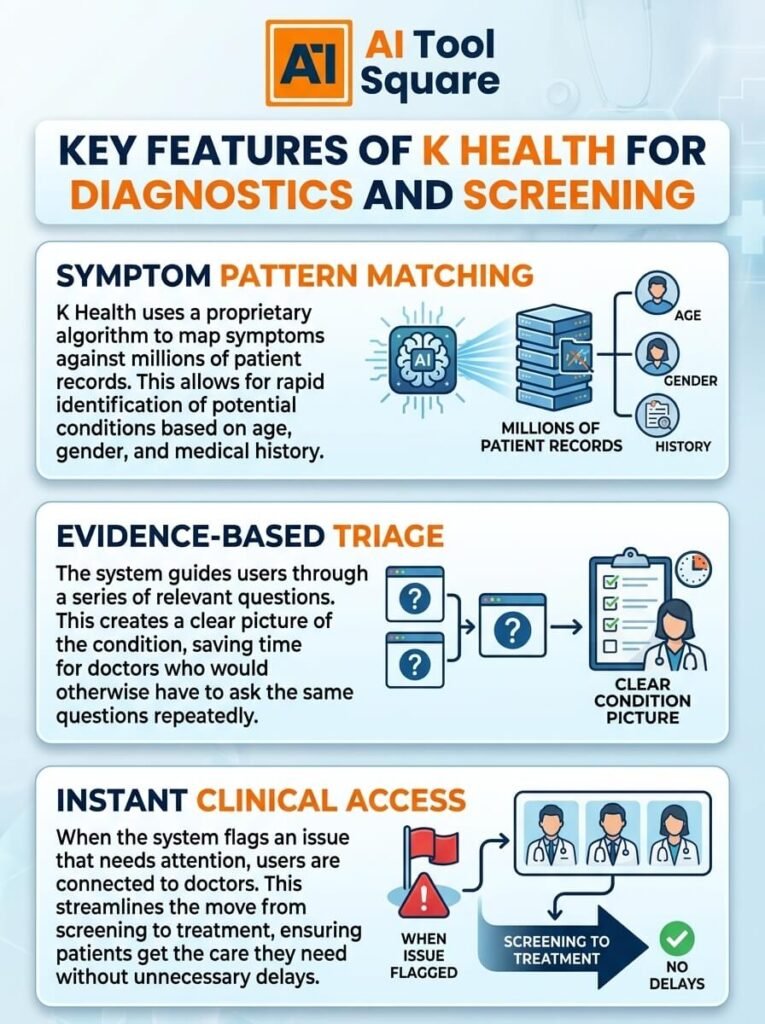
- Symptom Pattern Matching: K Health uses a proprietary algorithm to map symptoms against millions of patient records. This allows for rapid identification of potential conditions based on age, gender, and medical history.
- Evidence-Based Triage: The system guides users through a series of relevant questions. This creates a clear picture of the condition, saving time for doctors who would otherwise have to ask the same questions repeatedly.
- Instant Clinical Access: When the system flags an issue that needs attention, users are connected to doctors. This streamlines the move from screening to treatment, ensuring that patients get the care they need without unnecessary delays.
Benefits of Using K Health for Healthcare and Medical
The primary benefit of K Health is time. In the clinical world, time is the most expensive commodity. Every minute spent on basic symptom checking is a minute taken away from high-level decision-making. By automating the screening phase, clinicians can focus on diagnosis and treatment.
Quality improvement is the second major win. Human memory is fallible. Doctors have bad days. They get tired. An AI-driven tool does not get tired. It does not get distracted. It consistently applies the same logic to every patient. This reduces diagnostic variance.
Burnout is the silent killer of the industry. When staff are bogged down by repetitive tasks, they leave the profession. K Health keeps the focus on high-value interactions. This preserves the most valuable resource in any practice: the people.
Finally, there is the aspect of patient trust. When patients feel their symptoms are being listened to and processed through a smart, reliable system, their satisfaction scores increase. They feel cared for. They get answers faster. This drives loyalty and better adherence to treatment plans.
Pricing & Plans
K Health operates on a model that prioritises accessibility. Many of the initial symptom check features are available for free. This lowers the barrier for entry, allowing users to gain instant insights without an upfront cost.
For full clinical consultations, there is a clear, subscription-based or per-visit fee structure. This allows users to pay for exactly what they need. It is transparent. No hidden insurance hurdles, just direct access to care when it counts.
When compared to traditional urgent care visits, the cost of K Health is significantly lower. The goal is to provide a low-cost, high-value alternative to the expensive, slow emergency room or primary care queue for non-emergent issues.
The subscription options often include unlimited or discounted access to clinicians. For patients with recurring or chronic minor ailments, this is a massive cost-saving measure. It turns medical access into a utility rather than a luxury.
Hands-On Experience / Use Cases
Consider a busy clinic experiencing a surge in patients. Front-desk staff are overwhelmed by intake forms. A primary care team can use K Health to pre-screen these patients. The system captures the core symptoms and builds a patient profile.
When the patient meets the doctor, the clinician already has a structured summary. They do not need to spend ten minutes on history. They start at the diagnosis phase. The entire appointment becomes five minutes of high-value advice rather than twenty minutes of note-taking.
Another application is in remote health monitoring. A telehealth agency uses K Health to triage incoming queries. Only the most severe cases reach the top-tier doctors. Everything else is handled by the automated screening process or lower-tier support staff.
This allows the senior medical staff to scale. They can see twice as many patients without sacrificing quality. The AI handles the volume, the humans handle the critical judgment. It is a blueprint for scaling a medical practice.
Who Should Use K Health?
K Health is built for anyone who interacts with the health system. For patients, it is the first line of defense. It provides a logical starting point before they waste money on unnecessary appointments or panic over a cough.
For small medical practices, it is a tool for efficiency. It allows a small team to do the work of a larger, more bureaucratic operation. It reduces the time spent on intake and documentation significantly.
Agencies and telehealth providers benefit the most. If you are running a platform where patient volume is a problem, this is your solution. It sorts, filters, and prioritizes patients instantly. It optimizes your workflow to handle growth without overhead.
Even health insurance companies use similar technologies to manage risk. By identifying potential issues early, they reduce the cost of later, more complicated interventions. It is a win for the patient and a win for the bottom line.
How to Make Money Using K Health
Money in healthcare comes from volume and efficiency. K Health allows you to increase both. You stop losing hours to manual administration and focus on billable clinical hours.
- Streamlined Clinical Practice: By reducing intake time by 50%, a practice can see more patients daily. Each additional patient represents pure profit once overheads are covered.
- Telehealth Consulting Services: Use K Health to power your own remote screening service. You provide the clinical judgment; the tool provides the diagnostic speed.
- Corporate Wellness Packages: Offer local businesses a health screening bundle. Use the tool to manage employee health queries, keeping them productive and reducing absenteeism for your clients.
Imagine a provider managing a monthly retainer for corporate health. They use the tool to provide instant answers to employees. The cost of the tool is negligible compared to the contract value. It is pure margin.
Limitations and Considerations
No tool is perfect. K Health is not a doctor. It provides information based on probability, not a definitive diagnosis. It should never be used as the sole source of truth for critical emergencies.
There is also a learning curve. While the interface is simple, the integration into existing medical record systems can be complex. Staff need training to ensure they are using the insights effectively without relying too heavily on automation.
Data privacy is always a concern. While the data is anonymized, the industry is highly regulated. Always ensure that the version you are using complies with local health data laws, such as GDPR or HIPAA.
Finally, there is the risk of over-reliance. If clinicians stop using their own judgment and start deferring to the AI, they lose their edge. The AI is a co-pilot, not the captain. Keep human eyes on the process at all times.
Final Thoughts
K Health represents the future of clinical efficiency. It cuts out the noise and gives you the data. It saves time. It reduces the burden on healthcare systems. Most importantly, it gives patients faster, better care.
If you are still waiting on old processes, you are falling behind. Adapt to the new way of doing things. Use the tools that give you an edge. Start by evaluating how this can fit into your current medical workflow today.
Visit the official K Health website
Frequently Asked Questions
1. What is K Health used for?
K Health is primarily used to provide automated, data-driven health information and triage. It helps users understand their symptoms by comparing them with millions of historical medical records, providing a clear path forward.
2. Is K Health free?
Many features, such as basic symptom checking and general information, are free. However, accessing clinicians or advanced consultations usually involves a fee, which is often more affordable than traditional healthcare visits.
3. How does K Health compare to other AI tools?
K Health is distinct because it is built on vast, anonymized clinical datasets. Many other tools use generic data, whereas K Health offers a more medically grounded, evidence-based approach tailored to individual profiles.
4. Can beginners use K Health?
The platform is designed for ease of use. If you can use a smartphone, you can use K Health. The interface is intuitive, and the questions are framed in simple, plain language that anyone can understand.
5. Does the content created by K Health meet quality and optimization standards?
Yes, the content is medically vetted. The system uses clinical standards to ensure the information provided is accurate and safe for users. It is an excellent example of high-quality, data-driven health content.
6. Can I make money with K Health?
You can make money by integrating it into your clinical practice to improve efficiency. By seeing more patients in less time, your revenue increases. You can also offer specialized screening services powered by the tool.
7. How to make money with K Health?
Focus on operational efficiency. Use the tool to reduce administrative time, thereby increasing the number of patients your team can manage. Alternatively, market your clinic as a high-tech, fast-access provider, attracting patients who value convenience.