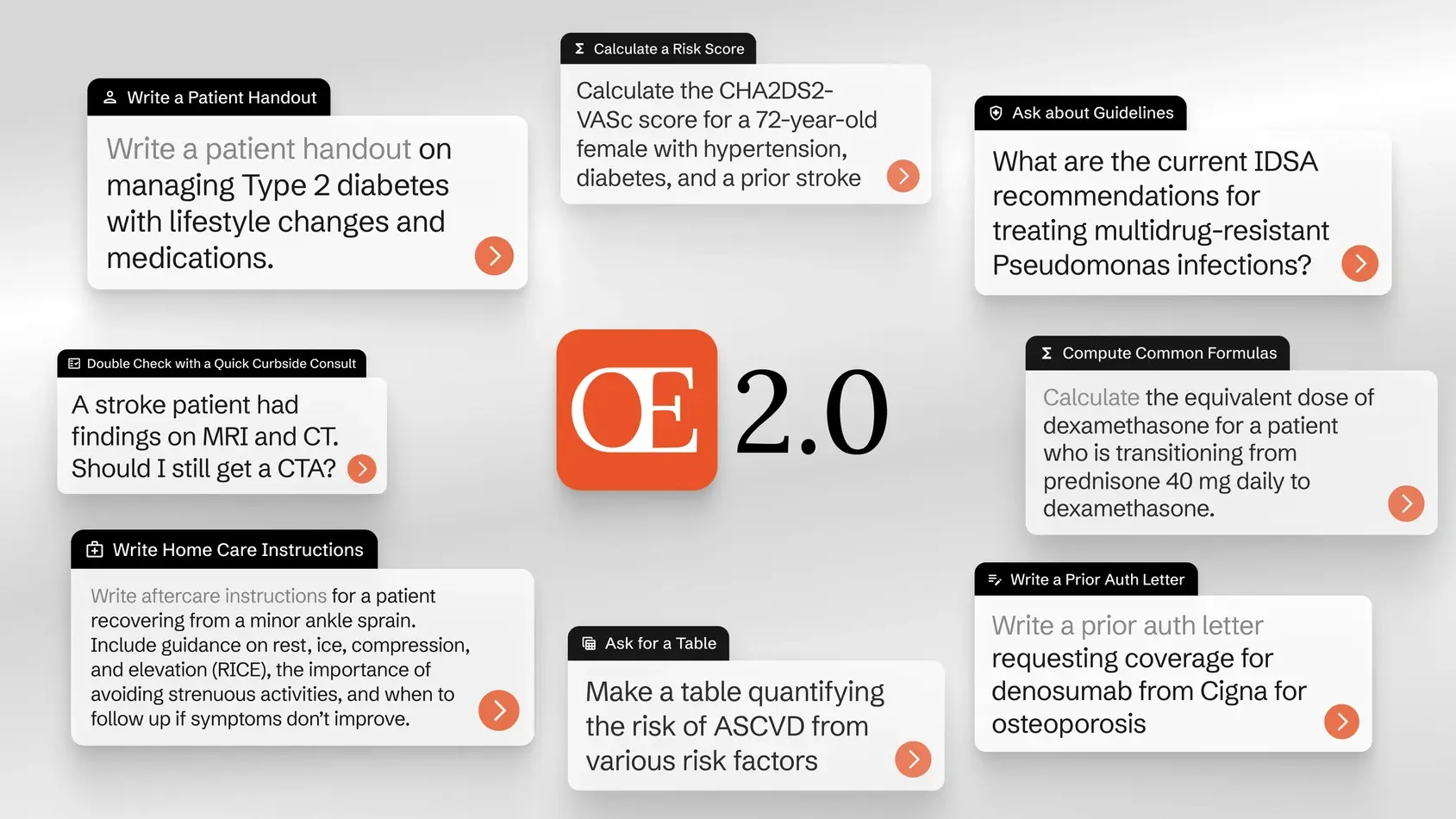

OpenEvidence for Clinical Decision Support cuts through the noise. Get evidence-based medical answers fast. Improve patient care now—start here.
Why OpenEvidence Is a Game-Changer in Clinical Decision Support
You have thousands of medical papers published every single day.
Medical professionals cannot possibly read them all.
But patients need the best care, and that care depends on current facts.
This creates a massive bottleneck.
You are either overwhelmed by data or operating on outdated information.
Neither scenario is acceptable.
Enter OpenEvidence.
It acts as a filter for the chaos.
It turns millions of clinical documents into clear, actionable answers.
When speed matters, this changes the healthcare and medical field for the better.
You get the right information without spending hours digging through databases.
This is the tool for those who value results over busywork.
It removes the friction between a question and a fact-based answer.
Stop guessing and start using verified evidence to drive outcomes.
This is how modern medicine functions.
- What is OpenEvidence?
- Key Features of OpenEvidence for Clinical Decision Support
- Benefits of Using OpenEvidence for Healthcare and Medical
- Pricing & Plans
- Hands-On Experience / Use Cases
- Who Should Use OpenEvidence?
- How to Make Money Using OpenEvidence
- Limitations and Considerations
- Final Thoughts
- Frequently Asked Questions
What is OpenEvidence?
OpenEvidence is a platform designed to make medical literature accessible.
It uses artificial intelligence to scan vast archives of peer-reviewed content.
Most search engines give you a pile of links.
OpenEvidence gives you the actual synthesis of the data.
It provides structured, cited answers.
You type in a clinical question, and the tool returns a response backed by current clinical decision support literature.
The focus is on accuracy, traceability, and speed.
It is built for anyone who needs to base decisions on high-quality proof.
The platform treats information as a resource, not an obstacle.
It cuts out the marketing fluff and the paywalled summaries.
It connects you directly to the peer-reviewed evidence.
This is exactly what clinicians need when they are short on time but cannot sacrifice accuracy.
Key Features of OpenEvidence for Clinical Decision Support
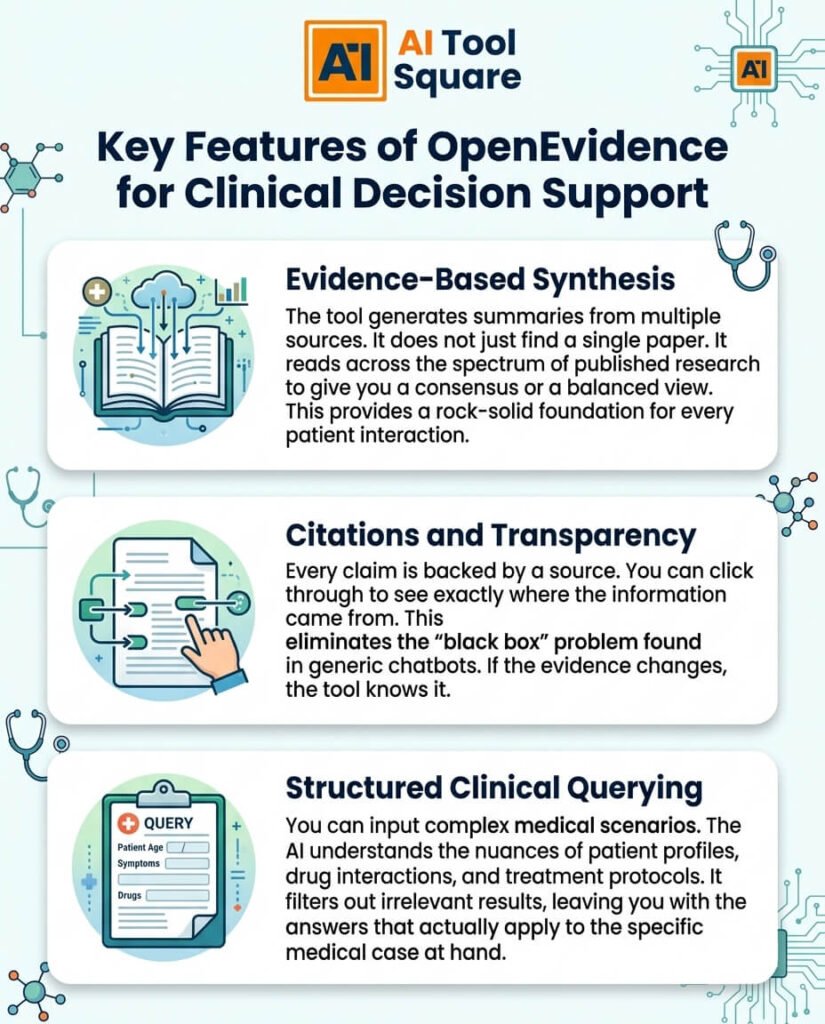
- Evidence-Based Synthesis: The tool generates summaries from multiple sources. It does not just find a single paper. It reads across the spectrum of published research to give you a consensus or a balanced view. This provides a rock-solid foundation for every patient interaction.
- Citations and Transparency: Every claim is backed by a source. You can click through to see exactly where the information came from. This eliminates the “black box” problem found in generic chatbots. If the evidence changes, the tool knows it.
- Structured Clinical Querying: You can input complex medical scenarios. The AI understands the nuances of patient profiles, drug interactions, and treatment protocols. It filters out irrelevant results, leaving you with the answers that actually apply to the specific medical case at hand.
Benefits of Using OpenEvidence for Healthcare and Medical
Time is your most expensive asset.
Searching through PubMed or scrolling through journals eats up hours that should be spent on patient care.
OpenEvidence returns high-quality answers in seconds.
It turns a task that takes an afternoon into one that takes thirty seconds.
The quality of decision-making improves instantly.
When you have the full picture of medical evidence at your fingertips, you make better calls.
You avoid common pitfalls by checking against the most recent trials.
Patients get better outcomes because their providers have access to the latest science.
Stress levels drop when you stop searching and start knowing.
The tool removes the “analysis paralysis” caused by contradictory studies.
It highlights the consensus, allowing you to focus on the application rather than the research phase.
This is efficient work at the highest level.
Pricing & Plans
OpenEvidence maintains a model that focuses on professional-grade access.
While many tools are free and then fail to deliver value, this tool is built for serious users.
There are options for individual clinicians as well as institutional access for hospitals and research teams.
The premium versions unlock deeper query capabilities.
You get access to a broader range of journals and faster processing speeds.
Think of it as an insurance policy for your knowledge base.
The ROI is high because the cost is negligible compared to the time saved and the quality of care improved.
Check the official site for current tier breakdowns.
Plans change, but the value proposition remains the same:
Access to the best clinical intelligence on the planet.
You pay for the reliability that free search engines simply cannot provide.
Hands-On Experience / Use Cases
Consider a physician evaluating a new treatment protocol for a rare condition.
Instead of spending six hours in library databases, they query the tool for “efficacy of protocol X in patients with comorbidity Y.”
Within seconds, the tool synthesises the top-tier peer-reviewed articles.
The physician verifies the citations and adjusts the treatment plan immediately.
A medical student or researcher uses the platform to generate a literature review outline.
They feed their core hypothesis into the tool.
It pulls the most relevant trials, noting any inconsistencies in current research.
The student saves dozens of hours of grunt work, allowing them to focus on the actual analysis and writing.
Hospital administrators monitor shifts in standard-of-care guidelines.
They use the tool to cross-reference their current internal protocols against global, evidence-based recommendations.
This keeps their institution at the bleeding edge of compliance and efficacy.
It moves the institution from reactive to proactive care management.
Who Should Use OpenEvidence?
Medical doctors and specialists are the primary users.
They handle high-stakes decisions every day.
They need verified information to back up their clinical judgment.
It is a tool for those who refuse to cut corners on patient safety.
Medical researchers benefit from the rapid literature synthesis.
It accelerates the discovery process by identifying gaps in existing research.
If a trial has already been done, you will know about it immediately.
This prevents wasted effort on redundant work.
Students and residents use it to learn faster.
It is a mentor that points them toward the most respected studies in any field.
Rather than reading random blogs, they get direct access to the clinical evidence.
It sets the standard for how a professional should study.
How to Make Money Using OpenEvidence
Efficiency is a revenue driver.
When you stop wasting time on manual research, you can see more patients or take on more complex consultations.
Value is created by your output, not your time spent searching.
Use the tool to build a reputation for being the most informed provider in your area.
- Consultancy Services: Offer specialized medical advisory services to clinics or law firms. Use the tool to generate rapid, evidence-based reports that usually take days to produce. You charge a premium for the speed and the reliability of the evidence.
- Medical Writing: Create high-quality, cited content for medical publications or industry blogs. The tool does the heavy lifting for your research. You get more articles done per week, scaling your income significantly without sacrificing quality.
- Compliance and Quality Assurance: Help small medical practices audit their patient care protocols against updated global guidelines. You become an efficiency consultant, showing them how to use tools like this to lower their risk and improve patient satisfaction.
There are users who have scaled their output by 5x using this model.
By outsourcing the search phase to AI, they dedicate their mental energy to the creative and high-stakes parts of the business.
They don’t work more hours; they work with more leverage.
Limitations and Considerations
AI is a tool, not a human expert.
It relies on the data provided to it.
You must always review the citations to ensure they are the correct fit for your specific query.
The tool can be smart, but you must remain the expert in the loop.
The learning curve is minimal, but the “prompting” style matters.
You get better results when you are specific about your query.
Don’t ask “is this drug good.”
Ask “what are the long-term side effects of drug X for patients aged 60+ with heart disease.”
Precision in input equals precision in output.
Remember that new research is added constantly.
Some fields move faster than others.
Always cross-check if the evidence you are looking at is the most current available.
Never abdicate your final decision-making power to a machine.
Final Thoughts
OpenEvidence is the tool you need if you are tired of the old ways of searching.
It is fast, it is accurate, and it is built for professionals.
You either use it to stay ahead or you continue to waste time on manual research.
The choice is simple for those who want to be the best in their field.
Integrate it into your workflow today.
The setup is fast, and the benefits are immediate.
Take control of your time and your medical evidence.
Start using OpenEvidence to master your clinical workflow now.
Visit the official OpenEvidence website
Frequently Asked Questions
1. What is OpenEvidence used for?
It is used for synthesizing medical literature and peer-reviewed research into quick, cited answers for clinical and academic purposes.
2. Is OpenEvidence free?
There are accessible options, but the professional-grade features usually require a subscription plan to support the depth and speed of the service.
3. How does OpenEvidence compare to other AI tools?
Unlike generic chatbots, it is specifically tuned for medical evidence and forces strict citation, reducing the risk of hallucinations.
4. Can beginners use OpenEvidence?
Yes, the interface is simple. As long as you have a background in the relevant medical field, you can start using it effectively immediately.
5. Does the content created by OpenEvidence meet quality and optimization standards?
It provides high-quality, scientifically grounded summaries, but professional review is always required for final medical decisions.
6. Can I make money with OpenEvidence?
Yes. By increasing your research speed and productivity, you can offer more professional services to clients, patients, or academic partners.
7. How to make money with OpenEvidence?
Focus on consultancy, medical writing, or protocol auditing. Use your speed to charge for higher volume or specialized expertise in your field.