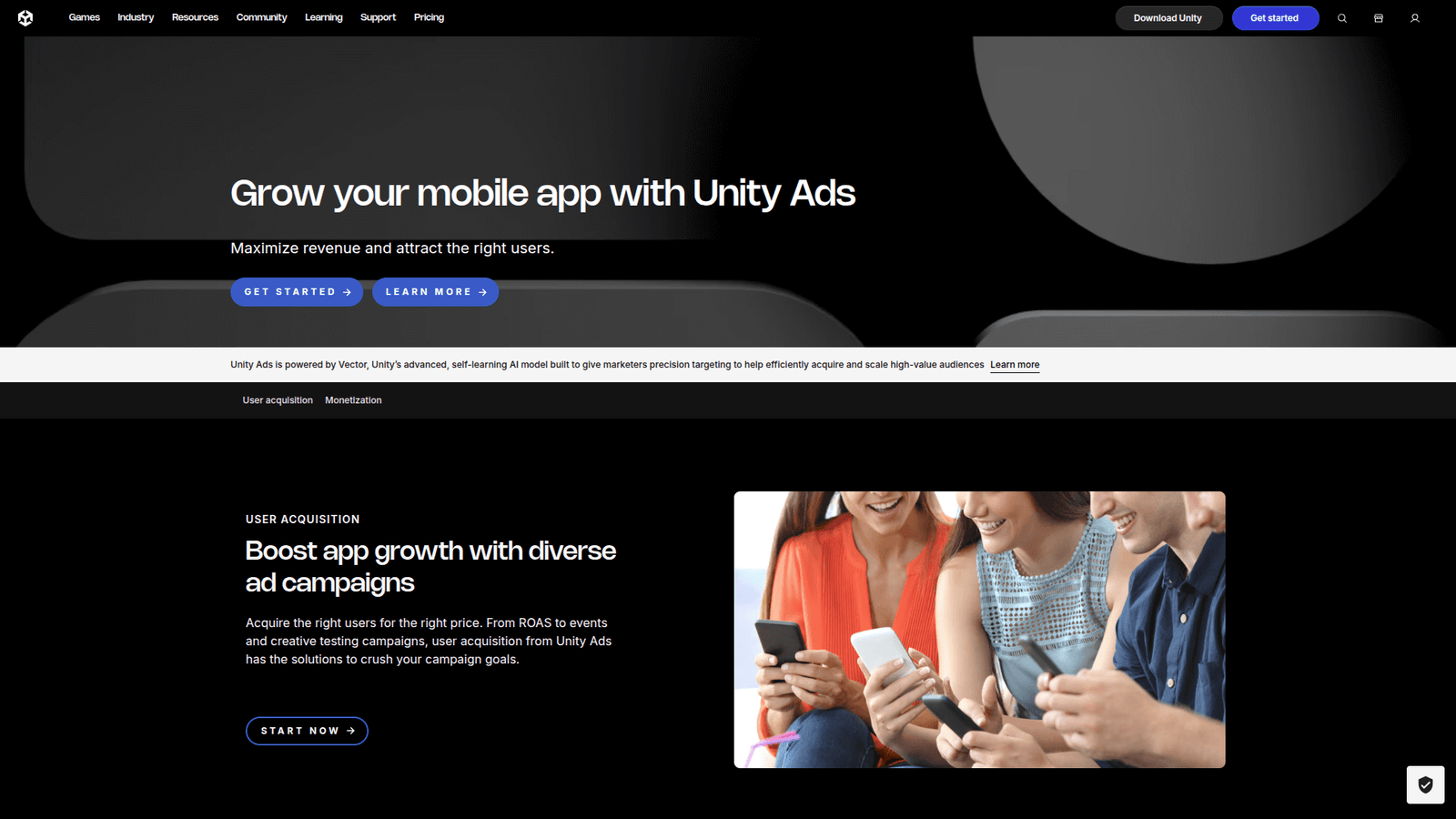

Unity Ads revolutionizes game monetization and marketing for developers. Boost revenue, optimize user acquisition, and scale faster. Ready to amplify your game’s success?
Unity Ads Unlocks New Potential in Game Monetization and Marketing
Ever wonder how some games just… blow up?
It’s not always luck.
It’s often smart strategy, especially in how they make money and find new players.
The gaming and entertainment industry is cutthroat.
Developers pour their souls into creating incredible experiences.
But then comes the hard part: getting paid for it, and getting it into enough hands.
AI isn’t just for chatbots anymore.
It’s reshaping how games make bank and win hearts.
Unity Ads sits right at the heart of this revolution.
It’s an AI tool specifically engineered for game developers.
It handles the heavy lifting of game advertising, so you don’t have to.
Forget guessing games with your budget.
Forget endlessly tweaking campaigns.
Unity Ads promises to streamline your game monetization and marketing.
It helps you make confident decisions, backed by data.
This isn’t just about showing ads.
It’s about showing the *right* ads, to the *right* players, at the *right* time.
That’s how you turn passion into profit.
That’s how you grow your player base.
Ready to see how?
Table of Contents
- What is Unity Ads?
- Key Features of Unity Ads for Game Monetization and Marketing
- Benefits of Using Unity Ads for Gaming and Entertainment
- Pricing & Plans
- Hands-On Experience / Use Cases
- Who Should Use Unity Ads?
- How to Make Money Using Unity Ads
- Limitations and Considerations
- Final Thoughts
- Frequently Asked Questions
What is Unity Ads?
So, what exactly is Unity Ads?
Think of it as your secret weapon for making money and getting eyeballs on your game.
It’s an advertising platform built by Unity, the same company behind one of the most popular game engines.
This means it’s made specifically for game developers, by people who understand games.
Unity Ads allows you to integrate video ads, rewarded ads, and playable ads directly into your mobile games.
But it’s not just a passive ad display system.
It uses AI and machine learning to optimize ad placements and delivery.
This means the ads are shown to players who are most likely to engage with them.
It also means higher revenue for you.
For game developers, studios, and publishers, Unity Ads acts as a dual-purpose tool.
First, it’s a robust game monetization and marketing solution.
You earn money when players watch ads within your game.
Second, it’s a powerful user acquisition channel.
You can run campaigns to promote your own game within other games that use Unity Ads.
This creates a closed-loop system where you can both earn and spend, all within the same platform.
The core function is simple: connect advertisers with publishers (game developers).
But the execution is smart.
Its algorithms analyse player behavior, game data, and ad performance.
This ensures maximum eCPM (effective cost per mille) for publishers.
It also ensures higher conversion rates for advertisers.
It’s a win-win.
You get paid more.
Advertisers get better results.
It’s about making your game profitable without sacrificing player experience.
It’s about intelligently integrating ads, not just slapping them everywhere.
Unity Ads takes the guesswork out of game advertising.
It lets you focus on what you do best: making awesome games.
Forget endless spreadsheets and manual campaign management.
This tool is designed to automate and optimize.
It’s built to scale with your success.
Key Features of Unity Ads for Game Monetization and Marketing
Alright, let’s get down to brass tacks.
What does Unity Ads actually *do*?
It’s packed with features designed to solve real problems for game developers.
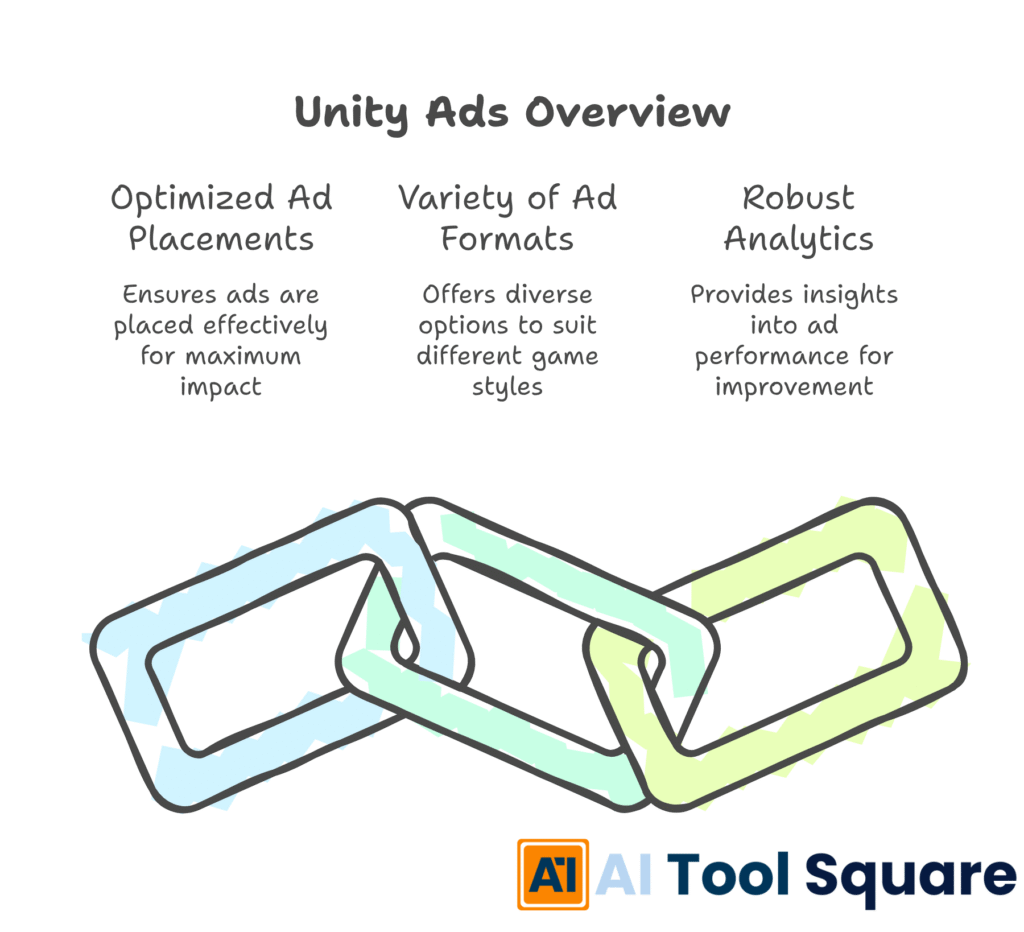
- Optimized Ad Placements and Delivery:
This is where the AI really shines.
Unity Ads doesn’t just throw ads at your players.
It uses machine learning to determine the best time and place to show an ad.
It considers player behavior, game progression, and even their likelihood to convert.
Imagine a player finishes a tough level.
A rewarded video offering extra lives might be just what they need.
Or, a player who consistently skips ads might not see as many interstitial ads.
This intelligent placement means higher engagement for ads.
It means less irritation for players.
Result? More revenue for you.
It helps boost your overall game monetization and marketing efforts by making every ad impression count.
- Variety of Ad Formats:
One size does not fit all in advertising.
Unity Ads understands this.
It offers several ad formats to suit different game types and player preferences.
You’ve got **Rewarded Video Ads**, where players opt-in to watch an ad in exchange for an in-game reward (coins, power-ups, extra lives).
These are gold because players choose to watch them.
Then there are **Interstitial Video Ads**, full-screen video ads that appear at natural breaks in gameplay (like between levels or after a game over screen).
Use these carefully to avoid annoying players.
Finally, **Playable Ads** offer a mini-game experience.
Players get a taste of another game before deciding to download.
This variety allows you to create a balanced ad strategy.
It helps maximize revenue while keeping your players happy.
- Robust Analytics and Reporting:
You can’t improve what you don’t measure.
Unity Ads provides comprehensive dashboards and reports.
These show you exactly how your ads are performing.
You’ll see metrics like impressions, clicks, conversions, eCPM, and revenue.
This data is crucial for understanding what’s working and what isn’t.
Are your rewarded videos earning more than interstitials?
Are players in certain regions responding better to ads?
These insights allow you to tweak your strategy in real-time.
It’s not just raw numbers; it’s actionable intelligence.
This empowers you to make data-driven decisions.
It helps you optimize your ad placements and increase your earnings.
It takes the guesswork out of optimizing your ad strategy.
This feature is key for any serious developer looking to master gaming and entertainment monetization.
Benefits of Using Unity Ads for Gaming and Entertainment
Why should you bother with Unity Ads?
Because it solves some massive headaches for anyone in gaming and entertainment.
It’s not just another ad platform; it’s a strategic partner.
First, let’s talk about time savings.
Managing ad networks, optimizing campaigns, tracking performance – it’s a full-time job.
Unity Ads automates much of this.
Its AI handles the heavy lifting of ad selection and delivery.
This frees you up to focus on game development, not ad ops.
You spend less time wrestling with dashboards.
You spend more time perfecting your game.
Next, there’s a huge bump in quality improvement for your monetization strategy.
Because Unity Ads uses predictive analytics, it can show ads that are more relevant to your players.
This means better conversion rates for advertisers.
It means higher eCPM for you.
The ads feel less intrusive.
The player experience is preserved, sometimes even enhanced (think rewarded ads).
This isn’t about spamming players.
It’s about smart, contextual advertising.
It’s about making money without driving players away.
Unity Ads also helps you overcome creative blocks in monetization.
Struggling to figure out how to make your free-to-play game profitable?
Unity Ads provides diverse ad formats that can be creatively integrated.
Rewarded video can become an integral part of your game economy.
Playable ads can drive cross-promotion without heavy design work.
It gives you a ready-made suite of tools.
These tools can be adapted to almost any game type.
Another massive benefit is its ability to scale with your game’s success.
As your game grows in popularity, Unity Ads automatically adjusts.
It connects you with a larger pool of advertisers.
It optimizes delivery for more impressions.
You don’t need to rebuild your monetization infrastructure.
The platform handles increasing traffic and demand seamlessly.
This means you can focus on building a hit game.
You can trust that your monetization will keep pace.
Finally, the platform’s integration with the Unity engine is a huge plus.
If you’re building your game in Unity (which many are), integration is simple.
It’s a few lines of code, not a complex SDK implementation.
This reduces technical hurdles.
It accelerates your time to market.
It means fewer bugs.
It means less frustration.
Unity Ads simplifies even complex game monetization and marketing strategies.
It really is a game-changer.
Pricing & Plans

Alright, let’s talk money.
How much does Unity Ads cost?
This is where it gets interesting, and frankly, very appealing for developers of all sizes.
Unity Ads primarily operates on a revenue-sharing model.
For publishers (game developers), it’s essentially free to use for monetization.
You integrate the SDK into your game.
You start showing ads.
Unity takes a percentage of the ad revenue generated.
You keep the rest.
The exact split can vary based on various factors.
But the key takeaway is: you don’t pay an upfront fee to start monetizing.
This is massive for indie developers and small studios.
There’s no financial barrier to entry.
You only pay when you make money.
Now, if you’re using Unity Ads for user acquisition – meaning you’re buying ads to promote your own game – then you are the advertiser.
In this scenario, you set your own budget.
You bid on impressions or installs.
This operates on a standard cost-per-install (CPI) or cost-per-impression (CPM) model, depending on your campaign type.
You decide how much you want to spend to acquire new players.
Unity’s algorithms work to get you the best results for that budget.
Compared to alternatives, this revenue-sharing model is fairly standard in the mobile ad network space.
Many networks like AdMob, Facebook Audience Network, or ironSource operate similarly.
However, Unity Ads often has an edge due to its deep integration with the Unity engine.
This often results in better performance and easier setup for Unity-based games.
There are no “premium” versions to unlock for monetization features.
All the optimization tools and ad formats are available to all publishers.
This levels the playing field.
Even small developers get access to top-tier monetization technology.
The only “premium” aspect might be if you’re a massive publisher.
You might get dedicated account management.
But the core functionality for game monetization and marketing remains the same.
The pricing model is designed to align Unity’s success with yours.
They only make money when you make money.
This incentivizes them to provide the best possible ad performance.
It’s a straightforward, performance-based system.
No hidden fees.
No complicated tiers.
Just revenue sharing.
Hands-On Experience / Use Cases
Okay, enough theory.
Let’s talk about how this actually plays out in the real world.
I’ve seen developers transform their games using Unity Ads.
Take a small indie studio, “Pixel Pioneers,” for example.
They released a charming, but niche, puzzle game.
Initially, they relied solely on in-app purchases (IAPs) for monetization.
Sales were slow.
They weren’t reaching enough players.
They felt stuck.
They integrated Unity Ads.
Specifically, they added rewarded video ads.
Players could watch a 30-second ad to get five extra moves, or a hint.
They also implemented interstitial ads between every 5 levels.
The usability was surprisingly simple.
Being a Unity game, the SDK integration took less than an hour.
Configuring the ad placements in the Unity Ads dashboard was intuitive.
You set up “placement IDs” for each ad type and location.
Then, you call those IDs in your game’s code when an ad should appear.
The real magic happened after launch.
Within weeks, Pixel Pioneers saw their revenue jump by 40%.
The rewarded ads were a massive hit.
Players loved the option to earn rewards without spending money.
The interstitial ads, placed strategically, didn’t cause a significant drop in player retention.
The Unity Ads dashboard showed them detailed analytics.
They could see which ad placements performed best.
They tweaked the frequency of interstitials.
They experimented with different reward values for videos.
This wasn’t just about making more money from existing players.
They also started running user acquisition campaigns through Unity Ads.
They promoted their puzzle game within other casual mobile games.
Their CPI (cost-per-install) was competitive.
They acquired new players who were already engaged with similar games.
The results were a positive feedback loop.
More players meant more ad impressions and higher revenue.
Higher revenue allowed them to invest more in user acquisition.
It was a self-sustaining growth engine.
This studio went from barely breaking even to funding their next project.
Another example: a larger studio launching a hyper-casual game.
For these games, game monetization and marketing is almost entirely ad-driven.
They used Unity Ads to serve a high volume of interstitial and rewarded video ads.
Their main focus was maximizing eCPM and fill rate.
Unity Ads’ intelligent algorithms consistently delivered.
The platform’s global reach ensured high fill rates across different regions.
The AI optimization meant they always got the best-performing ads.
This wasn’t just about making money; it was about efficiency.
The platform handled the complexity.
The studio could iterate on game design quickly.
These real-world examples show Unity Ads isn’t just a theoretical solution.
It’s a practical, powerful tool that delivers tangible results.
It helps developers of all sizes thrive.
Who Should Use Unity Ads?

Alright, so we know what it does and how it helps.
But is it for *you*?
Let’s break down the ideal user profiles for Unity Ads.
First up: Indie Game Developers and Small Studios.
If you’re building games on a shoestring budget, Unity Ads is a godsend.
It provides a professional-grade monetization solution without upfront costs.
It frees you from the complexities of setting up multiple ad networks.
You get a powerful tool to generate revenue from your passion project.
Next: Mobile Game Publishers.
Whether you’re pushing hyper-casual, mid-core, or even premium mobile titles, Unity Ads fits.
Its robust optimization, diverse ad formats, and strong analytics are essential.
These features help maximize ad revenue and drive effective user acquisition.
It’s a core component of a modern mobile publishing strategy.
Then we have: Game Marketing Agencies.
If you’re managing user acquisition or monetization for multiple clients, Unity Ads is a strong platform.
Its self-serve dashboard allows for efficient campaign management.
The detailed reporting helps you prove ROI to your clients.
It’s a reliable tool for delivering results in game advertising.
Also: Developers Building Games with the Unity Engine.
This one’s almost a no-brainer.
The seamless integration is a huge advantage.
Reduced technical friction means quicker implementation and fewer bugs.
If Unity is your engine of choice, Unity Ads should be your ad network of choice.
Finally: Anyone Looking to Improve Game Monetization and Marketing Efficiency.
If you’re tired of manual optimizations.
If you’re drowning in data from various sources.
If you want to spend less time managing ads and more time creating, Unity Ads is for you.
Its AI-driven approach is all about efficiency and results.
It’s not for console-only developers who don’t do mobile.
It’s not for web-based games that don’t have mobile app components.
It’s specifically for mobile game advertising.
But for anyone in the mobile gaming and entertainment space looking to get serious about revenue and growth, Unity Ads is a powerful ally.
How to Make Money Using Unity Ads
Alright, let’s get to the good stuff.
How do you actually fill your pockets using Unity Ads?
It’s pretty straightforward, but there are layers to it.
The primary way is through direct ad revenue from your own games.
This is the core monetization model.
You integrate Unity Ads into your game.
Players watch ads.
You get a share of the revenue.
But let’s break down how to optimize that.
- Optimize Rewarded Video Ads for High Engagement:
This is your cash cow.
Rewarded ads are opt-in, meaning players *choose* to watch them.
They’re less intrusive and often have higher eCPMs.
Design your game economy around them.
Offer valuable, desirable rewards: extra lives, in-game currency, power-ups, cosmetic items.
Place them at strategic points where players feel a genuine need for the reward.
For instance, after failing a level, before a big boss fight, or to speed up timers.
A great example is a puzzle game developer who lets players watch an ad to “undo” a wrong move.
This saved players frustration and generated revenue.
- Strategic Use of Interstitial Ads:
Interstitial ads are full-screen ads that pop up at natural breaks.
Think between levels, at the start of a new session, or after a specific number of game rounds.
The key here is “strategic.”
Don’t overdo it.
Too many will annoy players and hurt retention.
Unity Ads’ AI helps here by optimizing frequency.
But you still need to set sensible limits.
A casual endless runner might show one every few runs.
A story-driven RPG might show one after a chapter conclusion.
Monitor your metrics closely.
Find the sweet spot between revenue and player experience.
- User Acquisition Campaigns (Cross-Promotion):
This isn’t direct monetization, but it leads to it.
You can use Unity Ads to advertise your own game within other games on the network.
This means you’re spending money to get players.
But if those players are high-quality, they’ll generate ad revenue (or IAP revenue) in your game.
This can be a highly profitable loop.
Acquire users at a lower CPI than their Lifetime Value (LTV) through ads.
A developer, “GameGurus,” launched a new strategy game.
They used Unity Ads to target players of similar strategy and simulation games.
Their CPI was $1.50, but the average LTV of those players was $3.00 (from ads and IAPs combined).
That’s a 2x return on ad spend.
This isn’t just making money; it’s making *more* money by acquiring profitable users.
So, how does “GameGurus” make $X/month using Unity Ads for Game Monetization and Marketing?
Let’s say “GameGurus” has two popular mobile titles: a casual puzzle game and a mid-core RPG.
They generate about $10,000/month from rewarded video and interstitial ads in their puzzle game alone.
They then allocate $3,000 of that revenue to user acquisition campaigns within Unity Ads.
These campaigns promote their new RPG.
With their optimized CPI and LTV, that $3,000 in ad spend brings in new players who eventually generate $6,000 in revenue for the RPG.
This results in a net gain of $3,000 from the RPG’s user acquisition efforts.
Combining the direct monetization from the puzzle game ($10,000) and the net gain from cross-promotion ($3,000), “GameGurus” effectively generates $13,000/month directly attributable to their smart use of Unity Ads.
This shows how the platform isn’t just a revenue stream.
It’s an entire economic engine for your games.
Limitations and Considerations
No tool is perfect.
Unity Ads is powerful, but it has its quirks and limitations you need to be aware of.
First, let’s talk about accuracy and editing needs.
While Unity Ads’ AI is smart, it’s not a magic bullet.
The ads shown are determined by a complex bidding system and advertiser creative.
You don’t have direct control over *which* specific ads are displayed.
Occasionally, you might see an ad that doesn’t quite fit your game’s brand.
You can implement content filtering (e.g., block certain categories or specific advertisers).
But it requires manual oversight to ensure quality.
It’s not a “set it and forget it” solution if you’re hyper-sensitive about ad content.
Then there’s the learning curve.
While integrating the SDK is straightforward for Unity developers, understanding the analytics dashboard and campaign management for user acquisition takes time.
Optimizing ad placements, setting bid strategies, and interpreting eCPM reports requires some learning.
It’s not incredibly complex.
But it’s not something you master in an afternoon.
New users will need to spend time exploring the platform.
They’ll need to understand the terminology and best practices.
Another point is dependency on mobile games.
Unity Ads is primarily for mobile game monetization and user acquisition.
If your game is solely on PC, console, or web, this tool isn’t for you.
Its strengths are deeply tied to the mobile gaming and entertainment ecosystem.
This isn’t a limitation of the tool itself, but a limitation of its scope.
Consider ad network diversification.
Relying solely on one ad network, even Unity Ads, can be risky.
Market conditions change.
Ad fill rates can fluctuate.
Many successful developers use a mediation platform.
This platform integrates multiple ad networks (Unity Ads included).
It automatically chooses the highest-paying ad for each impression.
While Unity Ads can be a primary revenue driver, a diversified strategy often provides more stability and higher overall revenue.
Finally, potential for player experience impact.
Even with intelligent optimization, poorly planned ad placements can still detract from player enjoyment.
If you spam players with too many interstitials, they’ll leave.
If rewarded ads offer trivial rewards, players won’t engage.
You, the developer, still need to design your game with ad integration in mind.
You need to be thoughtful about how and when ads appear.
Unity Ads gives you the power.
But with great power comes great responsibility.
These aren’t deal-breakers, just things to keep in mind.
Understanding these points helps you use Unity Ads more effectively.
Final Thoughts
So, where do we land on Unity Ads for Game Monetization and Marketing?
It’s simple: If you’re serious about making money and growing your audience in mobile gaming and entertainment, you need to be using it.
This isn’t just another ad network.
It’s a smart, AI-driven platform designed specifically for games.
It takes the guesswork and grunt work out of monetization.
It lets you focus on creating amazing experiences.
The value proposition is clear: better revenue, optimized user acquisition, and a streamlined workflow.
It delivers on its promise to help you work smarter, not harder.
You get access to powerful tools.
You get insights to make data-backed decisions.
You get a system that scales with your success.
Is it perfect? No tool is.
You still need to be thoughtful about ad placements.
You still need to monitor performance.
But Unity Ads handles the complex algorithms and global network management.
This puts you in a strong position.
My recommendation is straightforward: Integrate Unity Ads into your next (or current) mobile game.
Start with rewarded video ads.
Experiment with interstitial ads cautiously.
Use its analytics to guide your strategy.
You’ll likely see a significant impact on your revenue.
You’ll gain a deeper understanding of your players’ monetization behavior.
Don’t just launch your game and hope for the best.
Arm yourself with tools that actually deliver.
Unity Ads is one of the best out there for modern game monetization and marketing.
Take the plunge. Your bottom line will thank you.
Visit the official Unity Ads website
Frequently Asked Questions
1. What is Unity Ads used for?
Unity Ads is used by game developers to monetize their mobile games through in-game advertising and to acquire new users by promoting their games within other games. It’s an AI-powered platform for smart game monetization and marketing.
2. Is Unity Ads free?
Yes, for game developers (publishers), Unity Ads is free to use for monetization. It operates on a revenue-sharing model, meaning you get a percentage of the ad revenue generated, and Unity takes the rest. If you use it for user acquisition (advertising your own game), you pay based on your campaign budget and bids.
3. How does Unity Ads compare to other AI tools?
Unity Ads is specifically tailored for mobile gaming and entertainment. While other AI tools might focus on content creation or general marketing, Unity Ads’ AI is optimized for ad placement, delivery, and user acquisition within games. Its deep integration with the Unity engine gives it a unique edge over general-purpose ad networks.
4. Can beginners use Unity Ads?
Absolutely. While understanding the analytics takes some learning, integrating the Unity Ads SDK is relatively straightforward for anyone familiar with the Unity game engine. The dashboard is intuitive, and there are plenty of resources available to help beginners get started with game monetization and marketing.
5. Does the content created by Unity Ads meet quality and optimization standards?
Unity Ads itself doesn’t “create” ad content; it serves ads from various advertisers. However, its AI-driven optimization ensures that ads are displayed in a way that maximizes engagement and revenue while minimizing player friction. Advertisers typically provide high-quality, optimized creatives for their campaigns. You can also implement content filtering to maintain quality standards.
6. Can I make money with Unity Ads?
Yes, you can definitely make money with Unity Ads. By integrating rewarded video, interstitial, and playable ads into your mobile game, you earn revenue from players watching those ads. Many developers use Unity Ads as a primary or significant source of income for their games, significantly boosting their game monetization and marketing efforts.