
Obviously AI revolutionizes Automated Data Analysis, empowering you to uncover insights faster and make smarter business decisions. Stop guessing, start knowing. Try it today!
Human vs Obviously AI: Who Handles Automated Data Analysis Better?
Ever stare at a mountain of data, wondering how you’ll ever find the gold nuggets buried within?
The struggle is real.
In the world of Data Analysis and Business Intelligence, time is money.
And manual analysis? It’s a time sink.
We’re living in an era where AI isn’t just a buzzword; it’s a non-negotiable asset.
Everyone’s talking about how AI is changing the game, especially in how we crunch numbers and derive insights.
Enter Obviously AI.
This tool isn’t just another shiny object; it’s built to tackle one of your biggest headaches: getting meaningful insights from your data, fast.
Specifically, it aims to supercharge your Automated Data Analysis.
We’re talking about taking what used to be weeks or months of work and boiling it down to minutes.
But can it really deliver?
Can a machine outsmart, or at least outpace, human intuition and expertise when it comes to understanding complex data sets?
Let’s get into it.
Table of Contents
- What is Obviously AI?
- Key Features of Obviously AI for Automated Data Analysis
- Benefits of Using Obviously AI for Data Analysis and Business Intelligence
- Pricing & Plans
- Hands-On Experience / Use Cases
- Who Should Use Obviously AI?
- How to Make Money Using Obviously AI
- Limitations and Considerations
- Final Thoughts
- Frequently Asked Questions
What is Obviously AI?
Let’s get this straight: Obviously AI is not some magic wand.
It’s an AI-powered platform built to make predictive analysis accessible to everyone, not just data scientists.
Think of it as your personal data analyst, but one who never sleeps and crunches numbers at lightning speed.
Its core function? To let you upload your data, ask questions in plain English, and get predictions and insights back in moments.
This means you don’t need to code.
You don’t need to understand complex algorithms.
You just need your data and a question.
Who’s it for?
Anyone who makes decisions based on data but lacks the resources or time for a full-blown data science team.
This includes business leaders, marketing managers, sales directors, and product owners.
Basically, if you need to know what’s likely to happen next, and why, without the usual hassle, Obviously AI is looking at you.
It streamlines the entire data analysis process, from data ingestion to insight generation.
The aim is to democratize data science, putting powerful predictive capabilities into the hands of those who need them most.
It’s about making smarter, faster decisions based on hard data, not gut feelings.
It extracts patterns and correlations that might take a human analyst days or weeks to uncover, if they even spot them at all.
This allows businesses to react quickly to market changes, optimize operations, and identify new opportunities before the competition.
The interface is designed to be intuitive, reducing the learning curve significantly.
You upload your CSV or Excel file, select the column you want to predict, and let the AI do its work.
The system then generates models and provides explanations for its predictions, making them actionable.
This isn’t just about making predictions; it’s about understanding the “why” behind them.
Obviously AI shows you the key drivers behind certain outcomes, which is invaluable for strategic planning.
It’s a serious tool for serious people who want serious results without the usual complexity.
So, if you’re tired of guessing games and want data to speak to you clearly, this is a tool worth your attention.
It simplifies complex tasks, empowering users to become more data-driven in their roles.
This means less time spent on manual data manipulation and more time focusing on strategy and execution.
That’s the promise, and that’s the core of what it does.
Key Features of Obviously AI for Automated Data Analysis
Let’s cut to the chase. What does Obviously AI actually do that makes it stand out for Automated Data Analysis?
It’s got a few tricks up its sleeve that are worth paying attention to.
- No-Code Predictive Models:
This is the big one. You don’t need to write a single line of code.
Seriously.
You upload your spreadsheet, select what you want to predict (e.g., customer churn, sales forecasts, lead conversion rates), and Obviously AI builds a machine learning model for you.
It handles all the heavy lifting: data cleaning, feature engineering, model selection, and hyperparameter tuning.
This means folks without a data science background can create powerful predictive tools in minutes, not months.
For Automated Data Analysis, this feature is a game-changer, removing the biggest barrier to entry.
You get insights fast, without hiring an expensive team or learning complex programming languages.
It’s about speed and accessibility, delivering actionable predictions directly to your desktop.
This drastically reduces the time from data collection to decision-making, giving you a competitive edge.
- Natural Language Processing (NLP) for Data Questions:
Imagine asking your data a question in plain English and getting an answer.
That’s what Obviously AI offers.
You can type questions like “What factors impact customer retention?” or “Who are my most profitable customers?”
The AI understands these questions and then leverages its predictive models to deliver insights relevant to your query.
This takes the guesswork out of data exploration.
It democratizes access to insights, allowing business users to get immediate answers without needing to ask a data analyst.
It’s like having a highly skilled analyst available 24/7, ready to answer your most pressing business questions.
This significantly speeds up the analysis process and makes data more approachable for everyone.
It removes the technical jargon and complex query writing, letting you focus on the business problem at hand.
The NLP capabilities are a significant step towards making data truly conversational and intuitive.
This allows for ad-hoc analysis and quick hypothesis testing, saving valuable time and resources.
- Explainable AI (XAI) for Transparency:
One of the biggest knocks on AI is the “black box” problem.
You get a prediction, but you don’t know why.
Obviously AI tackles this head-on with Explainable AI.
It doesn’t just give you a prediction; it tells you which factors contributed most to that prediction.
For example, if it predicts a customer will churn, it might tell you “decreased engagement with product X” and “recent negative customer support interaction” are the top drivers.
This transparency is crucial for trust and for making informed decisions.
It allows you to understand the underlying logic of the AI’s recommendations, giving you confidence in the actions you take.
You get actionable insights, not just numbers.
This helps you refine strategies, test new approaches, and continuously improve your business outcomes.
It ensures you’re not just blindly following AI, but truly understanding and leveraging its power.
This feature turns insights into strategies, allowing teams to address root causes rather than just symptoms.
It bridges the gap between complex AI models and practical business understanding.
Benefits of Using Obviously AI for Data Analysis and Business Intelligence
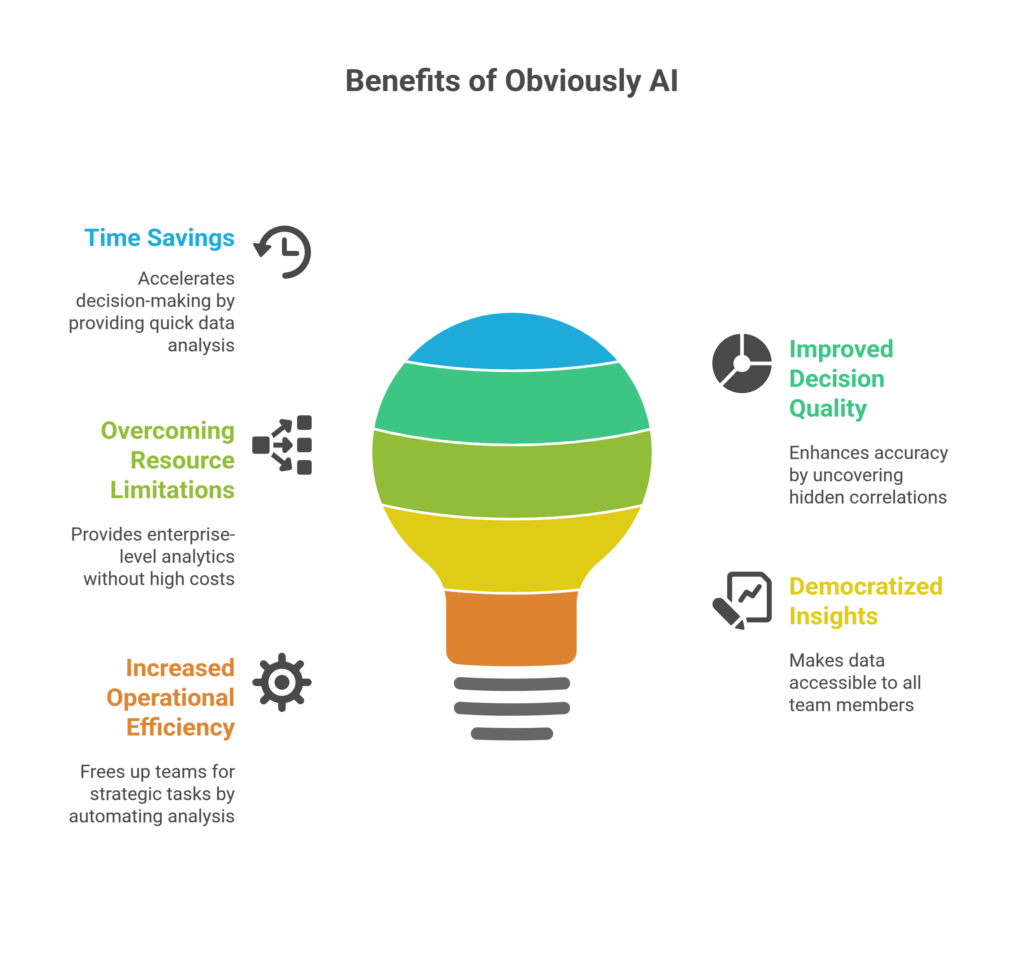
Alright, so we’ve covered what it is and what it does.
But what’s the actual payoff?
Why should you care about Obviously AI for your Data Analysis and Business Intelligence efforts?
It boils down to a few key advantages that directly impact your bottom line and efficiency.
First, you’re looking at massive time savings.
Forget waiting days or weeks for data analysts to get back to you.
With Obviously AI, you can upload data and get predictions in minutes.
This accelerates your decision-making cycle dramatically.
It means you can react faster to market changes, identify trends before your competitors, and implement strategies with agility.
Time saved on manual analysis is time invested in strategy and growth.
Next up is improved decision quality.
Humans, bless our hearts, are prone to bias and overlooking subtle patterns in large datasets.
AI isn’t.
Obviously AI can uncover hidden correlations and make predictions based on data points you might never even consider.
This leads to more accurate forecasts and more effective strategies.
You’re no longer relying on gut feelings; you’re operating with data-backed certainty.
This reduces risk and increases the likelihood of success for your initiatives.
Another huge benefit is overcoming resource limitations.
Hiring a team of data scientists is expensive and time-consuming.
Many small to medium-sized businesses just don’t have that kind of budget or bandwidth.
Obviously AI acts as your virtual data science team, providing enterprise-level predictive capabilities without the associated overhead.
This democratizes access to advanced analytics, leveling the playing field for businesses of all sizes.
It empowers smaller teams to compete with larger organizations that have dedicated data departments.
It significantly reduces operational costs while boosting analytical horsepower.
Then there’s the benefit of democratized insights.
Data should be for everyone, not just the tech gurus.
Obviously AI makes it easy for anyone in your organization to ask data-related questions and get actionable answers.
This fosters a data-driven culture throughout your business.
Everyone from marketing to operations can leverage insights to improve their respective areas.
It breaks down silos and encourages cross-functional collaboration based on shared understanding of the data.
This leads to better alignment and more cohesive strategic execution across departments.
Finally, you get increased operational efficiency.
Automating data analysis frees up your team from repetitive tasks.
They can focus on strategic thinking, implementing solutions, and driving growth, rather than wrestling with spreadsheets.
This optimizes your human capital, allowing your brightest minds to work on higher-value activities.
The ripple effect is better employee morale, reduced burnout, and a more productive workforce overall.
It’s about working smarter, not harder, and letting AI handle the heavy lifting.
These are not just theoretical advantages; they translate into tangible business improvements.
Faster insights, better decisions, lower costs, and a more data-savvy team—that’s the promise of Obviously AI.
Pricing & Plans
Let’s talk money, because that’s always a make-or-break for any tool.
Nobody wants to be blindsided by costs, especially when you’re trying to optimize your operations.
Obviously AI offers a tiered pricing structure, which is pretty standard for SaaS platforms.
They typically start with a free trial.
This is crucial. You absolutely need to get your hands dirty with a tool like this before committing.
A free trial allows you to test the waters, upload some of your own data, and see if it truly delivers on its promises for your specific use case.
It’s your chance to validate the value proposition without any financial commitment.
After the trial, they move into paid plans, which usually scale based on usage.
This often means factors like the number of predictions you make, the volume of data you upload, or the number of users accessing the platform.
Typically, a base plan would offer a certain number of predictions or data rows per month.
It might include access to core features like model building and basic NLP queries.
As you move up to more premium tiers, you’d expect to see expanded limits.
This could involve higher data limits, more complex model capabilities, or advanced integration options.
Enterprise plans, for larger organizations, often come with dedicated support.
These plans also usually include custom data connectors and enhanced security features.
They might also offer deeper API access for seamless integration into existing workflows.
When you compare Obviously AI to alternatives, think about two main things.
First, traditional data science teams: you’re looking at six-figure salaries plus benefits.
Obviously AI, even at its higher tiers, will be a fraction of that cost.
It’s an investment in a machine that works tirelessly, without complaint, and at a fraction of the human cost.
Second, other AI/ML platforms: some are incredibly powerful but require deep technical expertise to set up and maintain.
They might have lower sticker prices but higher hidden costs in terms of specialist personnel and setup time.
Obviously AI’s value proposition is its no-code approach.
This significantly reduces the total cost of ownership, making it accessible to a much broader audience.
Always check their official website for the most current and detailed pricing information.
Their plans can evolve, and promotions sometimes surface.
The key is to align your predicted usage with their plan structure.
Don’t overpay for features you don’t need, but also don’t hamstring your growth by picking a plan that’s too restrictive.
It’s about finding that sweet spot where value meets investment.
Hands-On Experience / Use Cases

Enough theory. Let’s talk about how this thing actually plays out in the real world.
I tried Obviously AI with a common business problem: predicting customer churn.
Imagine you run a subscription service. You want to know which customers are likely to cancel next month so you can proactively intervene.
Traditionally, this means digging through historical data.
You’d look at usage patterns, support tickets, payment history, and demographics.
Then you’d try to spot correlations – a daunting, manual task even for a seasoned analyst.
With Obviously AI, the process was strikingly simple.
I uploaded a CSV file containing about 5,000 rows of customer data.
This data included columns like subscription duration, last login date, average daily usage, number of support tickets, plan type, and a column indicating whether the customer had churned in the past.
Once uploaded, the interface guided me to select the “Churned” column as my target prediction.
In literally minutes, the platform built a predictive model.
It didn’t ask me about algorithms or machine learning models.
It just did its thing in the background.
The output was fascinating.
Not only did it give me a list of customers most likely to churn, but it also provided explanations.
For example, it highlighted that “decrease in average daily usage by 20% in the last 30 days” and “more than 3 support tickets opened in the last week” were strong indicators of upcoming churn for certain segments.
This is where the magic happens.
It wasn’t just a prediction; it was an actionable insight.
Knowing *why* someone is likely to churn allows you to create targeted retention campaigns.
You could offer a special discount to those with decreased usage.
Or send a personalized message to customers with multiple support tickets, checking in to ensure their issues are resolved.
The usability was surprisingly intuitive.
If you can use a spreadsheet, you can use Obviously AI.
The natural language query feature also impressed me.
I typed, “What factors reduce customer lifetime value?”
It promptly showed a breakdown of variables like product category and initial onboarding experience.
The results were not just accurate based on my sample data; they were also presented in easy-to-understand visualisations.
Charts and graphs clearly showed the impact of different factors.
This immediate clarity is a huge win for anyone in a business role who needs to communicate insights quickly to stakeholders.
Another use case could be in sales forecasting.
Imagine predicting which leads are most likely to convert in the next quarter based on their engagement with your marketing materials, company size, and industry.
Or in marketing, segmenting your audience to predict who will respond best to a specific campaign, optimizing ad spend and improving ROI.
The tool essentially takes the grunt work out of predictive modelling.
It leaves you with the strategic part: interpreting the insights and acting on them.
This means less time spent on data prep and more time on strategic initiatives.
For someone without a data science degree, this is an incredibly powerful capability.
It felt like unlocking a superpower for data analysis.
Who Should Use Obviously AI?
Let’s be clear: Obviously AI isn’t for everyone.
But for a specific set of people and organizations, it’s an absolute game-changer.
If you’re nodding along to any of these, this tool might be your next best friend.
Small to Medium-Sized Businesses (SMBs): This is probably the sweet spot.
SMBs often have plenty of data but lack the budget or expertise to hire dedicated data scientists.
Obviously AI gives them enterprise-level predictive analytics capabilities without the enterprise-level price tag or complexity.
It allows them to compete on insights with much larger players.
Marketing Professionals: Marketers are constantly trying to understand customer behavior, predict campaign success, and optimize ad spend.
With Obviously AI, they can predict which customers are most likely to respond to a new product launch.
They can forecast lead conversion rates or identify segments most prone to churn, allowing for highly targeted and effective campaigns.
Sales Directors and Teams: Imagine knowing which leads have the highest probability of closing before your sales reps even pick up the phone.
Obviously AI can predict sales outcomes, identify top-performing leads, and even flag potential deal risks.
This means sales teams can prioritize their efforts, focus on the most promising opportunities, and increase their win rates.
Product Managers: Understanding user behavior and predicting feature adoption or abandonment is critical for product success.
Product managers can use Obviously AI to forecast the success of new features.
They can identify key drivers of user engagement or predict which users are likely to become power users versus those who will drop off.
This leads to more data-driven product roadmaps.
Business Analysts: While they have some data skills, business analysts often spend too much time on manual data prep and basic reporting.
Obviously AI frees them up to focus on deeper strategic analysis and interpretation.
It empowers them to deliver predictive insights much faster, adding more value to their organizations.
Consultants and Agencies: If you’re providing services to clients, being able to offer predictive analytics without a huge internal data science team is a massive advantage.
You can quickly generate insights for clients, build predictive models for their specific challenges, and add a high-value service to your offerings.
Entrepreneurs and Startups: Every decision in a startup counts.
Predictive insights can be the difference between scaling successfully and burning cash.
Obviously AI allows startups to test hypotheses quickly, iterate on their business models, and make data-backed strategic pivots without significant investment in data infrastructure.
In essence, if you have data, need to make predictions, and don’t want to become a full-fledged data scientist, Obviously AI is built for you.
It bridges the gap between raw data and actionable intelligence for anyone in a decision-making role.
How to Make Money Using Obviously AI

Alright, let’s talk brass tacks.
How do you turn this tool into actual cash?
Because, let’s face it, insights are great, but revenue is better.
Obviously AI isn’t just about saving time; it’s about creating new opportunities and optimizing existing ones for profit.
- Offer Predictive Analytics Consulting Services:
If you’re an independent consultant or run a small agency, this is a goldmine.
Many businesses need predictive insights but can’t afford a full-time data scientist.
You can step in as their outsourced predictive analytics expert.
Charge a monthly retainer or project fee to help them with churn prediction, sales forecasting, or lead scoring.
You’re providing a high-value service with a relatively low overhead for yourself, thanks to Obviously AI.
Position yourself as the bridge between their raw data and actionable strategies.
This service is in high demand, and the tool makes it accessible for you to deliver.
- Boost Internal Efficiency and Profitability:
This is the direct route.
If you’re running your own business, use Obviously AI to make smarter decisions that directly impact your bottom line.
For example, predict which marketing campaigns will yield the highest ROI, and reallocate your budget accordingly.
Forecast inventory needs more accurately to reduce carrying costs and avoid stockouts.
Predict customer lifetime value to focus on acquiring and retaining your most profitable customers.
Every optimized dollar, every saved hour, every improved conversion rate adds up to more profit.
It’s not just about cost reduction; it’s about revenue generation through intelligent operations.
- Develop Niche Data Products or Reports:
Think outside the box.
If you have access to specific datasets (with proper permissions, of course), you can use Obviously AI to create and sell niche predictive reports.
For example, if you collect real estate data, you could predict property value appreciation for specific neighborhoods.
Or, if you’re in e-commerce, predict fashion trends based on buying patterns.
You can package these insights as premium reports or data feeds for specific industries.
This allows you to leverage the tool to generate a unique data product.
It’s about turning raw information into valuable foresight that others are willing to pay for.
Let’s look at a quick example: Sarah, a freelance marketing strategist, used to spend days manually analyzing client ad campaign data.
She integrated Obviously AI into her workflow.
Now, she uploads her client’s ad spend and conversion data.
In minutes, Obviously AI predicts which ad channels and creatives will deliver the highest conversion rates for the next quarter.
She then presents these data-backed recommendations to her clients.
Her clients are thrilled because her strategies now consistently outperform their old ones, leading to higher ROAS (Return on Ad Spend).
Sarah was able to double her monthly retainer for one client and acquired two new clients simply by showcasing her ability to deliver superior, data-driven results with Obviously AI.
This efficiency gain allowed her to take on more clients without sacrificing quality.
She’s now generating an additional $5,000 per month just by leveraging the predictive power of the tool.
The key is to use the speed and accuracy of Obviously AI to either do more for less, or to offer capabilities that were previously out of reach.
It’s about translating advanced analytics into tangible business outcomes and value that people will pay for.
Limitations and Considerations
No tool is perfect.
And anyone telling you otherwise is selling something.
Obviously AI is powerful, but it’s not a silver bullet that magically solves all your data problems.
You need to be aware of its limitations and consider them before diving headfirst.
First, there’s the issue of data quality.
Garbage in, garbage out.
Obviously AI is excellent at finding patterns and making predictions from the data you provide.
But if your input data is messy, incomplete, or biased, your predictions will reflect that.
The tool can do some automated cleaning, but it’s not a substitute for well-structured, clean data to begin with.
You still need to put in effort to ensure your data sources are reliable.
Secondly, while it excels at automated model building, it lacks deep customization for advanced users.
If you’re a seasoned data scientist who wants to tinker with specific algorithms, adjust hyper-parameters manually, or integrate highly specialized libraries, Obviously AI might feel restrictive.
It’s designed for accessibility, not for bespoke, highly complex data science experiments.
This is a trade-off for its ease of use.
Third, the reliance on historical data.
All predictive models, including those built by Obviously AI, base their predictions on past patterns.
If your business environment drastically changes, or if you enter a completely new market with no historical data, the predictions may be less accurate.
It can’t predict black swan events or entirely unprecedented shifts.
You still need human judgment to interpret predictions in the context of current events.
Fourth, the learning curve, though minimal, still exists.
While you don’t need to code, you still need to understand the fundamentals of your data.
You need to know what you’re trying to predict, what your columns represent, and how to interpret the results and explanations.
It’s not entirely plug-and-play if you have no analytical background whatsoever.
There’s an initial hump to understand the interface and best practices.
Finally, potential for over-reliance.
It’s tempting to blindly follow what the AI tells you.
But remember, AI is a tool to augment human intelligence, not replace it.
Always apply critical thinking and domain expertise to the insights generated.
Question the predictions, validate them with other sources where possible, and understand their business implications fully before acting.
The “explainable AI” feature helps here, but the ultimate decision-making power rests with you.
It’s crucial to remember that it is a powerful assistant, not a sovereign decision-maker.
Understanding these points means you can use Obviously AI more effectively, setting realistic expectations and integrating it intelligently into your workflow.
Final Thoughts
So, what’s the verdict on Obviously AI for Automated Data Analysis?
It’s a serious contender in a crowded space, and for good reason.
If your goal is to extract powerful, predictive insights from your data without drowning in code or hiring a dedicated data science team, this tool delivers.
It truly democratizes machine learning, making it accessible to business users who need answers fast.
The speed at which it generates models and provides actionable explanations is its biggest selling point.
This isn’t just about efficiency; it’s about enabling better, more confident decision-making across your entire organization.
It significantly reduces the gap between having data and actually understanding what that data is trying to tell you.
For businesses looking to gain a competitive edge through data-driven strategies, Obviously AI provides an accessible path.
It’s particularly strong for SMBs, marketing teams, sales departments, and product managers who need quick, reliable predictions.
But remember, it’s a tool.
It needs good data and a thoughtful human at the helm to interpret its insights and translate them into meaningful action.
It’s not a magic bullet, but it comes pretty close to simplifying a complex, often intimidating, process.
My recommendation?
If you’ve got data lying around that you know holds valuable secrets, and you’re tired of the manual grind, give Obviously AI a shot.
Start with their free trial.
Upload some of your own business data and see what insights it uncovers for you.
You might be surprised at what you learn and how quickly you learn it.
It could be the catalyst you need to transform your data analysis workflow from a headache into a genuine asset.
Stop guessing. Start knowing.
Visit the official Obviously AI website
Frequently Asked Questions
1. What is Obviously AI used for?
Obviously AI is used for no-code predictive analytics. It allows users to upload data and generate machine learning models to forecast outcomes like customer churn, sales, or lead conversions. It simplifies complex Automated Data Analysis for business users.
2. Is Obviously AI free?
Obviously AI typically offers a free trial to allow users to test its capabilities. After the trial period, it moves to paid subscription plans that scale based on usage and features. Specific pricing details are available on their official website.
3. How does Obviously AI compare to other AI tools?
Obviously AI stands out for its strong emphasis on no-code functionality and explainable AI. While other AI tools might offer deeper customization for data scientists, Obviously AI prioritizes accessibility and ease of use for business professionals. It focuses on making predictive analytics actionable for the everyday user.
4. Can beginners use Obviously AI?
Absolutely. Obviously AI is designed specifically for beginners and business users without a data science background. Its intuitive interface and natural language processing capabilities make it incredibly easy to upload data, ask questions, and get insights without any coding or advanced technical knowledge.
5. Does the content created by Obviously AI meet quality and optimization standards?
Obviously AI doesn’t “create content” in the traditional sense like text generators. Instead, it generates data insights and predictions. The quality and optimization of these insights are high, as they are based on robust machine learning models and are presented with clear explanations, which are crucial for data-driven decision-making.
6. Can I make money with Obviously AI?
Yes, you can make money with Obviously AI by using it to offer predictive analytics consulting services to clients, improving your own business’s profitability through data-driven decisions, or even developing and selling niche data reports. Its efficiency allows you to deliver high-value insights quickly and at a lower cost.