
Unlock AI Dashboard Generation with ThoughtSpot! Streamline Data Analysis & BI. Get instant insights. Learn more!
Why ThoughtSpot Is a Game-Changer in AI Dashboard Generation
The world of Data Analysis and Business Intelligence is on fire. AI isn’t just a buzzword anymore; it’s the engine driving better decisions, faster. Businesses are drowning in data, and pulling out actionable insights feels like finding a needle in a digital haystack.
And let’s talk about dashboards. They’re supposed to be the answer, right? Visualisations of your business health. But building them? That’s often a slow, painful process. Especially when you need them powered by AI.
What if there was a tool that could cut through the noise? Something that could not only help you understand your data but also build the reports you need, powered by AI, without a massive technical team?
Enter ThoughtSpot. This isn’t just another BI tool. It’s designed to put the power of data directly into the hands of everyone, not just the data scientists. Especially when it comes to something as critical as AI Dashboard Generation.
This article breaks down why ThoughtSpot is becoming the go-to for businesses wanting to leverage AI for their dashboards. We’ll look at what it is, how it works, and why you might be leaving serious value on the table if you’re not looking at it.
This is about making your data work for you, not the other way around.
Table of Contents
- What is ThoughtSpot?
- Key Features of ThoughtSpot for AI Dashboard Generation
- Benefits of Using ThoughtSpot for Data Analysis and Business Intelligence
- Pricing & Plans
- Hands-On Experience / Use Cases
- Who Should Use ThoughtSpot?
- How to Make Money Using ThoughtSpot
- Limitations and Considerations
- Final Thoughts
- Frequently Asked Questions
What is ThoughtSpot?
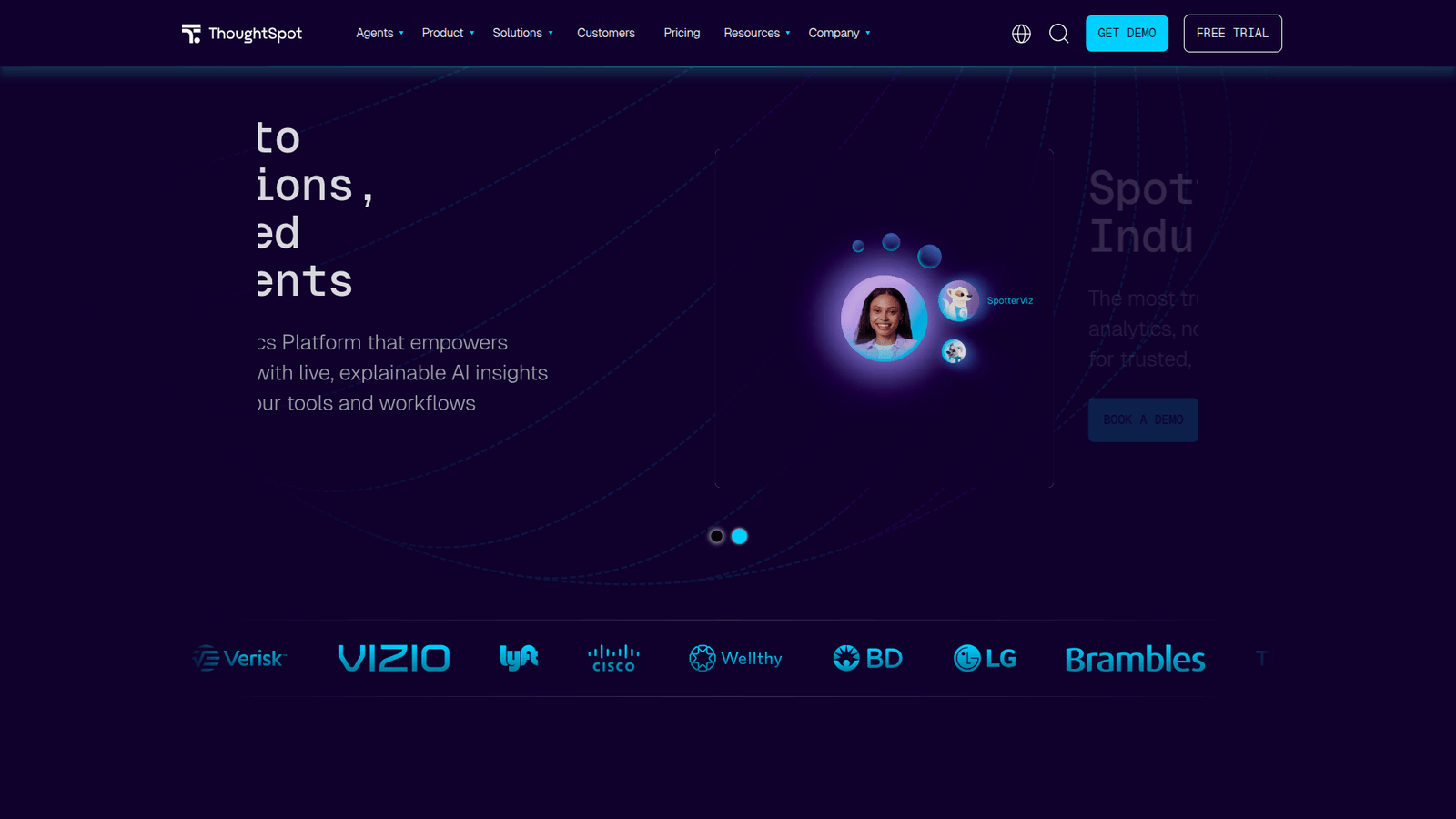
ThoughtSpot is a cloud-based analytics platform. Its main goal is to make data accessible to everyone in an organisation. Think of it as a search engine for your business data.
Instead of complex queries or waiting for IT to build reports, users can simply type in questions in natural language, like “What were our sales in the UK last quarter?” and get instant answers in the form of charts and graphs.
It’s built for business users, not just data analysts. Marketers, sales teams, operations managers – anyone who needs data to make decisions can use it.
The real game-changer? It integrates AI. This means it doesn’t just pull data; it helps you understand it, spot trends, and even predict outcomes. This is massive for something like AI Dashboard Generation, where you want intelligent insights, not just static numbers.
It cuts down the need for traditional BI development cycles. Businesses can get answers and insights much faster, leading to quicker, more informed decisions.
This democratisation of data is crucial in today’s fast-paced business environment. Everyone having access to the right insights, at the right time, is a competitive advantage.
ThoughtSpot’s approach is fundamentally different. It empowers users to explore data without needing to know SQL or complex BI software. This dramatically speeds up the process of getting to the insights you need.
Key Features of ThoughtSpot for AI Dashboard Generation
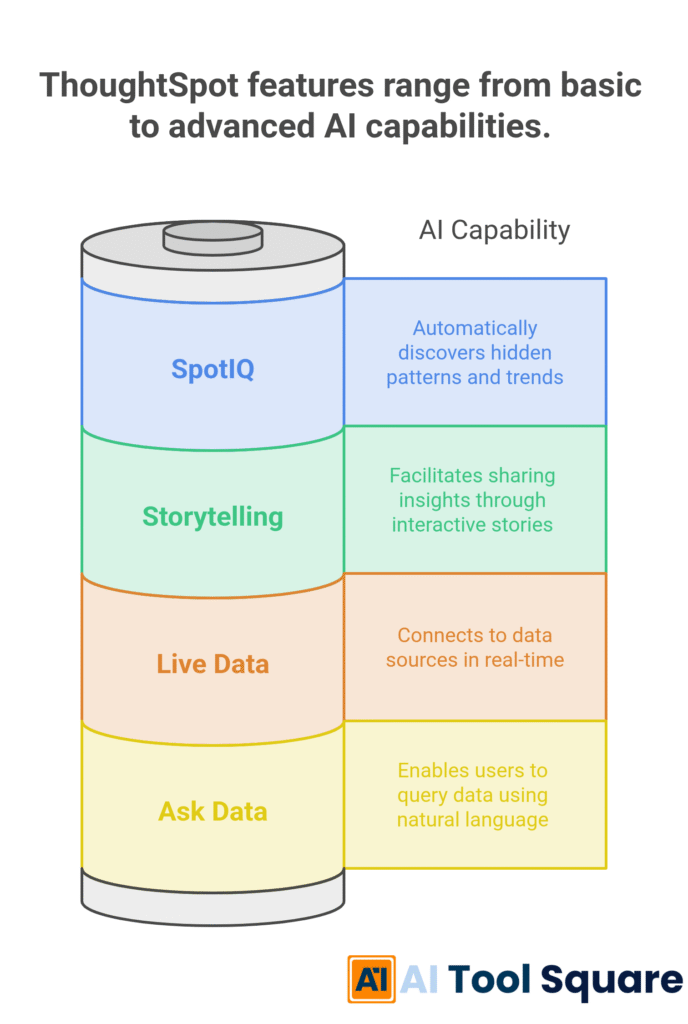
ThoughtSpot packs a punch with features designed to simplify and accelerate AI Dashboard Generation. It’s not just about seeing data; it’s about interacting with it and getting intelligent outputs.
- Feature 1: Natural Language Search (Ask Data)
This is the star of the show. Users can type questions in plain English, like “Show me revenue by product line for the last year.” ThoughtSpot’s AI interprets these queries and instantly generates relevant visualisations – charts, graphs, tables.
For AI dashboard generation, this means you don’t need to design the dashboard structure from scratch. You ask for the insights you want, and the system builds the visual representation. This dramatically speeds up the creation of AI-powered dashboards, ensuring they directly answer the business questions you have.
- Feature 2: AI-Powered Insights (SpotIQ)
Beyond just answering questions, ThoughtSpot’s AI proactively surfaces interesting trends, anomalies, and opportunities that users might not have even thought to ask about. SpotIQ analyses your data and points out what’s happening and why.
This is invaluable for AI dashboard generation because it injects intelligence into the reports. Dashboards aren’t just passive displays; they become active tools that highlight key performance indicators, potential risks, or areas of exceptional growth, automatically.
- Feature 3: Live Data Connectivity & Performance
ThoughtSpot connects directly to your existing data sources – databases, cloud applications, spreadsheets – without the need for extensive data warehousing or ETL processes. It then queries this data live.
This ensures that the dashboards you generate are always based on the most up-to-date information. For AI dashboard generation, this real-time access means insights are fresh and actionable, allowing for rapid response to changing business conditions. The platform is engineered for speed, delivering insights in seconds.
- Feature 4: Collaborative Workspaces and Storytelling
Users can create “Stories” from their insights, combining multiple answers and visualisations into a narrative. These Stories can be shared, commented on, and iterated upon within the platform.
This feature enhances AI dashboard generation by allowing teams to collectively build and refine dashboards. A complex AI dashboard can be developed collaboratively, with different team members contributing their questions and insights, leading to a more comprehensive and valuable final product.
Benefits of Using ThoughtSpot for Data Analysis and Business Intelligence
For anyone knee-deep in Data Analysis and Business Intelligence, the advantages of a tool like ThoughtSpot are profound. It’s not just about having fancy charts; it’s about fundamentally changing how you work with data.
Massive Time Savings: The most obvious win is speed. Traditional BI can take days, weeks, or even months for a new report. With ThoughtSpot’s natural language search, you can get answers in seconds. This means less time waiting for IT and more time acting on insights.
Democratised Data Access: You don’t need to be a data scientist to get powerful insights. Marketers, sales reps, HR – anyone can ask questions of their data and get answers. This empowers more people to make data-driven decisions, leading to a more agile organisation.
Deeper, Proactive Insights: ThoughtSpot doesn’t just show you what you ask for. Its AI capabilities actively hunt for trends, anomalies, and potential issues you might miss. This proactive approach can uncover hidden opportunities or flag risks before they become major problems.
Improved Decision Making: When insights are fast, accurate, and easy to understand, decisions become better. Businesses can react quickly to market changes, optimise campaigns, and identify areas for improvement with confidence.
Reduced IT Burden: By enabling business users to self-serve their data needs, ThoughtSpot significantly reduces the workload on IT and BI teams. They can focus on more strategic projects instead of constantly fulfilling report requests.
Enhanced Collaboration: The ability to create and share “Stories” fosters a more collaborative data culture. Teams can build on each other’s findings, leading to richer analysis and shared understanding.
Faster Time to Insight: This is the ultimate benefit. The gap between having data and having actionable knowledge is drastically shortened. For tasks like AI Dashboard Generation, this means getting intelligent visualisations up and running in a fraction of the time.
These benefits aren’t theoretical. They translate directly into efficiency gains, better customer understanding, improved operational performance, and ultimately, a stronger bottom line.
Pricing & Plans

ThoughtSpot operates on a commercial pricing model, meaning there isn’t a free plan available for general use. This is typical for enterprise-level Data Analysis and Business Intelligence platforms designed for robust business applications.
The pricing is usually based on factors like the number of users, the specific features required, and the deployment model (cloud or on-premises). They offer different editions tailored to meet the needs of various business sizes and complexities.
For businesses looking into AI Dashboard Generation, the specific capabilities and pricing tiers will need to be evaluated against their budget and functional requirements.
To get precise pricing details, the best course of action is to contact the ThoughtSpot sales team directly. They can provide custom quotes based on your organisation’s unique needs and scale.
This approach ensures that you’re paying for the features and capacity that are relevant to your business, rather than a one-size-fits-all subscription. It allows for scalability as your data needs and user base grow.
While there’s no free entry point, the value proposition is in the significant efficiency and insight gains, which can often outweigh the investment for businesses that rely heavily on data for decision-making.
Hands-On Experience / Use Cases
A retail analytics team needs to understand daily sales performance across different regions and product categories. Instead of waiting for a weekly report, a sales manager can type, “Show me daily revenue by category for the last 7 days, filter for stores in the North region.” ThoughtSpot instantly generates a bar chart showing revenue for each category, updated live.
The system might then proactively flag, via SpotIQ, that “Category C sales in the North region dropped 15% yesterday, driven by a specific product.” The manager can then drill down further by asking, “What was the promotion status for that product yesterday?” This allows for immediate investigation and potential course correction.
A marketing team wants to track the ROI of their latest campaign. A marketing specialist can ask, “What is the customer acquisition cost for campaign X, broken down by lead source?” The system pulls data from CRM and marketing automation tools, displaying the cost per lead and conversion rates for each source.
SpotIQ might then highlight, “Leads from Social Media are converting 20% higher than average for this campaign.” This insight helps the team reallocate budget or focus more effort on high-performing channels. They can then save this visual as part of a “Campaign Performance Dashboard” for ongoing monitoring.
An operations manager is concerned about supply chain efficiency. They might ask, “What is the average lead time for raw materials from our top 3 suppliers?” ThoughtSpot pulls data from ERP systems and displays the lead times. The AI might then identify, “Supplier B’s lead time has increased by 3 days over the past month.”
This prompt action allows the manager to contact Supplier B, understand the issue, and potentially explore alternative suppliers to prevent production delays. This forms part of an “Operational Efficiency Dashboard,” providing real-time visibility.
These scenarios highlight how ThoughtSpot transforms data exploration. For AI Dashboard Generation, these interactions become the building blocks. Instead of manually creating charts, users effectively *ask* their dashboards into existence, powered by AI insights.
The platform facilitates rapid iteration. If a dashboard doesn’t answer the question, the user refines their query or asks a follow-up, building a more accurate and insightful view with each interaction.
Who Should Use ThoughtSpot?

ThoughtSpot is designed for a broad spectrum of users within organisations that rely on data for their operations and strategy. The key is a need for fast, accessible, and intelligent data insights.
Business Analysts: These professionals can leverage ThoughtSpot to quickly validate hypotheses, explore data trends, and build reports without complex coding. They are often the bridge between business needs and technical solutions.
Sales Teams: Sales reps and managers can use it to track performance, identify high-potential leads, understand customer behaviour, and forecast sales figures more accurately. Real-time dashboards showing sales pipeline and regional performance are invaluable.
Marketing Departments: Marketers can analyse campaign effectiveness, track customer acquisition costs, understand audience segmentation, and measure ROI. This allows for agile adjustments to marketing strategies based on real-time data.
Operations and Supply Chain Managers: These individuals can monitor efficiency, track inventory levels, analyse supplier performance, and identify bottlenecks in production or delivery processes. Dashboards can provide critical operational metrics.
Finance Professionals: Financial analysts and controllers can use ThoughtSpot for budget tracking, expense analysis, revenue forecasting, and identifying financial anomalies. Quick access to financial data supports better financial planning.
Executives and Decision-Makers: Leaders can get high-level overviews of business performance, key metrics, and strategic initiatives without needing to wade through complex reports. Natural language queries ensure they get the exact information they need, quickly.
Small to Medium-Sized Businesses (SMBs): Even smaller companies can benefit immensely. They might not have large dedicated BI teams but need to make smart decisions based on their data to compete. ThoughtSpot levels the playing field.
Agencies: Marketing, advertising, or consulting agencies can use ThoughtSpot to provide data-driven insights and performance reports to their clients, enhancing their service offering and demonstrating value.
The common thread is a requirement for self-service analytics and a desire to move away from traditional, time-consuming report creation processes. For anyone involved in Data Analysis and Business Intelligence, especially concerning AI Dashboard Generation, ThoughtSpot offers a powerful, user-friendly solution.
How to Make Money Using ThoughtSpot
ThoughtSpot isn’t just a tool for internal analysis; it can be a revenue-generating asset. By leveraging its capabilities, individuals and businesses can create new services, improve existing offerings, and gain a competitive edge that translates to profit.
- Service 1: Data Insights as a Service for Clients
Consultancies, marketing agencies, and freelance data analysts can use ThoughtSpot to offer advanced Data Analysis and Business Intelligence services. Instead of just delivering reports, they can offer clients interactive dashboards built with ThoughtSpot, powered by AI insights.
Clients get the ability to ask their own questions of their data, leading to higher engagement and perceived value. This service can command premium pricing due to its interactive and AI-driven nature, especially for AI Dashboard Generation that provides proactive recommendations.
- Service 2: Enhancing Client Reporting and ROI Demonstration
For agencies managing client campaigns (e.g., digital marketing, advertising), ThoughtSpot can revolutionise reporting. Instead of static PDFs, agencies can provide clients with live, interactive dashboards that clearly demonstrate campaign performance, ROI, and key insights.
This transparency builds trust and client retention. The ability to showcase AI-driven insights – like which ad creative is performing best or which audience segment is most engaged – provides a tangible, high-value service that justifies higher retainers or project fees.
- Service 3: Internal Efficiency Gains Leading to Profitability
For internal teams, the efficiency gains from ThoughtSpot directly impact profitability. By automating data analysis and AI Dashboard Generation, businesses can:
Reduce operational costs: Less time spent by analysts on manual report building means those resources can be reallocated to more strategic work or simply reduce headcount costs over time.
Improve decision-making speed: Faster insights lead to quicker, more effective business decisions. This can mean capitalising on market opportunities faster, mitigating risks before they escalate, or optimising processes to reduce waste, all of which contribute to the bottom line.
Example Case Study: Imagine a small e-commerce consultancy. They start using ThoughtSpot to analyse their clients’ website traffic and sales data. By offering interactive AI dashboards, they charge a £500 premium per client per month for this service. If they have 10 clients, that’s an extra £5,000 monthly revenue, directly attributable to the efficiency and insight capabilities of ThoughtSpot for Data Analysis and Business Intelligence.
Another agency might use ThoughtSpot internally to track their own sales pipeline and client project progress. The time saved on report generation frees up account managers to spend more time selling and managing client relationships, directly boosting new business acquisition and client satisfaction.
Limitations and Considerations
While ThoughtSpot is a powerful tool, it’s not a magic bullet. Understanding its limitations is key to successful implementation and expectation management.
Data Governance and Quality: ThoughtSpot relies heavily on the quality of the underlying data. If your data is messy, incomplete, or inconsistent, the insights and dashboards generated will be equally flawed. Robust data governance practices are essential before implementing ThoughtSpot.
Learning Curve for Advanced Features: While basic querying is intuitive, mastering all the advanced features, including building complex Stories or optimising data models for performance, might require dedicated training and practice. It’s user-friendly but not entirely without a learning curve for power users.
Cost: As a commercial enterprise solution, ThoughtSpot represents a significant investment. Businesses need to conduct a thorough ROI analysis to ensure the benefits justify the cost, especially compared to less feature-rich or open-source alternatives.
Dependency on Data Sources: While ThoughtSpot connects to many sources, the quality and accessibility of those sources are paramount. If data sources are difficult to access or poorly structured, it will hinder the tool’s effectiveness.
AI Capabilities are Not Always Prescriptive: SpotIQ can identify trends and anomalies, but it doesn’t always provide prescriptive solutions. Users still need to apply their business acumen to interpret the AI’s findings and decide on the best course of action. It’s an intelligence *assistant*, not a decision-maker.
Integration Complexity: While it connects to many sources, the initial setup and integration with existing IT infrastructure can require specialised knowledge and effort, particularly in large or complex enterprise environments.
Considering these points allows for a more realistic integration of ThoughtSpot into your Data Analysis and Business Intelligence strategy, ensuring you maximise its strengths while mitigating potential challenges, especially in areas like AI Dashboard Generation.
Final Thoughts
In the relentless pursuit of data-driven decision-making, ThoughtSpot stands out as a formidable ally, particularly in the realm of AI Dashboard Generation. It’s fundamentally reshaping how businesses interact with their data, moving from cumbersome reporting to intuitive, AI-powered exploration.
The ability to ask questions in natural language, coupled with AI that proactively surfaces insights, removes significant barriers to entry for data analysis. This empowers a wider range of users to extract value, driving more informed and agile business strategies.
For those in Data Analysis and Business Intelligence, ThoughtSpot offers a compelling solution to speed, accessibility, and depth of insight. It’s a tool that enables organisations to truly harness the power of their data, transforming it into actionable intelligence that fuels growth and efficiency.
If you’re looking to empower your teams, accelerate your insights, and build intelligent dashboards that actually drive business outcomes, exploring ThoughtSpot is a non-negotiable next step. The future of data is conversational, and ThoughtSpot is leading the charge.
Visit the official ThoughtSpot website
Frequently Asked Questions
1. What is ThoughtSpot used for?
ThoughtSpot is primarily used for business analytics and data intelligence. It allows users to ask questions of their data in natural language and receive instant answers in the form of visualisations. It’s designed to make data accessible to everyone, enabling self-service analytics and faster decision-making.
2. Is ThoughtSpot free?
No, ThoughtSpot is a commercial enterprise solution and does not offer a free plan for general use. Pricing is typically based on user count, feature set, and deployment model. Businesses should contact ThoughtSpot directly for a custom quote.
3. How does ThoughtSpot compare to other AI tools?
ThoughtSpot differentiates itself by focusing on a natural language search interface combined with AI-powered proactive insights (SpotIQ). Unlike some AI tools that might focus purely on generative content or complex model building, ThoughtSpot’s core strength is democratising data access and accelerating BI, particularly for AI Dashboard Generation.
4. Can beginners use ThoughtSpot?
Yes, ThoughtSpot is designed with beginners in mind. Its natural language search function means users don’t need to know complex coding languages like SQL. However, mastering the full suite of features, especially for advanced analytics and dashboard creation, may require some learning and practice.
5. Does the content created by ThoughtSpot meet quality and optimization standards?
ThoughtSpot focuses on generating data visualisations and insights, not written content in the way a language model does. The “quality” of its output relates to the accuracy and relevance of the data insights and the clarity of the visualisations. These visualisations can be integrated into reports or presentations that are then optimised for specific purposes.
6. Can I make money with ThoughtSpot?
Yes, you can make money with ThoughtSpot. Businesses can offer data analytics services, client reporting, or gain internal efficiencies that lead to cost savings and increased revenue. Think of it as a tool to provide higher-value services and make better, faster business decisions.
7. How to make money with ThoughtSpot?
To make money with ThoughtSpot, you can offer specialised Data Analysis and Business Intelligence services to clients, build and sell interactive AI-powered dashboards, or improve your company’s internal efficiency and decision-making, leading to profitability. The key is to leverage its unique capabilities for insight generation and reporting.