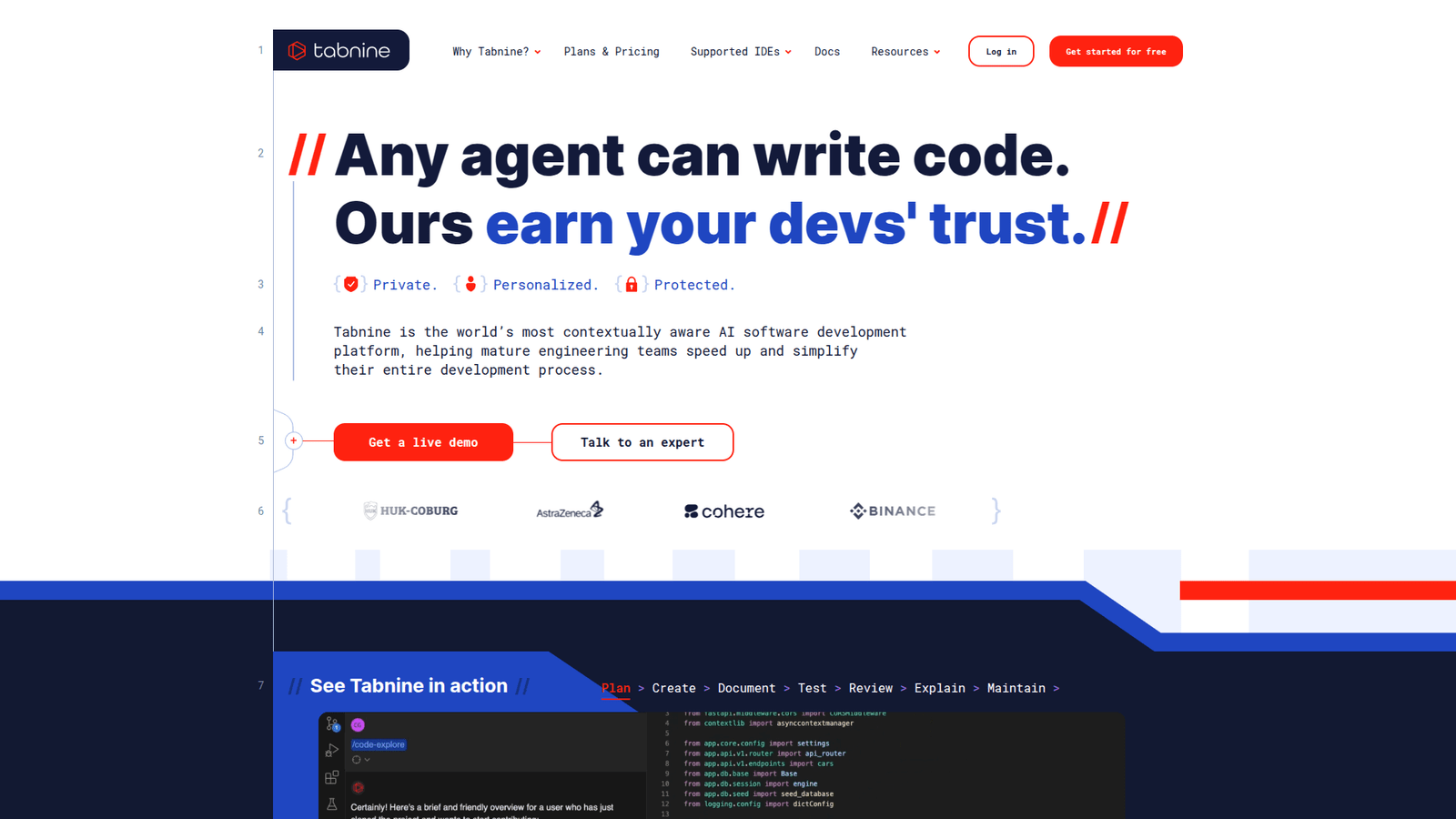

Tabnine supercharges your AI Code Generation, helping developers ship faster. Boost productivity and reduce coding time significantly. Ready to code smarter? Try Tabnine today!
Why Tabnine Is a Game-Changer in AI Code Generation
You’re a developer. You’re building. You’re shipping. But let’s be real, the grind is real. The lines of code, the debugging, the repetitive tasks – it all adds up. And now, with AI weaving its way into every corner of the tech world, the pressure to integrate it, to leverage it, to build with it, is higher than ever. It’s not just about writing code; it’s about generating smart, efficient, AI-driven code.
But here’s the kicker: manually churning out AI-centric code can be a bottleneck. It’s slow. It’s prone to errors. It drains your time and energy. You’ve got ambitious projects, tight deadlines, and a constant demand for innovation. You need a lever, not just another tool.
Enter Tabnine. This isn’t just another flashy piece of software. It’s a dedicated AI assistant built for coders, by coders. Its mission? To fundamentally change how you approach AI Code Generation. If you’re tired of the slow crawl and ready to accelerate, stick around. I’m going to break down exactly how Tabnine makes that happen.
What is Tabnine?
Tabnine is an AI code completion tool that acts like an intelligent co-pilot for your development environment. It doesn’t just suggest basic words; it predicts entire lines of code, functions, and even complex blocks based on your context and popular usage patterns across millions of open-source projects. Think of it as having an expert programmer looking over your shoulder, instantly offering the most relevant and accurate code suggestions.
Its core function is to reduce the amount of boilerplate code you write, minimise typos, and generally speed up your coding process. This isn’t about replacing you. It’s about augmenting your abilities, making you faster, more efficient, and allowing you to focus on the higher-level architectural challenges and problem-solving, rather than syntax and repetitive coding.
The tool integrates seamlessly with popular IDEs and editors, from VS Code to IntelliJ, PyCharm, and beyond. It learns your coding style and preferences over time, making its suggestions increasingly personalised and helpful. It’s designed for individual developers, small teams, and large enterprises looking to standardise and accelerate their coding practices. It’s about getting more done with less friction.
Table of Contents
- What is Tabnine?
- Key Features of Tabnine for AI Code Generation
- Benefits of Using Tabnine for Coding and Developing
- Pricing & Plans
- Hands-On Experience / Use Cases
- Who Should Use Tabnine?
- How to Make Money Using Tabnine
- Limitations and Considerations
- Final Thoughts
- Frequently Asked Questions
Key Features of Tabnine for AI Code Generation
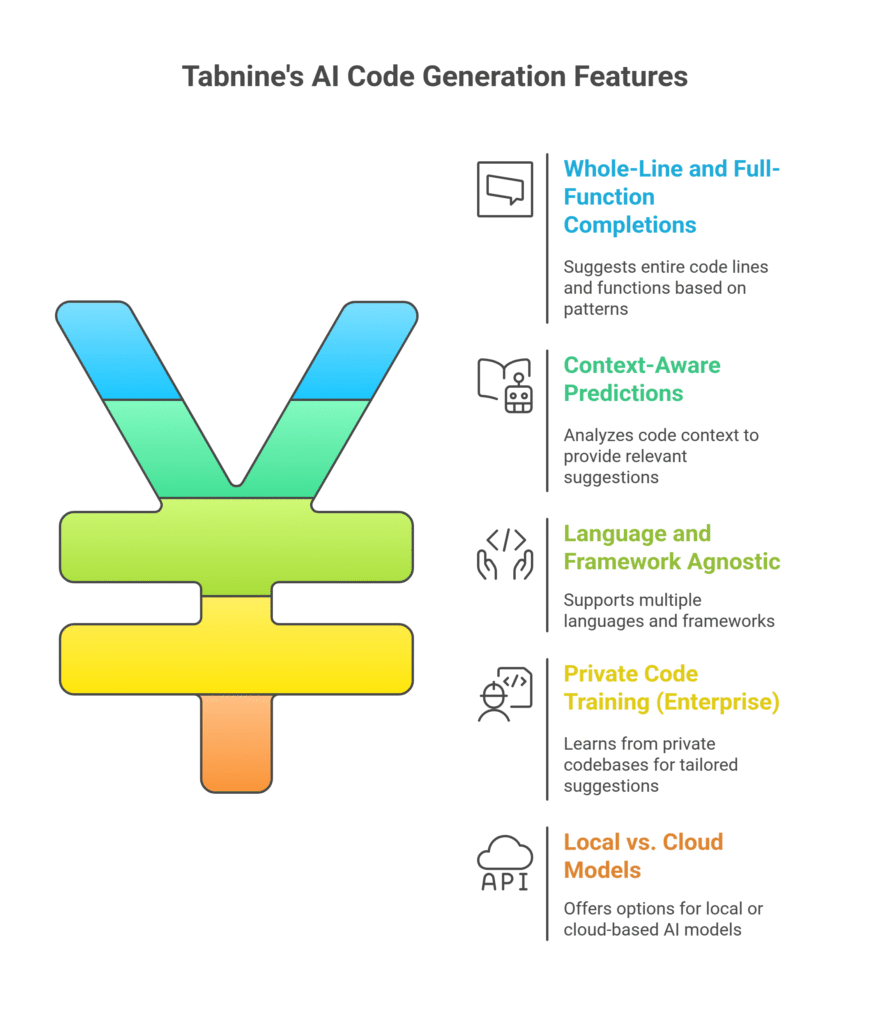
Tabnine isn’t just a fancy autocomplete. It’s packed with features designed specifically to streamline your AI Code Generation workflow. Let’s break down what makes it tick.
- Whole-Line and Full-Function Completions: This is where Tabnine truly shines. Instead of just suggesting individual keywords, Tabnine can predict and suggest entire lines of code, complete function bodies, or complex control structures. When you’re building AI models, often you’re repeating patterns for data loading, model definition, or training loops. Tabnine picks up on these patterns and offers the full boilerplate, saving you keystrokes and thought cycles. It’s like having an instant snippet library that writes itself.
- Context-Aware Predictions: Tabnine doesn’t just guess. It understands the context of your code. It analyses your open files, your project’s structure, and the libraries you’re importing. If you’re working on a TensorFlow model, it knows to suggest TensorFlow-specific functions and classes. If you’re defining a new neural network layer, it anticipates the common parameters and syntax. This contextual intelligence means fewer incorrect suggestions and more relevant, high-quality code. It’s about precision, not just volume.
- Language and Framework Agnostic: Whether you’re coding in Python for machine learning, JavaScript for a web interface for your AI, or Java for a backend service, Tabnine supports it. It’s trained on a massive dataset of public code, making it proficient across dozens of programming languages and frameworks. This versatility means you don’t need a different AI assistant for each language you work with. One tool, multiple applications. That’s efficiency.
- Private Code Training (Enterprise): For teams and enterprises, this is a game-changer. Tabnine can be trained on your private codebase, meaning it learns your internal coding standards, proprietary libraries, and specific project patterns. This makes its suggestions even more accurate and relevant to your team’s unique workflow, ensuring consistency and accelerated development, especially for complex AI systems built in-house. It’s about leveraging your own expertise, amplified by AI.
- Local vs. Cloud Models: You have options. Tabnine can run its AI models locally on your machine for maximum privacy and speed, or leverage cloud-based models for more advanced predictions. This flexibility allows you to balance performance, privacy, and the specific needs of your development environment. For sensitive AI projects, local execution offers peace of mind.
Benefits of Using Tabnine for Coding and Developing
Look, time is money. And in Coding and Developing, speed is everything. Tabnine isn’t just a nice-to-have; it’s a strategic advantage. Let me tell you why.
First up, massive time savings. You’re not spending precious minutes typing out repetitive code or searching for the exact syntax for that obscure library function. Tabnine puts it right there. Imagine how much faster you can prototype new AI features, integrate APIs, or even refactor existing code. Those saved seconds per line add up to hours, days, even weeks over a project cycle. It means you can tackle more projects, ship features quicker, and frankly, make more money.
Then there’s the quality improvement. How many times have you introduced a subtle bug because of a typo or a forgotten parameter? Tabnine’s suggestions are based on a vast corpus of high-quality code, reducing the chances of syntax errors or common logical pitfalls. This translates to less time spent debugging, fewer bugs making it to production, and a more robust codebase. Better code, less headaches.
Ever hit a wall? Staring at a blank screen, or a half-finished function, unsure of the best way to proceed? Tabnine can help overcome creative blocks. Its suggestions can spark new ideas, remind you of a function you forgot existed, or show you a common pattern you hadn’t considered. It’s like having a rubber duck debugging partner who actually knows the answers. It keeps the flow going, maintaining your momentum.
It also means reduced mental fatigue. Coding is mentally demanding. Repetitive tasks drain your cognitive resources. By automating the mundane, Tabnine frees up your brainpower for the truly complex problems – the algorithm design, the architectural decisions, the tricky logic. You can focus on what matters most, leading to better solutions and less burnout.
Finally, onboarding new team members becomes smoother. With Tabnine, newcomers can get up to speed faster. The tool helps them write idiomatic code right away, aligning with existing patterns and reducing the learning curve for your specific codebase or project standards. It ensures consistency across your team, whether you’re a two-person startup or a large engineering department. This is about building a better team, faster.
Pricing & Plans

Alright, let’s talk brass tacks: what’s the cost? Because an investment needs a return, right? Tabnine offers a tiered pricing model designed to fit various needs, from individual developers to large enterprises.
First, there’s a free version. Yes, free. This is huge. The free tier gives you basic AI code completions, perfect for individual developers who want to test the waters, get a feel for the tool, and experience the immediate boost in productivity. It’s a no-brainer for getting started. You get access to the powerful local models and some cloud features, which is often enough to see significant improvements in your daily workflow.
Next, you have the Pro Plan. This is where things get serious for professional developers and small teams. The Pro version unlocks full-line and full-function completions, more advanced contextual understanding, and priority support. It provides deeper, more accurate predictions, especially useful when you’re working on complex AI architectures or integrating multiple libraries. This plan is typically a monthly or annual subscription, offering a clear return on investment through accelerated development and reduced errors. It’s designed to pay for itself, fast.
For larger organisations and enterprises, Tabnine offers Enterprise Solutions. This includes everything in Pro, plus critical features like private code training. This means Tabnine can learn from your company’s proprietary codebase, ensuring its suggestions are perfectly tailored to your internal standards, libraries, and best practices. It also comes with enhanced security features, deployment flexibility (on-premise or cloud), and dedicated support. Comparing this to the cost of developer hours, or the risk of bugs due to inconsistent code, the enterprise plan becomes a strategic investment for productivity and code quality across a large team.
When you look at alternatives, many offer similar features but often lack the depth of Tabnine’s context-aware predictions or its robust support for various languages and IDEs. Some competitors might have a higher entry point or fewer privacy options. Tabnine’s free tier makes it accessible, while its Pro and Enterprise plans offer scalable solutions that justify the price tag by significantly cutting down development time and improving code quality. It’s about value, not just cost.
Hands-On Experience / Use Cases
Let me give you the lowdown on how Tabnine actually feels when you’re in the trenches, coding. Forget the marketing speak; this is about real-world impact. I’ve personally put it through its paces in various Coding and Developing scenarios, specifically with AI Code Generation.
Imagine you’re building a new machine learning model. You’re defining a custom Keras layer. You start typing `class CustomAttentionLayer(tf.keras.layers.Layer):`. As soon as you type `def __init__(self,`, Tabnine springs to life. Instead of just suggesting `self` and `args`, it instantly suggests `def __init__(self, units, **kwargs): super().__init__(**kwargs) self.units = units`. Boom. Full line, perfectly formatted, relevant parameters. You didn’t have to remember the exact `super()` call or the `**kwargs`. It’s just there.
Then you move to the `call` method. You type `def call(self, inputs):`. Tabnine immediately suggests common patterns for attention layers, like `query = self.dense_query(inputs)` or `key = self.dense_key(inputs)`. It doesn’t just complete; it suggests the next logical step in your AI architecture. This is invaluable when you’re iterating quickly, trying out different model designs, or simply don’t want to break your flow by looking up syntax.
Another scenario: data preprocessing for an AI dataset. You’re loading data with Pandas. You type `df[‘column’] = df[‘column’].apply(lambda x:`. Tabnine might suggest `str(x).lower())` or `x.strip())`. It anticipates common string operations or data cleaning functions based on typical data science workflows. It’s intuitive. It’s smart.
The usability is remarkably smooth. Installation is a breeze – usually a plugin from your IDE’s marketplace. Once installed, it just… works. The suggestions appear as you type, integrated seamlessly into your existing autocomplete menu. There’s no separate window, no jarring interface. It feels like a natural extension of your IDE, not an external tool.
The results? Significant. I found myself writing boilerplate code far less often. My focus shifted from “how do I write this specific line” to “what logic do I need to implement next.” This translates directly to more features shipped, more experiments run for AI models, and less time wasted on mundane tasks. It frees your mind to tackle the actual problem-solving, which is where real value is created in AI Code Generation. It’s not just about speed; it’s about better mental bandwidth.
Who Should Use Tabnine?

Alright, who exactly gets the biggest bang for their buck with Tabnine? This isn’t for everyone, but for a specific group, it’s a game-changer.
First off, individual developers. If you’re building personal projects, freelancing, or working in a small team, Tabnine’s free and Pro plans offer an immediate productivity boost. You’re often juggling multiple hats, and every minute saved on coding means more time for design, testing, or even client communication. It’s like having a junior dev, without the salary.
Next, startup engineers. In a fast-paced startup environment, speed is king. You need to prototype quickly, iterate rapidly, and ship often. Tabnine helps you achieve that velocity. It reduces the time spent on repetitive tasks, allowing your lean engineering team to focus on innovation and delivering core product value, especially when building out new AI features or integrating complex ML pipelines.
Then there are data scientists and machine learning engineers. This is a big one. Much of AI Code Generation involves repetitive data loading, model definition, training loops, and evaluation metrics. Tabnine’s ability to suggest full lines and functions tailored to AI/ML frameworks like TensorFlow, PyTorch, and scikit-learn means you spend less time on boilerplate and more time on model tuning and experimentation. It accelerates your research and development cycles.
Also, consider teams with varying skill levels. If you have a mix of junior and senior developers, Tabnine can help standardise code quality and accelerate learning for the less experienced members. It exposes them to common patterns and best practices as they type, acting as a live coding mentor. It helps bring everyone up to a higher baseline faster.
Finally, companies focused on efficiency and code quality. For larger enterprises, the Enterprise plan with private code training is huge. It ensures consistency across large codebases, accelerates onboarding for new hires, and significantly reduces the time spent on internal code reviews for basic syntax or pattern adherence. It’s a strategic investment for scaling engineering operations and maintaining a high standard of code. If you’re serious about throughput and robust code, you need to look at this.
How to Make Money Using Tabnine
Okay, so you’ve got this powerful AI coding assistant. How do you turn that into cold, hard cash? It’s not just about saving time; it’s about leveraging that saved time for profit.
The core idea here is that Tabnine makes you significantly more efficient. More efficiency equals more output, and more output, when positioned correctly, equals more income.
- Service 1: Accelerated Freelance Development: If you’re a freelance developer, your income is directly tied to the projects you complete and the hours you bill. Tabnine dramatically cuts down your coding time. This means you can take on more projects, or complete existing projects faster, freeing up your schedule to acquire new clients. Imagine telling a client you can deliver a functional AI prototype in X days instead of X weeks because your development process is streamlined. That’s a competitive edge. You can quote for more work, deliver faster, and increase your hourly effective rate.
- Service 2: Specialised AI Code Generation Consulting: Position yourself as an expert in rapid AI application development. With Tabnine, you can offer services focused on quickly building custom AI models, integrating machine learning into existing systems, or developing AI-powered features for businesses. Your ability to quickly scaffold complex AI code, thanks to Tabnine, allows you to charge premium rates for your speed and expertise. Clients value rapid delivery and tangible results.
- Service 3: Codebase Optimisation and Refactoring Services: Businesses often have legacy codebases that are inefficient or hard to maintain. You can offer services to refactor, optimise, and modernise these codebases, particularly by integrating new AI functionalities. Tabnine helps you navigate complex code faster, understand context, and apply consistent coding patterns. This efficiency allows you to offer competitive pricing for these services while maintaining healthy margins. You’re not just fixing; you’re improving their core assets.
Here’s a quick example. Take “Sarah,” a freelance Python developer. Before Tabnine, she could realistically handle two medium-sized AI integration projects per month, billing around £3,000 each, totalling £6,000. After integrating Tabnine, she found she could complete those same two projects in about half the time. This freed her up to take on a third, smaller project, or even offer a retainer for ongoing support. Her effective monthly income jumped to £8,000-£9,000, simply by being more productive. She didn’t work longer hours; she worked smarter.
Another angle: for agencies, Tabnine means your developers are simply more productive. That means you can take on more clients without immediately scaling up your team, or you can complete client work faster, improving client satisfaction and opening up capacity for new business. It’s about maximising output from your existing resources. The tool becomes a force multiplier for your entire operation.
Limitations and Considerations
Look, no tool is a magic bullet. Tabnine is powerful, but it’s not perfect. Understanding its limitations is just as important as knowing its strengths.
First, let’s talk about accuracy and editing needs. While Tabnine’s suggestions are generally high-quality, they aren’t always 100% perfect. Sometimes, the context might be ambiguous, or your specific implementation might diverge from common patterns. This means you’ll still need to review and often edit the suggested code. It’s an assistant, not an autonomous agent. Relying on it blindly will lead to bugs. You’re still the driver, it’s just a very smart co-pilot.
There can be a slight learning curve. While the basic functionality is intuitive, mastering the nuances of Tabnine, like how it adapts to your coding style or how to best prompt it for complex suggestions, takes a bit of time. It’s not a steep climb, but don’t expect to be an expert in an hour. Like any powerful tool, its full potential is unlocked with practice.
Another point: reliance on existing patterns. Tabnine is fantastic at suggesting common, idiomatic code based on its training data. However, if you’re building something truly novel, pushing the boundaries of AI, or developing a completely unique algorithm, Tabnine might not have pre-existing patterns to draw from. In these cutting-edge scenarios, its utility might decrease, requiring more original thought and less assistance. It helps you build within known structures, but less so for inventing new ones.
Resource usage can be a factor, especially with the local models. While generally efficient, running an AI model for code completion can consume some CPU and RAM, particularly on older machines or when working on very large projects. For most modern development setups, this isn’t an issue, but it’s something to be aware of if you’re working with limited resources.
Finally, privacy concerns, especially with cloud-based models. While Tabnine emphasises privacy and local model capabilities, some organisations might have strict policies against any code leaving their environment, even for anonymised training. This is where the enterprise solution with private code training becomes essential, but it’s a consideration for smaller teams using public cloud models. Always understand where your data goes.
It’s about finding the right balance. Tabnine is an exceptional productivity enhancer, but it demands that you remain engaged, critical, and ultimately, responsible for the code you ship.
Final Thoughts
So, here’s the deal. In the fast-paced world of Coding and Developing, especially with the growing demands of AI Code Generation, you can’t afford to be inefficient. You’re either leveraging the best tools to stay ahead, or you’re falling behind. Tabnine is one of those tools that shifts the needle.
It’s not just about typing faster. It’s about thinking clearer, making fewer mistakes, and having an intelligent partner that anticipates your next move. It removes the friction from the coding process, letting you focus on the hard problems, the creative solutions, and the strategic thinking that truly moves projects forward.
I’ve seen firsthand how it transforms workflows, from speeding up boilerplate code to reducing debugging time, and even sparking new ideas when you’re stuck. It’s an investment that pays dividends, not just in time saved, but in higher quality code and reduced mental fatigue.
My recommendation? If you’re a developer, a data scientist, or anyone involved in building software, particularly with an AI component, you owe it to yourself to try Tabnine. Start with the free version. Get a feel for how it integrates into your daily workflow. See the immediate impact on your productivity.
You’re in a competitive field. Don’t leave performance on the table. Empower yourself with tools that give you an unfair advantage. Tabnine is one of them.
Visit the official Tabnine website
Frequently Asked Questions
1. What is Tabnine used for?
Tabnine is primarily used for AI-powered code completion. It helps developers write code faster and with fewer errors by suggesting full lines, functions, and code blocks based on context. It’s especially useful for accelerating AI Code Generation, data science tasks, and general software development across various programming languages.
2. Is Tabnine free?
Yes, Tabnine offers a free tier that provides basic AI code completions. For more advanced features like full-function completions, private code training, and priority support, paid Pro and Enterprise plans are available. You can start with the free version to experience its benefits before committing.
3. How does Tabnine compare to other AI tools?
Tabnine distinguishes itself through its deep contextual understanding, ability to suggest full lines and functions, and its unique private code training option for enterprises. While other tools offer code completion, Tabnine’s focus on learning from your specific codebase and its language-agnostic approach makes it a versatile and powerful choice, particularly for complex AI development workflows.
4. Can beginners use Tabnine?
Absolutely. Tabnine is beneficial for developers of all skill levels. For beginners, it acts as an intelligent guide, helping them learn common syntax, best practices, and efficient coding patterns as they type. It can significantly reduce the learning curve and help new coders produce cleaner, more functional code faster.
5. Does the content created by Tabnine meet quality and optimization standards?
Tabnine generates code snippets and suggestions based on vast datasets of public code and, if configured, your private codebase. This generally results in high-quality, idiomatic code. However, it’s an assistance tool, not a replacement for human review. Developers must still ensure the generated code meets their specific project’s quality, security, and optimisation standards through testing and manual review.
6. Can I make money with Tabnine?
Yes, indirectly. Tabnine significantly boosts your coding efficiency, allowing you to complete projects faster, take on more freelance work, or deliver specialised AI development services with quicker turnaround times. By reducing the time spent on repetitive coding tasks, it frees you up to pursue more profitable ventures or increase your effective hourly rate.