
Make.com simplifies Trigger-based Automation with powerful AI. Automate tasks, integrate apps, and save time. Boost your workflow now!
How Make.com Transforms Your Trigger-based Automation Workflow
Ever feel like you’re just moving digital pieces around?
Connecting App A to App B?
Waiting for something to happen, then kicking off the next thing manually?
It’s like you’re the middleman in your own business processes.
Worse, it feels like you’re leaving money on the table because you can’t scale.
You know Automation and Integration is the answer.
Especially Trigger-based Automation.
Something happens, it triggers a cascade of other actions.
But setting that up usually means code, complex APIs, or expensive developers.
What if there was a tool that made this stupid simple?
A visual builder, drag and drop, connecting pretty much anything?
Enter Make.com.
This isn’t just another piece of software.
It’s a total shift in how you think about connecting your tools and automating workflows.
Let’s get into how Make.com helps you ditch the manual grind and scale up fast.
Table of Contents
- What is Make.com?
- Key Features of Make.com for Trigger-based Automation
- Benefits of Using Make.com for Automation and Integration
- Pricing & Plans
- Hands-On Experience / Use Cases
- Who Should Use Make.com?
- How to Make Money Using Make.com
- Limitations and Considerations
- Final Thoughts
- Frequently Asked Questions
What is Make.com?
Okay, first off, what is Make.com?
Think of it as the central nervous system for your business apps.
It’s a visual platform.
You build workflows, called “scenarios,” by connecting different apps.
It’s like building with digital Lego bricks.
Each brick is an app or an action.
You link them together to create automated sequences.
Need to save email attachments to Google Drive?
Want to post new blog articles to social media automatically?
Collect form submissions and add them to a CRM?
That’s what Make.com does.
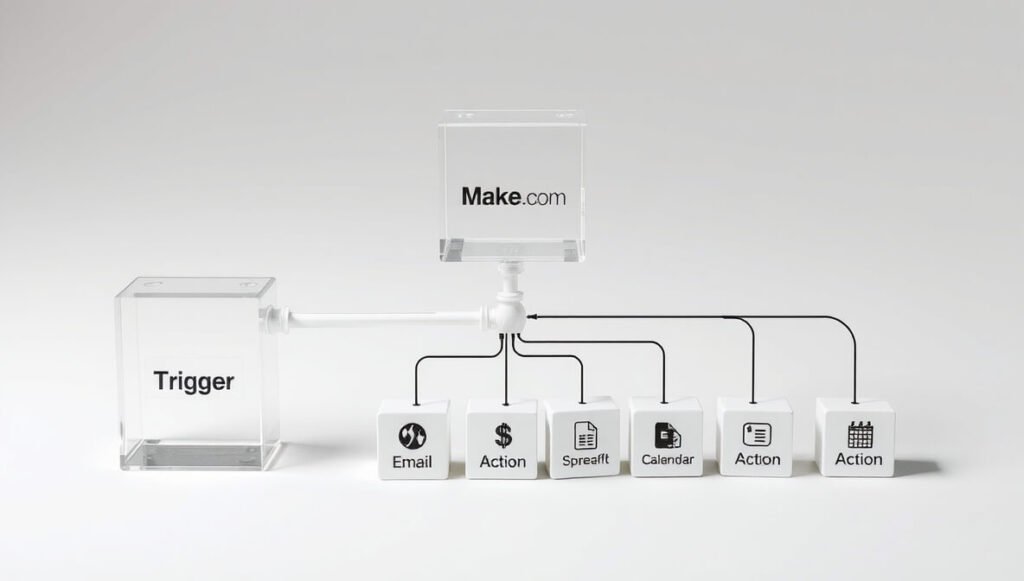
It watches for a “trigger.”
That trigger could be a new email, a form submission, a row added to a spreadsheet, anything.
When the trigger happens, Make.com runs the rest of the sequence you set up.
This is the core of Trigger-based Automation.
It’s designed for pretty much anyone who uses multiple apps and wants them to talk to each other.
Marketers who need to automate lead nurturing.
Sales teams wanting to log calls or update deals automatically.
Support teams automating ticket responses.
Even creators and writers can use it to automate publishing or content distribution.
It removes the need for manual data entry between systems.
It gets rid of tedious copy-pasting.
It saves you hours every week.
The visual interface makes it accessible even if you have zero coding skills.
You see your workflow laid out visually.
You can drag, drop, and connect.
You can also see exactly where data is flowing.
It’s a powerful tool for anyone looking to streamline operations.
And when you talk about Automation and Integration, Make.com is a serious contender.
It connects to thousands of apps.
Seriously, thousands.
From popular ones like Google Sheets, Gmail, Slack, CRM systems, social media, to niche industry tools.
This massive library of integrations is what makes Make.com so versatile.
It doesn’t matter what tools you’re currently using.
Chances are, Make.com can connect to them.
This opens up a ton of possibilities for automation.
You can build complex workflows that span multiple platforms.
All initiated by a single trigger event.
That’s the power we’re talking about.
Key Features of Make.com for Trigger-based Automation
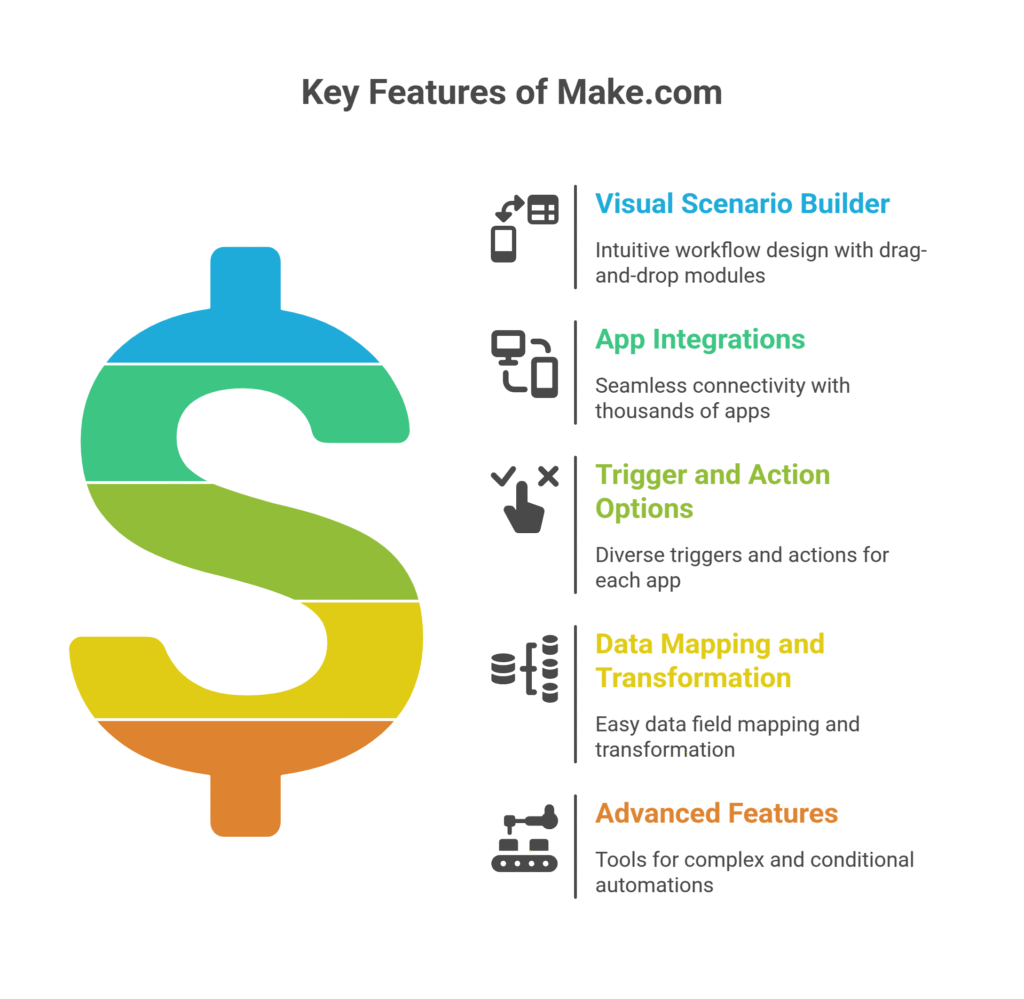
- Visual Scenario Builder:
This is probably the coolest part.
Forget confusing code or complex APIs.
Make.com gives you a canvas.
You add modules representing your apps and actions.
Then you link them together with lines.
It’s literally drawing your workflow.
When a trigger event happens in the first module (like a new email), the data flows visually through the scenario.
You can see each step.
You can see how data is transformed or filtered.
This makes building and debugging automation scenarios incredibly intuitive.
You don’t need a degree in computer science to build powerful Trigger-based Automation.
- Thousands of App Integrations:
I mentioned this, but it’s worth repeating.
Make.com boasts integrations with thousands of popular apps and services.
Think marketing tools, CRM, project management, cloud storage, communication apps, payment gateways, e-commerce platforms, you name it.
This is crucial for Trigger-based Automation.
Your trigger could be in App A.
Your first action might be in App B.
The next action in App C.
The final output in App D.
Make.com connects them all seamlessly.
This wide compatibility means you can automate workflows that touch every part of your business.
It doesn’t force you to change the apps you already use and love.
It just makes them work together.
- Robust Trigger and Action Options:
Every connected app in Make.com has specific modules.
These modules have various “Triggers” and “Actions.”
A trigger is the event that starts the scenario.
Examples: “New Email Received” (Gmail), “New Row Added” (Google Sheets), “New Contact Created” (CRM), “New Order” (Shopify).
An action is something Make.com does in another app after the trigger fires.
Examples: “Send Email” (Gmail), “Create Row” (Google Sheets), “Add Contact” (CRM), “Create Invoice” ( invoicing app).
The variety of available triggers and actions for each app is what gives you so much control over your automation.
You can fine-tune exactly what starts your automation and exactly what steps happen next.
This is the engine of powerful Trigger-based Automation.
- Data Mapping and Transformation:
Data comes into Make.com from the trigger app.
Maybe it’s a customer’s name, email, and order details.
You need to send that data to another app.
But maybe the second app calls “Customer Name” something different, like “Contact Name.”
Make.com lets you easily map the data fields.
You drag the “Customer Name” field from the trigger module and drop it into the “Contact Name” field in the action module.
You can also transform data.
Combine fields, format dates, perform calculations, filter data based on conditions.
This ensures the right data gets to the right place in the correct format.
It’s essential for building sophisticated Trigger-based Automation that actually works.
- Advanced Features (Filters, Routers, Iterators, Aggregators):
Once you get comfortable, Make.com offers more advanced tools.
Filters let you stop a scenario if certain conditions aren’t met.
Example: Only proceed if the email contains a specific keyword.
Routers let you split a single trigger into multiple different paths.
Example: If the lead source is “Facebook,” send to one sequence. If it’s “Website,” send to another.
Iterators process lists of items one by one.
Example: If an email has multiple attachments, iterate through each one and save it separately.
Aggregators combine multiple items into a single bundle.
Example: Collect all items from an order and put them into a single summary email.
These tools let you build incredibly powerful, complex, and conditional automations.
They move you beyond simple A-to-B connections to real, dynamic workflows.
Benefits of Using Make.com for Automation and Integration
Alright, why bother with all this?
What’s the payoff for using Make.com for your Automation and Integration?
The biggest one? Time.
You get back hours.
Hours you used to spend on repetitive, soul-crushing tasks.
Copying data from one spreadsheet to another.
Manually sending follow-up emails.
Updating project statuses.
Make.com handles it automatically, instantly.
This frees you up to do actual high-value work.
Strategy, creativity, sales calls, growing your business.
Work a human is good at.
Stuff a machine shouldn’t be doing anyway.
Another huge benefit is accuracy.
Humans make mistakes.
Typos, missed steps, incorrect data entry.
Automation done right is consistent.
Data is transferred accurately every time.
Tasks are completed in the right order, without fail.
This reduces errors, prevents problems, and improves the overall quality of your work.
You also see improved efficiency.
Automated tasks happen instantly.
No waiting for someone to get around to it.
No delays in information flow between teams or apps.
This speeds up your processes.
Leads get followed up faster.
Customers get responses quicker.
Projects move forward without bottlenecks.
Make.com helps you build scalable workflows.
Your manual processes might work fine when you have 10 customers.
What about 100? 1000? 10,000?
They break.
With Make.com, your automations handle the increased volume.
Whether it’s 1 trigger event per day or 10,000, the scenario runs the same way.
This allows your business to grow without needing to constantly hire more people just to manage manual tasks.
It improves data flow and visibility.
Often, data is siloed in different apps.
It’s hard to get a complete picture.
Make.com connects these data sources.
It moves information where it needs to go.
This provides better insights and ensures everyone is working with the most current information.
Finally, it leads to cost savings.
Saving time equals saving money.
Reducing errors saves money.
Scaling without proportional increases in headcount saves money.
Make.com is an investment that pays for itself rapidly through these efficiencies and savings.
Especially when you factor in the cost of the time you save.
That’s time you can reinvest into profit-generating activities.
Or, you know, actually having a life outside of work.
Pricing & Plans
Okay, so what does this cost?
Make.com has several pricing tiers, including a free plan.
Yes, free.
The Free Plan is great for testing the waters.
It gives you a limited number of “operations” per month.
An operation is basically one task executed within a scenario.
If your scenario has 3 steps and runs, that’s 3 operations used.
The free plan is enough to build and run simple automations.
You can connect to a good range of apps.
It lets you see how it works and if it fits your needs.
It’s perfect for someone just starting with Trigger-based Automation.
Then there are paid plans: Core, Pro, Teams, and Enterprise.
These plans increase the number of operations you get per month significantly.
They also unlock premium features.
Things like higher data transfer limits, more frequent scenario scheduling (running your automations more often), priority support, and team features for collaboration.
The Pro plan is where most serious users land.
It offers a healthy number of operations per month and access to most features needed for complex workflows.
Teams and Enterprise plans are for larger organisations with higher volume and more complex requirements, needing features like single sign-on or dedicated account managers.
How does it compare to alternatives like Zapier?
Both are powerful automation tools.
Zapier is arguably simpler for very basic A-to-B automations (they call them “Zaps”).
Make.com, with its visual builder and advanced flow control tools (filters, routers), tends to be more powerful for complex, multi-step workflows.
Make.com is often considered more cost-effective, especially as your operation volume increases.
You get more operations for your money compared to similar tiers on Zapier.
The visual builder on Make.com can have a steeper initial learning curve for very simple tasks, but it pays off when building anything beyond a linear sequence.
Think of Zapier as great for quick, simple connections.
Think of Make.com as a full automation engine for building intricate systems.
Ultimately, the best plan depends on your needs and the volume of tasks you want to automate.
Start with free.
See how many operations you use.
Then look at the paid plans as you scale up your Trigger-based Automation efforts.
Hands-On Experience / Use Cases
Let’s get real.
How would you actually use Make.com for Trigger-based Automation?
Here are a few examples I’ve seen or built myself.
Use Case 1: Lead Qualification and Follow-up
Imagine someone fills out a lead form on your website (Trigger).
That form data goes into Google Sheets.
Make.com watches that sheet.
New row added = Trigger.
Make.com then takes that data.
Action 1: Create a new contact in your CRM (e.g., HubSpot, Salesforce).
Action 2: Send an internal notification to the sales team in Slack.
Action 3: Add the lead to a specific email sequence in your email marketing tool (e.g., Mailchimp, ActiveCampaign).
Action 4 (Optional, using a filter): If the lead specified their company size is over 50 people, create a task in a project management tool (e.g., Asana, Trello) for a sales rep to call them within 24 hours.
That’s a simple but powerful Trigger-based Automation.
Manual version: You’d get the email, copy-paste into CRM, type up a Slack message, manually add to email list, maybe forget the task or add it later.
Make.com version: Happens instantly, perfectly, every time.
Use Case 2: Social Media Content Distribution
You publish a new blog post on your WordPress site (Trigger).
Make.com’s WordPress module detects the new post.
Action 1: Format a tweet and post it to Twitter/X.
Action 2: Create a post on LinkedIn.
Action 3: Share the link to a specific Facebook group.
Action 4: Save the blog post title and URL to a Google Sheet for tracking.
This saves you the repetitive task of manually sharing your new content across multiple platforms.
It ensures your content gets seen faster after publishing.
Use Case 3: E-commerce Order Fulfilment Workflow
A customer places an order in your Shopify store (Trigger).
Make.com is watching for new orders.
Action 1: Send the order details to your accounting software (e.g., Xero, QuickBooks).
Action 2: Create a shipping label in your shipping software (e.g., Shippo, ShipStation).
Action 3: Send a confirmation email to the customer (or trigger an email sequence).
Action 4: Update stock levels in a separate inventory management system if needed.
Action 5: Notify the warehouse team in a dedicated Slack channel.
This automates the entire post-purchase process.
It reduces errors in order processing.
It speeds up fulfillment.
It keeps your customers informed automatically.
These are just a few examples.
The beauty of Make.com is its flexibility.
Anytime you have a process that involves data moving between apps, or a series of steps that always follow a specific event (a trigger), Make.com is probably the tool to automate it.
Building these scenarios involves dragging modules, connecting them, and mapping the data fields.
You can run tests to see the data flow in real-time.
This visual debugging makes it much easier to troubleshoot than sifting through code.
My experience building these has been mostly positive.
The visual interface takes a little getting used to, especially with the advanced features.
But once you understand the basic building blocks (modules, operations, triggers, actions), you can start creating powerful automations quickly.
The sheer number of apps you can connect is genuinely impressive and unlocks a lot of possibilities.
Who Should Use Make.com?

Who actually benefits from using Make.com?
Basically, anyone who feels like they’re doing repetitive digital tasks.
If you use multiple software apps in your daily work, you are a potential Make.com user.
Here are some specific profiles:
Small Business Owners: You wear multiple hats. You don’t have time for manual data entry or repetitive tasks. Make.com lets you automate key workflows without hiring more staff.
Marketers: Automate lead capture, email follow-ups, social media posting, data syncing between your CRM and marketing tools. Streamline campaign execution.
Sales Teams: Automate contact creation, deal updates, task creation, logging calls or emails in your CRM based on activity in other apps.
Operations Managers: Automate data reporting, file management, notifications, onboarding/offboarding processes. Improve efficiency across the board.
Freelancers & Agencies: Automate client onboarding, project setup, reporting, invoice generation based on project milestones or time tracking. Save time across multiple client projects.
E-commerce Businesses: Automate order processing, inventory management, shipping notifications, customer service follow-ups.
HR Professionals: Automate parts of the hiring process, employee onboarding tasks, sending documents, updating employee databases.
IT Departments: Automate user provisioning, monitoring system events, sending alerts, managing cloud resources.
Anyone Using Spreadsheets Extensively: If you spend hours copying data in and out of Google Sheets or Excel, Make.com can probably automate that away for you.
You don’t need to be a tech expert.
The visual interface lowers the barrier to entry significantly.
If you can logically map out a process on paper, you can likely build it in Make.com.
The ideal user is someone who sees repetitive patterns in their work or data flow between different systems and thinks, “There has to be a better way.”
Make.com is that better way.
It’s for people who want to leverage AI and automation to work smarter, not just harder.
It’s particularly powerful for implementing Trigger-based Automation across disparate systems.
How to Make Money Using Make.com
Okay, the big question.
Can you actually make money with Make.com?
Absolutely.
Beyond saving time and increasing your own efficiency (which translates directly to making more money per hour), you can offer services around Make.com.
- Service 1: Automation Consulting & Implementation:
Many businesses know they need automation but don’t know where to start or how to implement it.
You can position yourself as an automation expert.
Audit a client’s workflow.
Identify bottlenecks and repetitive tasks.
Propose Make.com scenarios to automate these processes, focusing on Trigger-based Automation.
Then, build and implement the scenarios for them.
You charge for your expertise and the time it takes to build the automations.
This is a high-value service. You’re not just selling software; you’re selling efficiency and time savings.
Charge hourly or by project.
Many Make.com consultants charge hundreds or even thousands per automation setup, depending on complexity.
- Service 2: Niche Automation Solutions:
Become an expert in automating workflows for a specific industry (e.g., real estate, e-commerce, non-profits) or for specific software stacks (e.g., HubSpot + Google Sheets + Slack automation).
Develop pre-built templates or common scenarios for that niche.
Market yourself as the go-to person for automating operations within that specific area.
This makes sales easier because clients in that niche immediately see the relevance.
You can charge a premium for this specialized knowledge.
- Service 3: Maintenance and Optimization:
Automation systems need monitoring.
Integrations can break if APIs change.
Clients might need help optimising existing scenarios or building new ones as their needs evolve.
Offer monthly retainers for maintenance, monitoring, and ongoing support.
This provides recurring revenue.
You act as their fractional Head of Automation.
Real case study example (simulated):
Sarah, a freelance marketer, used to spend 10 hours a week manually moving lead data from LinkedIn Ads to a client’s CRM and then sending intro emails.
She built a Make.com scenario: LinkedIn Lead Gen Form (Trigger) -> Create CRM Contact -> Send Intro Email (Gmail) -> Notify Client in Slack.
This scenario takes seconds to run automatically per lead.
She saved 10 hours a week.
At her rate of £75/hour, that’s £750 saved weekly.
Over a month, that’s £3000 saved.
Her Make.com cost? Maybe £20-£50 for a paid plan.
Net gain: £2950 per month in her own time saved.
Then, she started offering this automation service to other clients.
She charges a setup fee (£500-£1500 depending on complexity) and a small monthly fee (£50-£100) for monitoring.
With just a few clients, she added several thousand pounds in new monthly revenue streams, all powered by her Make.com expertise.
The key is focusing on the value: time saved, errors eliminated, processes sped up.
That’s what businesses pay for.
Limitations and Considerations
No tool is perfect.
Make.com is incredibly powerful, but there are limitations and things to consider.
Learning Curve: While the visual builder is intuitive for basic tasks, mastering the advanced features (routers, aggregators, error handling) takes time and practice. It’s not impossible, but expect to spend some time learning the ropes, especially compared to simpler tools like Zapier.
Error Handling: Automations can fail. An API might be down, data might be in an unexpected format, or a service might throw an error. Setting up robust error handling within your Make.com scenarios is crucial to ensure workflows don’t just silently break. Make.com has tools for this, but you need to configure them correctly.
Monitoring: Once your automations are running, you need to monitor them. Is the scenario running on schedule? Are there failed operations? Make.com provides logs and dashboards, but you need to actively check them, especially for critical workflows.
Dependency on Third-Party APIs: Your automations rely on the APIs of the apps you’re connecting. If an app changes its API, or if there’s an outage, your Make.com scenario connected to that app might break. Make.com usually updates its modules quickly, but there can be temporary disruptions.
Cost Scaling: While potentially more cost-effective per operation than some competitors, the cost scales with your usage (number of operations). If you build automations that run thousands or millions of operations per month, the costs can add up on the higher tiers. You need to monitor your usage.
Building Complex Logic: For extremely complex conditional logic or transformations that require significant computation or custom scripting, you might hit limitations within Make.com’s built-in functions. In such cases, you might need to use code snippets within Make.com or involve external services.
Documentation Quality (Can Vary): While Make.com’s own documentation is good, the quality and detail of documentation for specific app modules can vary. Some integrations are simple and well-explained, others might require a bit of trial and error to figure out how the triggers and actions work precisely.
These aren’t reasons to avoid Make.com.
They are simply things to be aware of.
Plan for a learning phase.
Design your scenarios carefully with error handling in mind.
Regularly check your scenario logs.
Understand that you are building systems that rely on external services.
For most common Trigger-based Automation tasks, Make.com handles them beautifully.
The limitations usually only become apparent when you push the boundaries into highly complex or custom scenarios.
Final Thoughts
So, bottom line?
Make.com is a beast for Automation and Integration.
Especially if you’re focused on Trigger-based Automation.
It takes the painful, manual work out of connecting your apps.
The visual builder is a game-changer for accessibility.
It lets you see your workflow, build it piece by piece, and understand how data flows.
The sheer number of integrations means it can likely connect every tool you use.
From saving hours on repetitive tasks to building scalable business processes, the benefits are clear.
You save time, reduce errors, improve efficiency, and free yourself up for higher-value work.
It’s also a legit way to create new income streams by offering automation services to others.
Is there a learning curve? Yes, a bit.
Does it require attention to detail, especially with error handling? Absolutely.
But the payoff? Massive.
If you’re stuck doing the same tasks over and over, waiting for X to happen so you can do Y and Z, you need Trigger-based Automation.
And Make.com is one of the most powerful, flexible, and increasingly popular tools to make that happen.
It delivers on its promise.
It simplifies complexity.
It gives you control over your digital workflows.
Ready to stop being the bottleneck in your own operations?
Ready to automate the grunt work?
Ready to scale?
Give it a look.
Start with the free plan.
Build one simple scenario.
See the magic happen.
You’ll quickly see how it can transform your workflow.
Visit the official Make.com website
Frequently Asked Questions
1. What is Make.com used for?
Make.com is used for automating workflows and integrating different software applications.
It connects apps so that when an event occurs in one app (a trigger), it automatically performs actions in one or more other apps.
It’s especially good for Trigger-based Automation across various platforms.
2. Is Make.com free?
Yes, Make.com offers a free plan with a limited number of operations per month.
This is suitable for basic automations and for trying out the platform.
They also have paid plans (Core, Pro, Teams, Enterprise) that offer more operations and advanced features for heavier usage and teams.
3. How does Make.com compare to other AI tools?
Make.com isn’t an AI content generation tool like ChatGPT or Jasper.
It’s an automation and integration platform.
While it can connect to AI tools (e.g., triggering an AI task or using AI output in a workflow), its core function is connecting apps and automating processes based on logic and triggers.
Compared to other automation platforms like Zapier, it is known for its powerful visual builder and competitive pricing, especially for complex, multi-step scenarios.
4. Can beginners use Make.com?
Yes, beginners can definitely use Make.com.
The visual drag-and-drop interface makes it much more accessible than traditional coding.
While building complex scenarios requires some learning, simple automations are relatively easy to set up, especially using their templates.
5. Does the content created by Make.com meet quality and optimization standards?
It doesn’t create content itself in the way a writing AI does.
It automates *actions* related to content, like posting blog titles to social media or saving form data.
If you connect it to an AI writing tool, the quality of the generated content depends on the AI tool, not Make.com.
Make.com simply moves and processes the data generated by other tools.
6. Can I make money with Make.com?
Absolutely.
You can make money by using it to automate your own business processes, saving time and increasing efficiency.
You can also offer automation consulting and implementation services to other businesses, building and managing their Make.com workflows for a fee.
Specialising in specific industries or types of automation can be particularly lucrative.