
The OpenAI Agents SDK is the gold standard for Agent Development. Learn how this powerful framework helps you build high-performance AI Agents. Start building smarter today.
Why OpenAI Agents SDK Is a Game-Changer in Agent Development
You have goals. You have deadlines. You have a mountain of tasks that eat up your day.
Most people try to solve this by hiring more help or burning the midnight oil.
That is the slow path to mediocrity.
The fast path is building systems that do the work for you.
This is where the OpenAI Agents SDK comes into play.
It changes how you think about building intelligence into your software.
If you want to stay ahead in the race, you need to understand how to handle AI Agents properly.
Stop wasting cycles on manual workflows.
Start building agents that actually deliver results.
This is the framework you have been waiting for.
Table of Contents
- What is OpenAI Agents SDK?
- Key Features for Development
- Benefits of Using the SDK
- Pricing & Plans
- Hands-On Use Cases
- Who Should Use This SDK?
- How to Make Money
- Limitations and Considerations
- Final Thoughts
- Frequently Asked Questions
What is OpenAI Agents SDK?
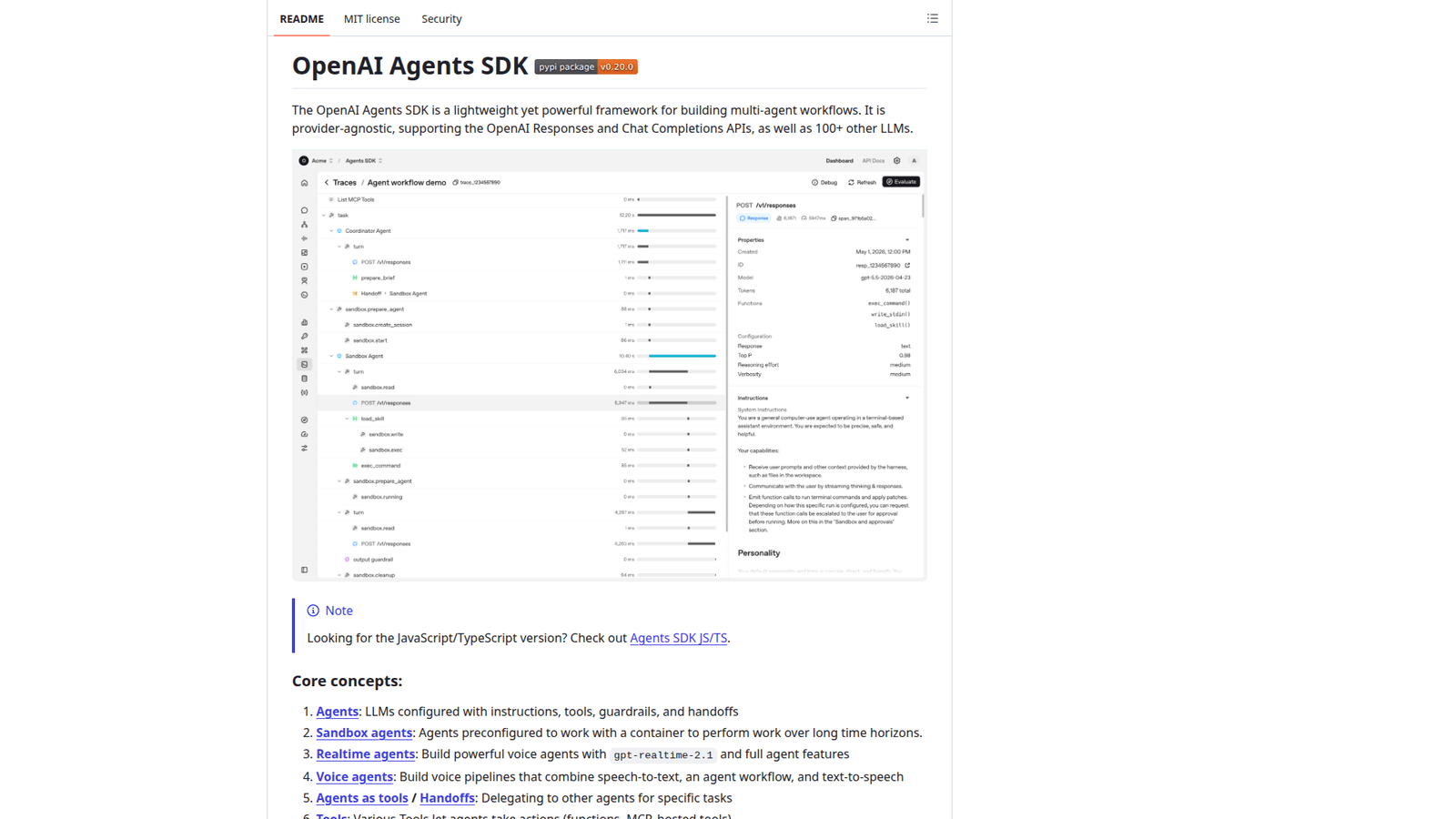
The OpenAI Agents SDK is a software development kit designed to build autonomous agents.
Think of it as the engine for your automated workforce.
It provides the tools, hooks, and logic required to connect large language models to external tools and data.
It removes the heavy lifting of wiring up API calls and managing state.
You define the goal, provide the context, and the agent takes it from there.
It is not just a chat interface.
It is a framework for task-oriented automation.
Developers use this to build agents that perform actions, solve problems, and execute workflows without constant human input.
It bridges the gap between raw model intelligence and real-world utility.
If you want to scale output, this is the tool to use.
Key Features of OpenAI Agents SDK for Agent Development
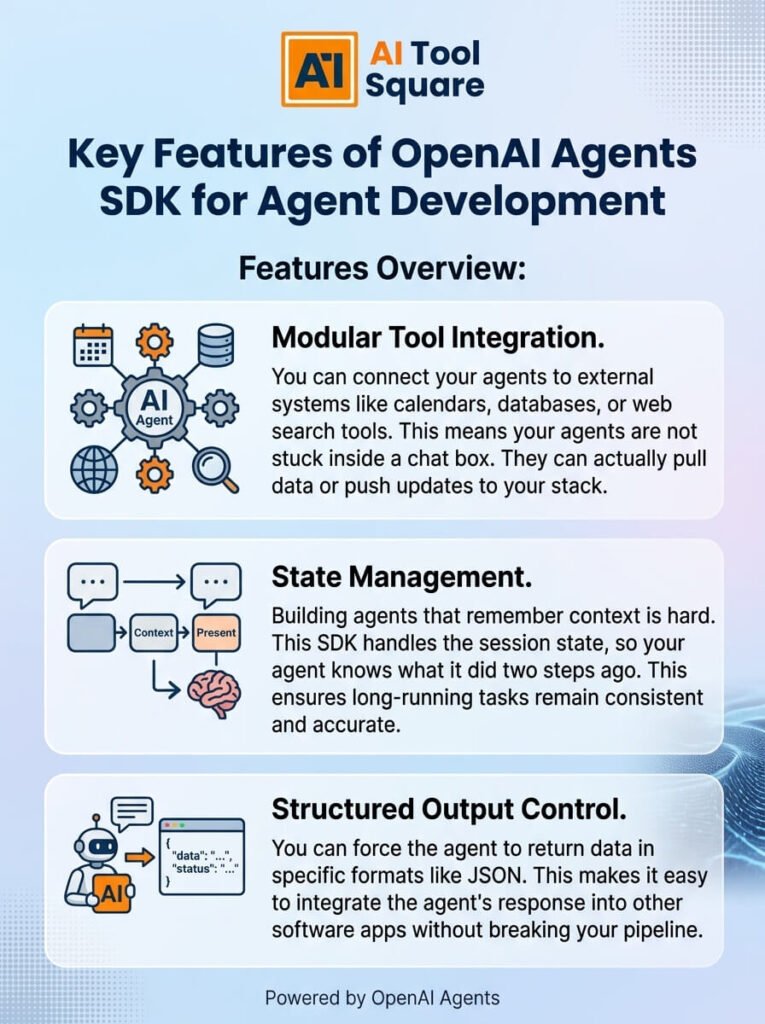
- Modular Tool Integration: You can connect your agents to external systems like calendars, databases, or web search tools. This means your agents are not stuck inside a chat box. They can actually pull data or push updates to your stack.
- State Management: Building agents that remember context is hard. This SDK handles the session state, so your agent knows what it did two steps ago. This ensures long-running tasks remain consistent and accurate.
- Structured Output Control: You can force the agent to return data in specific formats like JSON. This makes it easy to integrate the agent’s response into other software apps without breaking your pipeline.
Benefits of Using OpenAI Agents SDK for AI Agents
Using this SDK saves you time.
You are not coding custom wrappers for every API call.
You are using a standard framework built by the people who make the models.
This improves reliability.
Your agents crash less because the framework handles the edge cases.
It overcomes the creative block of trying to build an architecture from scratch.
You can start with a template and iterate.
Most businesses struggle with scaling their processes.
They add people to solve volume problems.
Agents allow you to add code to solve volume problems.
Code does not sleep. Code does not get tired.
Code is cheaper than headcount.
When you build with this SDK, you create assets that pay dividends over time.
Pricing & Plans

The OpenAI Agents SDK is essentially a developer resource.
The library itself is open-source and free to access.
You are not paying for the framework.
You are paying for the API usage.
When your agent runs, it consumes tokens from your OpenAI account.
This is standard practice.
You can test and build locally without incurring heavy costs.
Scale up when you move to production.
Monitor your token usage via the OpenAI dashboard.
Set budget limits so you never run into unexpected bills.
The costs are fractional compared to hiring a developer to maintain a custom, brittle automation script.
You are paying for performance.
Hands-On Experience / Use Cases
A software company uses this SDK to automate customer support tickets.
The agent is given access to a database of technical documentation.
When a user asks a question, the agent reads the query, queries the database, and drafts a response.
The agent handles 70% of routine inquiries without human intervention.
Another example involves a marketing agency managing social media content.
The agent is connected to a content calendar and a research tool.
It identifies trending topics, pulls fresh news, and prepares social posts for review.
The human team only clicks “approve.”
Teams report a massive drop in busywork.
The focus shifts from executing tasks to managing the logic of the agents.
This is the shift from operator to architect.
Your systems become the bottleneck, not your employees.
Who Should Use OpenAI Agents SDK?

Software developers are the primary users.
If you know Python or JavaScript, you can get an agent running in an afternoon.
Tech-savvy agency owners also benefit.
They can build bespoke tools for their clients to increase their retention and service value.
Product managers should also pay attention.
They can use this to prototype features faster than engineering teams using legacy stacks.
Small business owners who understand logic flows can build simple automations.
If you can draw a flowchart, you can design an agent.
It is for anyone who wants to automate repetitive tasks that involve data, search, or structured communication.
Stop doing the same thing twice.
If you do it three times, build an agent.
How to Make Money Using OpenAI Agents SDK
Money follows value.
If you save a client ten hours a week, you have a valuable service.
- Build Specialized Agents: Create a niche agent for industries like legal or real estate. Sell it as a monthly subscription service. The agent does the research, they pay for the output.
- Automation Consulting: Help companies connect their internal systems to AI. Charge a setup fee and a maintenance retainer. You are selling efficiency.
- Agent Maintenance: Companies will build agents but will not know how to fix them when they break. Offer a “keep it running” service. It is high-margin revenue with low effort once the agent is stable.
Example: A consultant builds a lead-qualification agent for a real estate firm.
It scrubs leads from a website, checks for key criteria, and puts them into a CRM.
The firm closes two extra deals a month because the agent responds instantly.
The consultant earns a recurring fee based on the number of leads processed.
This is scalable income.
Limitations and Considerations
No tool is perfect.
Agents can hallucinate.
You must include guardrails.
Never give an agent uncontrolled access to delete or modify critical data.
The learning curve is real if you have never worked with APIs.
You will need to understand basic error handling.
Debugging an agent is different from debugging static code.
The output is probabilistic, not deterministic.
You have to accept that sometimes the agent will get it wrong.
Plan for failure.
Design a human-in-the-loop step for critical decisions.
Treat your agents like smart interns, not magic wands.
They need guidance, supervision, and clear instructions.
Final Thoughts
The OpenAI Agents SDK is a bridge to a more efficient future.
It allows you to build better systems faster.
The winners in the next few years will be the ones who build the most agents.
They will outpace competitors by a factor of ten.
Stop overthinking it.
Pick a boring task you do every day.
Build an agent to do it for you.
Go to the documentation, follow the tutorial, and get your first agent running.
The sooner you start, the further ahead you will be.
Building intelligence is now a commodity.
Use the OpenAI Agents SDK to make that intelligence work for you.
Visit the official OpenAI Agents SDK website
Frequently Asked Questions
1. What is OpenAI Agents SDK used for?
It is used to build autonomous agents that can use tools, manage state, and interact with external systems to perform complex tasks automatically.
2. Is OpenAI Agents SDK free?
The SDK itself is free to use, but you will pay for the usage of the underlying language models via your OpenAI API account.
3. How does OpenAI Agents SDK compare to other AI tools?
It is deeply integrated with OpenAI models, offering a standardized approach to agent logic, state, and tool use compared to generic or fragmented frameworks.
4. Can beginners use OpenAI Agents SDK?
Yes, if you have a basic grasp of programming concepts and APIs, the documentation is clear enough to get you building quickly.
5. Does the content created by OpenAI Agents SDK meet quality and optimization standards?
Yes, provided you give the agent the right system instructions and guardrails to keep the content relevant and structured to your needs.
6. Can I make money with OpenAI Agents SDK?
Yes, by building custom automation services for businesses or creating specialized agents that provide specific value in niche markets.
7. How to make money with OpenAI Agents SDK?
You can offer consulting, build niche agents as products, or provide ongoing maintenance and optimization for businesses integrating AI into their workflows.