
Discover the top 7 AI note taking apps that will supercharge your productivity and learning. Learn how these AI note taking apps leverage artificial intelligence to revolutionise the way you capture, organise, and recall information, making smart note taking easier than ever.
The 7 Best AI Note Taking Apps for Unlocking Peak Productivity
Right, let’s get straight to it. If you’re anything like me, you’ve probably got a graveyard of half-baked notes and forgotten ideas lurking in various apps. It’s a productivity killer, plain and simple. We’re constantly bombarded with information, and the old-school pen-and-paper or basic digital notes just aren’t cutting it anymore.
That’s why I’ve been deep diving into the world of AI note taking apps, and let me tell you, it’s a game-changer. These aren’t just glorified text editors; these are intelligent assistants that help you capture, organise, and retrieve information with a speed and precision that’s frankly astonishing. I’m talking about tools that actively work with you to make sure your brilliant ideas don’t get lost in the shuffle.
I’ve personally tested a stack of these AI note taking apps, and I’ve distilled down the absolute best ones that are truly worth your time and attention. My goal here is simple: to show you how these powerful AI note taking apps can radically improve your ability to learn, remember, and execute. Forget about information overload; with the right AI note taking app, you’ll be able to process more, faster, and smarter. It’s about working smarter, not harder, and these tools are the leverage you need. So, buckle up, because we’re about to transform the way you think about taking notes forever.
Table of Contents
- What Are the Best Smart Note Taking Tools?
- Top 7 Smart Note Taking Tools (Detailed Reviews)
- Feature Comparison
- Pricing Breakdown
- Real-World Use Cases
- Who Should Use Each Tool?
- How to Choose the Right Tool
- Making Money with These Tools
- Common Limitations
- Final Verdict and Recommendations
- Frequently Asked Questions
What Are the Best Smart Note Taking Tools?
Alright, so what exactly makes a note-taking tool “smart”? It’s not just about typing things down. We’re talking about artificial intelligence embedded directly into the process. The best AI note taking apps go beyond simple organisation. They actively help you summarise, categorise, transcribe, and even generate new content based on your existing notes.
Think about it: no more manually linking related ideas or spending hours trying to find that one specific quote from a meeting six months ago. These AI note taking apps handle the heavy lifting, freeing up your brainpower for deeper thinking and creativity. This is about making your notes work for you, not the other way around. It’s a fundamental shift in how we interact with information.
The core benefit of these AI note taking apps is their ability to process and understand natural language. This means you can speak your thoughts, record meetings, or just jot down unstructured ideas, and the AI will get to work, turning that raw data into actionable insights. Some will automatically create action items, others will pull out key themes, and some can even translate languages on the fly. We’re moving from passive note-taking to active knowledge management.
These tools are designed to amplify your memory and extend your cognitive abilities. They’re not just for students or academics; anyone who deals with a lot of information on a daily basis, from entrepreneurs to creatives, will find immense value in integrating these AI note taking apps into their workflow. It’s about building a living, breathing knowledge base that grows with you, always accessible and intelligently organised. This category of tools is revolutionising how we approach learning and education, offering unprecedented support for smart note taking. Interested in other Learning and Education tools? Check out our dedicated section.
The power of these AI note taking apps comes from their ability to automate tedious tasks. Instead of spending time formatting, organising, and indexing, the AI does it for you. This means you can focus on the content itself, on generating ideas, and on making connections. It’s about reducing friction in your creative and learning process.
If you’re serious about maximising your output and minimising administrative overhead, then paying close attention to these AI note taking apps is a must. They’re not just a convenience; they’re a competitive advantage in a world overflowing with data. The right AI note taking app can literally pay for itself in saved time and improved output. This isn’t just about “better notes,” it’s about a better way of thinking and operating. It’s truly a game-changer for anyone serious about smart note taking.
Top 7 Smart Note Taking Tools (Detailed Reviews)
Notion AI – AI Note Taking Apps Review
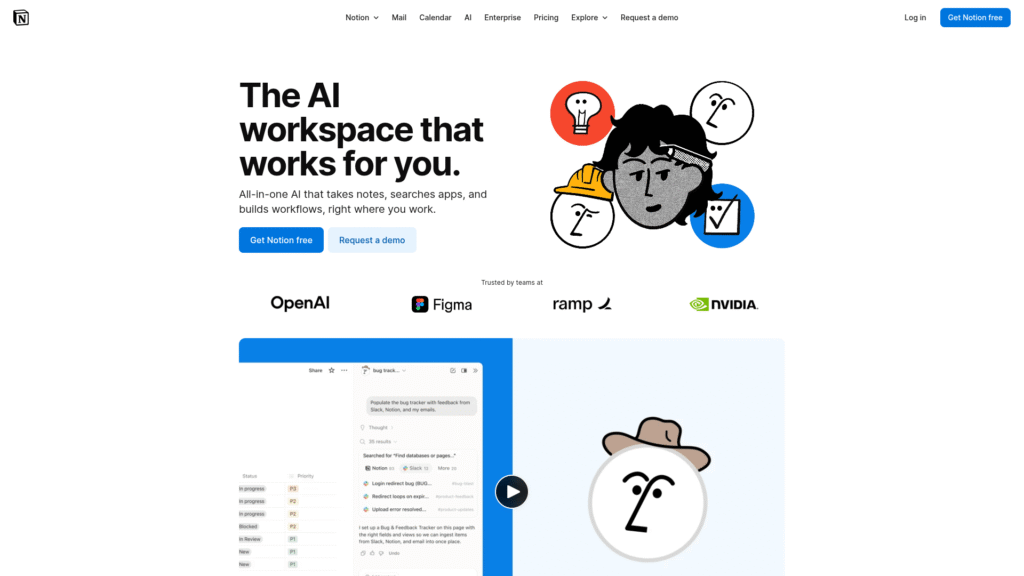
Notion AI integrates directly into the popular Notion workspace, bringing powerful AI capabilities to your existing pages and databases. This isn’t a standalone AI note taking app; it’s an enhancement that lets you leverage AI within the context of your broader projects and knowledge base. You can use it to summarise long documents, brainstorm ideas, generate different content formats (like blog posts or meeting agendas), translate text, and even fix grammar.
It acts as a writing assistant, helping you get unstuff and generate first drafts rapidly. The beauty here is its seamless integration; the AI lives where your work lives, making it incredibly convenient for a wide range of tasks beyond just simple note capture. It’s particularly strong for those who already use Notion for project management, content creation, or personal knowledge management.
- Features: Summarisation, content generation (blog posts, social media, outlines), brainstorming, translation, grammar correction, action item extraction, Q&A on your notes.
- Pricing: Notion AI is an add-on to existing Notion plans. It starts at $10 per member per month when billed annually, or $10 per member per month when billed monthly. Free users get a limited number of AI responses.
- Pros: Deep integration with existing Notion workspaces, versatile for various content creation and summarisation tasks, powerful for generating ideas and overcoming writer’s block.
- Cons: Requires an existing Notion subscription, not a standalone note-taking app, AI features can be limited for free users.
Visit official Notion AI website
Otter.ai – AI Note Taking Apps Review
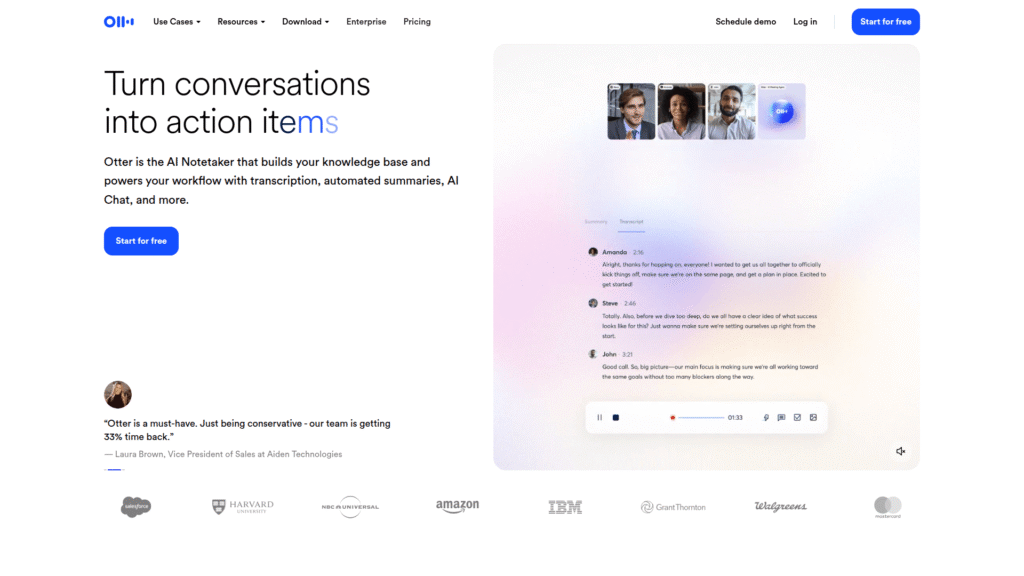
Otter.ai is primarily an AI note taking app focused on audio transcription. It’s brilliant for meetings, interviews, lectures, and any scenario where you need a accurate text record of spoken words. Otter.ai listens, transcribes in real-time, and can even identify different speakers. Post-transcription, it offers features like summarisation, keyword extraction, and the ability to search through your conversations.
This is a must-have for anyone who attends a lot of virtual meetings or records spoken information. It frees you up from frantic note-taking during a call, allowing you to focus on the conversation itself. The generated transcripts are incredibly accurate, and the ability to play back specific sections linked to the text is a huge time-saver. For precise audio-to-text conversion, Otter.ai is one of the top AI note taking apps on the market.
- Features: Real-time transcription, speaker identification, summarisation, keyword extraction, searchable transcripts, audio playback linked to text, integration with Zoom, Google Meet, and Microsoft Teams.
- Pricing: A free plan offers 30 minutes of transcription per month. Paid plans start at $10 per user per month (Pro) or $20 per user per month (Business) when billed annually, offering more transcription minutes and advanced features.
- Pros: Highly accurate real-time transcription, excellent for meetings and lectures, speaker identification is robust, easy search and playback functionality.
- Cons: Primarily focused on audio transcription, less suited for general unstructured text notes, some advanced features require paid plans.
Visit official Otter.ai website
Mem AI – AI Note Taking Apps Review
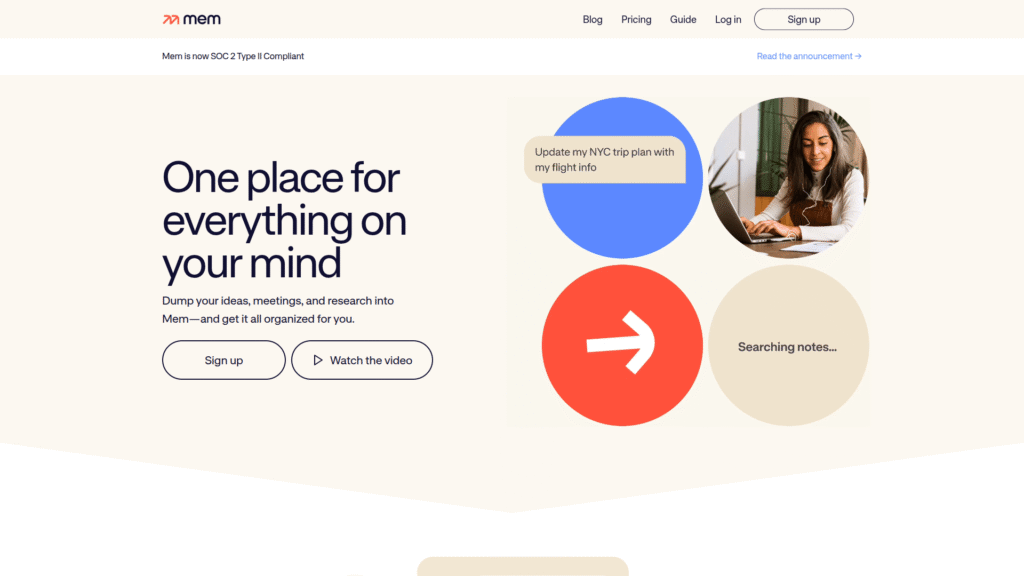
Mem AI positions itself as a self-organising workspace, a “second brain” that uses AI to connect your thoughts and ideas automatically. Unlike traditional note-taking apps where you manually categorise and link, Mem AI observes your input and starts creating connections based on content. It’s designed to reduce the friction of organisation, allowing you to simply dump information in, knowing that the AI will help you retrieve it later in meaningful ways.
This AI note taking app is particularly good for individuals who struggle with consistent organisation or who work across diverse projects and need a fluid way to see how ideas intersect. It learns from your usage, making its suggestions and connections more relevant over time. If you’re looking for a tool that actively helps you make sense of your knowledge base without constant manual effort, Mem AI is definitely worth exploring.
- Features: Self-organising notes (Mem Spots), AI-powered search, automatic topic detection, bi-directional linking, smart suggestions, daily review prompts.
- Pricing: Mem AI offers a free tier with basic features. The paid “Mem X” plan costs $10 per month, unlocking unlimited Mem storage, advanced AI capabilities, and priority support.
- Pros: Excellent for passive organisation, learns from your usage patterns, helps connect disparate ideas, strong for knowledge discovery.
- Cons: Can feel less structured for users who prefer strict manual organisation, AI features are more prominent in the paid plan.
Obsidian – AI Note Taking Apps Review
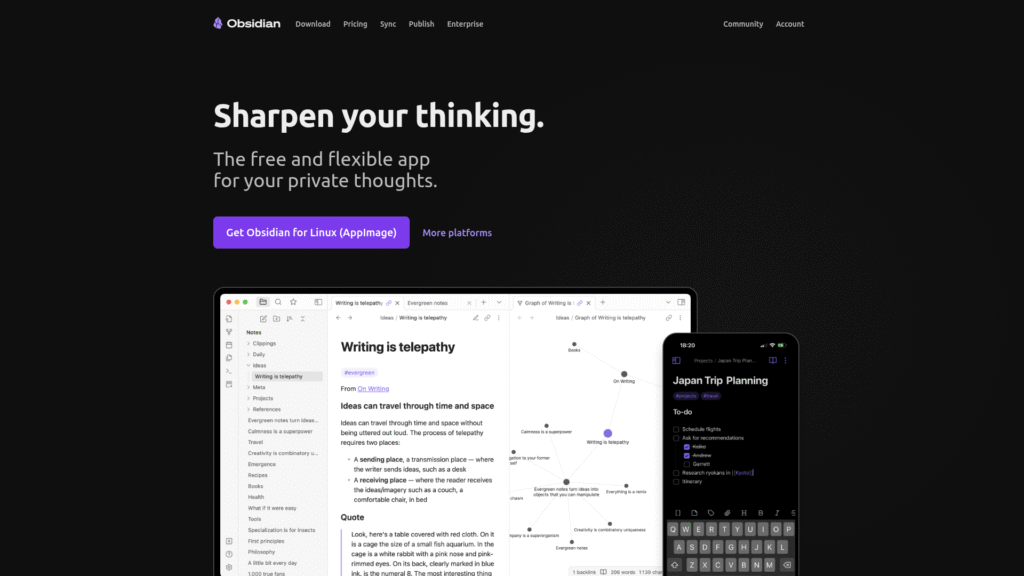
Obsidian is a powerful, local-first knowledge base that excels at creating a “second brain” through linked notes. While not natively an AI note taking app in the same vein as some others, its extensibility through a vibrant plugin ecosystem allows users to integrate various AI capabilities. This means you can add plugins for summarisation, idea generation, natural language processing, and even chatbots that interact with your notes.
Obsidian’s strength lies in its graph view, which visually represents the connections between your notes, making it incredibly effective for visual thinkers and those who want to build a dense network of interconnected ideas. It’s highly customisable, allowing users to tailor the experience precisely to their needs. For users who want complete control over their data and a highly personalised note-taking environment with optional AI power, Obsidian stands out among AI note taking apps.
- Features: Bi-directional linking, graph view, local-first storage, highly extensible with plugins (including AI plugins), Markdown support, customisable interface.
- Pricing: Free for personal use. “Obsidian Sync” for synchronisation across devices costs $8 per month, and “Obsidian Publish” for publishing notes online costs $16 per month. AI functionalities typically come via third-party plugins, which may have their own costs or be free.
- Pros: Ultimate control over your data, highly customisable, excellent for building interconnected knowledge graphs, strong community and plugin support for AI features.
- Cons: Steeper learning curve for new users, AI capabilities are not built-in and require plugins, requires more manual setup for AI features compared to dedicated AI tools.
Visit official Obsidian website
Evernote – AI Note Taking Apps Review
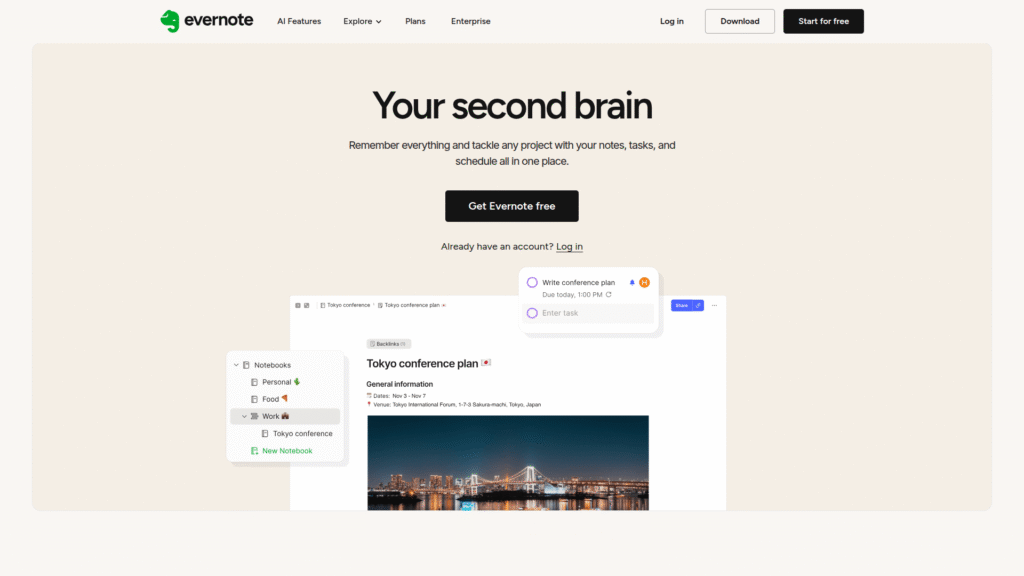
Evernote has been a long-standing player in the note-taking space, and it has recently integrated AI features to stay competitive as one of the leading AI note taking apps. Its AI capabilities focus on enhancing search, suggesting related notes, and summarising content. Evernote is known for its robust clipping features, allowing you to save web pages, PDFs, and images easily, and its AI helps make sense of this diverse content.
The AI-powered search is particularly useful for digging through years of accumulated notes, helping you find exactly what you need even if you don’t remember the exact keywords. It’s a solid choice for those who have a vast archive of information and need intelligent assistance in managing and retrieving it. Evernote aims to make your existing notes more valuable by providing AI insights and connections.
- Features: Web clipping, AI-powered search, suggested related notes, document scanning, task management, cross-device sync.
- Pricing: Evernote offers a free plan with limited features. Paid plans include “Personal” at £10 per month and “Professional” at £13 per month, offering increased storage, AI search, and advanced features.
- Pros: Excellent for long-term note archiving, robust web clipping, AI search enhances discoverability, good for diverse content types.
- Cons: Free plan is quite limited, AI features are primarily focused on search and suggestions rather than content generation, can be expensive for full features.
Visit official Evernote website
Grain – AI Note Taking Apps Review
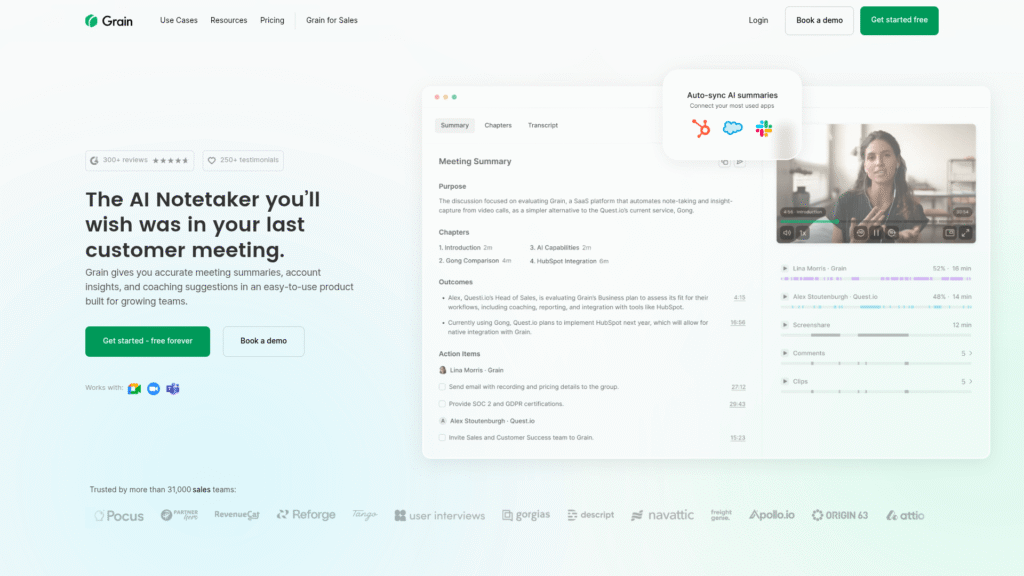
Grain is another specialist among AI note taking apps, specifically designed for streamlining video meetings. Similar to Otter.ai, it transcribes meetings, but Grain goes further by allowing you to easily clip, highlight, and share key moments from your recorded calls. Its AI automatically generates summaries, pulls out highlights, and can even create short video clips of important discussions. This is invaluable for teams who need to quickly disseminate meeting outcomes, create training materials from calls, or revisit specific points without rewatching the entire recording.
Grain integrates directly with popular video conferencing platforms, making it incredibly easy to use. If your workflow heavily involves video meetings and you need to maximise the value from those interactions, Grain is an essential AI note taking app. It ensures that no valuable insight from a video call is ever lost or hard to find. This is a crucial tool for smart note taking in a remote work environment.
- Features: Real-time transcription of video calls, AI-generated summaries and highlights, video clipping and sharing, speaker identification, integration with Zoom, Google Meet, Microsoft Teams.
- Pricing: Grain offers a free plan with limited recording and storage. Paid plans start at $19 per user per month (Pro) or $39 per user per month (Business), offering more recording time, storage, and advanced team features.
- Pros: Excellent for extracting value from video meetings, easy to share key moments, strong summarisation capabilities, good for team collaboration.
- Cons: Primarily focused on video call transcription and analysis, not a general-purpose note-taking app, free plan has significant limitations.
Bear – AI Note Taking Apps Review
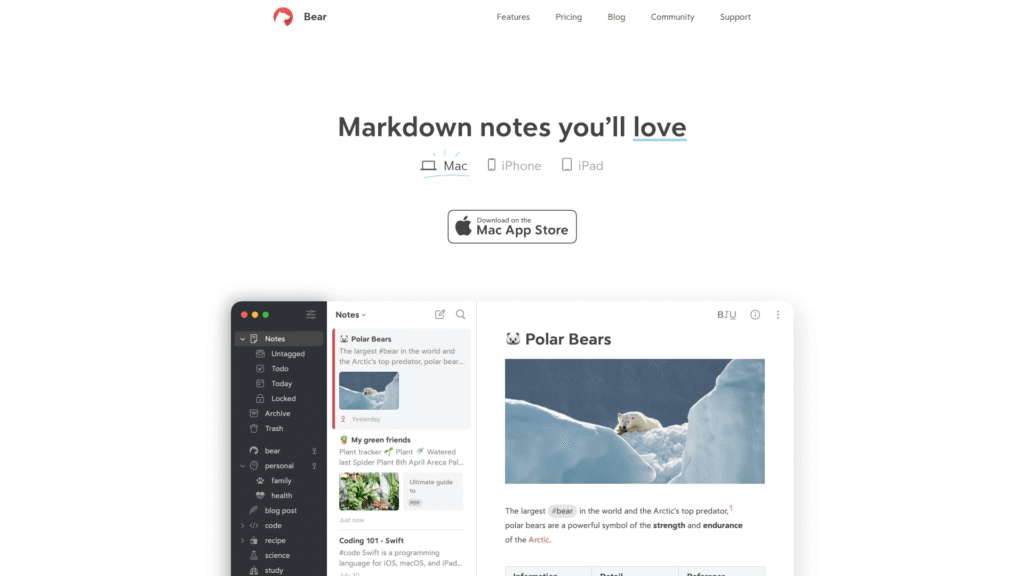
Bear is a beautifully designed, focused markdown editor for Apple devices (macOS, iOS, iPadOS) that, while not inherently an AI note taking app, can be significantly enhanced with AI capabilities through integrations. Its strengths lie in its speed, elegant interface, powerful search, and robust tagging system. While Bear doesn’t have built-in AI for summarisation or content generation, it’s a fantastic environment for capturing thoughts quickly and cleanly.
Users can easily integrate AI tools via shortcuts or by pasting output from external AI services. For those who value a clean, distraction-free writing experience and want to add AI power as needed, Bear offers a premium base. It’s particularly popular with writers and developers who appreciate markdown and a minimalist aesthetic. If you’re an Apple user looking for a fast, reliable note editor that can be paired with your favourite AI tools, Bear is an excellent choice for a hybrid AI note taking app setup.
- Features: Markdown editor, powerful search, tagging system, beautiful UI, cross-device sync (paid), export options, focus mode.
- Pricing: Free for basic features. “Bear Pro” costs £1.49 per month or £14.99 per year for synchronisation across devices and advanced themes. AI features would typically be external tools or integrations.
- Pros: Fast and responsive, clean user interface, excellent markdown support, robust tagging for organisation, great for Apple ecosystem users.
- Cons: No built-in AI features, only available on Apple platforms, advanced features require a Pro subscription.
Feature Comparison
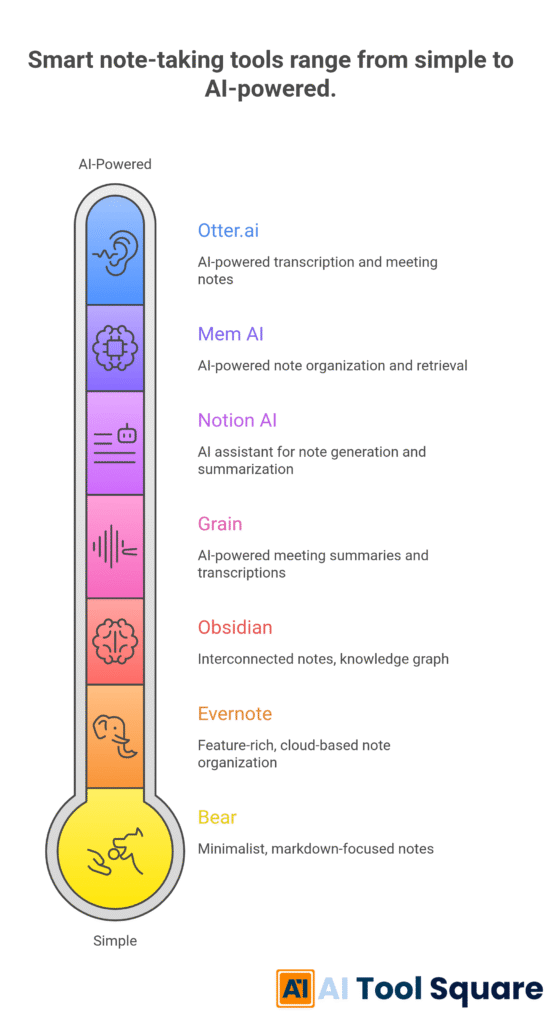
When looking at these AI note taking apps, it’s clear they offer a diverse set of functionalities. Notion AI stands out for its deep integration into a comprehensive workspace, making it ideal for tasks that require AI assistance within broader project management or content creation workflows. Otter.ai and Grain are specialists, excelling in audio and video transcription respectively, and are indispensable for anyone dealing with frequent meetings or verbal information.
They automate the capture of spoken words, transforming them into searchable and actionable text or clips. Mem AI approaches organisation from a unique angle, focusing on self-organising notes and intelligent connections, which is brilliant for those who prefer a more fluid, less manual approach to knowledge management. These AI note taking apps cater to very specific needs.
Obsidian, while not natively AI-powered, offers unparalleled customisation and local data control, making it a powerhouse for users who want to build a highly interconnected personal knowledge base and are comfortable integrating AI via plugins. Evernote, a veteran in the field, leverages AI primarily for enhancing search and suggesting related content across a vast repository of diverse note types.
It’s perfect if you’ve been accumulating notes for years and need smart ways to find and connect them. Bear, on the other hand, is a minimalist’s dream, offering a superb writing experience on Apple devices, with AI capabilities being integrated through external tools. Each of these AI note taking apps carves out its own niche, offering specific strengths that cater to different preferences and workflows. The choice often comes down to what your primary pain point is – be it transcription, self-organisation, content generation, or ultimate data control.
The variety of AI note taking apps means there isn’t a one-size-fits-all solution. Some prioritise speed and ease of capture, others focus on deep organisation and retrieval. The “best” feature often depends on your individual needs. For instance, if you’re a student recording lectures, Otter.ai’s transcription is paramount. If you’re a writer grappling with ideas, Notion AI or Mem AI’s content generation and connection features could be more valuable.
The key is to understand what each tool excels at and how that aligns with your specific goals for smart note taking. Don’t chase every feature; identify the core problems you need solved and then match them with the AI note taking app that offers the most robust solution in that area. This strategic approach will save you time and ensure you get the most out of your chosen tool.
Pricing Breakdown
Understanding the pricing of these AI note taking apps is crucial, as costs can vary significantly depending on the features you need and your usage intensity. Most of these tools offer a free tier, but these typically come with limitations on storage, transcription minutes, or access to advanced AI functionalities.
For instance, Otter.ai and Grain provide a generous free plan for basic transcription, but if you’re holding daily meetings, you’ll quickly hit those limits and need to upgrade. Notion AI is an add-on, meaning you already need a Notion subscription, and then the AI functionality comes at an additional monthly cost per user. This can add up for teams but offers immense value if you’re already deeply embedded in the Notion ecosystem.
Mem AI and Evernote also offer free entry points, with their premium tiers unlocking more storage, AI capabilities, and cross-device synchronisation. Mem X, for example, gives you unlimited storage and advanced AI for a reasonable monthly fee. Evernote’s professional plans are structured to cater to heavier users, offering increased storage and premium features.
Obsidian is unique; the core app is free for personal use, but if you want synchronisation across devices or publishing capabilities, you’ll need to pay for their “Sync” or “Publish” services. The AI elements for Obsidian typically come from free or paid community plugins, so those costs are variable and dependent on your chosen setup. Bear also follows a freemium model, with the “Pro” subscription unlocking sync and themes.
When evaluating the pricing, it’s important to consider your long-term needs. Are you an individual user or part of a team? How often will you use the AI features? Is unlimited storage critical? Often, investing in a paid plan for an AI note taking app that perfectly fits your workflow will pay dividends in saved time and increased productivity, outweighing the monthly cost.
The free tiers are great for testing the waters and getting a feel for the interface and core features. However, for serious users who want to fully leverage the power of these AI note taking apps, a paid subscription is almost always necessary to unlock their full potential. Always check for annual billing discounts, as many providers offer significant savings if you commit for a year.
Real-World Use Cases
Let’s talk about how these AI note taking apps actually get used in the wild. For students, imagine recording a lecture with Otter.ai. You get a perfect transcript, with speaker identification, and the AI can even summarise the key points, saving you hours of re-listening or frantic note-taking. This is a massive win for learning and retention. Researchers can use Mem AI to connect disparate articles, ideas, and observations, letting the AI surface unexpected links and patterns that might lead to breakthroughs. The “second brain” concept really shines here, allowing for serendipitous discovery from your accumulated knowledge base. These AI note taking apps are powerful tools for academic success.
For professionals, think about sales calls or client meetings. Grain can record, transcribe, and then allow you to easily clip and share critical decisions or action items with your team in seconds. No more “what was said?” debates. Project managers can use Notion AI within their existing Notion pages to rapidly generate meeting agendas, summarise project updates, or even brainstorm solutions to roadblocks, all within the context of their project data.
This streamlines communication and speeds up decision-making. Even writers can benefit immensely; using Notion AI to generate outlines or overcome writer’s block, then refining those ideas in Bear, or organising research in Obsidian with AI-powered tagging and summarisation plugins. The practical applications of these AI note taking apps are broad and impactful.
Entrepreneurs can leverage these AI note taking apps for market research, capturing insights from webinars, summarising competitive analysis, or even drafting initial business plans. The ability to quickly process large amounts of information and distill it into actionable intelligence is a superpower. For anyone in content creation, from bloggers to YouTubers, these tools can help generate ideas, structure content, and even repurpose existing notes into new formats.
The common thread across all these use cases is efficiency and intelligence. These AI note taking apps aren’t just making existing processes a bit faster; they’re enabling entirely new ways of working and thinking, allowing users to focus on higher-level tasks by automating the information management grunt work. This is the true power of smart note taking.
Who Should Use Each Tool?
Choosing the right AI note taking app really boils down to your specific needs. If you’re someone who lives and breathes Notion for project management, content creation, or knowledge management, then adding Notion AI is a no-brainer. It seamlessly integrates into your existing workflow, making your entire workspace smarter without having to jump between apps. It’s for the Notion power user who wants to amplify their productivity within their established system. This AI note taking app acts as an assistant within an already powerful platform.
For professionals and students heavily reliant on spoken information—think frequent meetings, interviews, or lectures—Otter.ai and Grain are your champions. Otter.ai is superb for pure audio transcription and general meeting notes, while Grain excels at extracting actionable insights and shareable clips from video calls. If your job involves a lot of virtual collaboration or learning from spoken content, these AI note taking apps will literally save you hours every week. They are essential tools for smart note taking in a verbose world.
Mem AI is ideal for those who struggle with traditional organisation methods and prefer a more organic, self-organising approach to their knowledge. If you want an AI note taking app that actively helps you connect dots and surface forgotten ideas without constant manual tagging or linking, Mem AI is a fantastic choice. Obsidian, on the other hand, is for the power user, the tinkerer, the one who wants complete control over their data and a highly customisable, local-first knowledge graph. It’s for those willing to invest time in setting it up to perfection, potentially with AI plugins.
Evernote suits individuals with a vast historical archive of diverse notes who need powerful AI search and suggestion capabilities to make sense of their accumulated knowledge. Bear is for the Apple minimalist, the writer, or developer who values a clean, fast Markdown editor and prefers to integrate AI as needed through external means, maintaining a focused writing environment. Each of these AI note taking apps serves a distinct personality and workflow.
How to Choose the Right Tool
Picking the best AI note taking app isn’t about finding the “perfect” tool, because that doesn’t exist. It’s about finding the perfect tool for *you*. First, identify your core problem. Are you drowning in meeting notes? Can’t remember where you put that brilliant idea from last month? Do you need help summarising long articles? Pinpointing your biggest pain point will immediately narrow down your options among the many AI note taking apps available. If transcription is your nightmare, look at Otter.ai or Grain. If content creation and summarisation within a broader workspace are key, Notion AI is a strong contender. For connecting disparate ideas without manual effort, Mem AI is your go-to.
Next, consider your existing ecosystem. Are you an Apple-only user? Bear might be a great fit. Do you already use Notion extensively? Then Notion AI makes sense. The less friction you create by adopting a new tool, the more likely you are to stick with it. Don’t underestimate the power of seamless integration with your current tech stack. Also, think about data ownership and control. If having your notes stored locally and in Markdown format is paramount, Obsidian is a clear winner, allowing you to integrate AI capabilities on your own terms. The level of customisation you desire also plays a role; Obsidian offers near-infinite customisation, while others are more opinionated in their design.
Finally, trial the free versions. Most of these AI note taking apps offer a free tier or a trial period. Use it. Get your hands dirty. See how it feels to actually work with the tool for a few days or weeks. Does the interface make sense to you? Is the AI genuinely helpful, or does it feel like a gimmick? Does it solve the problem you identified in step one?
Don’t commit to a paid plan until you’ve thoroughly tested it in your real-world scenarios. Your time is valuable, and finding the right AI note taking app to support your smart note taking efforts is an investment in that value. Don’t rush the decision; make an informed choice that will genuinely boost your productivity.
Making Money with These Tools
Alright, so how can these AI note taking apps actually put money in your pocket? It’s not about direct monetisation of the apps themselves, but rather leveraging their capabilities to increase your efficiency, output, and overall value. Think about it: if you can summarise client meetings in minutes with Otter.ai or Grain, you free up hours you can bill for other work. This direct time saving translates into more billable hours or the capacity to take on more clients.
For freelancers, consultants, or agencies, this is a significant advantage. The less time you spend on administrative tasks like note organisation, the more time you spend on high-value, client-facing work. These AI note taking apps make you faster and more effective, directly impacting your bottom line.
Content creators can use Notion AI to rapidly generate blog post outlines, social media content, or even script ideas for videos. This speeds up the content creation process, allowing you to publish more frequently and consistently, which directly impacts audience growth and potential ad revenue or sponsorships. Researchers or analysts can use Mem AI or AI-enhanced Obsidian to process vast amounts of data more quickly, identify trends, and generate comprehensive reports faster than competitors. This increased output and analytical depth can lead to higher-paying projects or more lucrative insights for your business. The ability of these AI note taking apps to handle information overload means you can offer more valuable services.
Furthermore, these AI note taking apps enhance your knowledge base, making you a more informed and authoritative expert in your field. This expertise can be monetised through consulting, online courses, or premium content. For example, by using an AI note taking app to meticulously document your learning and insights on a specific niche, you can then package that knowledge into a product or service.
The smarter you are at processing and recalling information, the more valuable you become. So, while you won’t find a “make money” button within these apps, their indirect impact on your productivity, output, and expertise can directly lead to increased earning potential. It’s about smart leverage, plain and simple. This is smart note taking at its most financially impactful.
Common Limitations
While AI note taking apps offer incredible advantages, it’s crucial to be aware of their limitations. First, accuracy isn’t always 100%, especially with transcription services like Otter.ai or Grain. Accents, background noise, and technical jargon can sometimes lead to errors, requiring manual correction. While good, they’re not perfect. This means you can’t blindly trust every transcription or summary; a human review is often necessary, which adds a small layer of overhead. The AI is a powerful assistant, not a complete replacement for human judgment. Even with the best AI note taking apps, a quick check can save you from miscommunications.
Another limitation can be the “black box” nature of some AI functions. When Notion AI generates content, for instance, it’s not always clear *how* it arrived at that output. While it’s great for brainstorming, relying solely on AI for critical content without understanding the underlying logic can be risky. There’s also the potential for “hallucinations” where the AI invents information that sounds plausible but isn’t factual. This is why human oversight remains essential. Furthermore, the effectiveness of AI features often scales with the quality of your input. “Garbage in, garbage out” still applies. If your notes are poorly structured or unclear, even the smartest AI note taking app will struggle to provide meaningful insights.
Finally, privacy and data security are always considerations. While reputable companies offering these AI note taking apps have robust security measures, entrusting your potentially sensitive notes to a cloud-based AI service requires a degree of trust. Local-first options like Obsidian offer more control in this regard, but then you’re responsible for your own backup and sync. The cost of advanced features can also be a limitation; while free tiers exist, unlocking the full power of these AI note taking apps often requires a paid subscription, which might not be feasible for everyone. It’s about balancing the benefits against these practical constraints to find the right fit for your smart note taking needs.
Final Verdict and Recommendations
So, after diving deep into these 7 AI note taking apps, my final verdict is clear: these tools are not a luxury; they’re a necessity for anyone serious about productivity and knowledge management. The ability to offload cognitive grunt work to AI, whether it’s transcription, summarisation, or idea generation, is genuinely transformative. My top recommendation really depends on your primary use case. If you’re embedded in Notion, then Notion AI is your most logical and powerful upgrade. It makes an already robust workspace even smarter, allowing you to generate content, summarise long documents, and brainstorm ideas within the context of your projects. It’s an indispensable AI note taking app for existing Notion users.
For anyone drowning in audio or video meetings, you absolutely need either Otter.ai or Grain. Otter.ai is phenomenal for accurate transcripts of pure audio, making it perfect for interviews and lectures. Grain takes it further for video calls, allowing for easy clipping and sharing of key moments, which is a game-changer for team collaboration and disseminating meeting outcomes. If you’re after a “second brain” that actively connects your ideas and helps you discover new insights without constant manual effort, Mem AI is an incredibly innovative choice. Its self-organising capabilities are truly impressive and reduce the friction of knowledge management, making it one of the most intelligent AI note taking apps available.
For the power user who wants ultimate control over their data, and is comfortable with a slightly steeper learning curve, Obsidian with AI plugins is unbeatable. It offers unparalleled customisation and a robust local-first knowledge graph. Evernote is still a strong contender for those with vast archives who need smart search and discovery features, while Bear remains the king for Apple users desiring a fast, clean Markdown editor that can be paired with external AI tools.
Ultimately, I recommend you try the free versions of the AI note taking apps that align most closely with your needs. See which one clicks with your workflow, because the right tool, used consistently, will truly revolutionise your smart note taking and supercharge your productivity. Give these AI note taking apps a serious look; they’re worth the investment of your time and attention.
Frequently Asked Questions
What are AI note taking apps?
AI note taking apps are digital tools that use artificial intelligence to enhance the process of capturing, organising, and retrieving information, often including features like transcription, summarisation, and content generation.
Are AI note taking apps accurate for transcription?
Most AI note taking apps, like Otter.ai and Grain, offer high accuracy for transcription, especially in clear audio environments, but they can still make errors with accents or background noise, requiring some manual review.
Can AI note taking apps help with content creation?
Yes, many AI note taking apps, such as Notion AI and Mem AI, can assist with content creation by generating outlines, summarising texts, brainstorming ideas, and even drafting initial versions of various content formats.
Are my notes secure with AI note taking apps?
Reputable AI note taking apps prioritise data security with encryption and robust privacy policies; however, for ultimate control, local-first options like Obsidian give you direct ownership of your data.
Do AI note taking apps integrate with other tools?
Many AI note taking apps offer integrations with popular platforms like Zoom, Google Meet, Microsoft Teams, and existing workspaces like Notion, streamlining your workflow across different applications.
Is there a free AI note taking app?
Most AI note taking apps offer a free tier with limited features or trial periods, allowing users to test their core functionalities before committing to a paid subscription for more advanced capabilities.
Which AI note taking app is best for students?
For students, Otter.ai is excellent for transcribing lectures and meetings, while Notion AI can help with summarising readings and structuring research, making both top AI note taking apps for academic use.
How do AI note taking apps organise information?
AI note taking apps organise information through various methods, including automatic tagging, smart linking of related ideas, summarisation, and in some cases, self-organising features that learn from your usage patterns to surface relevant connections.