
Discover the 7 best AI audio cleaner tools to instantly remove background noise and enhance your sound. Perfect for podcasters, musicians, and content creators looking for pristine audio quality.
The 7 Best AI Audio Cleaners: Instant Noise Removal for Pristine Sound
I get it. You’ve recorded a masterpiece, a truly game-changing podcast, or a musical track that’s going to blow minds. But then you listen back, and there it is: the hum of your computer, the neighbour’s dog, the incessant chirping of crickets. It’s enough to make you want to throw your microphone out the window. Well, don’t. Because in this article, I’m going to show you how an AI audio cleaner can turn your muddy recordings into crystal-clear masterpieces. We’re talking about getting rid of unwanted noise instantly, with minimal effort. This isn’t magic; it’s just incredibly smart technology. So, if you’re serious about your audio, stick around.
The truth is, bad audio isn’t just annoying; it’s a barrier. It stops people from listening, from engaging, and ultimately, from valuing your content. You could have the most profound message, the most beautiful melody, but if it’s drowned in static or background chatter, nobody’s going to hear it. That’s why an effective AI audio cleaner is no longer a luxury; it’s a necessity for anyone creating audio content. From podcasters to musicians, YouTubers to online educators, clean audio is the bedrock of quality. And thankfully, the tools available today are more powerful and accessible than ever before. Let’s dive into the specifics of how these AI audio cleaner solutions can revolutionise your workflow.
Table of Contents
- What Are the Best Noise Reduction and Audio Cleanup Tools?
- Top 7 Noise Reduction and Audio Cleanup Tools (Detailed Reviews)
- Feature Comparison
- Pricing Breakdown
- Real-World Use Cases
- Who Should Use Each Tool?
- How to Choose the Right Tool
- Making Money with These Tools
- Common Limitations
- Final Verdict and Recommendations
- Frequently Asked Questions
What Are the Best Noise Reduction and Audio Cleanup Tools?
Alright, let’s cut to the chase. You want clean audio, and you want it now. The market is flooded with options claiming to be the ultimate solution, but not all AI audio cleaner tools are created equal. Some are brilliant for voice, others excel with music, and some try to do a bit of everything with varying degrees of success.
My goal here is to sift through the noise, pun intended, and present you with the top contenders that truly deliver on their promise. We’re talking about tools that leverage sophisticated artificial intelligence to intelligently identify and remove unwanted sounds, leaving your core audio pristine. This isn’t just about applying a simple filter; it’s about intelligent processing that understands the nuances of sound.
The best noise reduction and audio cleanup tools employ advanced algorithms to differentiate between desired audio and extraneous noise. Imagine having a digital sound engineer meticulously going through your track, isolating every stray breath, every background hum, and every unexpected thump, then surgically removing it without touching the integrity of your voice or instrument. That’s the power of a high-quality AI audio cleaner.
These tools often come with intuitive interfaces, making them accessible even if you’re not an audio engineering guru. They’re designed to save you hours of manual editing, allowing you to focus on what you do best: creating incredible content. From web-based solutions to desktop applications, the flexibility offered by these AI audio cleaner options is truly impressive. We’ll be looking at a range that covers different needs and budgets, ensuring there’s a perfect fit for everyone.
When I talk about “best,” I’m talking about effectiveness, ease of use, speed, and ultimately, the quality of the final output. A great AI audio cleaner should be able to tackle a variety of noise types, from static and hiss to reverb and plosives. It should preserve the naturalness of the speech or music, avoiding that artificial, over-processed sound that can plague lesser tools.
Furthermore, a top-tier AI audio cleaner often provides additional features like automatic levelling, loudness normalisation, and even transcription services, adding even more value to your audio production workflow. This holistic approach to audio enhancement is what sets the elite tools apart from the rest. Get ready to discover the specific AI audio cleaner solutions that can genuinely make a difference to your audio quality.
Top 7 Noise Reduction and Audio Cleanup Tools (Detailed Reviews)
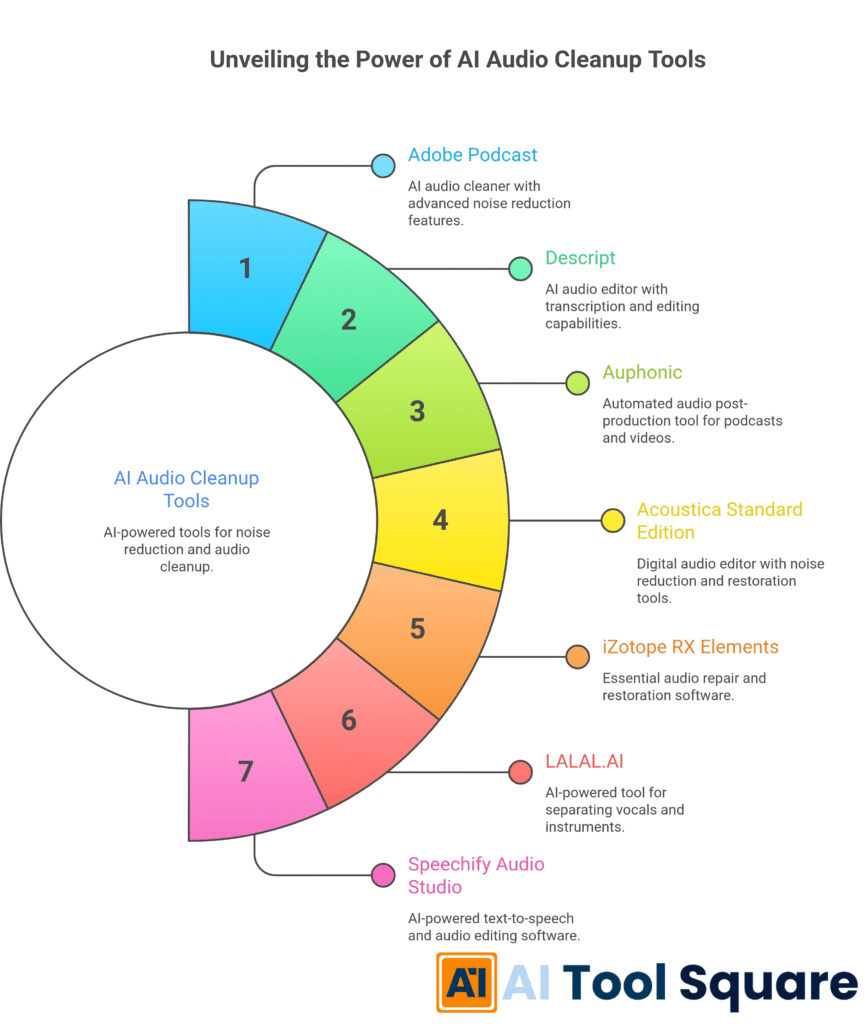
Adobe Podcast (formerly Project Shasta) – AI audio cleaner Review
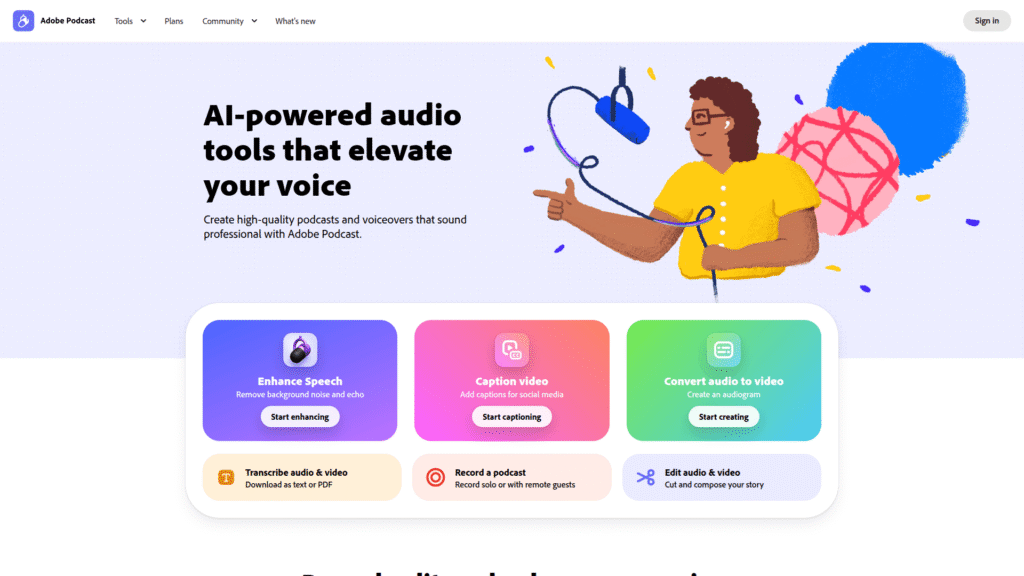
Adobe Podcast is a cloud-based AI audio cleaner that’s gaining serious traction, especially among podcasters. It uses AI to automatically clean up recordings, remove background noise, and even make your voice sound like it was recorded in a professional studio. The “Enhance Speech” feature is particularly impressive, taking even poorly recorded audio and making it sound incredibly clear and present. It’s an excellent AI audio cleaner for quick fixes and impressive results.
Features: AI-powered speech enhancement, background noise reduction, echo reduction, automatic transcription, mic check. It’s a powerful AI audio cleaner for spoken word content.
Pricing: A free tier is available, offering a generous amount of processing time. Paid plans for more extensive use are expected in the future. This AI audio cleaner is very accessible.
Pros: Extremely effective speech enhancement, very user-friendly interface, excellent for voice-centric content, free tier available. This AI audio cleaner is a game-changer for podcasters.
Cons: Primarily focused on speech, less suitable for music cleanup, limited control over specific parameters compared to dedicated DAWs. Not a universal AI audio cleaner, but brilliant for its niche.
Visit official Adobe Podcast website
Descript – AI audio cleaner Review
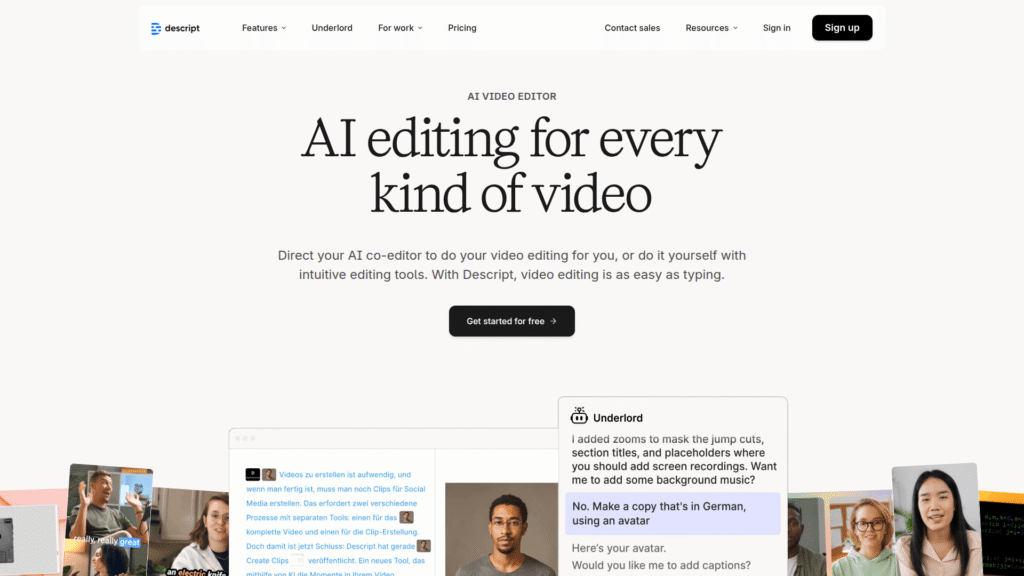
Descript is more than just an AI audio cleaner; it’s an all-in-one audio and video editor that treats your media like a document. Its “Studio Sound” feature uses AI to remove noise and improve clarity, making it an incredibly powerful AI audio cleaner for podcasts, videos, and presentations. You edit audio by editing text, which is revolutionary. This AI audio cleaner simplifies complex tasks.
Features: AI Studio Sound, text-based editing, automatic transcription, multi-track editing, screen recording, video editing. A comprehensive AI audio cleaner integrated into a full suite.
Pricing: Free tier available with limited features. Creator plan starts at $12/month (billed annually). Pro plan is $24/month (billed annually). This AI audio cleaner offers scalable options.
Pros: Text-based editing is incredibly intuitive, Studio Sound is highly effective, excellent for collaborative projects, robust feature set beyond just audio cleanup. A versatile AI audio cleaner for various media.
Cons: Can be resource-intensive, learning curve for new users due to unique workflow, not solely an audio cleanup tool. While a strong AI audio cleaner, it’s part of a larger ecosystem.
Visit official Descript website
Auphonic – AI audio cleaner Review
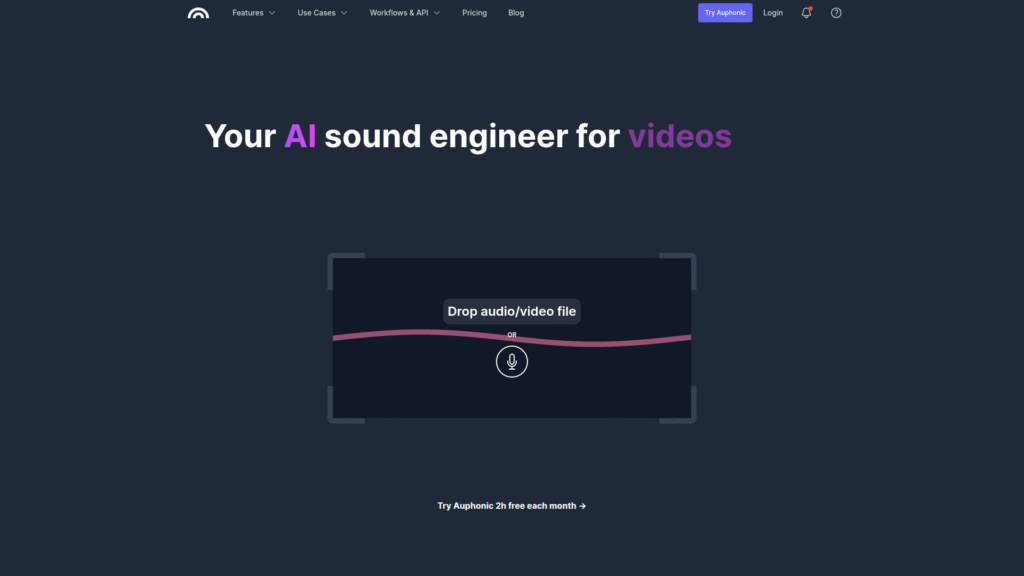
Auphonic is a web service designed for automatic audio post-production. It’s a fantastic AI audio cleaner for podcasters, broadcasters, and musicians who want professional-sounding audio without the hassle of manual editing. It handles noise reduction, loudness normalisation, levelling, and even reduces hum and clicks automatically. This AI audio cleaner is like having an audio engineer in the cloud.
Features: Adaptive Leveler, Loudness Normalisation, Noise Reduction, Hum Reduction, Filtering, Gating, Audio Restoration. A robust AI audio cleaner with a strong focus on post-production.
Pricing: Free tier with 2 hours of processed audio per month. Various paid plans starting from €11/month for more processing time. Flexible options make this AI audio cleaner accessible.
Pros: Excellent for achieving broadcast-quality loudness and levels, very effective noise and hum reduction, supports various input/output formats, batch processing. A professional-grade AI audio cleaner.
Cons: Less granular control over individual processing steps compared to a DAW, primarily a post-processing tool rather than a real-time AI audio cleaner, web-based only. Still, an invaluable AI audio cleaner.
Visit official Auphonic website
Acoustica Standard Edition – AI audio cleaner Review
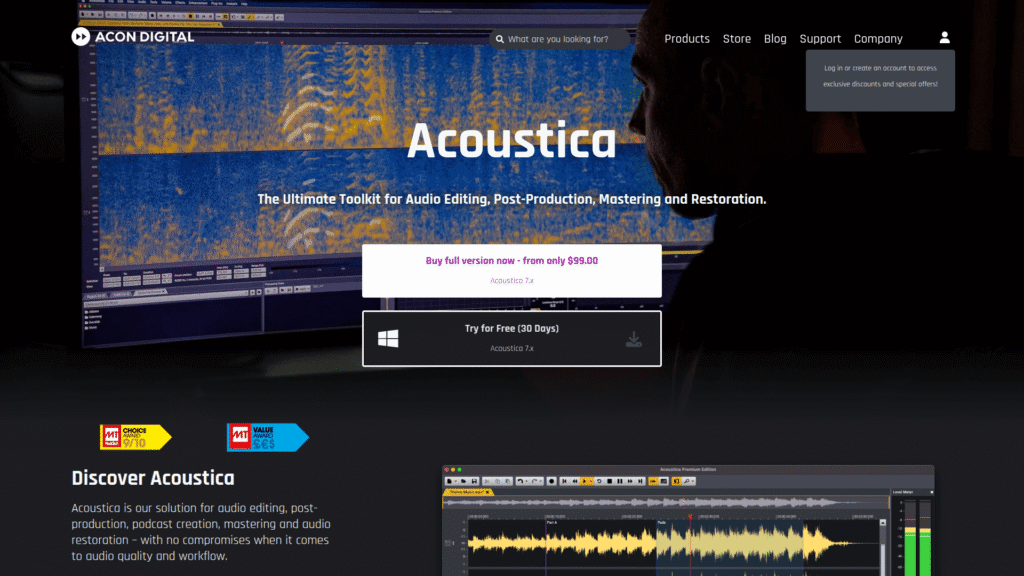
Acoustica Standard Edition by Acon Digital is a powerful desktop audio editor that incorporates excellent noise reduction capabilities. While not exclusively an AI audio cleaner, its suite of tools, including the “DeNoise” and “DeHum” plugins, leverage advanced algorithms to clean up audio effectively. It’s a fantastic AI audio cleaner for those who prefer a dedicated desktop application with more control.
Features: Comprehensive audio editing, DeNoise, DeHum, DeEss, Restoration tools, spectral editing, VST/AU plugin support. A feature-rich AI audio cleaner for detailed work.
Pricing: One-time purchase of €59.90 for the Standard Edition. A more advanced Premium Edition is also available. A good value AI audio cleaner for a lifetime license.
Pros: High-quality noise reduction algorithms, excellent control over processing parameters, stable desktop application, spectral editing for precise cleanup. A serious AI audio cleaner for serious users.
Cons: Steeper learning curve than some web-based tools, not a subscription model (which some prefer for updates), interface can feel a bit traditional. Still, a powerful AI audio cleaner.
Visit official Acoustica website
iZotope RX Elements – AI audio cleaner Review
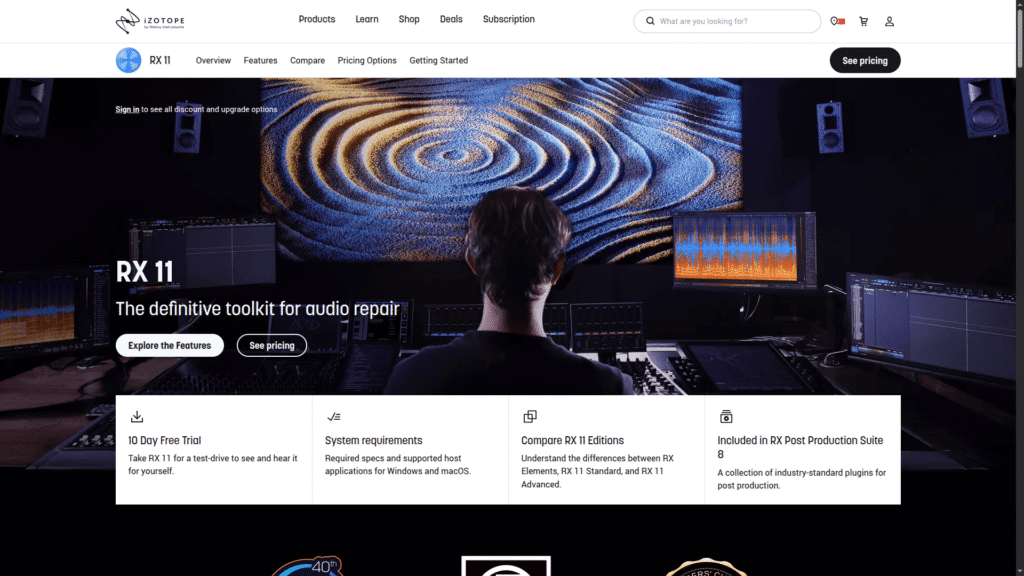
iZotope RX is the industry standard for audio repair, and RX Elements serves as an excellent entry point into its powerful ecosystem. It’s an indispensable AI audio cleaner for anyone serious about professional audio. The “Voice De-noise,” “De-hum,” and “De-clip” modules are incredibly effective at cleaning up common audio issues. This AI audio cleaner is a staple in many studios.
Features: Voice De-noise, De-hum, De-clip, De-click, Repair Assistant (AI-powered analysis and repair suggestions), standalone editor and plugin versions. A top-tier AI audio cleaner.
Pricing: One-time purchase, typically around £99. Often included in bundles or available during sales. A worthwhile investment for a professional AI audio cleaner.
Pros: Industry-leading algorithms for audio repair, highly effective at removing various types of noise, flexible workflow (standalone or plugin), Repair Assistant is a great starting point. The ultimate AI audio cleaner for many.
Cons: Can be complex for beginners (even the Elements version), more expensive than some entry-level options, other versions of RX offer more features. Still, this AI audio cleaner is very potent.
Visit official iZotope website
LALAL.AI – AI audio cleaner Review
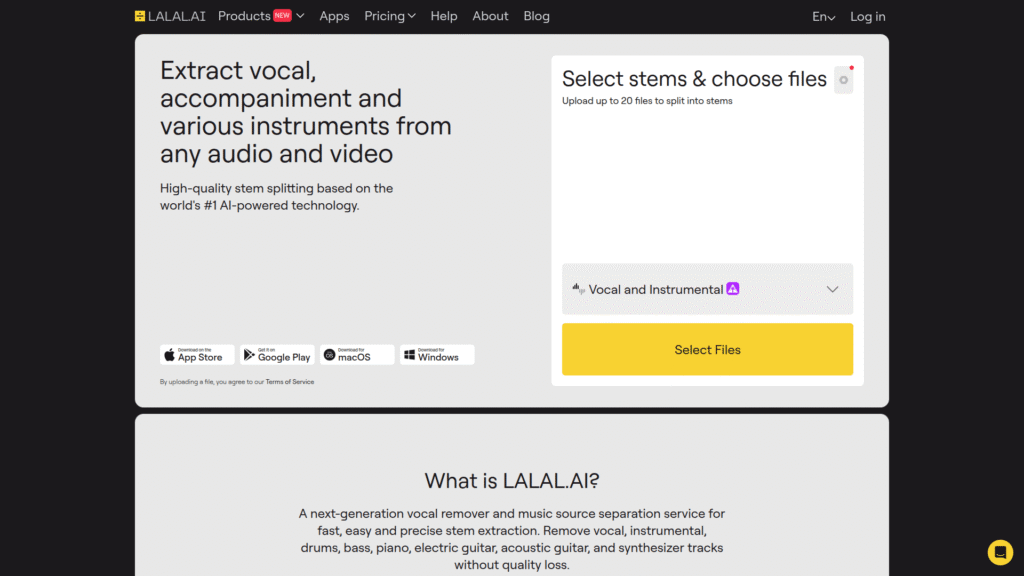
LALAL.AI is a unique AI audio cleaner primarily known for its stem separation capabilities, but it also offers excellent noise and vocal removal. It’s perfect for musicians, DJs, and producers who need to isolate specific elements from a track or remove unwanted background noise from a recording. This AI audio cleaner is fast and remarkably accurate, a real gem for specific tasks.
Features: Stem separation (vocals, instrumental, drums, bass, piano, acoustic guitar, electric guitar, synthesizer, wind instruments, string instruments), noise removal, vocal removal. A niche but powerful AI audio cleaner.
Pricing: Pay-as-you-go credit system. Starter pack for around €15 for 90 minutes. Larger packs available. This AI audio cleaner offers flexible payment for usage.
Pros: Exceptional stem separation, very effective noise and vocal removal, fast processing, simple web-based interface. A highly specialised AI audio cleaner for targeted cleaning.
Cons: Not a full audio editor, primarily focused on separation and removal rather than general post-production, credit-based system might not suit all users. Still, a brilliant AI audio cleaner for its purpose.
Visit official LALAL.AI website
Speechify Audio Studio (formerly wellsaid labs) – AI audio cleaner Review
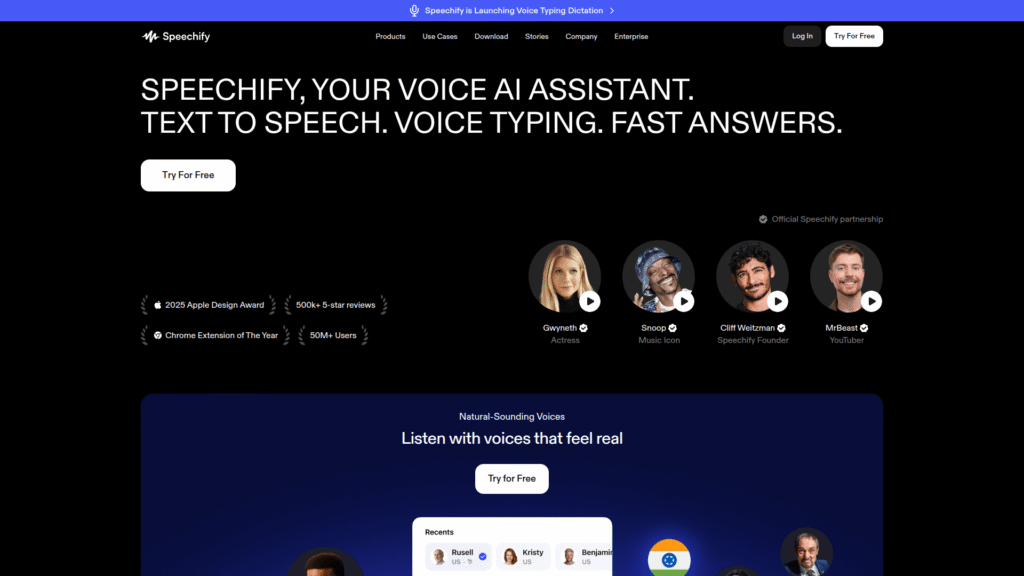
Speechify Audio Studio, while primarily known for AI voice generation, includes features that contribute to audio cleanup and enhancement. For users creating AI-generated speech, it offers tools to ensure the output is clear and free of artefacts. It acts as a specialized AI audio cleaner within its ecosystem, ensuring pristine synthetic voices. This platform is more about generating clean audio from the start, rather than cleaning up existing recordings.
Features: AI voice generation, text-to-speech, various voice styles and languages, some basic audio processing for generated speech. A unique angle on the AI audio cleaner concept.
Pricing: Subscription-based, with various tiers depending on usage and features. A free trial is often available. Consider this AI audio cleaner for new speech content.
Pros: High-quality AI voice generation, useful for creating clean speech from scratch, user-friendly interface for generating audio. A different kind of AI audio cleaner that prevents noise.
Cons: Not designed for cleaning pre-recorded human audio, more of a generation tool than a repair tool, limited traditional noise reduction features. Not a traditional AI audio cleaner for existing files.
Visit official Speechify Audio Studio website
Feature Comparison
When you’re choosing an AI audio cleaner, understanding the nuanced differences in features is critical. It’s not just about “noise reduction”; it’s about what *kind* of noise reduction and what else the tool brings to the table. For instance, Adobe Podcast excels at making spoken word sound studio-quality with minimal fuss, but it won’t separate instrumental tracks from vocals. Descript, on the other hand, offers an incredible text-based editing workflow alongside its Studio Sound feature, making it a hybrid powerhouse for creators who also handle video or extensive transcription. Each AI audio cleaner has its unique selling proposition.
Auphonic stands out for its comprehensive post-production suite, automatically handling loudness normalisation and levelling – crucial for broadcast and podcast consistency. While it’s a stellar AI audio cleaner for finishing touches, it’s not designed for the granular spectral editing that Acon Digital’s Acoustica offers. Acoustica gives you a deeper level of control, allowing you to visually identify and remove specific unwanted sounds. iZotope RX Elements, as an industry standard, provides incredibly precise and powerful algorithms for a wide range of audio repair tasks, although it does come with a slightly steeper learning curve for beginners. These different approaches highlight why identifying your primary use case is so important when selecting an AI audio cleaner.
LALAL.AI carved its niche with exceptional stem separation, making it an invaluable AI audio cleaner for musicians, remixers, and producers who need to isolate components of a track. While it can remove noise, its core strength lies in its ability to dissect complex audio. Speechify Audio Studio takes a completely different approach, focusing on generating pristine, clean speech from text rather than cleaning up existing recordings. So, if you’re looking to create new, perfectly clear voiceovers, it’s an interesting option. Ultimately, the “best” AI audio cleaner often depends on whether you prioritise ease of use, deep control, specific niche features like stem separation, or comprehensive post-production automation. Evaluate your needs closely.
Pricing Breakdown
Let’s talk money, because even the most powerful AI audio cleaner isn’t useful if it breaks the bank. The pricing models for these tools vary significantly, from free tiers and one-time purchases to subscription services and credit-based systems. Adobe Podcast offers a generous free tier, making it incredibly accessible for podcasters just starting out. This is a huge win for anyone needing an effective AI audio cleaner without immediate financial commitment. Descript also has a free tier, but its true power unlocks with its subscription plans, which are competitively priced given the breadth of features beyond just audio cleanup. You’re paying for a comprehensive media editor, not just an AI audio cleaner.
Auphonic follows a similar model with a free tier and then scalable subscription plans based on processing hours. This pay-as-you-go or tiered approach is common for cloud-based AI audio cleaner services that consume computing resources. Acon Digital’s Acoustica and iZotope RX Elements, on the other hand, opt for a one-time purchase model. This can be appealing if you prefer owning software outright rather than recurring subscriptions, offering a long-term, cost-effective AI audio cleaner solution. However, future major updates might require purchasing a new version. LALAL.AI uses a credit-based system, which is great if your usage is sporadic; you only pay for what you process. This makes it a very flexible AI audio cleaner for project-based work.
Speechify Audio Studio operates on a subscription model, reflecting its nature as a service for generating content. The cost will depend on the volume of speech you generate. When assessing the pricing, consider your usage patterns. Are you a casual user needing occasional cleanups? A free tier or credit system for an AI audio cleaner might be best. Are you a professional producing daily content? A subscription like Descript or Auphonic, or a one-time purchase like Acoustica or RX Elements, could offer better value over time. Always check for free trials or demos to test out the AI audio cleaner before committing, ensuring it fits both your workflow and your budget.
Real-World Use Cases
The practical application of an AI audio cleaner is where the rubber meets the road. It’s not just theoretical magic; these tools solve real problems for real people. Imagine you’re a podcaster recording interviews remotely. The guest’s microphone might pick up ambient room noise, or a sudden external sound might interrupt their flow. An AI audio cleaner like Adobe Podcast or Descript’s Studio Sound can miraculously scrub out those distractions, making the interview sound like it happened in a professional studio. This instantly elevates your content quality and listener experience. This is the power of a dedicated AI audio cleaner.
For musicians and producers, the challenges are different. You might have a fantastic vocal take, but there’s a slight hiss from the preamp or a faint hum from the guitar amp. An AI audio cleaner like iZotope RX Elements or Acoustica can precisely target and remove these imperfections without compromising the vocal performance. LALAL.AI shines here too, allowing producers to isolate vocals or instruments from mixed tracks for remixing or sampling, or to remove background noise from stems. The ability to surgically clean up individual components of a mix is invaluable. This makes the right AI audio cleaner a crucial tool in the production chain.
Even for everyday users, an AI audio cleaner has its place. Think about online educators creating video lectures where the room echo or keyboard clicks are distracting. Using a tool like Auphonic can not only clean the audio but also normalise the loudness, ensuring a consistent listening experience for students. YouTubers needing to quickly clean up voiceovers for their vlogs or product reviews will find a quick, effective AI audio cleaner like Adobe Podcast a massive time-saver. The sheer versatility of these AI audio cleaner solutions means that virtually anyone creating audio content can benefit from integrating one into their workflow. The goal is always clearer, more engaging sound.
Who Should Use Each Tool?
Choosing the right AI audio cleaner isn’t just about features; it’s about aligning the tool with your specific needs and workflow. If you’re a podcaster who primarily works with spoken word and wants quick, studio-quality results without deep audio engineering knowledge, Adobe Podcast is your go-to audio cleaner. It’s incredibly user-friendly and delivers exceptional vocal clarity. For content creators who produce both audio and video, especially those who transcribe their work, Descript offers an unmatched all-in-one solution. Its text-based editing combined with the Studio Sound AI audio cleaner is revolutionary.
Broadcasters, professional podcasters, and anyone needing consistent, broadcast-ready loudness and levelling will find Auphonic indispensable. It’s an automated post-production powerhouse, acting as a sophisticated audio cleaner for the final polish. If you’re an audio engineer, sound designer, or serious hobbyist who demands granular control and desktop power, Acoustica or iZotope RX Elements are the AI audio cleaner solutions for you. They offer a deep dive into audio repair, allowing for surgical precision in cleaning up even the most challenging audio issues. These are professional-grade audio cleaner tools.
Musicians, DJs, and remixers who need to separate stems or remove specific elements from a track will find LALAL.AI to be an essential AI audio cleaner. Its specialisation in stem separation is unparalleled. Finally, if your primary need is to generate brand-new, perfectly clean AI voices for narration, explainer videos, or e-learning content, Speechify Audio Studio provides a robust platform for that specific application. While not a traditional audio cleaner for existing recordings, it excels at creating pristine audio from scratch. Understand your primary use case, and the best AI audio cleaner becomes clear.
How to Choose the Right Tool
Making the final decision on an audio cleaner can feel like a big deal, but it doesn’t have to be. Start by honestly assessing your primary needs. Are you mainly cleaning up spoken word, or do you work with music? Do you need a quick, automated solution, or do you crave granular control over every aspect of the audio? Your answers to these questions will immediately narrow down the field. For instance, if you’re a podcaster, an AI audio cleaner optimised for speech like Adobe Podcast or Descript will likely serve you better than one focused on stem separation. Conversely, a musician will lean towards LALAL.AI or iZotope RX.
Next, consider your technical proficiency. Are you comfortable with complex audio interfaces and detailed parameters, or do you prefer a “set it and forget it” approach? Tools like Auphonic offer excellent automation, while Acoustica and iZotope RX require a deeper understanding of audio principles. Don’t pay for features you won’t use. If you only need basic noise reduction, an expensive, feature-laden audio cleaner might be overkill. Also, think about your existing workflow. Does the AI audio cleaner integrate well with your current editing software? Some tools are standalone, while others offer plugins that work directly within your digital audio workstation (DAW).
Finally, and perhaps most importantly, evaluate the pricing against your budget and expected usage. Take advantage of free trials and free tiers. Many of these audio cleaner solutions offer a way to test them out before committing. This allows you to experience the quality of their noise reduction and overall usability firsthand. Read reviews, watch tutorials, and see how the AI audio cleaner performs on actual examples of your own problematic audio. By systematically evaluating these factors, you’ll be able to confidently select the audio cleaner that best empowers you to produce consistently high-quality sound.
Making Money with These Tools
Yes, you can absolutely make money using an AI audio cleaner. These tools aren’t just for cleaning up your own projects; they open doors to offering professional audio cleanup services. Think about it: many content creators, from indie filmmakers to aspiring podcasters, struggle with poor audio quality but lack the expertise or software to fix it. This is where you step in. You can offer services to remove background noise, reduce reverb, normalise loudness, and generally polish their audio using your chosen audio cleaner. You’re providing a solution to a common and frustrating problem.
Imagine offering “Podcast Audio Enhancement” packages, “Vocal Cleanup for Musicians,” or “Clear Speech for eLearning Videos.” You can market these services on platforms like Fiverr, Upwork, or even directly to local businesses and creators. The efficiency of an AI audio cleaner means you can process files much faster than manual editing, allowing you to take on more clients and increase your hourly rate. Your investment in an audio cleaner becomes a tool for generating income, providing a valuable service that enhances the production quality of others. It’s about leveraging technology to meet a market demand.
Furthermore, if you’re a content creator yourself, using an AI audio cleaner significantly elevates the professional appearance of your own work. Higher quality audio leads to better engagement, more subscribers, and ultimately, increased monetisation through ads, sponsorships, or direct sales of your content. Whether you’re selling your cleaned-up music, getting more views on your enhanced YouTube videos, or attracting a larger audience to your pristine podcast, the investment in an audio cleaner directly contributes to your earning potential. It’s not just an expense; it’s a strategic business decision to improve your product.
Common Limitations
While an AI audio cleaner is incredibly powerful, it’s not a magic bullet. Understanding its limitations is just as important as knowing its strengths. The biggest limitation across the board is that even the most advanced AI struggles to perfectly separate desired audio from noise when the noise is too loud or too similar in frequency to the main audio. For example, if someone is talking while a dog barks loudly right next to them, an audio cleaner might reduce the bark, but it could also introduce artefacts or slightly alter the quality of the speech. There’s a fine line between cleaning and degrading the original sound.
Another common issue is over-processing. If you push an AI audio cleaner too hard, the result can sound unnatural, “watery,” or robotic. This is particularly true for speech, where excessive noise reduction can strip away the natural resonances of the voice, making it sound thin or artificial. It’s a delicate balance, and often, less is more. Some tools might also struggle with very specific types of noise that they haven’t been extensively trained on. While general background hums and static are usually handled well, complex, transient noises like sudden bangs or overlapping speech can still pose a significant challenge for any audio cleaner.
Finally, dependence on an internet connection can be a limitation for web-based AI audio cleaner tools. If you’re working offline or in an area with poor connectivity, these tools become unusable. Desktop applications like Acoustica and iZotope RX mitigate this, but they require local processing power. It’s important to set realistic expectations. An audio cleaner can dramatically improve flawed audio, but it can’t always recover truly unsalvageable recordings. The best approach is always to record in the cleanest possible environment first, and then use an AI audio cleaner as a powerful enhancement tool, not a fix-all for poor recording practices.
Final Verdict and Recommendations
So, after breaking down the top contenders, where do we land? My recommendation depends entirely on your primary application. If you’re a podcaster or a content creator whose main focus is spoken word, and you want an incredibly easy-to-use, highly effective audio cleaner, then Adobe Podcast is a no-brainer. Its “Enhance Speech” feature is genuinely revolutionary for quick, professional results. For those who also work with video and want a truly integrated, text-based editing experience alongside powerful AI audio cleanup, Descript is the ultimate powerhouse. It’s more than just an AI audio cleaner; it’s a full media production studio.
For professionals and serious hobbyists who demand the absolute best in audio repair and deep control, iZotope RX Elements is still the industry benchmark audio cleaner. It requires a bit more technical know-how but delivers unparalleled precision. If your workflow involves a lot of automated post-production, like consistent loudness normalisation for podcasts or broadcast, Auphonic provides an excellent cloud-based AI audio cleaner solution. And for the niche but increasingly vital task of stem separation, or surgically removing specific elements from music, LALAL.AI is simply the best AI audio cleaner out there for that job.
Acoustica offers a fantastic middle ground for those wanting a powerful desktop audio cleaner with good control without the full complexity and price tag of the higher-end RX versions. And if you’re generating entirely new audio with AI voices, Speechify Audio Studio ensures that your synthetic speech is pristine from the get-go. Ultimately, the “best” AI audio cleaner is the one that fits your specific needs, skill level, and budget. Don’t be afraid to try out the free tiers and trials. Once you experience the clarity these tools bring, you’ll wonder how you ever managed without a dedicated audio cleaner.
Frequently Asked Questions
Is an AI audio cleaner better than manual noise reduction?
For many common noise types, an AI audio cleaner can be significantly faster and often more effective than manual methods, especially for users without extensive audio engineering experience. AI can intelligently differentiate between noise and desired audio with impressive accuracy.
Can an AI audio cleaner remove all types of background noise?
While an AI audio cleaner is highly effective against many common noises like hum, hiss, and static, it may struggle with very loud, complex, or transient noises, especially if they overlap significantly with the main audio. Success depends on the quality of the AI and the nature of the noise.
Are AI audio cleaner tools good for music?
Yes, some AI audio cleaner tools like iZotope RX and Acoustica offer powerful features for cleaning up music, including removing clicks, hum, and even reverb. LALAL.AI is particularly good for isolating or removing specific elements within a musical track.
Do I need an internet connection to use an AI audio cleaner?
Many popular AI audio cleaner tools like Adobe Podcast, Descript, Auphonic, and LALAL.AI are cloud-based and require an internet connection. Desktop applications like Acoustica and iZotope RX can be used offline after initial installation.
How much does an AI audio cleaner cost?
The cost of an AI audio cleaner varies widely. Some offer free tiers (e.g., Adobe Podcast, Descript, Auphonic), others are one-time purchases (e.g., Acoustica, iZotope RX Elements), and some use a credit-based system (e.g., LALAL.AI). Monthly subscriptions are also common.
Can an AI audio cleaner improve overall audio quality, not just remove noise?
Yes, many AI audio cleaner tools include features beyond just noise reduction, such as automatic levelling, loudness normalisation, and speech enhancement, which can significantly improve the overall perceived quality and consistency of your audio.
What is the easiest AI audio cleaner to use for beginners?
For beginners focused on spoken word, Adobe Podcast is widely considered one of the easiest and most effective AI audio cleaner tools to use, offering impressive results with minimal effort. Descript also has an intuitive, text-based editing workflow.
So there you have it. The world of audio cleanup has been revolutionised by the power of artificial intelligence. No matter your budget, your skill level, or your specific audio needs, there’s an audio cleaner out there that can help you achieve pristine, professional-sounding results. Stop letting bad audio hold you back; embrace the clarity that an AI audio cleaner can bring to your projects.