
Discover the best AI podcast tools that revolutionized Podcast and Audio Content Creation for millions. Optimize your audio workflow, boost efficiency, and get incredible results. Unlock your podcasting potential today!
Unlock Your Podcast Power: The Best AI Podcast Tools
You’re a creator. You have stories to tell, knowledge to share, and an audience waiting. But let’s be real, the grind of producing high-quality audio content, especially podcasts, can be relentless. From scripting to editing, sound design to promotion, it’s a constant juggle. This is where AI podcast tools step in, not just to help, but to truly shock you with their capabilities. They’re not just improving workflows; they’re redefining what’s possible in Content Creation.
I’ve seen countless creators hit a wall, overwhelmed by the technical demands and time commitment. They often leave money on the table because they can’t scale their output. It’s a classic problem: great ideas, limited bandwidth. But what if I told you that you could dramatically cut down your production time, enhance your audio quality, and even generate entirely new content with the help of smart software solutions? It’s not magic; it’s the power of artificial intelligence.
These tools are not a crutch for lack of talent; they’re accelerators for ambition. They allow you to focus on your core genius – your message – while automation handles the heavy lifting. I’m talking about digital tools that transform hours of tedious work into minutes, freeing you up to create more, better, and faster. Ready to see what’s out there? Let’s jump into the insane AI podcast tools that are shaking up the industry.
Table of Contents
- What Are the Best Podcast and Audio Content Creation Tools?
- Top 9 Podcast and Audio Content Creation Tools (Detailed Reviews)
- Feature Comparison: What to Look For
- Pricing Breakdown: Free vs Premium Options
- Real-World Use Cases and Results
- Who Should Use Each Tool?
- How to Choose the Right Tool for Your Needs
- Making Money with These Podcast and Audio Content Creation Tools
- Common Limitations to Consider
- Final Verdict and Recommendations
- Frequently Asked Questions
What Are the Best Podcast and Audio Content Creation Tools?
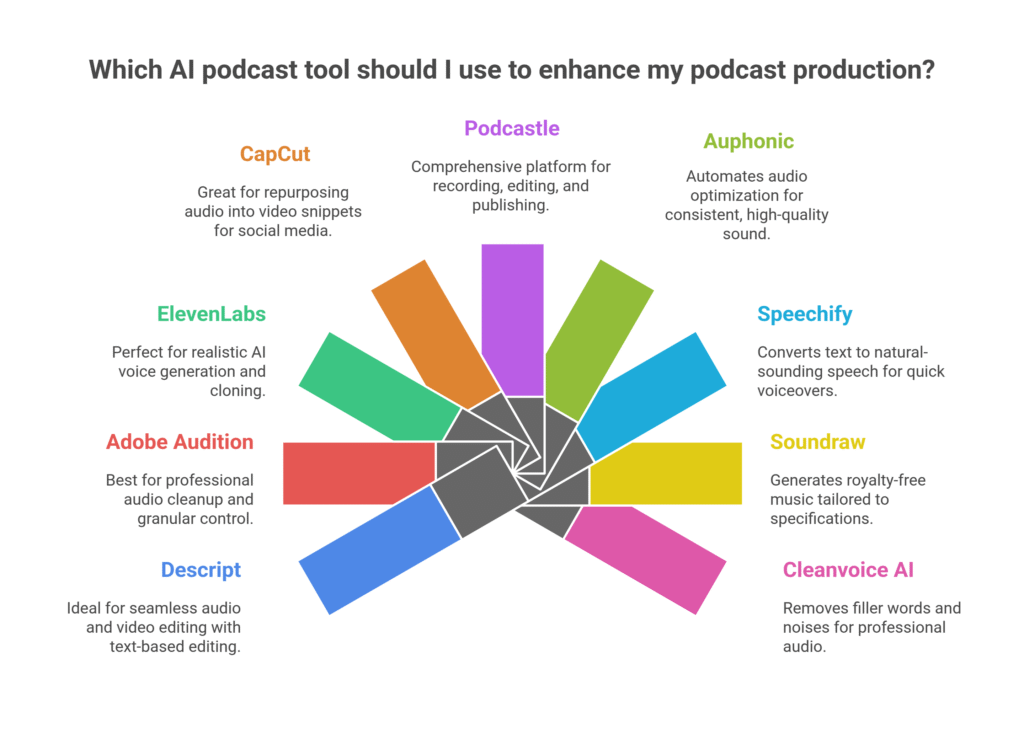
The best AI podcast tools aren’t just about automation; they’re about optimization. They help you achieve professional-grade results without needing a professional-grade studio or a decade of audio engineering experience. When I talk about “best,” I’m looking for a few key things: ease of use, impact on workflow, and tangible improvement in your final output. These digital tools should boost your productivity and enhance performance.
These software solutions span a range of functions: from intelligent transcription and editing to AI-generated voices and advanced sound clean-up. They leverage artificial intelligence to take the grunt work out of Podcast and Audio Content Creation, allowing you to focus on your narrative and audience connection. No more hours spent manually removing filler words or trying to perfectly level audio tracks.
We’re going to dive into specific AI tools that tackle different pain points in your podcast journey. Think of them as your personal production team, powered by algorithms. They help you streamline processes and deliver high-quality content consistently. The goal is simple: more impact, less effort.
Here’s a quick overview of the AI podcast tools that are changing the game:
Descript – AI podcast tools Review
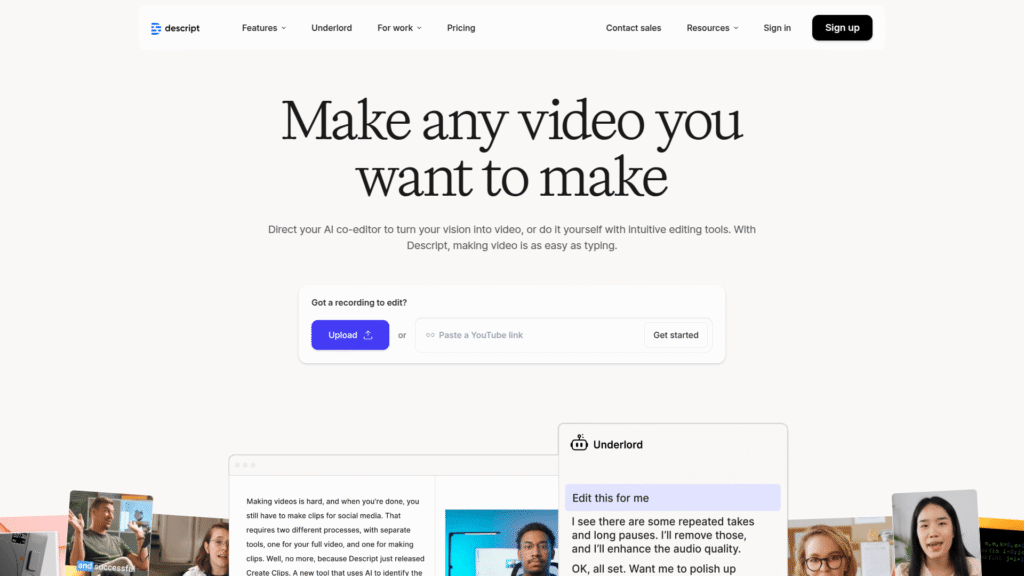
Descript combines transcription, video, and audio editing into one seamless package. It allows you to edit audio by simply editing text, which is an absolute game-changer. It’s perfect for removing filler words, cutting dead air, and even overdubbing your voice with AI. This tool drastically cuts down editing time.
Visit the official Descript website
Adobe Audition – AI podcast tools for Audio Cleanup
While not purely AI-driven, Adobe Audition integrates AI elements for noise reduction, spectral editing, and automatic ducking. It’s a powerful tool for professional audio engineers and podcasters who need granular control over their sound. It excels at cleaning up less-than-perfect recordings.
Visit the official Adobe Audition website
ElevenLabs – Best AI podcast tools for Voice Generation
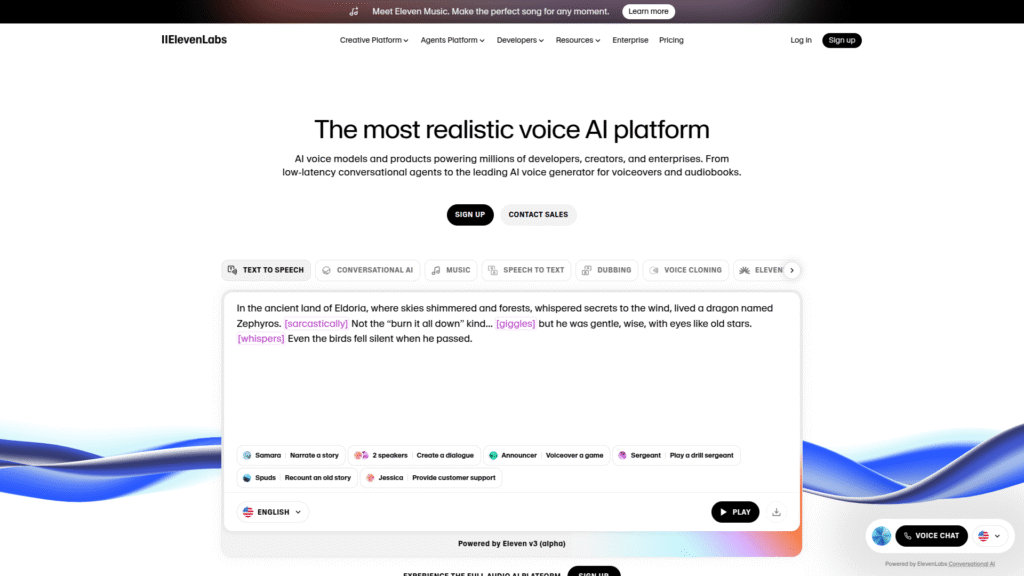
ElevenLabs offers incredibly realistic AI voice generation and voice cloning. Imagine creating entire podcast episodes or voiceovers without ever speaking into a mic. This tool is a powerhouse for synthetic speech, offering multiple languages and emotional ranges. It’s a top choice for generating professional-sounding audio.
Visit the official ElevenLabs website
CapCut – AI podcast tools for Visual & Audio Production
Primarily known for video editing, CapCut has strong AI features for audio, including background music generation, noise reduction, and automatic captions. It’s becoming an increasingly popular choice for podcasters who repurpose their audio into video snippets for social media. This makes Content Creation for multiple platforms easy.
Visit the official CapCut website
Podcastle – AI podcast tools for Full Production Suite
Podcastle is an all-in-one platform for recording, editing, and publishing podcasts. It uses AI for background noise removal, automatic leveling, and even offers an AI co-host feature. This tool is built specifically for podcasters, simplifying the entire workflow from start to finish. It’s a robust software solution.
Visit the official Podcastle website
Auphonic – AI podcast tools for Audio Post-Production
Auphonic automatically optimizes your audio files for podcasts, broadcast, and web. It handles loudness normalization, intelligent noise reduction, and ducking, all with a few clicks. It’s an automation dream for anyone wanting consistent, high-quality audio without manual effort. This tool ensures peak performance.
Visit the official Auphonic website
Speechify – AI podcast tools for Text-to-Speech
Speechify converts text into natural-sounding speech across a wide range of voices and languages. While often used for personal consumption, it’s also a powerful AI tool for creators needing quick voiceovers, script previews, or even to turn blog posts into audio content. It boosts productivity significantly.
Visit the official Speechify website
Soundraw – AI podcast tools for Music Generation
Soundraw generates royalty-free music tailored to your specifications. Need an intro, outro, or background track? Just choose your genre, mood, and length, and Soundraw creates unique music in seconds. This saves countless hours searching for suitable tracks and ensures you avoid copyright issues. It’s an innovative technology solution.
Visit the official Soundraw website
Cleanvoice AI – AI podcast tools for Filler Word Removal
Cleanvoice AI is laser-focused on one specific task: removing filler words, stuttering, and mouth noises from your audio. It uses advanced artificial intelligence to identify and eliminate these common audio distractions, making your podcast sound much more professional and polished. It’s incredible for efficiency.
Visit the official Cleanvoice AI website
Top 9 Podcast and Audio Content Creation Tools (Detailed Reviews)
Let’s break down these AI podcast tools one by one. You need to know exactly what each one offers, its strengths, and where it fits into your workflow. These are the digital tools that are truly making waves, offering incredible efficiency and quality improvements for your Content Creation. I’ve seen these tools revolutionize how people approach audio.
Descript for AI podcast tools Excellence
Descript stands out as one of the most intuitive AI podcast tools available. Its core feature is the “text-based editing” capability, where your audio is transcribed, and you edit the transcript as if it were a document. Deleting text deletes the corresponding audio. It’s mind-blowing how much time this saves, especially for those long-form interviews or rambling solo episodes. It also offers “Studio Sound” which cleans up audio quality with a single click, reducing background noise and echo. The “Overdub” feature allows you to correct words or phrases by typing, and Descript’s AI generates it in your voice. This is a massive leap in productivity for podcasters.
- Features: Text-based audio/video editing, AI Studio Sound, Overdub (voice cloning), transcription, screen recording, multitrack editing.
- Pricing: Free tier with limited transcription, Creator ($12/month), Pro ($24/month), Enterprise (custom).
- Pros: Extremely easy to learn, revolutionary text-based editing, excellent AI sound enhancement, great for collaboration.
- Cons: Can be resource-intensive for very large projects, Overdub requires voice training, transcription isn’t always 100% accurate.
- Use Cases: Interview podcasts, solo commentary, video podcasts, quick audio clean-up, repurposing content.
Visit the official Descript website
Adobe Audition – Premier AI podcast tools for Audio Editing
Adobe Audition, while not a pure AI native tool, incorporates powerful AI and machine learning algorithms, making it one of the most robust AI podcast tools for audio professionals. Its adaptive noise reduction, automatic loudness matching, and spectral frequency display for pinpoint problem identification are AI-enhanced. It’s the go-to for serious audio cleanup and mastering. If you’re dealing with challenging audio environments or aiming for the highest audio fidelity, Audition’s deep feature set and precise controls are unmatched. This software solution offers incredible performance for detailed audio work.
- Features: Advanced noise reduction, spectral editing, multi-track mixing, loudness normalization, audio repair tools, integration with Adobe Creative Cloud.
- Pricing: Part of Adobe Creative Cloud subscription ($20.99/month for single app, more for full suite).
- Pros: Industry-standard audio quality, extremely powerful editing capabilities, precise control over every aspect of sound, excellent for professional results.
- Cons: Steep learning curve for beginners, subscription model, not purely AI-driven for all tasks.
- Use Cases: Professional podcast production, audio restoration, sound design, complex mixing, advanced post-production.
Visit the official Adobe Audition website
ElevenLabs for AI podcast tools Voice Generation
ElevenLabs is arguably the best AI podcast tools for realistic voice generation. It’s not just about converting text to speech; it’s about creating emotional, nuanced, and incredibly natural-sounding voices. You can generate speech in various voices, languages, and even clone your own voice or someone else’s with a small audio sample. This artificial intelligence technology is so advanced it’s hard to distinguish from human speech. For creators looking to experiment with new formats, produce content faster, or expand into multiple languages without hiring voice actors, ElevenLabs is a game-changer. It ensures optimal content output.
- Features: Highly realistic text-to-speech, voice cloning, multilingual support, emotional rendering, API access.
- Pricing: Free tier (limited characters), Starter ($5/month), Creator ($22/month), Independent Publisher ($99/month), Enterprise (custom).
- Pros: Unparalleled voice realism, wide range of emotions and languages, powerful for synthetic media, incredible for productivity.
- Cons: Ethical considerations with voice cloning, can be costly for high volume, occasional robotic artifacts with complex phrasing.
- Use Cases: Generating voiceovers, creating AI-narrated podcasts, audiobooks, character voices, multilingual content.
Visit the official ElevenLabs website
CapCut – Versatile AI podcast tools
CapCut might surprise you, but it’s quickly becoming one of the most utilized AI podcast tools, especially for podcasters who want to convert their audio into engaging video snippets for social media. Its AI features include automatic captions, which are incredibly accurate and customizable. It also offers AI-powered background music generation and solid noise reduction capabilities. While primarily a video editor, its audio features are robust enough to significantly boost the production quality and reach of your Podcast and Audio Content Creation. This technology helps streamline the repurposing process.
- Features: Automatic captions, AI background music, noise reduction, video editing, green screen, effects, transitions.
- Pricing: Mostly free with premium features/assets available through CapCut Pro ($7.99/month).
- Pros: User-friendly interface, excellent for social media content, strong automatic captioning, mostly free.
- Cons: Primarily a video editor, less control over audio than dedicated DAW, can compress video/audio slightly.
- Use Cases: Creating video clips from podcasts, social media promotion, adding visual elements to audio, quick audio edits.
Visit the official CapCut website
Podcastle for End-to-End AI podcast tools Production
Podcastle is an all-in-one AI podcast tools solution designed specifically for podcasters. It brings together recording, editing, and publishing into a single platform. Its AI capabilities include “Magic Dust” for noise reduction and automatic audio leveling, ensuring your sound is always consistent. It even boasts an “AI Host” or “AI Co-Host” feature, allowing you to generate additional audio segments using synthetic voices. This is a powerful tool for streamlining your entire Content Creation workflow, from concept to listener. Its focus on efficiency makes it stand out.
- Features: Remote recording, AI noise reduction, auto-leveling, text-to-speech, AI Co-Host, royalty-free music library, publishing tools.
- Pricing: Free tier (limited), Storyteller ($11.99/month), Pro ($23.99/month), Enterprise (custom).
- Pros: Comprehensive suite for podcasters, user-friendly interface, good AI audio enhancements, remote recording features.
- Cons: AI voice quality not as advanced as ElevenLabs, some advanced editing features might be lacking for pros, occasional bugs.
- Use Cases: Solo podcasters, interview podcasts, remote recording, beginners, those wanting an integrated workflow.
Visit the official Podcastle website
Auphonic – AI podcast tools for Automatic Post-Production
Auphonic is one of those AI podcast tools that handles the often-dreaded audio post-production for you. You upload your audio, and its artificial intelligence processes it, applying loudness normalization, noise reduction, and level balancing automatically. It ensures your podcast meets industry standards for loudness (like LUFS) and sounds consistent across different listening environments. If you’re tired of fiddling with compressors and EQs, Auphonic is your secret weapon. It guarantees professional sound quality with minimal effort, boosting your optimization and overall performance.
- Features: Automatic loudness normalization, adaptive noise reduction, hum reduction, leveler, ducking, multi-track processing, metadata editing.
- Pricing: Free tier (2 hours/month), various paid options based on processing hours (e.g., $11 for 9 hours, $49 for 45 hours).
- Pros: Set-it-and-forget-it audio mastering, consistent professional sound, excellent for busy creators, saves immense time.
- Cons: Limited control over individual parameters, not an editing suite, only post-production focused.
- Use Cases: Finalizing podcast episodes, ensuring broadcast-ready audio, consistent sound across multiple projects, solo producers.
Visit the official Auphonic website
Speechify – AI podcast tools for Rapid Text-to-Speech
Speechify excels as an AI podcast tools for transforming written content into engaging audio. While many use it for personal reading, its powerful text-to-speech engine makes it invaluable for Podcast and Audio Content Creation. Need a quick voiceover for an ad, an intro, or even to preview your script in an artificial voice? Speechify delivers high-quality, natural-sounding voices in multiple languages and accents. It’s a fantastic tool for creators looking for speed and versatility in generating spoken audio from text. This boosts productivity and offers immense flexibility.
- Features: Text-to-speech, natural-sounding voices, multiple languages/accents, adjustable reading speed, browser extension, app support.
- Pricing: Free tier (limited voices/features), Premium ($139/year), Teams (custom).
- Pros: Fast and accurate text conversion, wide range of voice options, great for quick audio snippets, helps with accessibility.
- Cons: Can sound robotic with complex sentences, not ideal for full human-like narration, premium can be expensive.
- Use Cases: Short voiceovers, script narration, converting blog posts to audio, ad creatives, quick content generation.
Visit the official Speechify website
Soundraw – AI podcast tools for Music Creation
Soundraw is a unique entry among AI podcast tools because it focuses entirely on music generation. Say goodbye to endless searches for royalty-free tracks. With Soundraw, you input your desired genre, mood, instruments, and length, and its artificial intelligence generates unique, royalty-free music tailored to your specifications. This is invaluable for podcast intros, outros, background music, and transitions. It’s a creative powerhouse that ensures your audio always has the perfect sonic backdrop without copyright worries or expensive licensing fees. It’s pure optimization for your sound design.
- Features: AI music generation, customizable genre/mood/instruments, royalty-free, adjustable length, multiple versions for each generation.
- Pricing: Free tier (limited downloads), Creator Plan ($19.99/month), Business Plan ($29.99/month).
- Pros: Generates unique music quickly, no copyright issues, highly customizable, saves time and money.
- Cons: AI-generated music can lack human nuance, limited control over specific melodies, might sound generic if not carefully curated.
- Use Cases: Podcast intros/outros, background music, jingles, ad music, YouTube content, short films.
Visit the official Soundraw website
Cleanvoice AI – Specialized AI podcast tools for Perfection
Cleanvoice AI is a highly specialized tool among AI podcast tools. Its sole purpose is to automatically detect and remove filler words (um, ah, you know), stuttering, and mouth noises from your audio. This is a tedious and time-consuming manual editing task that Cleanvoice AI handles with impressive accuracy. The result is a much cleaner, more professional-sounding podcast. It dramatically improves the listening experience and frees up hours of your editing time, allowing you to focus on the creative aspects of Content Creation. This automation tool is a significant boost to efficiency.
- Features: Automatic filler word removal, stuttering detection, mouth noise elimination, multiple language support.
- Pricing: Free trial (30 minutes), various plans based on audio hours (e.g., €10 for 10 hours, €30 for 30 hours).
- Pros: Extremely accurate for its specialized task, saves immense editing time, dramatically improves audio clarity, easy to use.
- Cons: Only focuses on filler words/noise, not a full editing suite, occasional misidentification (rare).
- Use Cases: Interview podcasts, unscripted conversations, solo commentary, cleaning up raw audio quickly.
Visit the official Cleanvoice AI website
Feature Comparison: What to Look For
When you’re looking at AI podcast tools, it’s not just about what they *do*, but how well they do it and how it fits into your existing workflow. I’ve seen creators waste money on tools that don’t actually solve their biggest problems. Here’s what to consider in these software solutions.
You need to identify your biggest time sinks and quality bottlenecks. Is it editing? Sound cleanup? Generating ideas? Once you know that, you can pinpoint which of these digital tools will give you the biggest bang for your buck. These features directly impact your productivity and overall podcast performance.
For example, if you spend hours manually scrubbing through audio to remove “ums” and “ahs,” then a tool like Cleanvoice AI or Descript’s text-based editing will be a game-changer. If your recordings often suffer from poor acoustics, Auphonic or Adobe Audition’s AI-enhanced cleanup features become crucial. Don’t just chase the shiny new thing; chase the solution to your biggest problem.
Here’s a breakdown of key features to compare across various AI podcast tools:
Descript AI podcast tools Features
Descript excels in its core innovation: text-based editing. This means the ability to edit audio and video simply by manipulating a transcript. This feature is unparalleled for its speed and simplicity. It also offers AI Studio Sound for one-click audio enhancement and Overdub for voice cloning. These features drastically cut down on editing time and improve overall production efficiency. For Content Creation, this provides unmatched flexibility.
Adobe Audition AI podcast tools Features
Adobe Audition shines in its professional audio repair and restoration capabilities. Its AI-assisted spectral editing allows you to visually identify and remove specific sounds like clicks or hums. Features like adaptive noise reduction and automatic loudness matching are highly sophisticated, ensuring broadcast-quality audio. It’s built for precision and offers deep control over every audio parameter. This is a professional-grade software solution for optimal results.
ElevenLabs AI podcast tools Features
The standout feature of ElevenLabs is its ultra-realistic AI voice generation. It allows for text-to-speech with incredible emotional nuance, multilingual support, and highly accurate voice cloning. This technology opens doors for creating fully AI-narrated content or quick voiceovers that sound remarkably human. For efficiency in generating spoken audio, it’s a top-tier performer among AI tools.
CapCut AI podcast tools Features
CapCut’s strength for podcasters lies in its AI-powered automatic captioning, which is highly accurate and customizable, perfect for social media clips. It also offers AI background music generation and solid noise reduction. While a video editor, its ability to quickly enhance and repurpose audio into visual formats is a key feature, making it a versatile digital tool.
Podcastle AI podcast tools Features
Podcastle’s key strength is its all-in-one approach. Features like “Magic Dust” for noise reduction, automatic leveling, and the “AI Co-Host” provide a comprehensive solution for recording, editing, and publishing. It aims to simplify the entire podcast production process through integrated AI. This streamlines the Podcast and Audio Content Creation journey.
Auphonic AI podcast tools Features
Auphonic specializes in automatic audio post-production. Its core features include intelligent loudness normalization, adaptive noise reduction, and ducking, all handled by AI algorithms. This tool ensures consistent, broadcast-ready audio quality across all your episodes without manual mastering. It’s all about automation and performance.
Speechify AI podcast tools Features
Speechify’s main feature is its rapid, natural-sounding text-to-speech conversion. It provides a wide array of voices, languages, and adjustable reading speeds. This makes it ideal for quickly generating audio from text, whether for script previews, short voiceovers, or turning written content into audio format. It’s a quick productivity booster.
Soundraw AI podcast tools Features
Soundraw’s unique selling proposition is AI-powered music generation. You can create unique, royalty-free background music, intros, and outros by simply defining mood, genre, and length. This eliminates the need for manual music searching and ensures fresh, customized tracks every time. This artificial intelligence solution dramatically enhances creative output.
Cleanvoice AI podcast tools Features
Cleanvoice AI is a specialist. Its primary features are the highly accurate detection and removal of filler words (like “um,” “ah”), stuttering, and mouth noises. This tool is a time-saver for anyone aiming for a polished, clean, and professional-sounding podcast without hours of manual editing. It drives pure efficiency.
Pricing Breakdown: Free vs Premium Options
Let’s talk money. You need to know if these AI podcast tools are going to break your budget or if they’re a smart investment that pays for itself. I’ve found that most creators start with free options and scale up as their podcast grows and generates revenue. Understanding the pricing models is crucial for effective budget management in Content Creation.
Many of these software solutions offer free tiers. These are great for testing the waters, getting a feel for the interface, and seeing if the AI features actually deliver on their promises. But remember, free tiers always come with limitations – usually in terms of usage hours, features, or output quality.
Premium plans, on the other hand, unlock the full power of these digital tools. They often offer unlimited usage, advanced features, higher quality output, and better support. When you’re ready to invest, consider the return. How many hours will a premium tool save you? How much will it improve your podcast’s quality, leading to more listeners or better monetization? That’s the real value.
Descript AI podcast tools Pricing
Descript offers a robust Free tier that includes 1 hour of transcription per month and basic editing. The Creator plan at $12/month (billed annually) gives you 10 hours of transcription and full access to editing features and Studio Sound. The Pro plan ($24/month) ups transcription to 30 hours and unlocks Overdub, Filler Word Removal, and more advanced features. This makes it scalable for different levels of podcast production.
Adobe Audition AI podcast tools Pricing
Adobe Audition is available as part of Adobe Creative Cloud. It costs $20.99/month for a single app subscription. There’s no free tier, but a 7-day free trial is usually available. For a full Creative Cloud suite, prices vary but are typically around $54.99/month. This is a professional investment for those serious about audio engineering and maximum performance.
ElevenLabs AI podcast tools Pricing
ElevenLabs has a Free tier with a generous 10,000 characters per month, allowing you to test its realistic voices. The Starter plan for $5/month (or $1/month for the first month) gives you 30,000 characters and voice cloning. Higher tiers like Creator ($22/month) and Independent Publisher ($99/month) offer more characters and advanced features, suitable for scaling Podcast and Audio Content Creation.
CapCut AI podcast tools Pricing
CapCut is largely free to use, offering a vast array of video and audio editing features without charge. There is a CapCut Pro subscription available for around $7.99/month, which unlocks premium assets, cloud storage, and higher quality exports. For most podcasters, the free version provides excellent utility for repurposing content, ensuring efficiency.
Podcastle AI podcast tools Pricing
Podcastle offers a Free plan with limited recording, editing, and 1 hour of AI transcription. The Storyteller plan is $11.99/month, providing 8 hours of AI transcription, unlimited recording, and advanced editing. The Pro plan at $23.99/month includes 25 hours of AI transcription, higher audio quality, and the AI Co-Host feature. This offers good options for various production needs.
Auphonic AI podcast tools Pricing
Auphonic has a Free tier that provides 2 hours of processed audio per month. For more, you purchase credits. For example, 9 hours cost $11, and 45 hours cost $49. This pay-as-you-go model is flexible, meaning you only pay for the processing you need. It’s a cost-effective solution for consistent optimization.
Speechify AI podcast tools Pricing
Speechify provides a Free tier with limited voices and features. The Premium plan costs around $139/year, offering access to all premium voices, languages, and unlimited listening. There are also Teams and Enterprise plans with custom pricing. This is a solid investment for those generating a lot of audio from text and needing high productivity.
Soundraw AI podcast tools Pricing
Soundraw offers a Free plan with limited downloads and features. The Creator Plan is $19.99/month, allowing unlimited downloads and commercial use. The Business Plan, at $29.99/month, includes more advanced features for larger productions. This is an excellent way to get royalty-free music tailored to your needs, boosting your Content Creation capabilities.
Cleanvoice AI podcast tools Pricing
Cleanvoice AI provides a free trial of 30 minutes of processing. After that, pricing is based on audio hours. For example, 10 hours cost €10, 30 hours cost €30, and 100 hours cost €90. This pay-as-you-go model is efficient for those who only need this specialized clean-up feature, ensuring high performance without overspending.
Real-World Use Cases and Results
This is where the rubber meets the road. It’s one thing to talk about features; it’s another to see how these AI podcast tools actually perform in real-world scenarios. I’ve witnessed creators transform their entire workflow, delivering better quality content in a fraction of the time. These aren’t just tools; they’re growth engines for your Podcast and Audio Content Creation.
Imagine this: a podcaster used to spend 4 hours editing a 1-hour interview, mostly cutting out “ums” and “ahs,” and trying to balance sound levels. Now, with the right AI tools, that same 1-hour interview is ready for fine-tuning in under 30 minutes. That’s a massive gain in productivity and a huge leap in output potential.
These digital tools aren’t just for saving time; they’re for achieving results you couldn’t before without significant investment. AI allows for a level of precision and automation that was previously impossible for independent creators. Let’s look at some specific examples of these software solutions in action.
Descript AI podcast tools Case Study
I know a podcaster who uses Descript for his weekly interview show. His guests often have varying audio quality and tend to use a lot of filler words. By leveraging Descript’s text-based editing, he can quickly delete unwanted sections and filler words just by highlighting text. The AI Studio Sound feature automatically cleans up background noise, making his guests sound professional even when recording from home. He cut his editing time by 70%, allowing him to produce an extra episode per month. This tool ensures maximum efficiency.
ElevenLabs AI podcast tools Case Study
A content creator wanted to launch a daily news brief podcast but didn’t have the time to record a human voice every day. They used ElevenLabs to generate the daily news updates using a consistent AI voice. This allowed them to produce high-quality, professional-sounding episodes daily without needing a recording studio or voice actor. The listener feedback has been overwhelmingly positive, praising the clear and consistent narration. This showcases a new level of automation in Content Creation.
Auphonic AI podcast tools Case Study
A musician decided to start a podcast discussing music production. His recordings often varied in loudness and had slight background hums from his equipment. Instead of manually mastering each episode, he runs all his raw audio through Auphonic. The AI automatically normalizes the loudness to broadcast standards and removes the subtle hums. His podcast now has a consistent, polished sound across all episodes, enhancing the listening experience and ensuring top-tier performance.
Cleanvoice AI podcast tools Case Study
An educational podcaster records long, unscripted discussions with experts. These conversations often contain numerous filler words and occasional stutters. Before Cleanvoice AI, he spent hours manually editing these out. Now, he processes his audio through Cleanvoice AI, and within minutes, the AI removes almost all the distractions, delivering a much cleaner, more engaging listen. This massive time saving allows him to focus on researching new topics and securing more guests, boosting his productivity.
Who Should Use Each Tool?
Choosing the right AI podcast tools isn’t a one-size-fits-all situation. Your needs depend on your skill level, your budget, and your specific podcasting goals. I’ve seen too many people buy into hype only to find the tool isn’t right for them. Let’s figure out which of these digital tools makes sense for you and your Content Creation journey.
Are you a beginner looking for simplicity, or a seasoned pro craving granular control? Do you need an all-in-one solution, or are you looking to plug a specific gap in your workflow? Each of these software solutions offers unique benefits and is optimized for different types of creators. Identifying your particular use case is key to unlocking maximum efficiency and achieving your desired results.
Best AI podcast tools for Beginners – Podcastle & Descript
If you’re just starting, Podcastle is a fantastic all-in-one option. Its intuitive interface, AI noise reduction, and auto-leveling make it easy to record, edit, and publish without a steep learning curve. Descript is also excellent for beginners because its text-based editing simplifies the most tedious part of podcasting. You don’t need to understand complex audio waveforms; you just edit text. Both prioritize ease of use and immediate impact.
Best AI podcast tools for Professionals – Adobe Audition & Auphonic
For those with a solid understanding of audio, Adobe Audition offers unmatched precision and control. It’s where you go for deep audio repair, mastering, and complex mixing. Pair it with Auphonic for automated post-production that ensures consistent, broadcast-ready loudness and subtle enhancements across all your professional outputs. This combination ensures maximum performance and optimization.
Best AI podcast tools for Content Repurposing – CapCut & Speechify
If you’re big on extending your podcast’s reach, CapCut is your friend. Its AI-powered captions and easy video editing are perfect for turning audio clips into engaging social media videos. Speechify helps in converting blog posts or articles into audio snippets for quick content generation, giving your written content a voice and boosting productivity across platforms.
Best AI podcast tools for Specific Niche Needs – ElevenLabs, Soundraw & Cleanvoice AI
For specialized tasks, these AI podcast tools shine. If you need hyper-realistic AI voiceovers or want to clone a voice, ElevenLabs is the uncontested leader. For custom, royalty-free background music, Soundraw is a game-changer. And if your primary pain point is removing filler words and mouth noises, Cleanvoice AI is incredibly effective and efficient, saving hours of manual work in Podcast and Audio Content Creation. Each of these technology solutions solves a very specific problem.
How to Choose the Right Tool for Your Needs
Okay, you’ve seen the lineup of AI podcast tools. Now, how do you pick the one that’s perfect for you? This isn’t about getting the most expensive or feature-rich tool; it’s about finding the one that directly addresses your biggest problems and helps you hit your goals in Content Creation. I approach this like a business decision, not just a tech purchase.
First, identify your pain points. What takes the most time? What frustrates you most about your current audio production? Is it editing, sound quality, generating content, or finding music? Be brutally honest with yourself. This initial step helps narrow down the field of digital tools significantly.
Next, consider your budget. Are you looking for free solutions, or are you ready to invest in premium software that offers a clear return on investment through time saved and quality improved? Finally, think about your skill level and how much time you’re willing to spend learning a new interface. Do you need simplicity, or do you thrive on advanced features and granular control?
Here’s a simple decision framework:
- What’s your biggest bottleneck? (e.g., editing, audio cleanup, content generation).
- If editing: Descript, Podcastle.
- If audio cleanup: Auphonic, Adobe Audition, Cleanvoice AI.
- If voice content generation: ElevenLabs, Speechify.
- If music generation: Soundraw.
- If repurposing for social: CapCut.
- What’s your budget?
- Free/low-cost: Descript (free tier), CapCut (mostly free), ElevenLabs (generous free tier), Auphonic (free hours), Cleanvoice AI (free trial).
- Mid-tier investment: Descript (Creator/Pro), Podcastle (Storyteller/Pro), ElevenLabs (Starter/Creator), Soundraw (Creator).
- Professional investment: Adobe Audition, ElevenLabs (Independent Publisher), custom enterprise plans.
- How much time can you invest in learning?
- Low (quick results): Descript, Podcastle, CapCut, Cleanvoice AI, Auphonic.
- Moderate (some learning required): Speechify, Soundraw.
- High (professional-grade control): Adobe Audition.
By answering these questions, you can cut through the noise and pinpoint the AI podcast tools that will genuinely elevate your Podcast and Audio Content Creation. Don’t chase every new feature; chase the solution to your specific problem. That’s how you get real results and boost your overall productivity.
Making Money with These Podcast and Audio Content Creation Tools
This is where it gets exciting. These AI podcast tools aren’t just about saving time; they’re about creating new opportunities to generate income. I’ve always believed that efficiency should lead to profitability. With these software solutions, you can either scale your existing podcast monetization or launch entirely new services. It’s about leveraging technology for financial results.
Think about it: if you cut your production time in half, you can produce twice as much content. More content means more episodes, more listener engagement, and ultimately, more potential for ad revenue, sponsorships, or premium content sales. These digital tools are force multipliers for your Content Creation efforts.
But beyond your own podcast, these tools unlock services you can offer to others. The demand for high-quality audio content is exploding, and many businesses lack the time, skills, or resources to produce it themselves. You can step in, armed with these powerful AI tools, and offer solutions that are faster, better, and more affordable than traditional methods. This is about converting efficiency into cash.
Here are three specific services you can offer using these AI podcast tools:
Podcast Editing and Post-Production Services with AI podcast tools
Many busy professionals or small businesses want a podcast but dread the editing process. Using tools like Descript (for text-based editing, filler word removal, and Studio Sound), Auphonic (for automatic mastering and loudness normalization), and Cleanvoice AI (for precise filler word elimination), you can offer a premium editing service. You can take their raw audio, clean it up, make it sound professional, and deliver a polished episode in a fraction of the time it would take manually. Charge per episode or per hour, and highlight the speed and quality gained through artificial intelligence. Your efficiency becomes their advantage.
AI Voiceover and Audio Content Creation Services with AI podcast tools
The demand for voiceovers for explainer videos, e-learning modules, audiobooks, and even internal corporate communications is huge. With ElevenLabs and Speechify, you can offer services to generate highly realistic, natural-sounding voiceovers without the need for a human voice actor. You can create content in multiple languages, clone voices for brand consistency, or quickly turn written content into engaging audio. This opens up a vast market for on-demand audio content, ensuring high productivity and diverse offerings.
Custom Music and Sound Design for Content Creators with AI podcast tools
Podcasters, YouTubers, and filmmakers constantly need unique, royalty-free music for their projects. By using Soundraw, you can offer bespoke music creation services. Instead of relying on generic stock music, you can generate custom intros, outros, and background tracks tailored to a client’s specific needs, mood, and genre. This is a niche but high-demand service. Additionally, combining this with sound effects or minor audio enhancements using tools like Adobe Audition can elevate your offering and generate more income for your Podcast and Audio Content Creation services.
Common Limitations to Consider
Let’s be real. No tool is a silver bullet, and AI podcast tools are no exception. While they offer incredible advantages, it’s crucial to understand their limitations. I’ve seen people over-rely on AI, only to be disappointed when it doesn’t quite hit the mark. It’s about managing expectations and understanding where human oversight remains essential for optimal results and high performance.
Artificial intelligence is powerful, but it’s not magic. It excels at automation, pattern recognition, and processing vast amounts of data. However, it can sometimes lack the nuance, creativity, and subjective judgment that a human brings to the table. This isn’t a knock on the technology; it’s a recognition of its current stage of development.
Understanding these limitations helps you use these digital tools more effectively. It ensures you’re leveraging their strengths while compensating for their weaknesses, ultimately leading to better outcomes in your Content Creation. Don’t just set it and forget it; always review and refine.
Here are some common limitations to keep in mind:
- AI Voice Realism: While tools like ElevenLabs are stunningly realistic, not all AI voices are created equal. Sometimes, especially with complex sentences, specific inflections, or unusual pronunciations, AI voices can still sound slightly robotic or unnatural. Always review AI-generated audio for flow and emotion to ensure it meets your quality standards. This is about precision in output.
- Transcription Accuracy: AI transcription, even from leading AI podcast tools, is rarely 100% accurate. Accents, background noise, multiple speakers, and technical jargon can all lead to errors. You’ll almost always need to review and correct transcripts, especially if you plan to use them for captions or show notes. This affects workflow efficiency if not accounted for.
- Over-editing by AI: Tools that automatically remove filler words or silence can sometimes be too aggressive. They might cut out a natural pause that adds to the narrative, or mistakenly remove a word. It’s vital to have a human review the AI’s edits and make adjustments to maintain the desired flow and authenticity of your Podcast and Audio Content Creation.
- Lack of Creative Nuance: AI can generate music or even script ideas, but it often lacks the unique creative spark, emotional depth, or storytelling flair of a human. AI-generated content can be a fantastic starting point, but it usually benefits from a human touch to infuse personality and originality. Don’t mistake generation for creation.
- Dependency on Internet Connection: Most of these AI podcast tools are cloud-based, meaning you need a stable internet connection for them to function effectively. This can be a limitation if you frequently work offline or in areas with poor connectivity.
- Cost at Scale: While many tools offer free tiers, the cost can escalate quickly as your usage increases. For very high volumes of transcription, voice generation, or audio processing, premium plans can become a significant expense. Always factor in potential scaling costs when evaluating long-term usage.
- Ethical Considerations: Voice cloning and AI-generated content raise ethical questions, particularly around authenticity and potential misuse. Be mindful of these implications, especially when using AI voices that mimic real people. Transparency with your audience about AI usage is often appreciated.
Final Verdict and Recommendations
Alright, we’ve covered a lot of ground. You’ve seen the power of these AI podcast tools, their features, pricing, and even their limitations. Now it’s time for the bottom line: my top recommendations for different types of creators. This is about getting you to results, not just giving you options.
No single tool does everything perfectly. The smartest approach is often a combination of specialized AI tools that plug specific gaps in your workflow. Think of it as building your custom AI-powered production team. Your goal is to maximize efficiency, boost performance, and improve the quality of your Content Creation without breaking the bank or losing your sanity.
Remember, the goal is to free you up to do what you do best: create compelling audio content. These digital tools are there to assist, automate, and amplify your efforts. They are investments in your time, your quality, and your ability to scale.
Best AI podcast tools for Beginners & Solo Creators: Descript
If you’re starting out or a solo operator looking for the biggest bang for your buck, Descript is my top recommendation. Its text-based editing is a workflow revolution, making complex audio editing as simple as editing a document. The “Studio Sound” feature is magic for cleaning up less-than-perfect recordings with a single click. It’s intuitive, powerful, and scalable, offering immense value for streamlining your Podcast and Audio Content Creation.
Best AI podcast tools for Advanced Audio Quality & Professionals: Adobe Audition + Auphonic
For those who demand the absolute highest audio quality and have the skills (or desire to learn them), a combination of Adobe Audition and Auphonic is unbeatable. Audition gives you surgical precision for editing and restoration, while Auphonic ensures professional loudness and consistent post-production without manual mastering. This pairing represents the pinnacle of AI-enhanced performance and optimization.
Best AI podcast tools for AI Voice & Content Generation: ElevenLabs
If your strategy involves leveraging synthetic voices for narration, character work, or rapid content generation, ElevenLabs is the clear winner. Its voice realism is unmatched, and its ability to clone voices and handle multiple languages opens up vast possibilities for scaling content. This AI tool is crucial for efficient and innovative audio generation.
Best AI podcast tools for Cleaning Up Unscripted Audio: Cleanvoice AI
For interviewers or unscripted podcasters plagued by filler words, Cleanvoice AI is a highly effective, specialized solution. It’s a single-purpose tool that performs its job with incredible accuracy, saving you hours of tedious manual editing. If this is your biggest pain point, it’s a worthy investment for immediate improvement in clarity and professionalism, ensuring top efficiency.
Best AI podcast tools for Music Creation: Soundraw
Ditch the generic stock music. For custom, royalty-free intros, outros, and background music, Soundraw is a phenomenal tool. It gives you creative control over genre, mood, and length, generating unique tracks on demand. It’s an essential digital tool for enhancing your podcast’s sonic branding.
My final word: don’t get overwhelmed. Start with one or two AI podcast tools that address your most pressing needs. Integrate them, master them, and then expand as your skills and podcast grow. The future of audio Content Creation is here, and these AI podcast tools are leading the charge in helping creators like you shock millions of listeners.
Frequently Asked Questions
Let’s clear up some common questions you might have about AI podcast tools. I get these all the time, and it’s important to have clear answers before you commit to anything. This ensures you make an informed decision about these powerful digital tools and how they impact your Podcast and Audio Content Creation.
What are the best AI podcast tools?
The “best” AI podcast tools depend on your specific needs. For all-around editing and sound enhancement, Descript is a top contender. For professional audio quality, Adobe Audition combined with Auphonic stands out. ElevenLabs excels in realistic AI voice generation, while Cleanvoice AI is unmatched for filler word removal. Soundraw is excellent for custom music. Each tool offers unique benefits to optimize your workflow and results.
Are these AI podcast tools free?
Many AI podcast tools offer free tiers or free trials, allowing you to test their capabilities with limited usage. Descript, ElevenLabs, CapCut, Podcastle, Auphonic, Speechify, and Cleanvoice AI all have free options. However, to unlock their full potential, advanced features, and higher usage limits, premium subscription plans are usually required. The investment often pays for itself in time saved and quality improved, boosting your efficiency and overall performance.
Can AI write podcast scripts?
Yes, AI can absolutely assist with writing podcast scripts. Tools like ChatGPT or Jasper AI (while not specifically listed here as primary podcast tools) can generate script outlines, episode ideas, interview questions, and even full first drafts based on your prompts. While they might not be perfect, they provide a strong starting point that can dramatically speed up your Content Creation process and overcome writer’s block.
How can AI improve my podcast audio quality?
AI can significantly improve your podcast audio quality through several means. Tools like Descript’s Studio Sound and Auphonic automatically reduce background noise, remove hums, and normalize loudness to professional standards. Cleanvoice AI targets and removes filler words and mouth noises for a cleaner sound. Adobe Audition uses AI-assisted spectral editing for precise audio repair. These software solutions ensure consistent, polished sound without requiring extensive manual effort, leading to better optimization.
Is it ethical to use AI voices for a podcast?
The ethics of using AI voices for a podcast are still debated. Many believe it’s ethical as long as you are transparent with your audience that AI is being used. Some use AI voices for specific segments, for accessibility, or to translate content into multiple languages. It’s generally considered unethical to use AI to impersonate someone without their explicit consent. Always consider your audience and the context of your content, and prioritize transparency to maintain trust. This is about responsible technology use.
How much time can AI podcast tools save me?
The time saved by AI podcast tools can be substantial, often reducing production time by 50% or more, depending on your current workflow and which tools you implement. For example, text-based editing can cut editing time by hours, and automated post-production can eliminate manual mastering. This boost in productivity allows creators to produce more content, focus on creative aspects, or even offer production services to others, directly improving your results.
What is the learning curve for these AI podcast tools?
The learning curve for AI podcast tools varies. Many, like Descript, CapCut, Podcastle, and Cleanvoice AI, are designed to be intuitive and user-friendly, allowing you to get started quickly. Others, such as Adobe Audition, have a steeper learning curve due to their advanced features and professional-grade controls. Most offer tutorials and robust communities to help you learn, ensuring you can quickly maximize their performance.
TIME TO TAKE ACTION
The efficiency gains provided by AI are a direct path to monetization. You save time, reduce production costs, and scale your output, which allows you to pursue revenue streams that were previously impractical. Use these clear roadmaps to monetize your AI-powered workflow immediately.
Roadmap 1: Multi-Platform Discovery (YouTube & Social Media)
Goal: Leverage AI-accelerated repurposing to rapidly grow audience and qualify for ad revenue programs (e.g., YouTube Partner Program).
- Step 1: Clip Extraction
- Action: Identify 5-10 “viral moments” from the full podcast transcript (using keywords/highlights from your LLM show notes).
- AI Tool Used: LLM/Descript (to find clips quickly by reading text).
- Monetization Strategy: Increased discovery and subscriber growth.
- Step 2: Vertical Video Creation
- Action: Use CapCut to convert the audio clip into a 9:16 vertical video. MANDATORY: Add dynamic, auto-generated subtitles.
- AI Tool Used: CapCut (Auto Captions, Noise Reduction, BGM Ducking).
- Monetization Strategy: YouTube Shorts/Reels Ad Revenue (YPP) + driving traffic back to main podcast feed.
- Step 3: High-Volume Scheduling
- Action: Publish 1-3 vertical clips per day for 90 days across YouTube Shorts and Instagram Reels.
- AI Tool Used: Scheduling Tools (e.g., Buffer, Later) + LLM (to generate 3 versions of the clip description).
- Monetization Strategy: Volume maximizes algorithm exposure, leading to rapid audience acquisition.
Monetization Prompts (LLM/Gemini):
"Using the following transcript excerpt [INSERT TRANSCRIPT HERE], generate three distinct, 2200-character social media descriptions (including relevant hashtags) optimized for YouTube Shorts. Each description should focus on a different key takeaway from the clip."
Roadmap 2: Premium Member Content (Patreon/Subscriptions)
Goal: Create exclusive, high-quality bonus content instantly, minimizing production cost while maximizing member value.
- Step 1: Script Generation
- Action: Prompt an LLM to generate a 5-minute bonus topic or deep dive related to your main episode.
- AI Tool Used: LLM/Gemini (to draft a short, polished script).
- Monetization Strategy: Provides high-value, exclusive content for your highest-paying tiers.
- Step 2: AI Voice Synthesis
- Action: Feed the script into your voice clone (or a premium synthetic voice) to generate the final, broadcast-ready audio file.
- AI Tool Used: ElevenLabs (or similar Voice Cloning/TTS service).
- Monetization Strategy: Minimal time investment (minutes) for maximum content delivery (passive income from subscribers).
- Step 3: Release & Promotion
- Action: Label this bonus content clearly as “AI-Generated Exclusive” to maintain ethical transparency and showcase your advanced production methods.
- AI Tool Used: Auphonic (for final LUFS mastering).
- Monetization Strategy: Guaranteed weekly member perk that keeps churn low and upgrades frequent.
Content Generation Prompts (ElevenLabs/LLM):
"Read the following 500-word script in my cloned voice. The tone should be highly informative but conversational. Ensure the pacing is slightly slower than a standard podcast, suitable for a deep-dive bonus segment. [INSERT SCRIPT HERE]"
Roadmap 3: Premium Ad Sales (Sponsorships)
Goal: Use the guaranteed quality and efficiency of your AI toolkit to command higher rates from sponsors, promising reliable ad delivery and perfect audio quality.
- Step 1: Quality Guarantee
- Action: Market your podcast to sponsors by guaranteeing -16 LUFS compliance and zero background noise, a standard few independent podcasters can consistently achieve manually.
- AI Tool Used: Auphonic (guaranteed mastering compliance).
- Monetization Strategy: Allows you to charge a higher CPM (Cost Per Mille) because sponsors know their ad read will sound professional and won’t be ruined by poor audio.
- Step 2: Dynamic Ad Placement
- Action: Use the AI editing tool’s ability to seamlessly insert, update, or remove ad spots (dynamically or statically).
- AI Tool Used: Descript Overdub (to correct small reading mistakes without re-recording the whole ad).
- Monetization Strategy: Reduces sponsor friction; you can promise faster ad revisions and last-minute updates, making your inventory more valuable.
- Step 3: Localization Upsell
- Action: If you have cross-lingual voice cloning, offer sponsors localized ad reads in multiple languages (Spanish, German, etc.) without needing separate voice actors.
- AI Tool Used: ElevenLabs (Cross-Lingual Synthesis).
- Monetization Strategy: Charge a premium for expanded global reach, directly leveraging your AI tool investment.
By committing to these AI-driven roadmaps, you transform your AI toolkit from a production aid into a profit multiplier, finally equating your production efficiency with your financial success.