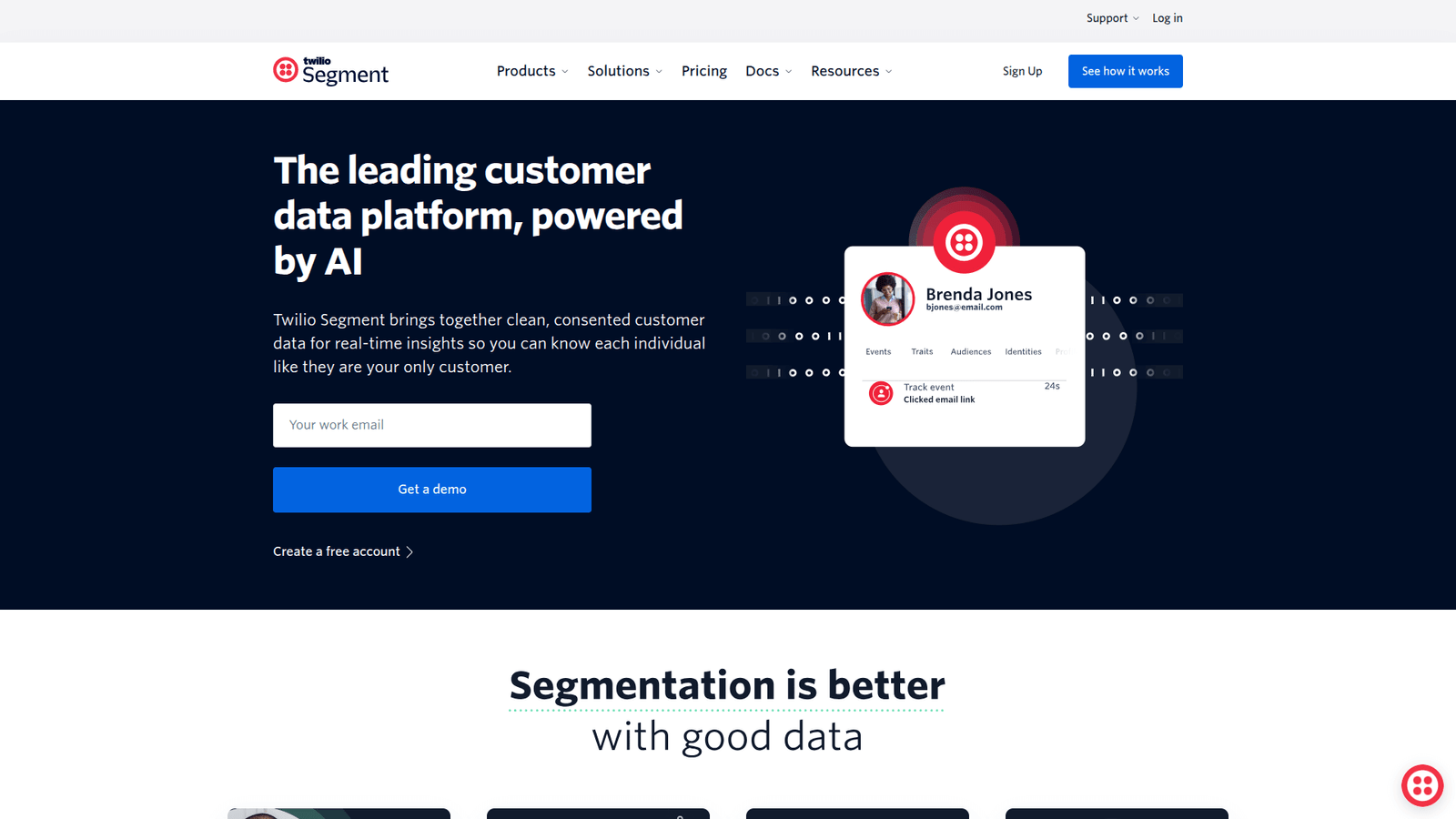

Segment transforms customer segmentation and prediction workflows for marketing and sales. Get deeper insights, boost conversions, and save time. Start using it today!
Why More People in Marketing and Sales Are Turning to Segment
Alright, let’s talk numbers.
And customers.
Specifically, knowing *which* customers.
And what they’re likely to do next.
Sounds simple, right?
It isn’t.
Traditionally, figuring out your ideal customer segments and predicting their behaviour was a grind.
Spreadsheets. Data silos. Gut feelings.
You hoped you were right.
Hope isn’t a strategy.
Especially not in Marketing and Sales.
Then AI crashed the party.
And things got interesting.
Tools popped up promising to make sense of the chaos.
Some delivered.
Many didn’t.
But one tool keeps coming up.
Not just for collecting data.
But for making that data *work* for you.
Specifically, for getting seriously good at Customer Segmentation and Prediction.
Why the buzz?
Why are teams ditching their old ways and flocking to it?
Let’s get into it.
What is Segment?
Okay, so what is it?
Think of it as a central nervous system for your customer data.
It’s a platform that collects data from all your different touchpoints – your website, mobile app, CRM, email marketing, advertising platforms, help desk, you name it.
It pulls it all together.
Cleans it.
Structures it.
And makes it ready for prime time.
Ready for *you* to use.
The real magic happens when you then send this unified, clean data out to all the tools you use.
Your analytics tools.
Your marketing automation platforms.
Your data warehouses.
It ensures everyone is talking the same language.
Everyone sees the same customer profile.
No more fragmented data.
No more arguing about whose numbers are right.
For folks in Marketing and Sales, this is huge.
It means you’re working with a single source of truth.
This isn’t just about tidying up data.
It’s about making that data actionable.
It lays the groundwork for deep Customer Segmentation and Prediction.
You can finally understand your customers on a granular level.
Who they are, what they do, what they *might* do next.
It’s designed for businesses that are serious about using data to drive growth.
From startups to large enterprises.
If you have customers and you use more than one tool to interact with them, it is likely relevant to you.
It solves the fundamental problem of data silos.
And that problem is a killer for effective marketing and sales.
Key Features of Segment for Customer Segmentation and Prediction
Alright, let’s break down the specific it features that make a real difference when you’re trying to nail Customer Segmentation and Prediction.
This is where the rubber meets the road.
- Unified Customer Profiles:
It pulls data from every interaction point.
Website clicks, app usage, CRM notes, email opens, purchase history.
It stitches it all together.
Into one comprehensive profile for each customer.
Imagine having a single view of Tim.
You see he visited page X, added product Y to his cart (but didn’t buy), opened your last email, and had a support chat about feature Z.
All in one place.
This unified view is gold.
It lets you segment Tim accurately based on his actual behaviour, not just where he came from.
- Audience Building:
This is where segmentation gets powerful.
Using those rich profiles, its Audience Builder lets you create highly specific segments.
Customers who bought product A *and* live in London? Easy.
Users who signed up in the last 30 days *and* viewed your pricing page more than twice? Done.
People who abandoned their cart *and* haven’t opened an email in a week? You get the picture.
You define the rules using all that beautiful, unified data.
No more guessing who fits where.
The segments are dynamic.
As customers fit the criteria, they automatically enter the segment.
As they stop fitting, they leave.
Your segments stay fresh and accurate.
- Predictive Audiences (often via integrations):
Okay, It itself isn’t a deep AI prediction engine out of the box like some standalone tools.
But its power lies in providing the *perfect data feed* for those tools.
It integrates seamlessly with predictive analytics platforms.
Think tools that predict churn risk, customer lifetime value (CLTV), or propensity to buy a specific product.
These predictive tools need clean, comprehensive behavioural data to work.
It is the master provider of that data.
It can even send the *output* of these predictive models (like “churn risk score: high”) back into the customer profile.
Then you can segment based on that prediction.
Create a segment of “High-Risk Churn Users”.
Or “High CLTV Potential”.
Then send those segments directly to your marketing tools for targeted campaigns.
This is where prediction becomes actionable within your marketing and sales workflows.
- Connections & Destinations:
Building segments and getting predictions is useless if you can’t act on them.
It connects to literally hundreds of other marketing, sales, and analytics tools.
Want to send your “Cart Abandoners – High Intent” segment to Facebook Ads for retargeting?
Push your “Likely Repeat Buyer” segment to your email platform for a special offer?
Sync your “Predicted High CLTV” segment to your CRM for your sales team?
It makes this flow automatic.
Your segments and predictive scores are live and available wherever you need them.
This eliminates manual list exports and imports.
Saves a ton of time.
And ensures your outreach is always based on the most current, accurate data and predictions.
Benefits of Using Segment for Marketing and Sales
Okay, we’ve seen the features.
But what does that actually *mean* for you?
What are the real-world wins?
It boils down to getting more done, making better decisions, and ultimately, making more money.
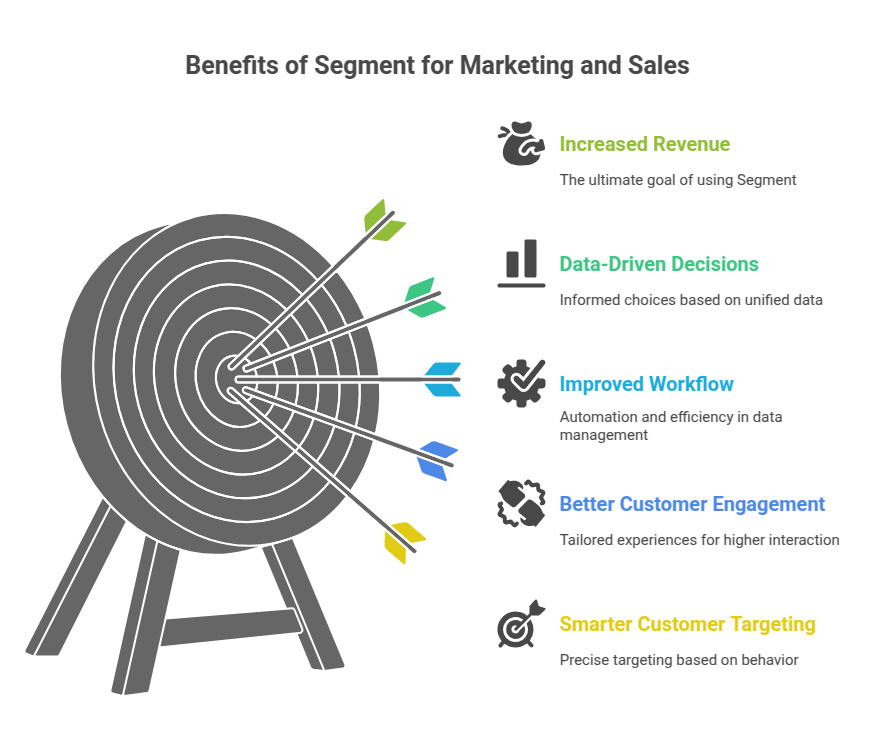
Smarter Customer Targeting: This is the big one. No more blasting generic messages. With it, you can target specific customer groups with hyper-relevant offers and messages based on their actual behaviour and predicted future actions. This leads to significantly higher engagement rates.
Improved Conversion Rates: When you understand your segments and can predict their needs, you can tailor landing pages, email campaigns, and sales pitches. Sending the right message to the right person at the right time is the oldest trick in the book, and it makes it possible at scale. Tailored experiences convert better. Period.
Higher Customer Lifetime Value (CLTV): By identifying and nurturing high-potential customers using predictive insights, you increase their loyalty and repeat purchases. You can run targeted campaigns to prevent churn for at-risk customers. Keeping customers costs less than acquiring new ones, boosting your CLTV.
Reduced Ad Spend Waste: Are you targeting people who are never going to buy? It helps you define audiences for advertising based on real data and predictions. Exclude low-potential segments, focus on high-intent or high-CLTV segments. Your ad budget goes further.
Faster Workflow: Forget wrestling with spreadsheets and exporting/importing lists between tools. It automates the data flow. Segments update automatically. This frees up your team’s time to actually *do* marketing and sales, not just manage data.
Better Sales-Marketing Alignment: Sales and marketing teams often work from different data sets. It provides a single source of truth. Marketing can build segments for sales outreach, and sales can see the full history marketing has on a lead. This reduces friction and improves collaboration.
Data-Driven Decision Making: When your data is clean, unified, and accessible, you can make decisions based on facts, not assumptions. It provides the foundation for better analytics and reporting, helping you understand what’s working and what isn’t for each segment.
Look, Customer Segmentation and Prediction aren’t academic exercises.
They are tools to make you more effective.
It removes the biggest barrier to being effective: messy data.
It puts the power of detailed customer understanding and predictive insights directly into your workflow.
That’s not a small win.
That’s the game.
Pricing & Plans
Okay, let’s talk money.
It isn’t typically the cheapest tool on the block.
But you’re not paying for a simple email list.
You’re paying for infrastructure.
For the pipes that handle all your customer data.
Their pricing model is primarily based on the number of “Monthly Tracked Users” (MTUs).
An MTU is basically any user it sees data for within a given month.
They have a few tiers, but the specifics can vary and are often customised for larger businesses.
Free Tier: Yes, they have a free plan. It’s pretty generous for a tool like this. It’s great for small projects or getting started. It usually has limits on MTUs and available features compared to paid plans. But it lets you kick the tires and see how the data collection works.
Team Plan: This is usually the entry-level paid plan. It increases the MTU limit and unlocks more features, like advanced audience building capabilities and access to more destinations (where you send your data). This is suitable for growing teams getting serious about data.
Business Plan: This is for larger organisations with more complex data needs, higher volumes of users, and requiring enterprise-level features, support, and security. Pricing is often custom here.
Compared to simply trying to build this infrastructure yourself, or relying on fragmented tools, Its pricing reflects the significant value of having a reliable, scalable data pipeline.
Alternatives often involve stitching together multiple tools (ETL tools, CDPs, etc.), which can quickly become more expensive and much harder to manage.
Its value proposition is simplifying complexity.
You pay for that simplification and the robust data foundation it provides.
Is it right for a brand new solo entrepreneur with 10 customers? Probably not yet.
Is it right for a business with a growing customer base and multiple marketing/sales tools? Almost certainly worth investigating the cost vs. the benefits.
The ROI comes from the increased efficiency, better targeting, and improved results in your Marketing and Sales efforts driven by better Customer Segmentation and Prediction.
You need to weigh the cost against the potential lift in conversions, CLTV, and reduced wasted spend.
Hands-On Experience / Use Cases

Let’s talk about actually using it.
My experience, and the experience of teams I’ve seen use it, often follows a similar pattern.
Phase 1: The “Oh wow, this is complicated” phase.
Setting up it initially requires some technical work.
You need to install their tracking library (on your website, app, etc.) and define the “events” you want to track.
What’s an event? A user signed up, a product was viewed, a button was clicked, a purchase was made, an email was opened.
Defining these events clearly is crucial.
This phase often involves developers.
It’s not a click-and-go setup for the data collection layer.
Phase 2: The “Okay, I see the potential” phase.
Once data starts flowing into it, you begin to see those unified profiles form.
You connect a few destinations – your CRM, your email tool, Google Analytics.
Suddenly, the data you tracked is appearing *everywhere* automatically.
This is when the penny drops.
No more waiting for data exports.
No more inconsistent numbers.
Phase 3: The “This changes everything” phase.
This is where you dive into Audience Builder.
You start creating segments based on real behaviour.
“Users who completed onboarding step 3 but not step 4”.
“Customers who haven’t ordered in 90 days but looked at the new arrivals page”.
You then send these segments to your marketing tools.
You run highly specific campaigns.
You start seeing results.
Let’s take a real use case: Abandoned Carts.
Standard abandoned cart emails are okay.
It makes them better.
You track “Product Added”, “Checkout Started”, “Order Completed” events.
It knows who did the first two but not the third. That’s your basic abandoned cart segment.
But with it, you can refine it:
“Abandoned cart, total value > $100”.
“Abandoned cart, viewed checkout page more than once”.
“Abandoned cart, *and* opened the last 3 marketing emails”.
You can send different messaging to these specific groups.
Maybe offer a discount only to the high-value cart abandoners.
Maybe send a “Need Help?” message to those who struggled at checkout.
It connects these segments automatically to your email tool (like HubSpot, Mailchimp, Customer.io).
The results? Higher recovery rates for abandoned carts compared to generic outreach.
Another use case: Identifying High-Value Leads for Sales.
It tracks website behaviour (pages visited, content downloaded), product usage (if applicable), and even interaction with marketing campaigns.
Combine this with CRM data (company size, industry).
You can build a segment of “Marketing Qualified Leads – High Intent”.
Define “High Intent” based on actions correlated with becoming a good customer.
Send this segment directly to your sales team’s CRM (like Salesforce, Pipedrive).
Alert sales when a lead enters this segment.
Sales calls are now based on a deep understanding of the lead’s actions, not just basic form data.
This is proactive, data-driven Marketing and Sales.
The usability of the Audience Builder itself is quite good once the data is flowing correctly. It’s drag-and-drop, intuitive.
The complexity lies in the initial setup and planning of your tracking strategy.
But once that’s done, the day-to-day use for segmentation is powerful and relatively easy.
Who Should Use Segment?
So, is it for everyone?
Probably not the corner shop unless they have a complex online operation.
It is for businesses that have a significant online presence and interact with customers across multiple channels.
Here’s who benefits most:
E-commerce Businesses: Tracking product views, add-to-carts, purchases, returns, wishlists. Creating segments based on buying behaviour, categories viewed, purchase frequency. Essential for targeted campaigns, upsells, and win-backs.
SaaS Companies: Tracking feature usage, subscription levels, trial progression, support interactions, in-app behaviour. Perfect for segmenting users by adoption stage, engagement level, churn risk, or upsell potential. Fuels product-led growth and customer success initiatives.
Media Companies: Tracking content consumption, subscription status, ad clicks, demographic data. Crucial for segmenting readers/viewers by interest, engagement, and subscription likelihood to personalise content and advertising.
Mobile App Developers: Tracking in-app events, user flows, feature adoption, push notification interactions. Vital for segmenting users based on app usage patterns to improve onboarding, engagement, and monetisation.
Marketing Agencies: Managing data for multiple clients. It provides a standardised way to collect and route data, simplifying reporting and enabling advanced segmentation strategies across client accounts.
Companies with Complex Customer Journeys: If your customers interact with you via website, app, email, CRM, support, physical store (with integrated data), etc., it brings all that together. This is where its power truly shines – unifying fragmented journeys.
Businesses Relying on Multiple Marketing & Sales Tools: If you use a separate email tool, CRM, advertising platform, analytics tool, and data warehouse, it saves you immense time and effort by sending consistent data to all of them.
Essentially, if you’re serious about using data to understand your customers, personalise their experience, and improve your Customer Segmentation and Prediction efforts at scale, it is a strong contender.
It’s for teams who have outgrown basic marketing automation segmentation and need a true, reliable customer data foundation.
How to Make Money Using Segment

Alright, the fun part.
How does using it actually translate into more money in your pocket?
It’s not a direct money-making tool like an ad platform.
It’s an *enabler*.
It makes your other Marketing and Sales activities perform better.
- Offer Data Integration & Setup Services:
Setting up it correctly can be technical.
Businesses need help implementing the tracking plan, connecting sources, and configuring destinations.
If you understand data architecture and it, you can offer this as a service.
Charge for the setup project.
This is valuable because getting the data layer right is fundamental.
- Provide Advanced Segmentation & Audience Strategy:
Many businesses collect data but don’t know how to use it effectively for segmentation.
With Segment’s Audience Builder, you can create highly sophisticated segments.
Offer services to analyze a client’s customer data (via Segment), identify high-value segments, at-risk segments, etc.
Develop a tailored Customer Segmentation and Prediction strategy.
Define the key audiences they should target.
This moves beyond just setting up the tool; it’s strategic consulting based on the data it provides.
Charge a retainer or project fee for this expertise.
- Run Highly Effective Marketing Campaigns for Clients:
If you run campaigns for clients (email, ads, etc.), Segment is your secret weapon.
Instead of working with basic lists, you access dynamic, behaviour-based segments directly from it.
You can promise and deliver better results – higher open rates, click-through rates, conversion rates.
Because your targeting is incredibly precise.
This allows you to command higher fees or demonstrate better ROI, leading to client retention and referrals.
Example: An agency used it for an e-commerce client. They created a segment of “Repeat Buyers – Browsed New Collection”. They sent a targeted email campaign with a small early-access discount. The conversion rate for that segment was 3x higher than generic blasts, directly boosting the client’s revenue. The agency could show a clear line from using it to increased profit.
- Improve Sales Enablement:
Help sales teams close more deals.
Use it to identify leads showing high purchase intent based on website or app activity.
Route these “hot” leads to sales instantly with full context from their Segment profile.
Train sales teams on how to use the unified customer view it provides within their CRM.
Improved sales efficiency and win rates mean more revenue.
You can structure this as a consulting service or part of a broader go-to-market strategy engagement.
Segment makes your entire growth engine more efficient and effective.
Monetizing it isn’t about selling the tool itself.
It’s about selling the *outcomes* it enables: better targeting, higher conversions, more efficient sales, and a deeper understanding of the customer.
Limitations and Considerations
Nothing is perfect.
Segment is powerful, but it has its points to consider.
Implementation Effort: As mentioned, setting up it properly requires technical resources and careful planning of your tracking. It’s not just installing a plugin. Defining your events (what you track) is a critical step that needs thought. Get this wrong, and the data flowing in won’t be as useful.
Cost: For smaller businesses or those just starting out, the paid plans can be a significant investment. The MTU model means costs scale with your user base. You need to be sure the ROI justifies the expense.
It’s a CDP, Not a Campaign Tool: Segment is a Customer Data Platform. Its strength is collecting, unifying, and routing data. It’s not an email marketing tool, a CRM, or an advertising platform itself. You need to connect it to those tools to take action.
Requires Data Strategy: It provides the data foundation, but you still need a strategy for *how* you’ll use that data. What segments matter most? What campaigns will you run? Segment enables the strategy, but doesn’t create it for you.
Prediction Often Requires Other Tools: While it provides the data *for* prediction, it relies on integrations with predictive analytics platforms or data science models built on top of its data warehouse destinations for deep predictive capabilities. You might need additional tools for advanced prophecy.
Ongoing Governance: Keeping your Segment implementation clean and accurate requires ongoing data governance. As your product or website changes, your tracking might need updates. It’s not a set-it-and-forget-it system entirely.
These aren’t necessarily reasons *not* to use it, but they are factors to be aware of.
It requires a commitment to being data-driven and investing in the infrastructure to support that.
For businesses where Customer Segmentation and Prediction is critical to growth, these considerations are often outweighed by the benefits.
Final Thoughts
So, wrapping this up.
It is a heavyweight in the world of customer data.
For anyone serious about leveraging data for Marketing and Sales, especially when it comes to deep Customer Segmentation and Prediction, it solves a fundamental problem: fragmented data.
It provides the single source of truth that makes everything else work better.
Your targeting becomes more accurate.
Your campaigns become more effective.
Your sales team is better informed.
Your decisions are based on solid ground.
Is it easy? Not always at the start.
Is it cheap? Not for serious usage.
But is it powerful and capable of transforming your approach to customer understanding and outreach? Absolutely.
If your business has reached a point where understanding your customer base is bottlenecked by messy, siloed data, Segment is likely the solution you need.
It’s an investment in the core infrastructure of your growth engine.
Start with the free plan, understand the setup process, and see how unified data feels.
Then, evaluate if the leap to a paid plan makes sense for your scale and goals.
For many growing and established businesses, it is becoming less of a “nice to have” and more of a requirement for effective, modern marketing and sales.
It helps you move from guessing to knowing.
And knowing your customer is the ultimate advantage.
Visit the official Segment website
Frequently Asked Questions
1. What is Segment used for?
Segment is primarily used as a Customer Data Platform (CDP) to collect, clean, and control customer data from various sources (website, app, CRM, etc.). It then routes this unified data to other tools like marketing automation, analytics, and advertising platforms. It’s essential for building accurate customer profiles and powering precise customer segmentation and prediction.
2. Is Segment free?
Yes, Segment offers a free plan which is useful for getting started and smaller projects. Paid plans are available for businesses needing higher volumes of users, more features, and advanced capabilities.
3. How does Segment compare to other AI tools?
Segment isn’t an AI tool in the sense of generating content or running complex predictive models itself. It’s a data infrastructure tool. It *powers* AI tools and predictive platforms by providing them with the clean, unified customer data they need to function effectively. It complements other AI tools rather than directly competing with them.
4. Can beginners use Segment?
Using Segment effectively requires some technical understanding, particularly during the initial setup phase where you define and implement tracking. The interface for building audiences and connecting destinations is more user-friendly, but a basic understanding of data concepts is helpful. It’s often a tool managed by data teams, engineers, or technical marketers.
5. Does the content created by Segment meet quality and optimization standards?
Segment does not create content. It collects and manages customer data. The quality and optimization of marketing content (like emails, ads, landing pages) created using segments from it depend entirely on the content creation tools and strategies you use downstream from Segment. It ensures you are sending that content to the *right* people based on reliable data.
6. Can I make money with Segment?
Yes, indirectly. You can make money by using it to improve the effectiveness of your or your clients’ marketing and sales activities, leading to higher conversions, better ROI, and increased revenue. You can also offer services related to Segment setup, data strategy, and advanced segmentation based on its capabilities.