
Power BI Copilot transforms AI Dashboard Generation. Say goodbye to manual work and boost efficiency. Get instant clarity & make data-driven decisions faster. Try it now!
If You’re Not Using Power BI Copilot, You’re Falling Behind
Let’s be real.
The world of data moves fast.
If you work in Data Analysis and Business Intelligence, you know the drill.
Mountains of data.
Clients demanding insights.
Tight deadlines.
And everyone’s talking about AI.
Specifically, how AI is changing the game for AI Dashboard Generation.
You’ve seen the headlines.
Heard the buzz.
Maybe you’re wondering, “How do I even keep up?”
Or maybe, “Is this AI thing just hype, or is it the real deal?”
Well, let me tell you something.
Ignoring AI in this field is like ignoring the internet in the 90s.
It’s not an option.
And when it comes to AI Dashboard Generation, there’s one tool everyone’s whispering about.
Power BI Copilot.
This isn’t some futuristic concept.
It’s here.
And it’s changing how we work.
It promises to take the pain out of building dashboards.
To give you insights faster.
To make you more efficient.
But is it actually any good?
Does it deliver?
That’s what we’re here to find out.
We’re going to break down exactly what Power BI Copilot is.
How it specifically helps with AI Dashboard Generation.
The real benefits you can expect.
Who it’s for.
And yes, even how you might make some extra cash using it.
Ready?
Let’s go.
Table of Contents
- What is Power BI Copilot?
- Key Features of Power BI Copilot for AI Dashboard Generation
- Benefits of Using Power BI Copilot for Data Analysis and Business Intelligence
- Pricing & Plans
- Hands-On Experience / Use Cases
- Who Should Use Power BI Copilot?
- How to Make Money Using Power BI Copilot
- Limitations and Considerations
- Final Thoughts
- Frequently Asked Questions
What is Power BI Copilot?
Okay, first things first.
What exactly are we talking about?
Power BI Copilot is Microsoft’s answer to bringing powerful AI capabilities directly into their Power BI platform.
Think of it like having an intelligent assistant right there, inside the tool you already use.
It’s built on large language models, similar to the tech behind things like ChatGPT.
But here’s the key difference: it’s specifically designed for working with data and building reports.
It understands the nuances of data models.
It knows how to look at tables and columns.
And it’s trained to help you visualise that data effectively.
The primary goal?
To make you faster and more efficient at getting from raw data to insightful dashboards.
It takes your natural language queries and translates them into actions within Power BI.
Instead of clicking through menus or writing complex DAX formulas just to get started, you can simply tell Copilot what you want.
Imagine saying, “Show me total sales by region for the last quarter” and having visuals appear.
That’s the promise.
It’s not just for data gurus either.
It’s aimed at anyone who needs to understand data and share insights.
That includes seasoned Data Analysis and Business Intelligence professionals, business analysts, managers, and even folks who are just starting out.
It lowers the barrier to entry for creating sophisticated reports.
It allows you to focus on the *what* you want to see, rather than the *how* to build it.
This frees up your time.
It lets you spend more energy interpreting the data and less on the mechanics of dashboard building.
It integrates directly within the Power BI Desktop and service environment.
This means it’s not a separate tool you have to switch to.
It’s right there where you work.
This seamless integration is crucial.
It makes the workflow feel natural, not clunky.
So, in short?
Power BI Copilot is your AI sidekick for everything data reporting and dashboard related within Power BI.
Key Features of Power BI Copilot for AI Dashboard Generation
Alright, let’s get specific.
How does this thing actually help you build dashboards using AI?
It’s got some pretty cool features that are specifically designed for this.
- Automatic Report Creation: This is the big one for AI Dashboard Generation. Instead of starting from a blank canvas, you can prompt Power BI Copilot to create a draft report based on your data. You tell it the high-level goal – “Analyse our sales performance by product category” or “Build a report showing customer churn trends”. Copilot looks at your data model and generates a starting point. It populates pages with relevant visuals and key metrics. It’s like getting a head start, potentially saving you hours of initial dragging and dropping.
You still need to refine it, of course.
But getting that first draft done automatically?
Huge time saver.
It understands relationships in your data model.
It tries to pick the right visual types for the data you’re asking about.
Lines for trends, bars for comparisons, maps for geography.
It takes a smart guess based on the data’s characteristics.
- Narrative Summaries: This is gold. Power BI Copilot can generate text summaries based on the data in your report. Instead of just showing charts, you can get written explanations of what the data means. Imagine a sales report where Copilot automatically writes a paragraph highlighting the top-performing region or the biggest sales dip. It adds context. It makes the report more accessible to people who aren’t data experts. This saves you the effort of manually writing interpretations for every chart. It adds a layer of storytelling to your data.
This feature is great for busy stakeholders.
They can read the summary and quickly grasp the key insights without spending ages analysing every visual.
It makes your reports more impactful.
More actionable.
- DAX Query Assistance: DAX can be tricky, right? Even for experienced users. Power BI Copilot helps here too. You can ask it questions about how to calculate something, and it can suggest DAX formulas. Need to calculate year-over-year growth or a running total? Describe it in plain English. Copilot can give you a starting point for the DAX code. This isn’t just about writing the code for you. It’s a learning tool. You can see how it constructs the formula and understand the logic. It helps bridge the gap for those who aren’t DAX ninjas yet.
It speeds up the development process.
Reduces errors.
And helps you tackle calculations you might have avoided before.
It’s like having a DAX tutor on demand.
These core features work together.
They streamline the entire process of turning data into a dashboard.
From the initial setup to getting the insights ready for consumption.
It’s about reducing the manual grunt work.
So you can focus on the analysis itself.
And making sure the story the data tells is clear and compelling.
Benefits of Using Power BI Copilot for Data Analysis and Business Intelligence
Okay, so it has some cool features.
But what’s the real payoff?
Why should you care?
Here are the tangible benefits you get by bringing Power BI Copilot into your workflow for Data Analysis and Business Intelligence.
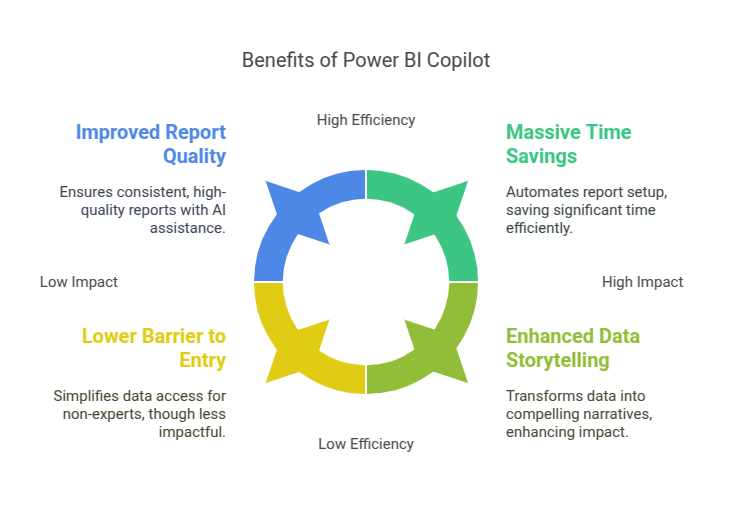
Massive Time Savings: This is probably the biggest one. Manually building dashboards, especially complex ones, takes ages. Gathering requirements, connecting data, creating visuals, formatting… it adds up. Copilot automates the initial setup. Generating a first draft report in minutes instead of hours is a game-changer. This frees up time for deeper analysis. For checking data quality. For refining the visuals. For actually understanding what the data means. You’re not just building reports faster; you’re getting to the valuable insights quicker.
Improved Report Quality and Consistency: AI can help you avoid common mistakes. It can suggest best practices for visualisations based on the data type. It ensures a baseline level of quality and consistency across reports. The narrative summaries add depth and context, making the reports more informative. This leads to higher-quality deliverables for your clients or internal stakeholders. And consistent reports are easier to understand and compare over time.
Lower Barrier to Entry: Not everyone using Power BI is a data wizard. Managers, sales teams, HR staff – they all need data. Power BI Copilot makes it easier for non-experts to get value from Power BI. They can use natural language to ask questions and get visuals or summaries. This democratises data access. It empowers more people within an organisation to be data-driven. You don’t need to rely solely on a dedicated BI team for every single report request.
Enhanced Data Storytelling: The narrative summaries aren’t just bullet points. They use AI to look at trends, outliers, and key figures in your data and present them in plain language. This is crucial for effective business intelligence. Data isn’t valuable until you can explain what it means and why it matters. Copilot helps you build that narrative automatically. It turns raw numbers into compelling stories that resonate with your audience.
Faster Iteration: Business requirements change. You often need to tweak reports based on feedback. With Copilot, making changes is quicker. You can ask it to add a new visual, filter data differently, or generate a summary for a specific section using natural language. This rapid iteration cycle means you can get to the final, perfect report much faster. It makes you more agile and responsive to changing needs.
Reduced Cognitive Load: Building complex data models and reports requires significant mental effort. Remembering DAX functions, choosing the right visual, ensuring filters are applied correctly – it’s a lot to juggle. Power BI Copilot takes some of that load off. It handles the initial structure and suggests visuals, allowing your brain to focus on the higher-level problem-solving and analysis.
These benefits translate directly into better outcomes.
You deliver insights faster.
Your reports are clearer.
More people can use data effectively.
And you save precious time and energy.
That’s the power of bringing AI like Copilot into your data workflow.
Pricing & Plans
Alright, the million-dollar question.
How much does this thing cost?
And is there a free version to try it out?
Power BI Copilot isn’t a standalone product you buy separately.
It’s an add-on capability within the Microsoft 365 and Power BI ecosystem.
To use Copilot features within Power BI, you typically need a Power BI Premium capacity or Power BI Premium per user (PPU) licence.
This means it’s generally not available on the standard Power BI Pro licence.
Premium capacity is usually for larger organisations that need dedicated resources and advanced features.
PPU is a per-user licence that gives individuals access to most Premium features without needing a shared capacity.
So, if you’re on a standard Power BI Pro licence, you’ll likely need to upgrade to access Power BI Copilot.
The pricing for Premium capacity can vary significantly based on the size and scale of your needs.
Power BI Premium per user (PPU) has a set monthly cost per user.
As of my last update, there isn’t a specific free trial *just* for Copilot itself, separate from Power BI Premium.
However, you can often get free trials for Power BI Premium or PPU, which would then give you access to Copilot features during the trial period.
How does this compare to alternatives?
Many other AI tools focus on specific aspects like text generation or image creation.
Power BI Copilot is unique because it’s built *into* a leading BI platform.
Its primary comparison point isn’t really another AI tool, but rather the manual way of building reports or using less integrated automation methods.
The value proposition is in the integration and the domain-specific AI capabilities for data and BI.
You’re paying for the AI to understand your data model and the Power BI environment.
While the Premium/PPU licence might seem like a jump from a Pro licence, the time savings and increased efficiency from Power BI Copilot can quickly justify the cost for individuals and teams who spend a significant amount of time on dashboard creation.
Think about how much time you’d save per week or month.
What’s that time worth?
For organisations already using Power BI Premium, Copilot is a powerful enhancement to an existing investment.
For others, it might require evaluating if the benefits of Premium, including Copilot, outweigh the cost increase over Pro.
Check the latest pricing details directly on the Microsoft Power BI website, as licensing and features can evolve.
Hands-On Experience / Use Cases

Talking about features and benefits is one thing.
Seeing it in action is another.
So, what does it actually look like when you use Power BI Copilot for AI Dashboard Generation?
Imagine you’re a data analyst for an e-commerce company.
Your boss just dropped a dataset on you.
It has sales data, customer info, product details, and shipping logs.
The task?
Build a dashboard summarising sales performance, customer demographics, and shipping efficiency.
In the old days, you’d spend a chunk of time just importing the data, modelling it, and then deciding which visuals to create first.
Line chart for sales over time?
Bar chart for sales by product category?
Map for sales by region?
Scatter plot for customer age vs. spending?
With Power BI Copilot, you load your data and ensure your model has basic relationships.
Then you open the Copilot pane.
You type something like: “Create a report analysing e-commerce sales performance, showing sales by product category, sales over time, and sales by customer location.”
Copilot gets to work.
It analyses your data model.
It might suggest focusing on specific tables like ‘Sales’ or ‘Customers’.
It then proposes creating a multi-page report.
Page 1 might be a sales overview with cards showing total sales, average order value, and visuals for sales by category and sales by month.
Page 2 could focus on customers, maybe showing sales by demographic (if you have that data) or new vs. returning customers.
Page 3 could tackle shipping, perhaps showing average shipping times by region or carrier.
It doesn’t just create empty pages.
It populates them with visualisations.
It might automatically create a bar chart for sales by product category, a line chart for sales over time, and a map visual for sales by customer location, picking appropriate fields from your data.
It might even add a narrative summary to the first page, highlighting key figures like the top-performing product category or peak sales month.
Now, this isn’t always perfect.
The visual choices might not be exactly what you’d pick.
The fields might need tweaking.
But you have a complete, functional starting point in minutes.
You can then refine it.
Change chart types.
Add more filters.
Customise colours and formatting.
Add more specific DAX calculations (maybe using Copilot’s DAX assistance!).
You can also interact with Power BI Copilot within existing reports.
Point to a visual and ask, “Explain the key factors driving the trend in this chart.”
Or select a measure and ask, “How do I calculate the percentage of total for this?”
The usability is straightforward – it’s a chat pane within Power BI.
You type your request, and Copilot responds by generating visuals, text, or code suggestions.
The result is a dramatically accelerated workflow for creating initial reports and adding explanatory context.
It’s less about starting from scratch and more about refining an AI-generated draft.
This hands-on capability makes AI Dashboard Generation much less of a manual grind.
Who Should Use Power BI Copilot?
So, who actually benefits the most from this tool?
Is it just for the hardcore data scientists, or can anyone jump in?
Here’s a breakdown of the ideal users:
Data Analysis and Business Intelligence Professionals: This is the obvious one. If you spend your days building reports, analysing datasets, and presenting insights in Power BI, Copilot is designed for you. It automates repetitive tasks, speeds up report creation, and helps with complex calculations (DAX). It allows you to handle more data and create more reports in less time. You can focus your expertise on the deeper analysis and strategic recommendations, rather than the mechanics of building visuals.
Business Analysts: Often the bridge between the business side and the data side. Business analysts need to quickly prototype reports, understand data trends, and communicate findings to non-technical stakeholders. Copilot’s ability to quickly generate reports and create narrative summaries is perfect for this role. It helps them respond faster to business questions and produce clear, actionable reports without needing deep technical Power BI skills.
Department Heads and Managers: Many managers need to see and understand data relevant to their teams or departments. They might not be Power BI experts but need quick access to insights. Power BI Copilot empowers them to ask questions about their data in natural language within Power BI. They can potentially create simple reports or get summaries of existing dashboards without relying on the BI team for every request. This fosters a more data-literate organisation.
Freelancers and Consultants: If you offer data reporting or BI services to clients, Power BI Copilot can be a competitive advantage. You can deliver initial drafts of dashboards much faster. The narrative summaries can enhance the value you provide. Increased efficiency means you can take on more projects or deliver projects quicker, increasing your revenue potential. It helps you stand out by leveraging cutting-edge AI capabilities.
Small Business Owners: For businesses that can’t afford a dedicated BI team, but still use Power BI for sales, marketing, or operational data, Copilot can be incredibly valuable. It lowers the technical barrier to getting insights from their data. An owner or a key employee can use Power BI Copilot to quickly build reports on key metrics without needing extensive Power BI training.
Beginners learning Power BI: Trying to learn Power BI can be intimidating. Copilot can act as a guide. Seeing how it generates reports or suggests DAX formulas can help beginners understand the structure and logic of Power BI. It provides a helpful starting point and reduces frustration.
Essentially, if you work with data in Power BI and need to create reports or understand insights faster and more efficiently, Power BI Copilot is worth considering. It’s about leveraging AI to augment human capability, making data work easier and more accessible.
How to Make Money Using Power BI Copilot

Okay, time for the part everyone asks about.
Can you actually turn this tool into a money-making machine?
Absolutely.
Think of Power BI Copilot as a force multiplier.
It doesn’t directly make money *for* you, but it makes *you* far more efficient at tasks that clients or employers pay for.
Here are some ways to leverage it for income:
- Offer Accelerated AI Dashboard Generation Services: This is the most direct application. Advertise your services specifically using AI-powered tools like Copilot. Promise quicker turnaround times for initial dashboard drafts. Since Copilot can generate a baseline report much faster than doing it manually, you save time on billable hours for that initial phase. You can charge a premium for the speed, or simply take on more projects because you’re completing them faster. Highlight the AI angle in your marketing – “Get your business insights dashboard in days, not weeks, with AI-powered Power BI development.”
Clients are willing to pay for speed and efficiency.
Your ability to leverage Copilot directly benefits them.
You can show them how quickly you can prototype their required reports.
- Provide Enhanced Data Storytelling and Reporting: The narrative summaries generated by Copilot add significant value. Offer this as a premium service. Instead of just delivering a dashboard, you deliver a dashboard *with* AI-generated explanations of the key trends and findings. This is particularly valuable for clients who aren’t data-savvy. You’re not just giving them charts; you’re giving them insights they can immediately understand and act on. Position yourself as someone who not only builds reports but also makes the data understandable.
This adds a layer of sophistication to your deliverables.
It makes your work more valuable.
And clients appreciate clear, actionable insights.
- Develop and Sell Power BI Templates with AI Capabilities: If you build dashboards for specific industries or business functions repeatedly (e.g., marketing analytics for e-commerce, sales performance for SaaS), you can create robust Power BI templates. Integrate Copilot’s features where possible, perhaps by setting up the model so Copilot can easily generate specific narratives or visuals. Sell these templates. You can also offer customisation services, using Copilot to quickly tailor the template to a client’s specific data structure. The template provides a base, and Copilot speeds up the customisation.
This creates a scalable revenue stream.
You build the base template once, sell it multiple times, and use Copilot to make customisation efficient.
You could also offer workshops or training on “How to Use Power BI Copilot for AI Dashboard Generation“. Position yourself as an expert in this new AI-driven BI workflow.
Another angle is internal efficiency for your own job.
If your company uses Power BI and gets Copilot, mastering it makes you more valuable.
You become the go-to person for leveraging the AI features.
This can lead to promotions or increased responsibilities, which means higher pay.
Let’s consider a simple example.
Suppose a freelancer charges £50/hour for Power BI development.
A typical dashboard might take 10 hours to build manually.
That’s £500.
With Power BI Copilot, the initial draft might take 1 hour, and refinement takes 4 hours.
Total time: 5 hours.
They could still charge £500 (value-based pricing for the dashboard itself, not just hours) and pocket £250 more profit per dashboard.
Or they could charge £400 (a slight discount for the client) and still complete two such projects in the time it used to take for one, doubling their revenue for that timeframe.
It’s all about the leverage.
Using Copilot makes you more productive, and you can sell that increased productivity (as faster delivery or higher output) to clients or employers.
Limitations and Considerations
Alright, let’s pump the brakes a little.
Power BI Copilot is powerful, but it’s not magic.
Like any AI tool, it has limitations.
And there are things you need to consider before relying on it completely.
Data Quality is Crucial: Copilot is only as good as the data you feed it. If your data is messy, inconsistent, or poorly structured, Copilot will generate reports based on that bad data. “Garbage in, garbage out” applies here big time. You still need a solid data model, clean data, and well-defined measures for Copilot to be truly effective. It doesn’t fix your underlying data issues.
Requires a Well-Structured Data Model: Copilot relies on understanding the relationships and semantics in your Power BI data model. If your model is complex, lacks clear relationships, or has ambiguous naming conventions, Copilot might struggle to interpret your requests correctly or generate relevant visuals. Investing time in building a robust and intuitive data model is essential for getting the most out of Copilot.
Editing and Refinement are Still Necessary: The reports generated by Copilot are drafts. They are a starting point, not usually the final product. You will almost certainly need to edit the visuals, adjust layouts, refine filters, and tweak narrative summaries. It’s a co-pilot, remember? Not an auto-pilot. Your expertise in dashboard design and data interpretation is still vital for turning the draft into a polished, insightful report.
Potential for Misinterpretation: AI models can sometimes misinterpret natural language queries. You might ask for one thing, and Copilot might deliver something slightly different based on its understanding of your data and your prompt. You need to review the generated content carefully to ensure it aligns with your intent and accurately represents the data.
Learning Curve for Prompts: While it uses natural language, getting the best results often requires learning how to phrase your prompts effectively. You’ll get better results by being specific about the data you want to see, the type of analysis, and potentially the desired visualisations. There’s a knack to writing good prompts for Copilot, just like with other AI tools.
Cost: As mentioned, it requires Power BI Premium or PPU licences, which are more expensive than Power BI Pro. This might be a barrier for individuals or smaller businesses on tighter budgets. You need to weigh the cost against the potential time savings and benefits.
Dependency on Microsoft’s Development: Copilot is a relatively new feature, and it’s still evolving. Its capabilities will change and improve over time. While this is mostly positive, it means you are dependent on Microsoft’s development roadmap and the stability of the service.
Using Power BI Copilot effectively means understanding its strengths and weaknesses.
It’s an accelerator and an assistant.
It doesn’t replace your skills in data analysis, modelling, and report design.
It augments them.
Treat it as a powerful tool in your belt, but know that you still need to be the driver.
Final Thoughts
Let’s wrap this up.
Power BI Copilot is a significant step forward for anyone working in Data Analysis and Business Intelligence.
Especially when it comes to AI Dashboard Generation.
It’s not just another AI gimmick.
It’s integrated into a leading BI platform.
It understands your data model.
And it offers real, tangible benefits.
The ability to generate initial report drafts automatically is a huge time saver.
The narrative summaries make your data accessible and tell a story.
The DAX assistance helps tackle complex calculations.
All of this adds up to increased efficiency, faster insights, and potentially higher quality reports.
It lowers the barrier for less technical users and empowers experienced professionals to focus on higher-value tasks.
Yes, it has limitations.
Data quality, model structure, and human review are still essential.
It requires an investment in Power BI Premium or PPU.
But if you spend a considerable amount of time building reports in Power BI, the potential return on that investment, in terms of time saved and value delivered, is significant.
For freelancers, consultants, or even internal teams, the ability to deliver dashboards faster and with AI-enhanced insights can be a major differentiator.
It allows you to take on more work, meet tighter deadlines, and provide more value to your clients or organisation.
If you’re already in the Microsoft ecosystem and use Power BI heavily, exploring Power BI Copilot is a no-brainer.
It’s the direction the industry is heading.
Leveraging AI like this isn’t just about keeping up; it’s about getting ahead.
It’s about working smarter, not just harder.
My recommendation?
If you have access to Power BI Premium or PPU, or if the potential efficiency gains justify the upgrade cost for you or your team, give Power BI Copilot a serious look.
Experiment with generating reports.
Try using the narrative summaries.
See how it handles your specific data and use cases.
It might just change the way you work.
And if you’re offering services?
Start marketing the speed and AI-powered insights you can provide with Power BI Copilot.
It’s a powerful tool that’s reshaping the landscape of business intelligence.
Don’t get left behind.
Visit the official Power BI Copilot website
Frequently Asked Questions
1. What is Power BI Copilot used for?
Power BI Copilot is an AI assistant integrated into Power BI.
It helps users create reports and dashboards, generate narrative summaries of data, and get assistance with calculations using natural language prompts.
Its primary use is to accelerate and simplify the process of getting from raw data to insightful reports in Power BI.
2. Is Power BI Copilot free?
No, Power BI Copilot is not free.
It requires a Power BI Premium capacity or Power BI Premium per user (PPU) licence to access its features within Power BI.
These are higher-tier licences than the standard Power BI Pro licence.
3. How does Power BI Copilot compare to other AI tools?
Power BI Copilot is specifically designed for data analysis and report generation within the Power BI platform.
Unlike general-purpose AI writing tools or image generators, it understands data models, relationships, and the nuances of business intelligence.
Its strength lies in its deep integration and domain-specific AI capabilities for working with structured data.
4. Can beginners use Power BI Copilot?
Yes, beginners can use Power BI Copilot.
It can actually help them by providing a starting point for reports and simplifying complex tasks like writing DAX formulas through natural language.
However, a basic understanding of data concepts and the Power BI interface is still beneficial for effective use and refinement of the AI-generated content.
5. Does the content created by Power BI Copilot meet quality and optimization standards?
Power BI Copilot generates drafts of reports, visuals, and narratives.
The quality of the output depends heavily on the quality and structure of your underlying data and data model.
Human review and refinement are always needed to ensure accuracy, relevance, and alignment with specific business requirements and design standards.
It provides a strong starting point but doesn’t guarantee a perfectly optimized final product without manual effort.
6. Can I make money with Power BI Copilot?
Yes, you can make money by leveraging the efficiency and capabilities of Power BI Copilot.
You can offer faster AI Dashboard Generation services to clients, provide enhanced reporting with AI-generated narratives, or use it to increase your productivity in a full-time data role, leading to career advancement and higher earning potential.