
Discover the best AI coding tools to accelerate your learning and master programming quickly, turning your time into profitable skills. This guide reviews the top options for rapid progress.
Unlocking Your Potential: The 7 Best AI Coding Tools for Rapid Learning
Looking for the best AI coding tools to accelerate your programming journey? You’re in the right place. I’m here to tell you straight: learning to code doesn’t have to be a slow grind. With the right artificial intelligence at your side, you can cut years off your learning curve. We’re talking about tools that don’t just write code for you, but genuinely teach you the ‘why’ and the ‘how’, making you a more effective developer faster than ever before. Forget the old ways; it’s time to leverage technology that actually works.
Many aspiring developers struggle with motivation, understanding complex concepts, or just getting stuck on syntax errors. The traditional path can be frustrating and slow. But what if there was a way to have a personal tutor, a debugging assistant, and a code generator all rolled into one? That’s exactly what the best AI coding tools offer. They provide personalised feedback, instant solutions, and structured learning paths that adapt to your pace. This isn’t about cheating; it’s about smart leverage to build valuable skills quickly. If you want results, you need the right instruments.
This article isn’t just a list; it’s a strategic guide for anyone serious about mastering code. I’ve scoured the market to identify the absolute best AI coding tools that deliver tangible results. We’ll break down what makes each one stand out, who it’s for, and how you can use it to not just learn, but to earn. My goal for you is simple: choose the right tool, put in the work, and watch your coding proficiency skyrocket. Let’s get to it and find the best AI coding tools for your specific needs.
Table of Contents
- What Are the Best Learning To Code Tools?
- Top 7 Learning To Code Tools (Detailed Reviews)
- Feature Comparison
- Pricing Breakdown
- Real-World Use Cases
- Who Should Use Each Tool?
- How to Choose the Right Tool
- Making Money with These Tools
- Common Limitations
- Final Verdict and Recommendations
- Frequently Asked Questions
What Are the Best Learning To Code Tools?
The best AI coding tools are essentially intelligent software applications designed to assist developers, from absolute beginners to seasoned professionals, in writing, debugging, testing, and learning code. They leverage machine learning algorithms to understand programming contexts, predict code patterns, and offer solutions that go beyond simple autocomplete. Think of them as your hyper-efficient coding assistant, always ready to lend a hand, correct a mistake, or suggest a more optimal approach. These tools aren’t just about saving time; they’re about enhancing comprehension and accelerating skill acquisition.
These sophisticated platforms can perform a multitude of tasks. They can generate entire functions based on a comment, refactor existing code for better performance or readability, and even translate code between different languages. For learners, this means getting instant feedback on assignments, having complex concepts explained in simpler terms, and seeing practical implementations of theoretical knowledge. The aim is to bridge the gap between abstract understanding and practical application, making the learning process far more engaging and effective. Choosing the best AI coding tools means selecting ones that align with your learning style and specific goals.
Historically, learning to code involved hours of trial and error, poring over documentation, and patiently debugging. While those elements remain crucial, AI tools significantly streamline this process. They act as a force multiplier, allowing you to experiment more, fail faster, and learn from mistakes without getting bogged down. The predictive capabilities help you anticipate common errors, while the generative features allow you to explore different solutions without manual boilerplate coding. This dramatically reduces the cognitive load, freeing you up to focus on logic and problem-solving, which are the real core of programming. The real value of the best AI coding tools lies in their ability to make you a more capable programmer, not just a faster one.
Moreover, these tools often come integrated with popular development environments (IDEs) or as standalone web applications, making them accessible regardless of your setup. They often learn from vast datasets of existing code, allowing them to recognise best practices and common pitfalls across various programming languages. This exposure to high-quality code can inherently improve your own coding habits. For anyone serious about making rapid progress in programming, understanding and utilising the best AI coding tools isn’t optional; it’s a strategic necessity. They are redefining what’s possible in code development and education. We’re talking about direct impact on your progress.
Top 7 Learning To Code Tools (Detailed Reviews)
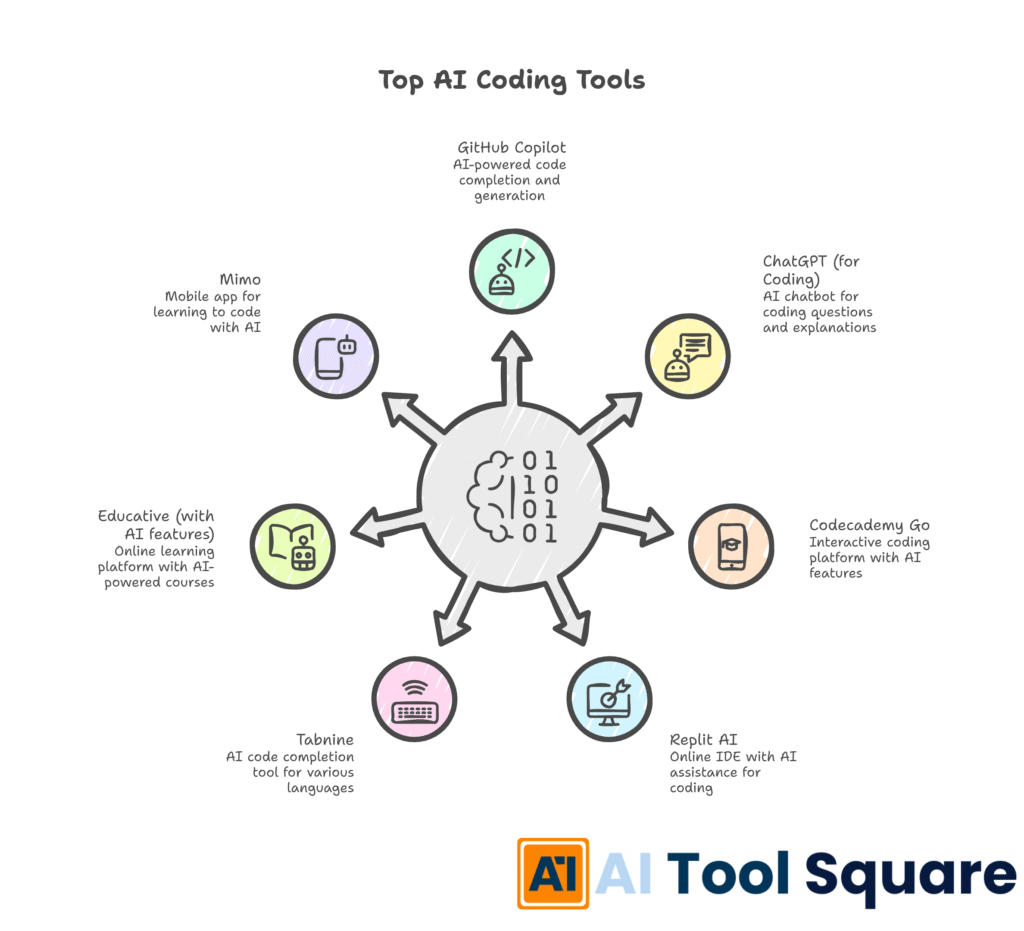
Alright, let’s get down to brass tacks. You want to know which specific platforms are the best AI coding tools. I’ve picked seven that offer distinct advantages for learning and practical application. Each one provides a unique approach, whether it’s pure code generation, interactive tutorials, or intelligent refactoring. This isn’t just about features; it’s about choosing the right leverage to achieve your coding goals. Pay attention to how each tool aligns with what you need to master. No fluff, just results. These are truly the best AI coding tools available right now for serious learners.
When evaluating these tools, I considered their effectiveness for accelerating learning, their integration capabilities, and their overall value proposition. It’s not enough for a tool to be ‘smart’; it must be smart in a way that directly translates to faster skill acquisition and more efficient problem-solving. Some excel at guiding beginners, others empower intermediate developers, and a few are potent for advanced users looking to optimise their workflow. The goal is to provide you with actionable insights so you can pick the best AI coding tools that will make a genuine difference in your coding journey. Don’t waste your time on tools that don’t deliver.
Each review will cover the core functionalities, how they help you learn, their pricing models, and a straightforward list of pros and cons. My aim is to give you a clear picture of what you’re getting into before you commit your time or money. This isn’t about marketing hype; it’s about providing you with the unfiltered truth about what works and what doesn’t. Choose wisely, because the right tool can dramatically impact your trajectory. Let’s dive into these truly exceptional best AI coding tools and see how they can serve your ambition to master code quickly and effectively.
GitHub Copilot – Best AI Coding Tools Review
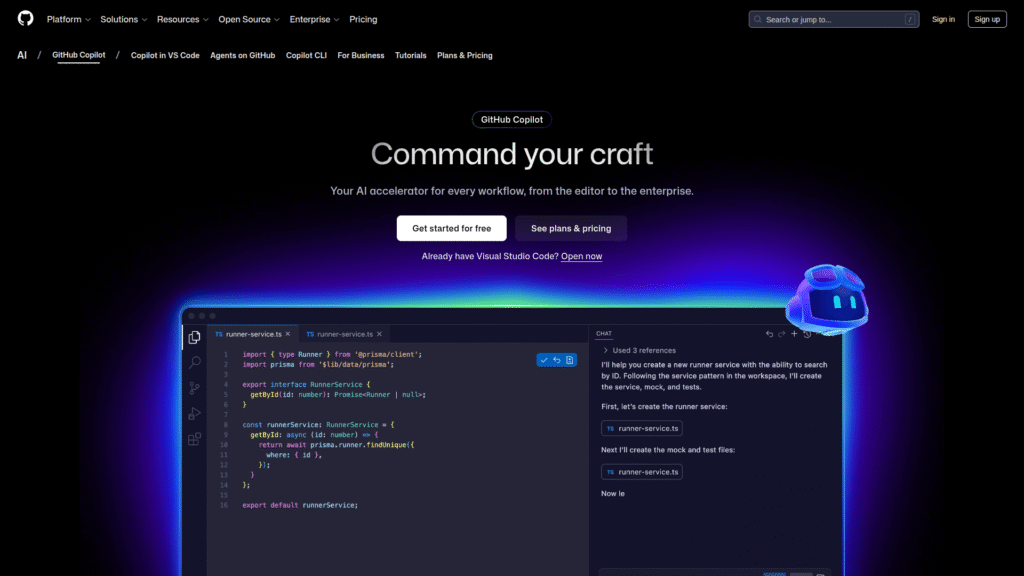
GitHub Copilot is often cited among the best AI coding tools, acting as an AI pair programmer. Developed by GitHub and OpenAI, it suggests code snippets, entire functions, and even complex algorithms in real-time as you type. It works across various programming languages and integrates seamlessly into popular IDEs like VS Code. For learners, Copilot is invaluable for seeing practical implementations, understanding idiomatic code, and getting unstuck when facing complex problems. It essentially gives you a constant stream of suggestions, teaching by example and demonstrating efficient coding patterns. This is a powerful way to learn by observing and adapting high-quality code. It’s one of the best AI coding tools for practical, on-the-job learning.
Features:
- AI-powered code suggestions and autocompletion.
- Generates entire functions from comments or function names.
- Supports numerous programming languages.
- Integrates with popular IDEs (VS Code, Neovim, JetBrains suite).
- Learns from public code repositories.
Pricing:
- Free for verified students and maintainers of popular open-source projects.
- Individual plan: $10 USD per month or $100 USD per year.
- Business plan: $19 USD per user/month.
Pros:
- Significantly boosts coding speed and efficiency.
- Excellent for learning new syntax and best practices from examples.
- Reduces boilerplate code and repetitive tasks.
- Works well across multiple languages and frameworks.
- Among the best AI coding tools for professional development acceleration.
Cons:
- Suggestions can sometimes be incorrect or less optimal, requiring careful review.
- Reliance can hinder deep understanding if not used thoughtfully.
- Potential for generating insecure or buggy code.
- Requires an active internet connection.
Visit official GitHub Copilot website
ChatGPT (for Coding) – Best AI Coding Tools Review
While not exclusively a coding tool, ChatGPT, and similar large language models, have become indispensable among the best AI coding tools for learning and assistance. You can ask it to explain complex concepts, debug code, generate code snippets for specific tasks, or even write entire scripts from a plain language description. For a learner, this is like having an infinitely patient tutor available 24/7. It can break down algorithms, provide examples, and answer follow-up questions, fostering a deeper understanding. It’s an interactive problem-solver, making it one of the most versatile of the best AI coding tools for conceptual understanding and practical application.
Features:
- Natural language code generation from prompts.
- Code explanation and concept clarification.
- Debugging assistance and error identification.
- Refactoring suggestions and performance optimisation tips.
- Supports virtually all programming languages.
Pricing:
- Free version available (GPT-3.5).
- ChatGPT Plus: $20 USD per month or $240 USD per year (access to GPT-4, higher limits).
Pros:
- Highly versatile for diverse coding tasks and learning needs.
- Excellent for conceptual understanding and explanations.
- Can generate complex code structures quickly.
- Good for exploring different approaches to a problem.
- One of the most accessible and effective best AI coding tools for immediate learning.
Cons:
- Can sometimes generate plausible but incorrect or suboptimal code.
- Lacks direct integration into IDEs (though API access exists for developers).
- Requires careful prompting for best results.
- May “hallucinate” information or provide outdated practices.
Visit official ChatGPT website
Codecademy Go (with AI features) – best AI coding tools Review
Codecademy Go leverages AI within its structured learning paths to provide a more personalised and effective experience, positioning it among the best AI coding tools for beginners. While Codecademy has always been known for its interactive courses, the integration of AI now offers smarter feedback, adaptive quizzes, and more tailored explanations based on a learner’s progress. This means you’re not just following a rigid curriculum; the AI identifies your strengths and weaknesses, guiding you to areas where you need more practice. It’s an ideal environment for those who thrive with hands-on, guided learning, complete with instant validation. This makes it one of the best AI coding tools for structured, beginner-friendly education.
Features:
- Interactive coding lessons and projects.
- AI-powered feedback on code exercises.
- Adaptive learning paths and personalised recommendations.
- Quizzes and challenges to reinforce learning.
- Covers a wide range of programming languages and technologies.
Pricing:
- Basic courses are free.
- Codecademy Pro: £15.99 /month or £95.99 /year (billed annually).
Pros:
- Excellent for beginners with structured, interactive learning.
- AI feedback helps identify and correct mistakes in real-time.
- Gamified approach keeps learners engaged.
- Strong community support.
- One of the best AI coding tools for guided learning.
Cons:
- Can feel too guided for advanced learners seeking open-ended challenges.
- Free tier has limited AI-enhanced features.
- May not always prepare learners for real-world, less structured coding environments.
- Subscription can be pricey for full access.
Visit official Codecademy Go website
Replit AI – Best AI Coding Tools Review
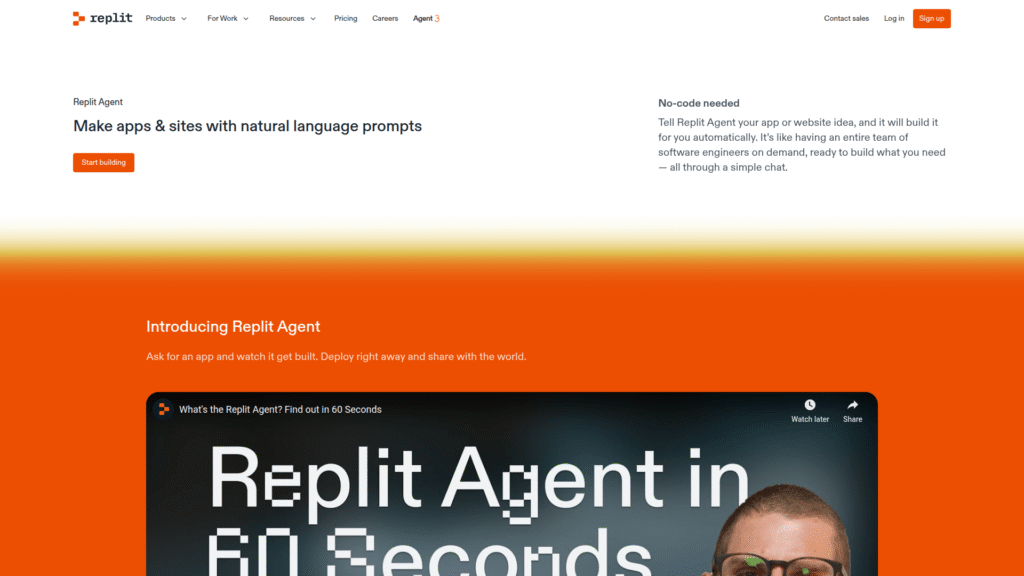
Replit AI brings robust AI coding assistance directly into a cloud-based IDE, making it one of the most accessible and collaborative of the best AI coding tools. Replit is known for its instant setup and collaborative features, and its AI additions enhance this significantly. It offers intelligent code completion, error detection, and even code generation within the browser-based environment. For learners, this means you can start coding instantly, get help with syntax, and understand error messages without needing to configure a local development environment. It’s perfect for experimenting, building quick prototypes, and collaborating on projects with AI assistance built right in. Definitely among the best AI coding tools for cloud-based development and learning.
Features:
- AI code completion and suggestions.
- Error highlighting and debugging assistance.
- Code generation from natural language prompts.
- Integrated cloud IDE supporting many languages.
- Collaborative coding features.
Pricing:
- Free tier with limited resources.
- Replit Core: $10 USD per month.
- Replit Teams: Custom pricing.
Pros:
- Zero setup required, code in your browser instantly.
- Excellent for collaborative projects with AI support.
- AI features are context-aware within the IDE.
- Good for rapid prototyping and learning new languages.
- Among the best AI coding tools for quick, accessible practice.
Cons:
- Performance can sometimes be limited by internet connection.
- Free tier has resource constraints.
- May not be suitable for very large, complex enterprise projects.
- Reliance on a browser might not suit all preferences.
Visit official Replit AI website
Tabnine – Best AI Coding Tools Review
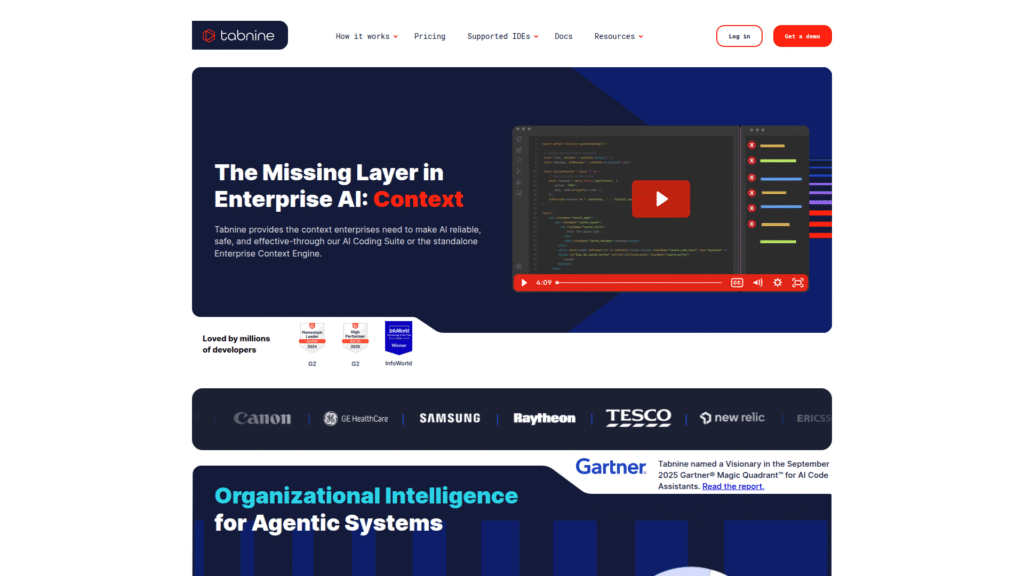
Tabnine positions itself as an AI code completion tool that focuses on privacy and security, making it a strong contender among the best AI coding tools for individual developers and teams. Unlike some cloud-based AI tools, Tabnine offers both cloud and local models, giving users more control over their data. It learns from your codebase and provides highly personalised code suggestions, improving accuracy over time. For learners, this means getting relevant, context-aware suggestions that align with the specific project or style they are working on, helping to internalise patterns and improve efficiency. It’s about smart, private assistance that accelerates your coding habits. Truly one of the best AI coding tools for focused, efficient code generation.
Features:
- Whole-line, full-function, and block code completions.
- Supports over 30 programming languages.
- Works with all major IDEs.
- Offers both cloud-based and local (on-device) AI models for privacy.
- Learns from your project’s context.
Pricing:
- Free tier with basic completions.
- Pro plan: $12 USD per month or $120 USD per year.
- Enterprise plan: Custom pricing for teams with enhanced security.
Pros:
- Excellent, highly accurate code completions.
- Strong focus on privacy with local model options.
- Integrates seamlessly into existing workflows.
- Learns and adapts to your specific coding style.
- One of the best AI coding tools for consistent, reliable suggestions.
Cons:
- Free version is quite limited in advanced features.
- Less focused on comprehensive learning modules compared to educational platforms.
- Can be resource-intensive with local models.
- Doesn’t provide full code generation from natural language like ChatGPT.
Visit official Tabnine website
Educative (with AI features) – best AI coding tools Review
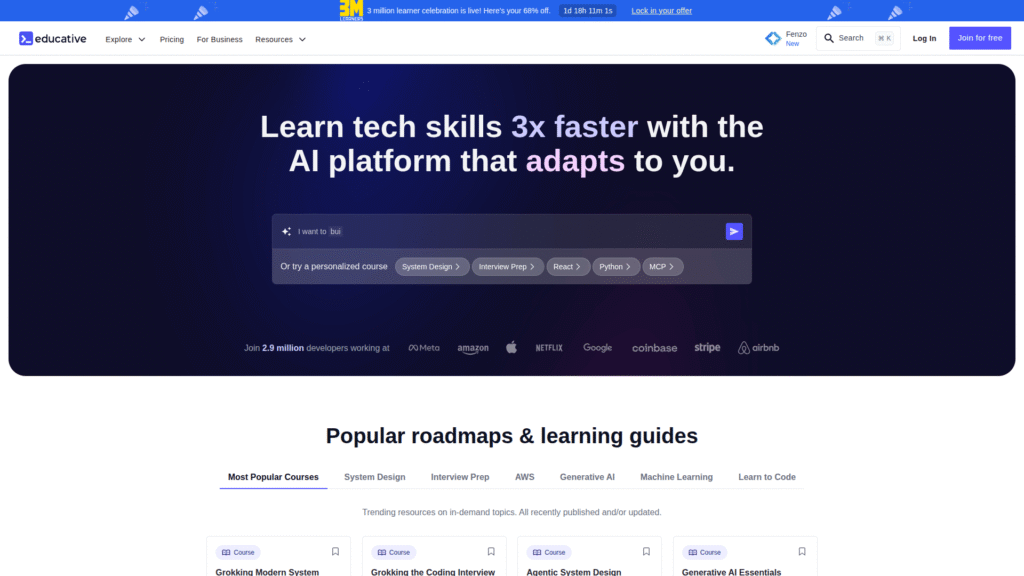
Educative stands out as one of the best AI coding tools for deep learning through interactive, text-based courses, now enhanced with AI. Unlike video-based platforms, Educative focuses on teaching concepts through rich text, embedded code snippets, and in-browser coding environments. Their AI features can offer smarter hints, assess code quality, and provide alternative explanations, making complex topics more digestible. This approach is highly effective for learners who prefer reading and hands-on practice without constant context switching. It helps in understanding the underlying principles deeply, which is crucial for becoming a skilled developer. It is among the best AI coding tools for conceptual understanding and practical application in a structured format.
Features:
- Interactive, text-based courses with in-browser coding environments.
- AI-powered hints and feedback on coding challenges.
- Pathways for various roles (e.g., frontend, backend, data science).
- Quizzes and assessments.
- Covers a wide range of programming languages, algorithms, and system design.
Pricing:
- Some free courses available.
- Educative Unlimited: $59 USD per month or $199 USD per year.
Pros:
- Excellent for in-depth conceptual learning and theoretical understanding.
- Interactive environment reduces setup friction.
- AI support enhances problem-solving and debugging skills.
- Text-based format allows for faster consumption than video.
- One of the best AI coding tools for serious, structured skill development.
Cons:
- May not appeal to visual learners who prefer video tutorials.
- Less focus on building full-stack projects from scratch compared to some.
- AI features are integrated more subtly rather than as a primary code generator.
- Full access requires a subscription.
Visit official Educative website
Mimo – Best AI Coding Tools Review
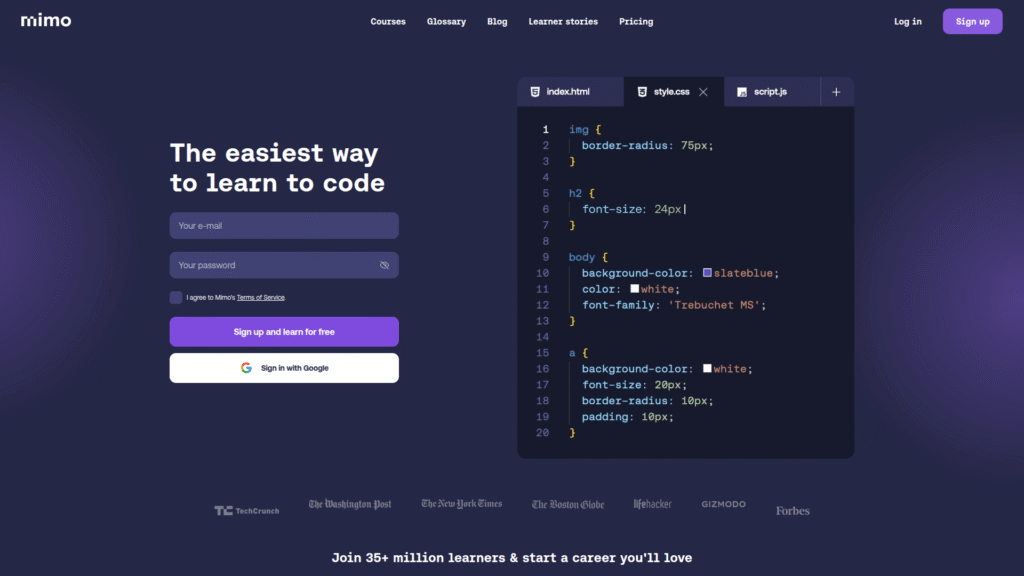
Mimo makes learning to code accessible and engaging right from your smartphone, earning its spot among the best AI coding tools for on-the-go education. It offers bite-sized lessons, interactive challenges, and coding exercises designed for mobile consumption. The platform incorporates AI to personalise learning paths, provide instant feedback on code, and suggest relevant topics based on your progress. This gamified approach makes daunting programming concepts feel manageable and fun, perfect for those with limited time or who prefer micro-learning. If you want to fit coding education into your daily commute or coffee break, Mimo is undeniably one of the best AI coding tools for you. It’s all about making progress, even in small chunks.
Features:
- Mobile-first interactive coding lessons and exercises.
- AI-driven personalised learning paths.
- Bite-sized content for quick learning sessions.
- Real-time feedback on code.
- Covers Python, JavaScript, HTML, CSS, SQL, and more.
Pricing:
- Free tier with limited access.
- Mimo Premium: £8.99 /month or £49.99 /year.
Pros:
- Extremely convenient for learning on the go.
- Gamified approach keeps users motivated.
- AI personalisation tailors content to individual needs.
- Great for beginners to grasp fundamental concepts.
- Among the best AI coding tools for casual, consistent learning.
Cons:
- May not be comprehensive enough for advanced topics or large projects.
- Reliance on a mobile screen can be limiting for extensive coding.
- Free content is quite restricted.
- Not a direct code generation tool in the same vein as Copilot.
Feature Comparison
When selecting from the best AI coding tools, understanding their distinct feature sets is crucial. You’re not just buying a tool; you’re investing in a specific capability. GitHub Copilot and Tabnine excel in real-time, context-aware code generation and completion directly within your IDE, making them powerhouses for increasing raw coding speed and adopting best practices through example. They are built for developers who already have a grasp of fundamentals and want to become more efficient, seeing immediate results in their workflow. These are prime examples of the best AI coding tools for productivity.
On the other hand, platforms like Codecademy Go, Educative, and Mimo integrate AI primarily to enhance the learning experience. They offer structured curricula, interactive exercises, and intelligent feedback mechanisms that guide beginners through concepts and reinforce understanding. Their AI acts more like a personalised tutor, adapting content and providing hints, rather than directly generating large blocks of production code. If your goal is foundational knowledge and conceptual mastery, these educational platforms represent some of the best AI coding tools for that purpose. They teach you the “why” behind the code.
ChatGPT and Replit AI sit somewhat in the middle, offering both generative capabilities and educational assistance. ChatGPT provides a conversational interface for debugging, explaining code, and generating snippets from natural language, making it incredibly versatile for both learning and quick problem-solving. Replit AI, embedded in a cloud IDE, allows for collaborative coding and instant code suggestions, blending learning with practical development in an accessible environment. These are fantastic for exploratory learning and rapid prototyping. Choosing among the best AI coding tools means matching the tool’s primary strength with your immediate and long-term objectives, whether it’s raw output or deep understanding.
Consider the learning style you prefer. Are you a hands-on doer who learns by seeing code generated and adapting it (Copilot, Tabnine)? Or do you prefer a guided, step-by-step approach with interactive lessons (Codecademy, Educative, Mimo)? Perhaps you value the flexibility of a conversational AI for explanations and diverse code tasks (ChatGPT) or a collaborative cloud environment for quick experimentation (Replit AI). Each of these best AI coding tools brings a unique flavour to the table, and the “best” one for you is the one that directly addresses your current learning or development bottlenecks. Don’t overcomplicate it; pick what solves your problem.
Pricing Breakdown
Understanding the pricing models for the best AI coding tools is crucial for budgeting and long-term commitment. You need to know what you’re getting for your money, or if you can even get started for free. Most of these tools offer a tiered approach: a free option with limited features, a mid-range subscription for individuals, and often an enterprise solution for teams. This allows you to scale your usage as your needs and proficiency grow. Don’t just look at the monthly fee; consider the annual savings and what features are unlocked at each level. Smart investment means getting maximum value from the best AI coding tools you choose.
GitHub Copilot offers a straightforward monthly or annual subscription, with significant discounts for students and open-source contributors, which is a big win for learners. ChatGPT has a robust free version (GPT-3.5) that’s excellent for many coding tasks, with a premium ‘Plus’ subscription unlocking access to more advanced models like GPT-4. This makes it highly accessible. Tabnine also follows a free/pro/enterprise model, emphasising its commitment to privacy even in its free offering. These are often the best AI coding tools for direct coding assistance where the cost scales with features.
For the educational platforms, Codecademy Go, Educative, and Mimo, the free tiers typically provide introductory content, acting as a gateway. To unlock comprehensive courses, projects, and advanced AI-powered feedback, a premium subscription is necessary. These subscriptions often grant access to an entire library of courses across multiple languages and technologies. Replit AI also offers a generous free tier for basic usage, with paid plans providing more computational resources, private projects, and enhanced AI capabilities. When evaluating the best AI coding tools for learning, weigh the cost of full access against the breadth and depth of the content provided.
My advice? Start with the free versions where available. Test the waters, see how the tool integrates with your workflow or learning style, and then make an informed decision about upgrading. An annual subscription often provides better value than monthly payments. Consider the return on investment: how much faster will you learn, and how much more efficient will you become? The cost of these best AI coding tools should be seen as an investment in your skills and career. Don’t be cheap if it means hindering your progress. Invest wisely to get the results you want from the best AI coding tools.
Real-World Use Cases
Knowing the features is one thing; seeing how the best AI coding tools are applied in real-world scenarios is another. These tools aren’t just theoretical constructs; they are actively shaping how developers build software, debug issues, and learn new technologies. For a junior developer, it might mean getting over the initial hurdles of understanding complex API structures or quickly grasping a new framework’s conventions. For an experienced engineer, it could be about accelerating the development of boilerplate code, refactoring legacy systems, or tackling unfamiliar languages with confidence. The applications are diverse and impactful.
Take GitHub Copilot, for instance. A common use case involves generating unit tests automatically for existing functions, saving immense time and ensuring code quality. Developers also use it to suggest complex regular expressions or database queries, tasks that often require meticulous syntax and specific domain knowledge. It’s about letting the AI handle the mechanical work, freeing the developer to focus on architectural design and business logic. This is precisely how the best AI coding tools are making a tangible difference in daily development cycles, increasing output dramatically.
ChatGPT’s real-world utility for coding is vast. Imagine you’re stuck on a tricky error message; you paste it into ChatGPT, and it not only explains the error but suggests multiple solutions and explains the reasoning behind each. Or perhaps you need to convert a Python script to Node.js; ChatGPT can provide a starting point and highlight key differences. For learning, it’s used to explain advanced data structures or algorithm complexities in layman’s terms. It’s one of the best AI coding tools for quick problem-solving and deep conceptual explanations, acting as an instant knowledge base.
Educational platforms like Codecademy, Educative, and Mimo are used by millions globally to start new careers, upskill for promotions, or simply learn a new hobby. A student might use Codecademy Go’s interactive lessons to master Python syntax, while a professional could leverage Educative’s in-depth courses to prepare for a system design interview. Mimo allows busy individuals to sneak in a JavaScript lesson during their commute. These are the best AI coding tools for structured learning, providing clear pathways to skill mastery. The core idea is simple: accelerate your learning, execute faster, and ultimately, build more. This direct correlation to results is why these best AI coding tools are indispensable for modern programmers.
Who Should Use Each Tool?
Choosing the right tool isn’t just about features; it’s about alignment with your current skill level, learning objectives, and professional ambitions. Each of the best AI coding tools we’ve discussed serves a slightly different master, and understanding this distinction is key to making an effective choice. Don’t just pick the flashiest option; pick the one that directly solves your problem or accelerates your specific growth area. This focused approach will yield far better results than a scattergun approach. For rapid progress, matching the tool to the user is paramount. You need the best AI coding tools for you.
If you’re an experienced developer looking to dramatically boost your productivity, reduce boilerplate code, and explore new languages efficiently, GitHub Copilot or Tabnine are your go-to options. They assume you know what you’re doing and simply provide highly intelligent suggestions to accelerate your output. These are the best AI coding tools for speed and efficiency for those already proficient. They are less about teaching from scratch and more about augmenting existing skill sets.
For beginners who need structured guidance, interactive lessons, and a clear learning path, Codecademy Go, Educative, and Mimo are excellent choices. Codecademy Go offers a comprehensive interactive experience, Educative provides deep textual explanations with in-browser coding, and Mimo is perfect for mobile-first, bite-sized learning. These are the best AI coding tools to build foundational knowledge, reinforce concepts with practice, and stay motivated through gamification and clear progress tracking. They are designed to hold your hand through the initial, often daunting, stages of learning.
If you need a versatile assistant for debugging, conceptual explanations, brainstorming code structures, or generating quick prototypes from natural language, ChatGPT is an unparalleled choice. It’s incredibly flexible and acts as a knowledge base and problem-solver for almost any coding query. Replit AI is ideal for students or those who enjoy collaborative coding, rapid prototyping, and want an integrated AI assistant within a cloud-based development environment. These are the best AI coding tools for exploration and immediate problem-solving. Ultimately, the “best” tool is the one that directly addresses your specific pain points and accelerates your journey towards coding mastery. Pick wisely to maximise your return on effort.
How to Choose the Right Tool
Picking from the array of best AI coding tools can feel overwhelming, but a systematic approach ensures you land on the one that delivers maximum value for your unique situation. Don’t fall for shiny object syndrome. Your choice should be strategic, aligned with your current skill level, your ultimate goals, and your preferred learning or working style. Think of it as investing in a specific outcome. The right tool isn’t just an accessory; it’s a force multiplier for your time and effort. This is about making an informed, data-driven decision for your coding future.
First, honestly assess your current proficiency. Are you an absolute beginner struggling with basic syntax, or an experienced developer aiming for greater efficiency? For beginners, tools with structured lessons and clear feedback (like Codecademy, Educative, or Mimo) will be more beneficial. If you’re intermediate or advanced, code completion and generation tools (GitHub Copilot, Tabnine) or a versatile assistant (ChatGPT) will provide a better return. Matching the tool’s core functionality to your skill level is the first, most critical step to selecting the best AI coding tools.
Next, define your primary objective. Do you want to learn a new language from scratch, speed up your current development workflow, debug complex issues, or simply explore coding concepts? If it’s pure learning, prioritise interactive platforms. If it’s productivity, look at AI assistants integrated into IDEs. For problem-solving and conceptual understanding, a conversational AI is likely the most effective. Your objective should dictate your choice among the best AI coding tools. Clarity here prevents wasted effort and ensures you get what you need.
Consider your budget and commitment level. Many of these best AI coding tools offer free tiers or trials. Take advantage of them. See if the tool genuinely enhances your learning or productivity before committing to a paid subscription. Also, think about integration. Does it fit seamlessly into your existing development environment or learning routine? A tool, no matter how powerful, is useless if it creates more friction than it solves. Finally, read reviews, but also experiment yourself. What works for one person might not work for another. Trust your own experience after a thorough trial to find the truly best AI coding tools for your personal journey.
Making Money with These Tools
This isn’t just about learning; it’s about leveraging the best AI coding tools to increase your earning potential. The fundamental principle is simple: efficiency and skill directly translate to value in the market. By learning faster and coding more efficiently, you become a more attractive candidate for employers, a more productive freelancer, and ultimately, you can command higher rates. These tools aren’t just gadgets; they are accelerators for your career trajectory. If you’re serious about monetising your coding skills, integrating the best AI coding tools into your workflow is a non-negotiable strategy.
For aspiring freelancers, using tools like GitHub Copilot or Tabnine means you can complete projects faster, taking on more clients or delivering quicker turnaround times. This directly impacts your revenue. Imagine reducing the time spent on boilerplate code by 30% – that’s 30% more billable hours or capacity for new projects. ChatGPT can help you quickly prototype ideas for clients, understand complex requirements, and even generate documentation, all of which save time and add value to your services. These are the best AI coding tools for boosting your freelance income.
In a corporate setting, mastering these best AI coding tools positions you as a highly productive and forward-thinking employee. Demonstrating how you can leverage AI to deliver features faster, improve code quality, or debug issues more efficiently makes you an invaluable asset. This can lead to promotions, salary increases, and opportunities to work on more challenging and rewarding projects. Tools like Educative, with its focus on in-depth understanding, can help you master advanced topics like system design, which are crucial for higher-paying senior roles. Investing in these best AI coding tools is investing in your professional capital.
Furthermore, these tools can facilitate entry into new, high-demand areas. Want to pivot to machine learning? Use AI-enhanced learning platforms to quickly grasp the fundamentals. Need to add a new framework to your resume? Leverage AI code generators to accelerate your learning-by-doing process. The speed at which you can acquire and apply new skills with the best AI coding tools directly translates to opening up new income streams and career opportunities. This isn’t passive income, but it’s a smart way to actively boost your earning potential through intelligent leverage. These are the best AI coding tools for a reason: they deliver results to your bottom line.
Common Limitations
While the best AI coding tools offer immense advantages, it’s critical to approach them with a clear understanding of their limitations. They are powerful assistants, not infallible replacements for human intelligence or diligence. Over-reliance, lack of critical thinking, and a failure to understand the underlying principles can actually hinder your growth, rather than accelerate it. Like any powerful instrument, they demand responsible usage. Acknowledging these drawbacks ensures you leverage them effectively and avoid potential pitfalls. Don’t confuse speed with mastery; the best AI coding tools augment, they don’t replace your brain.
One significant limitation is the potential for generating incorrect, suboptimal, or even insecure code. AI models are trained on vast datasets, but they don’t inherently “understand” context or intent in the human sense. They might produce code that compiles and runs but is inefficient, violates best practices, or contains subtle bugs that are hard to detect. For learners, blindly accepting AI-generated code without review can lead to bad habits and a shallow understanding of what makes good code. This is why critical evaluation and human oversight remain non-negotiable when using the best AI coding tools.
Another challenge is the “black box” nature of some AI suggestions. While tools like ChatGPT can explain code, others simply provide completions without deep rationale. If you’re learning, simply copying and pasting without understanding why a particular solution works deprives you of genuine learning. It might solve the immediate problem but does nothing to build your problem-solving muscle. The best AI coding tools are most effective when used as a starting point for exploration and understanding, not as a shortcut to bypass the intellectual heavy lifting.
Furthermore, AI tools can sometimes struggle with highly niche problems, very specific project contexts, or brand-new technologies where training data is scarce. They are also dependent on the quality and recency of their training data, meaning they might not always be up-to-date with the latest framework changes or security vulnerabilities. Finally, relying solely on AI can limit your ability to develop independent problem-solving skills, which are paramount for any successful developer. Use the best AI coding tools to enhance, not diminish, your own cognitive abilities. Your critical thinking is still your most valuable asset.
Final Verdict and Recommendations
Alright, you’ve got the lowdown on the best AI coding tools out there. My verdict is clear: these are not optional anymore. They are essential accelerators for anyone serious about coding, whether you’re just starting or you’re a seasoned pro. The right tool, applied with discipline, will dramatically cut your learning time and boost your output. This isn’t about magic; it’s about smart leverage. Choose strategically, implement diligently, and watch your skills and efficiency compound. You need to be using the best AI coding tools to stay competitive and effective.
For raw productivity and in-IDE code generation, GitHub Copilot and Tabnine are the undisputed champions. If your goal is to write code faster, reduce boilerplate, and learn best practices by example, these are your weapons of choice. They are particularly strong for developers who already have a solid foundation and want to scale their output. They truly are among the best AI coding tools for sheer development speed, transforming your workflow.
If you’re a beginner seeking a structured, interactive learning journey, I highly recommend Codecademy Go or Educative. For those who prefer learning on the go with bite-sized lessons, Mimo is excellent. These platforms excel at guiding you through fundamental concepts with AI-enhanced feedback, ensuring you build a strong foundation. They are the best AI coding tools for systematic skill acquisition, providing a clear path from novice to capable. They provide the structure you need to get good, fast.
For unparalleled versatility, debugging assistance, conceptual explanations, and rapid prototyping from natural language, ChatGPT is an absolute must-have in your toolkit. It’s like having an expert coding mentor on demand. And for collaborative, cloud-based development with integrated AI, Replit AI offers an accessible and powerful environment. These are the best AI coding tools for broad-spectrum assistance and rapid iteration, covering a multitude of use cases. Ultimately, the “best” choice depends on your specific needs, but integrating at least one of these best AI coding tools will undoubtedly supercharge your coding journey. Don’t procrastinate; start leveraging them today.
Frequently Asked Questions
Are AI coding tools cheating?
No, AI coding tools are not cheating. They are powerful assistants designed to enhance productivity, accelerate learning, and help solve complex problems. Think of them as intelligent compilers, advanced IDEs, or a highly knowledgeable assistant. They augment your abilities, allowing you to focus on higher-level logic and problem-solving, rather than getting bogged down in syntax or boilerplate code. Using the best AI coding tools effectively is a modern skill.
Can AI tools replace human programmers?
No, not entirely. While AI coding tools can automate many repetitive tasks and generate code snippets, they lack the creativity, critical thinking, strategic planning, and understanding of complex human requirements that human programmers possess. They are tools to empower developers, not to replace them. The unique insights and problem-solving abilities of a human developer are irreplaceable, even by the best AI coding tools.
How accurate are AI code suggestions?
The accuracy of AI code suggestions varies significantly depending on the tool, the context, and the complexity of the code. Many of the best AI coding tools, like GitHub Copilot and Tabnine, are highly accurate for common patterns and boilerplate code. However, they can sometimes generate incorrect, inefficient, or even insecure suggestions, especially for novel problems or obscure libraries. Always review AI-generated code carefully.
Which AI coding tool is best for beginners?
For beginners, the best AI coding tools are those that offer structured learning paths and interactive feedback. Codecademy Go, Educative, and Mimo are excellent choices as they provide guided lessons, challenges, and AI-enhanced explanations to build foundational knowledge. ChatGPT can also be incredibly useful for explaining concepts and debugging simple code as you learn.
Can I use these tools for professional projects?
Absolutely. Many of the best AI coding tools, especially GitHub Copilot, Tabnine, and even ChatGPT, are widely used by professional developers to increase productivity, accelerate development, and maintain code quality. However, it’s crucial to always review and understand the code generated by AI to ensure it meets project requirements, security standards, and performance benchmarks. Professional use of the best AI coding tools requires diligence.
Are there any free AI coding tools?
Yes, many of the best AI coding tools offer free tiers or basic versions. ChatGPT has a powerful free version (GPT-3.5). Replit AI and Codecademy Go provide free access to introductory features and lessons. Tabnine also offers a free tier for basic code completions. These free options are excellent for getting started and evaluating whether a tool suits your needs before committing to a paid plan.
How do AI coding tools learn?
AI coding tools learn by being trained on vast datasets of publicly available code, documentation, and natural language. They use machine learning models, often large language models (LLMs) and transformer architectures, to identify patterns, understand context, and predict the most likely or appropriate code snippets. The more data they are trained on, and the more sophisticated their algorithms, the better they become at generating relevant and accurate suggestions, making them truly the best AI coding tools for assistance.
The best AI coding tools are transforming how we learn, develop, and innovate. Master them, and you master your future in code.