
Unity ML-Agents transforms your Game Development and Design. Harness AI to build smarter games, faster, boosting player engagement. Ready to level up?
Why Unity ML-Agents Is a Game-Changer in Game Development and Design
Alright, let’s talk real talk.
The world of Gaming and Entertainment is changing. Fast.
If you’re still doing things the old way, you’re not just falling behind. You’re getting left in the dust.
AI isn’t some futuristic fantasy anymore. It’s here. And it’s making waves, big waves.
Especially in Game Development and Design.
That’s where Unity ML-Agents steps in.
This isn’t just another tool. This is a paradigm shift.
It’s about building smarter, more adaptive games.
It’s about efficiency. It’s about impact.
It’s about making your games, and your profits, go through the roof.
So, if you’re serious about your craft, pay attention.
Table of Contents
- What is Unity ML-Agents?
- Key Features of Unity ML-Agents for Game Development and Design
- Benefits of Using Unity ML-Agents for Gaming and Entertainment
- Pricing & Plans
- Hands-On Experience / Use Cases
- Who Should Use Unity ML-Agents?
- How to Make Money Using Unity ML-Agents
- Limitations and Considerations
- Final Thoughts
- Frequently Asked Questions
What is Unity ML-Agents?
Alright, what exactly is Unity ML-Agents? Let’s break it down without the jargon.
Think of it as a bridge. It connects the powerful Unity game engine with the cutting-edge of machine learning.
Specifically, reinforcement learning.
What does that mean for you? It means you can train intelligent agents directly within your Unity environments.
These agents aren’t just scripted NPCs. They learn. They adapt. They make decisions based on what you teach them.
It’s an open-source project. That’s a huge plus. It means a community, continuous improvement, and flexibility.
The core function? It allows game developers and researchers to create complex AI behaviours.
Without writing thousands of lines of explicit logic.
Imagine training a character to navigate a level, or an enemy to anticipate player moves.
Or even an entire game economy to balance itself.
It simplifies what used to be incredibly complex.
Your target audience? If you’re building games in Unity, from indie studios to AAA behemoths, this is for you.
If you’re a game designer looking to push boundaries, a developer wanting to automate testing, or a researcher exploring AI in interactive environments – pay attention.
It’s about making your game AI smarter, more natural, and ultimately, more fun for players.
This isn’t about replacing human creativity. It’s about augmenting it.
It’s about giving you the tools to build experiences that were previously out of reach.
It lets you focus on the big picture, while the AI handles the nitty-gritty of intelligent behaviour.
So, in essence, Unity ML-Agents empowers you to build AI that learns.
AI that evolves. AI that takes your games to the next level.
It cuts down on manual scripting and offers a path to truly emergent gameplay.
You define the goals, the AI figures out the best way to achieve them.
That’s the power we’re talking about here.
Key Features of Unity ML-Agents for Game Development and Design
- Reinforcement Learning Integration:
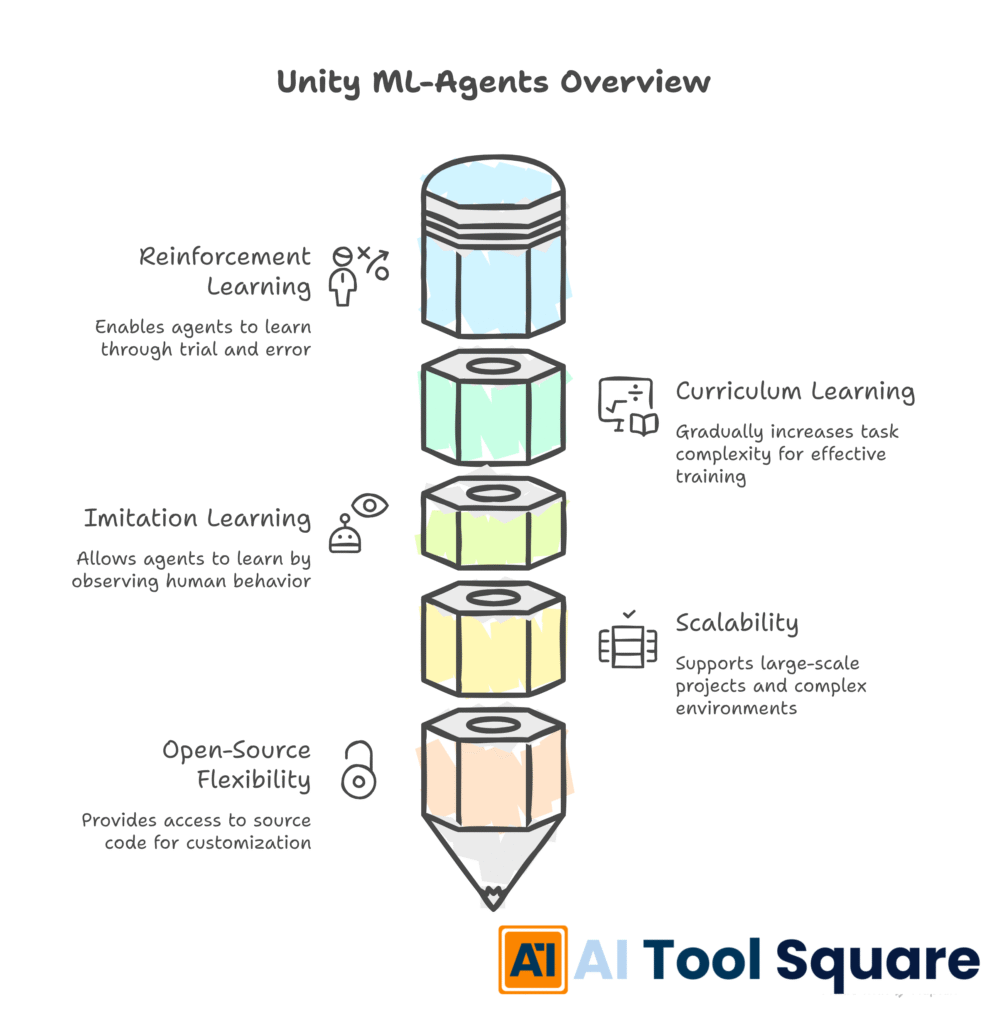
This is the big one. Unity ML-Agents is built specifically for reinforcement learning.
Instead of hand-coding every possible action and reaction, you define a reward system.
The AI agent then learns through trial and error, figuring out which actions maximise its rewards.
How does this help with Game Development and Design? Imagine training an NPC to intelligently patrol an area.
Or a sports game AI to strategise and adapt to player moves.
You set the rules of the game for the AI, and it learns to play it, often discovering strategies you never even considered.
This means less time scripting complex behaviours. More time focusing on core gameplay and narrative.
It also leads to more dynamic and unpredictable AI, which keeps players engaged longer.
Your enemies won’t just follow a static path. They’ll learn your habits. They’ll surprise you.
That’s a massive shift in how you build AI for games.
- Curriculum Learning & Imitation Learning:
These are powerful training techniques.
Curriculum Learning means you can train agents in stages, starting with simpler tasks and gradually increasing complexity.
Think about teaching a child. You don’t throw them into advanced maths on day one.
You start with counting, then addition, then subtraction, and so on.
This makes training more efficient and effective, especially for complex behaviours in your game.
You can train a character to walk before you teach it to run and jump across chasms.
Imitation Learning is also huge. It allows your agents to learn by observing human demonstrations.
You play the game, showing the AI what you want it to do, and it tries to mimic your actions.
This is a game-changer for capturing nuanced behaviours that are hard to describe with rewards alone.
Want an NPC to have a specific combat style? Show it to them.
Want a character to perform a complex parkour sequence? Record yourself doing it.
This accelerates development and ensures the AI’s behaviour aligns with your vision.
- Scalability and Open-Source Flexibility:
Unity ML-Agents is built to scale. You can train multiple agents simultaneously within the same environment.
This is crucial for accelerating the learning process. Imagine training hundreds of unique enemy types at once.
Or optimising crowd behaviour across an entire city simulation.
The fact that it’s open-source means you’re not locked into a proprietary system.
You have full access to the code. You can customise it. You can extend it.
This level of flexibility is invaluable for pushing the boundaries of what’s possible in AI for Gaming and Entertainment.
It also fosters a strong community, meaning plenty of resources, tutorials, and support.
You’re not on your own.
This translates to better game quality, faster iteration, and the ability to experiment with truly novel AI designs.
It means your game characters can be more than just predictable patterns.
They can be intelligent, evolving entities that truly enhance the player experience.
This ultimately creates deeper, more replayable games.
Benefits of Using Unity ML-Agents for Gaming and Entertainment
Let’s cut to the chase: what do you actually get out of using Unity ML-Agents?
First off, massive time savings. Forget spending weeks or months hand-scripting intricate AI behaviours.
You define the goal, the reward, and let the agents learn.
This frees up your developers to focus on other critical aspects of the game.
Imagine automating playtesting. Agents can learn to play your game and expose bugs or balance issues you might miss.
That’s less human grunt work, more actual development.
Next, a huge leap in game quality and player engagement.
AI trained with ML-Agents isn’t rigid. It’s adaptive. It learns.
This means NPCs that react more realistically, enemies that challenge players in unpredictable ways, and game systems that feel more alive.
Players get a richer, more dynamic experience.
They stick around longer. They talk about your game more. They recommend it.
Then there’s overcoming creative blocks. Sometimes, you just can’t think of the “perfect” AI strategy.
ML-Agents can discover emergent behaviours you never would have imagined.
It’s like having an AI co-designer, constantly experimenting and finding new solutions.
This opens up entirely new design possibilities for your games.
You can prototype complex AI concepts rapidly. Test ideas that would otherwise take months to implement traditionally.
It also brings unprecedented realism to character animation and physics.
Imagine training a character to walk, run, and jump over obstacles, adapting to terrain in real-time.
The result is fluid, natural movement that significantly enhances immersion.
For competitive games, ML-Agents can create incredibly challenging opponents.
These aren’t just bots that cheat. They are bots that learn strategies.
They become formidable opponents, pushing players to improve their own skills.
Finally, it’s about cost efficiency. Less time spent on manual AI development means lower labour costs.
Automated testing reduces QA expenses.
Higher player retention directly impacts your bottom line through increased sales, in-game purchases, or subscriptions.
Unity ML-Agents isn’t just cool tech. It’s a strategic advantage.
It helps you build better games, faster, and more profitably.
That’s a win for everyone involved.
Pricing & Plans
Okay, let’s talk brass tacks: what’s the damage?
Here’s the good news: Unity ML-Agents itself is an open-source project.
That means the core toolkit, the algorithms, and the Python API are all free to use.
You can download it, integrate it with your Unity projects, and start training agents without spending a penny on the ML-Agents software itself.
This is a huge benefit for indie developers, small studios, and researchers.
It dramatically lowers the barrier to entry for advanced AI in game development.
Now, what about the “premium” version or hidden costs?
There isn’t a premium version of ML-Agents in the traditional sense.
However, it runs on top of Unity, which does have its own licensing tiers.
Unity offers a free Personal plan for individuals or small teams with revenue/funding below a certain threshold (currently $100K USD annually).
Beyond that, you move into Plus, Pro, and Enterprise plans, which are subscription-based.
These Unity subscriptions come with additional features, support, and higher revenue caps.
But again, the ML-Agents component itself remains free.
What you might need to invest in are computational resources.
Training complex AI models can be computationally intensive.
You might need a powerful local machine with a good GPU, or you might opt for cloud-based training services (like Google Cloud, AWS, Azure).
These cloud services have their own pricing structures based on usage.
So, while the ML-Agents toolkit is free, factor in potential costs for hardware or cloud compute time if your training needs are significant.
How does this compare to alternatives?
Many proprietary AI solutions or specialised AI engines come with hefty licensing fees.
The open-source nature of ML-Agents, combined with Unity’s accessible licensing, makes it incredibly competitive.
You get cutting-edge machine learning for game AI without the upfront software cost.
This allows you to allocate your budget more effectively to other parts of game production.
It’s a smart move for anyone looking to innovate on a budget.
Hands-On Experience / Use Cases
Let me tell you about a real-world scenario. A small indie studio I know was struggling with enemy AI for their new RPG.
They wanted enemies that felt truly intelligent, not just following predefined paths or attack patterns.
Hand-scripting every variation was a nightmare. It was time-consuming, prone to bugs, and the AI still felt predictable after a few hours of gameplay.
They decided to try Unity ML-Agents.
Their goal: train a basic goblin enemy to patrol, detect the player, and engage in combat.
Instead of scripting “if player in range, attack,” they defined observations (like player distance, health, weapon equipped) and rewards (damage dealt, surviving hits, reaching patrol points).
The initial setup took a few days. This included defining the environment, setting up the observations, actions, and rewards in Unity.
They started with a simple curriculum: first, train the goblin to navigate the environment. Then, to spot and chase the player. Finally, to engage in combat, learning to dodge and attack effectively.
The results were mind-blowing. After a few hours of training across multiple simulated environments, the goblin AI became remarkably sophisticated.
It learned to take cover, flank the player, and even retreat when its health was low.
Behaviours they hadn’t explicitly programmed emerged from the learning process.
Players testing the game remarked that the goblins felt “smarter” and “less robotic” than typical game enemies.
They were genuinely surprised by the AI’s adaptability.
Usability-wise, the team found the integration surprisingly smooth.
The Python API for training was intuitive for anyone with a basic understanding of machine learning.
And the Unity side of things was familiar territory.
The visualisations provided during training were also incredibly helpful, allowing them to see how the agents were learning in real-time.
Another use case? Procedural content generation with intelligent agents.
Imagine training an agent to design game levels that are fun and challenging, based on player feedback data.
Or to create dynamic quests that adapt to player choices and skills.
Unity ML-Agents can also be used for automated game testing.
You can train agents to play through levels, identify broken paths, or find ways to exploit game mechanics.
This saves countless hours of manual QA and leads to a more polished product.
The power here is in iteration. You can train, evaluate, tweak rewards, and retrain.
This agile approach to AI development is a massive advantage.
It allows for rapid experimentation and refinement of game mechanics driven by intelligent agents.
The results? A more engaging, robust, and innovative game experience.
Who Should Use Unity ML-Agents?
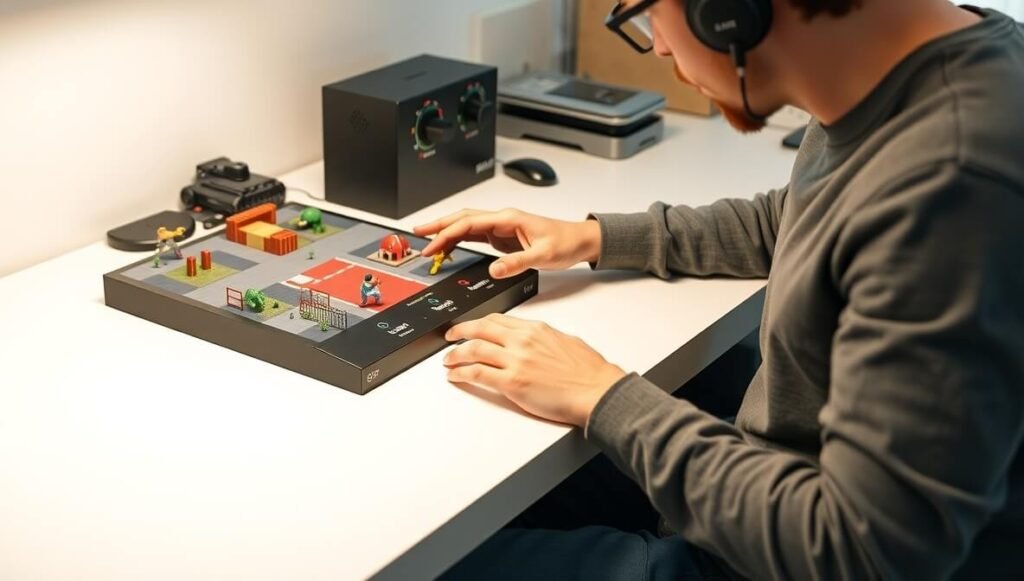
Alright, who’s this tool actually for?
If you’re building games in Unity, chances are there’s a place for ML-Agents in your workflow.
First up: Indie Game Developers and Small Studios.
You’re often resource-constrained. You need to do more with less.
ML-Agents lets you create sophisticated AI without needing a dedicated AI programmer for months.
It gives your small game big-studio AI capabilities.
Next, AAA Game Studios and Large Development Teams.
Even with vast resources, efficiency is key.
ML-Agents can accelerate the development of complex AI systems, automate testing, and help prototype new game mechanics faster.
It can handle everything from crowd behaviour to advanced enemy tactics, freeing up your senior AI engineers for cutting-edge research.
Then there are Game Designers.
If you’re tired of static, predictable AI, ML-Agents offers a sandbox for experimentation.
You can design emergent gameplay, challenge players with truly adaptive opponents, and craft deeper, more immersive experiences.
It’s about pushing the boundaries of what’s possible in interactive entertainment.
Educators and Researchers in Game AI are another prime audience.
It provides an accessible platform for teaching and exploring machine learning within interactive environments.
Students can get hands-on experience, and researchers can conduct experiments with real-time feedback.
Anyone doing R&D into intelligent agents will find this invaluable.
And finally, Technical Artists and Animators.
While not their primary function, ML-Agents can assist in creating more realistic and adaptive character movements.
Imagine an AI that learns to animate a character realistically traversing uneven terrain, rather than relying on predefined animation states.
In short, if your goal is to create more intelligent, dynamic, and engaging game experiences using Unity, then Unity ML-Agents is a tool you need to seriously consider.
It’s for anyone who wants to level up their game’s intelligence without getting bogged down in traditional AI scripting.
It’s for the innovators. It’s for the builders. It’s for you, if you’re serious about making an impact.
How to Make Money Using Unity ML-Agents
Okay, let’s talk turkey. How do you turn Unity ML-Agents into cash?
This isn’t just about building cooler games. It’s about building them smarter, faster, and with more impact.
That translates directly into profit.
First, build and sell better games.
This is the most direct route. By integrating advanced AI with ML-Agents, your games stand out.
Smarter enemies, more realistic NPCs, adaptive gameplay – these all lead to higher review scores, more purchases, and greater player retention.
Higher retention means more potential for in-game purchases, subscriptions, or simply spreading the word.
This isn’t just a marginal improvement; it’s a leap in quality that players will notice and pay for.
- Offer AI-as-a-Service for Game Development:
Many smaller studios or even larger ones lack in-house ML expertise. This is where you step in.
You can offer services to train specific AI behaviours for their games.
This could involve developing complex enemy AI, realistic crowd simulations, or intelligent pathfinding solutions.
You take their design brief, build the Unity environment, train the agents, and deliver the trained models ready for integration.
Think of it as an outsourced AI department. You’re selling expertise and cutting-edge technology.
This service can be incredibly valuable to studios aiming for next-gen AI without the overhead.
- Develop and Sell Unity Asset Store Packs with ML-Agents AI:
The Unity Asset Store is a goldmine.
You can create pre-trained AI models or entire AI systems (like a “Smart Enemy Pack” or “Adaptive NPC Kit”) that developers can drop straight into their games.
These assets would leverage ML-Agents to provide out-of-the-box intelligent behaviours.
Imagine a pack that offers different types of AI personalities for NPCs – a cautious merchant, an aggressive guard, a sneaky rogue – all trained with ML-Agents.
This saves other developers countless hours and offers them a plug-and-play solution for advanced AI.
It’s recurring revenue if you build solid, in-demand assets.
- Consultation and Training Workshops:
The learning curve for machine learning can be steep. Many developers want to use ML-Agents but don’t know where to start.
You can offer consultation services, guiding studios on how to integrate ML-Agents into their workflow.
Run workshops, both online and in-person, teaching developers the ins and outs of setting up environments, defining rewards, and training agents.
Package your knowledge into paid courses or premium content.
This positions you as an expert and generates income by sharing your skills.
“How Jane Doe makes £5K/month using Unity ML-Agents for Game Development and Design” – Jane, an independent developer, started by building a highly-rated asset pack with advanced enemy AI. She then began offering bespoke AI training services to smaller studios who saw the quality in her assets. Now, she balances asset sales with consulting, charging premium rates for her specialized ML-Agents expertise. Her efficiency gains from ML-Agents meant she could complete projects faster, taking on more clients and growing her revenue exponentially.
Unity ML-Agents isn’t just a cost-saver. It’s a revenue generator.
It enables you to deliver higher quality products and services that command premium prices.
It’s about leveraging cutting-edge technology to create tangible business value.
Limitations and Considerations
Look, no tool is perfect. Unity ML-Agents is powerful, but it has its quirks and considerations.
First, the learning curve. While Unity itself is user-friendly, dipping into machine learning requires a different skillset.
You need a basic grasp of Python, machine learning concepts (especially reinforcement learning), and how to structure observations and rewards.
It’s not just drag-and-drop. It demands some mental horsepower.
Second, computational resources are a real factor. Training complex agents can be incredibly demanding.
If you’re training a sophisticated AI for a complex game, you’ll need a powerful CPU, a good GPU, and potentially a lot of RAM.
For prolonged or large-scale training, cloud services become almost a necessity, which, as we discussed, comes with its own costs.
Don’t expect to train a world-class AI on your old laptop overnight.
Third, defining rewards and observations effectively is critical but challenging.
The quality of your AI depends entirely on how well you define what the agent “sees” (observations) and what it “wants” (rewards).
If your reward function is flawed, the AI will learn unintended behaviours, often hilariously bad ones.
It takes iteration and experimentation to get this right. It’s an art as much as a science.
Fourth, reproducibility and stability. Machine learning models, especially reinforcement learning, can sometimes be sensitive to small changes.
Getting the exact same results every time can be tricky, and the training process can sometimes be unstable, leading to a “collapsed” agent that stops learning.
You need strategies for managing this, like saving models periodically and using robust training practices.
Finally, deployment and inference overhead. Once trained, your AI model needs to run in the game.
While Unity ML-Agents provides tools for this, integrating a neural network into your game client adds a slight overhead.
You need to consider the performance impact, especially on lower-end devices.
It’s not as lightweight as a simple state machine.
These aren’t deal-breakers, but they are things you need to be aware of and plan for.
Unity ML-Agents is a powerful tool, but like any powerful tool, it requires skill, resources, and a thoughtful approach to wield effectively.
Final Thoughts
So, what’s the real takeaway here?
Unity ML-Agents isn’t just hype. It’s a genuine shift in how we approach Game Development and Design.
It’s not just about making games. It’s about making smarter games. More engaging games. Games that truly stand out in a crowded market.
The value proposition is clear: faster development cycles, superior AI, and ultimately, a more immersive player experience.
This translates directly into increased player satisfaction, higher retention, and a stronger bottom line for your studio.
For anyone serious about staying ahead in the Gaming and Entertainment industry, ignoring this tool would be a mistake. A big one.
Yes, there’s a learning curve. Yes, it demands resources. But the payoff? It’s massive.
You gain the ability to create AI behaviours that are emergent, adaptive, and truly intelligent, far beyond what traditional scripting can achieve.
My recommendation? Don’t just read about it. Get your hands dirty.
Start with a small project. Experiment with a simple agent. See for yourself the power it unlocks.
It will change your approach to game AI. It will elevate your projects.
It will give you a competitive edge.
This isn’t just a tool; it’s an investment in the future of your games.
Take the leap. The future of game AI is here, and it’s open-source.
Visit the official Unity ML-Agents website
Frequently Asked Questions
1. What is Unity ML-Agents used for?
Unity ML-Agents is used to train intelligent agents in Unity environments using machine learning, primarily reinforcement learning. It helps create dynamic and adaptive AI for game characters, NPCs, automated testing, and research in Game Development and Design. It allows for complex behaviors to emerge without extensive manual scripting.
2. Is Unity ML-Agents free?
Yes, the Unity ML-Agents toolkit itself is an open-source project and is free to download and use. However, you will need the Unity game engine, which offers a free Personal plan for eligible users, and may incur costs for more advanced Unity licenses or for cloud computing resources if training complex models.
3. How does Unity ML-Agents compare to other AI tools?
Unity ML-Agents stands out by seamlessly integrating advanced machine learning techniques, particularly reinforcement learning, directly within the Unity game engine. Unlike many proprietary AI solutions, it’s open-source and specifically tailored for interactive 3D environments, making it highly accessible and flexible for game developers and researchers.
4. Can beginners use Unity ML-Agents?
While Unity ML-Agents offers a user-friendly framework, it does require a basic understanding of Python and core machine learning concepts. Beginners with a willingness to learn and some programming experience can definitely use it, but there is a learning curve associated with setting up environments, defining rewards, and interpreting training results.
5. Does the content created by Unity ML-Agents meet quality and optimization standards?
Yes, AI behaviours trained with Unity ML-Agents can meet very high quality and optimization standards. The tool allows for iterative refinement of AI models, leading to sophisticated, emergent behaviours that enhance player experience. Performance considerations for deployed models are managed by the developer, ensuring efficient operation within the game.
6. Can I make money with Unity ML-Agents?
Absolutely. You can make money by developing and selling games with superior AI, offering AI development services to other studios, creating and selling Unity Asset Store packs with pre-trained ML-Agents AI, and providing consultation or training workshops on using the tool. It’s a powerful way to leverage cutting-edge AI for commercial gain in Gaming and Entertainment.