
Using Novel AI for Narrative and Storytelling helps you build immersive experiences faster. Master your workflow and scale your creative output today.
Why Novel AI Is a Game-Changer in Narrative and Storytelling
You have a vision. You want to build worlds, create characters, and hook your audience. But your brain hits a wall. The cursor blinks. You waste hours on a paragraph that feels flat. This is the bottleneck killing your production speed.
Most creators in Gaming and Entertainment struggle because they try to do everything manually. You are likely burning time on repetitive tasks instead of high-leverage creative work. You need a system that removes the friction.
Enter Novel AI. This tool acts as an engine for your creativity. It takes the heavy lifting out of world-building and character development. It is the shortcut for professionals who need to ship quality content without the burnout.
- What is Novel AI?
- Key Features of Novel AI for Narrative and Storytelling
- Benefits of Using Novel AI for Gaming and Entertainment
- Pricing & Plans
- Hands-On Experience / Use Cases
- Who Should Use Novel AI?
- How to Make Money Using Novel AI
- Limitations and Considerations
- Final Thoughts
- Frequently Asked Questions
What is Novel AI?
Novel AI is a platform built for assisted writing. It uses large language models to generate prose. Think of it as a creative partner that never gets tired. It learns your style and preferences to produce text that matches your vision.
It is designed for people who write for a living or as a core part of their project. Whether you are building complex lore for a video game or scripting a show, this tool handles the grunt work of generating ideas and filling out scenes.
It gives you control over the tone and direction. You feed it context. It provides output. You pick what works and refine the rest. It is a feedback loop that speeds up your production rate significantly.
Key Features of Novel AI for Narrative and Storytelling
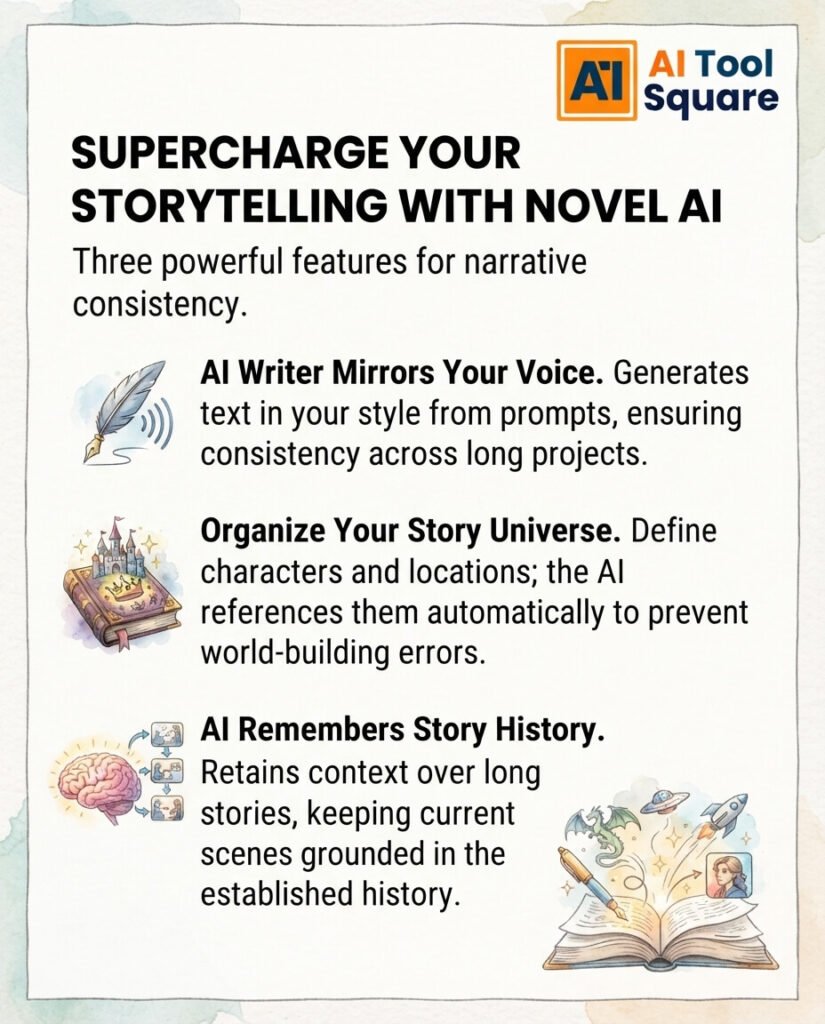
- Adaptive Prose Engine: This tool mimics specific tones and writing styles. You provide a prompt. It generates text that feels like your own voice, ensuring consistency across long-form projects.
- Lorebook Management: You can define characters, locations, and rules for your project. The AI references these entries automatically. This keeps your world building consistent and stops contradictions before they happen.
- Memory Tracking: Novel AI retains context over long stretches of text. You won’t have to keep repeating previous plot points. The system keeps the current scene grounded in the established history of your story.
Benefits of Using Novel AI for Gaming and Entertainment
Speed is the primary advantage. Writing takes time. Editing takes more time. When you use AI to generate first drafts, you jump straight to the editing phase. You spend your energy refining gold rather than mining for it.
Creativity is often a process of iteration. You might be stuck on a character’s motivation. The AI provides five variations in seconds. You pick the best one and move forward. You no longer get stuck in the mud.
Consistency keeps your audience hooked. In large-scale projects, plot holes destroy immersion. Because the tool remembers your lore, you maintain high quality throughout the entire scope of your work. You produce more volume without dropping the standard.
Pricing & Plans

Novel AI offers a tiered subscription model. Access usually depends on the level of model power you need. A free trial allows you to test the waters. This is smart because it lets you verify if the output matches your specific needs before committing capital.
Higher tiers grant access to larger memory contexts and more advanced models. These are built for power users. If you are handling large scripts or extensive world-building files, the premium plans pay for themselves by saving hours of manual labour each week.
Compare this to hiring a freelance writer. A subscription costs a fraction of an hourly rate. You gain control. You keep the copyright. You have a scalable asset that works 24/7. It is a simple math problem.
Hands-On Experience / Use Cases
A game designer uses the Lorebook feature to manage NPC backstories. When players interact with NPCs, the designer generates dialogue that respects the established personality of the character. This ensures every interaction feels authentic.
A screenwriter uses the prose engine to generate scenes for a script. They provide the objective of the scene and the character motivations. The system generates a draft. The screenwriter then polishes the dialogue to match the show’s unique voice.
Agencies use the tool to batch-produce content concepts. Instead of brainstorming from scratch, they generate lists of plot hooks and character traits. This turns an afternoon of meetings into a ten-minute sprint.
Who Should Use Novel AI?

Game developers need this for dialogue and lore. It removes the stress of keeping track of hundreds of entities. It lets the team focus on mechanics and visuals while the story stays robust.
Writers and novelists benefit from the ability to keep long-term context. If you feel like your project is too big to manage alone, this tool acts as your assistant. It holds the map while you drive the ship.
Marketers and content creators use it for brand storytelling. If you have to build a narrative around a product or service, you can generate consistent, thematic content that keeps your audience interested without manually writing every post.
How to Make Money Using Novel AI
Monetizing your skill with AI is all about output. You can sell services that were previously too time-consuming to offer. You become a high-volume producer of quality content.
You can offer world-building services for indie game developers. Use the AI to generate lore, NPC bios, and item descriptions. You deliver a complete world file to the client for a flat fee. You save them time, and they pay you for the result.
Ghostwriting becomes highly profitable. You can take on more clients because the time per project drops. You use the AI to create the structure and first drafts, then apply your professional touch to the final polish. You work less and earn more.
- Game Lore Creation: Generate entire wikis for game worlds. Sell these to indie developers who have the gameplay but need the story.
- Script Drafting: Offer fast, iterative scriptwriting for short-form video or episodic content. Charge per minute of finished script.
- Character Design Packs: Create detailed character profiles including motivations, flaws, and histories. Sell these as asset packs for writers or roleplay groups.
Limitations and Considerations
The AI is a tool, not a replacement for your taste. It generates the raw material. You must provide the direction. If your inputs are vague, the outputs will be generic. You need to learn how to prompt effectively.
Accuracy matters. Sometimes the system hallucinates facts. You must verify names and plot details. Editing is non-negotiable. Treat the output as a draft, not a final product. Your job is to curate and refine.
The learning curve exists. Understanding how to manage the Lorebook and memory settings is vital. Once you master the settings, the system becomes an extension of your own thought process. Put in the time to learn the system.
Final Thoughts
Novel AI is a lever. It allows you to produce more work with less friction. In a field where speed and consistency are everything, this is a competitive advantage. Stop fighting the blank page.
Start by setting up a small project. Experiment with the memory settings. See how the AI responds to your voice. Once you see the output potential, you will find it hard to go back to manual writing. Master your tools, build your stories, and scale your output today.
Visit the official Novel AI website
Frequently Asked Questions
1. What is Novel AI used for?
Novel AI is used for assisted writing and story generation. It helps users build consistent narratives, develop characters, and maintain lore for creative projects.
2. Is Novel AI free?
There is a free trial available to test the features. Full access to the most powerful models requires a paid subscription.
3. How does Novel AI compare to other AI tools?
Novel AI is specifically built for storytelling and long-form prose. Its Lorebook and memory features set it apart from general-purpose chatbots.
4. Can beginners use Novel AI?
Yes. The interface is intuitive, but users should expect a short period of learning to understand how to best prompt the AI for specific results.
5. Does the content created by Novel AI meet quality and optimization standards?
The content requires human oversight. It provides a high-quality draft, but you must edit it to ensure it meets your specific standards and creative vision.
6. Can I make money with Novel AI?
Yes. By increasing your production speed, you can take on more freelance clients or create your own content products more efficiently.
7. How to make money with Novel AI?
Offer services like game lore writing, script drafting, or character development. Use the efficiency of the AI to scale your output and deliver faster than the competition.