

Convai allows developers to create intelligent, conversational virtual beings that listen, think, and respond in real-time. This is not about better textures or higher frame rates. This is about better brains.
Why Convai Is a Game-Changer in NPC and Character
You want players to feel something. You want them to care about the people inside your game. Most developers struggle with robotic, pre-scripted dialogue that breaks immersion instantly. It kills the experience. Players stop feeling like they are in a world and start feeling like they are clicking through a spreadsheet.
You need a better way. Enter Convai. It allows developers to create intelligent, conversational virtual beings that listen, think, and respond in real-time. This is not about better textures or higher frame rates. This is about better brains.
If you are working in Gaming and Entertainment, you know that player retention comes down to emotional connection. When your characters actually talk back and react to the player’s voice or text, the rules change. You aren’t just selling a game; you are selling a live, breathing story.
Table of Contents
- What is Convai?
- Key Features of Convai for NPC and Character
- Benefits of Using Convai for Gaming and Entertainment
- Pricing & Plans
- Hands-On Experience / Use Cases
- Who Should Use Convai?
- How to Make Money Using Convai
- Limitations and Considerations
- Final Thoughts
- Frequently Asked Questions
What is Convai?
Convai is an AI platform built to bridge the gap between static game assets and intelligent, conversational entities. It provides the middleware required to give virtual characters the ability to process natural language, understand context, and generate human-like voices on the fly.
Most AI tools focus on text generation for marketing or basic chatbots. Convai is different. It is built for 3D engines. It integrates directly into platforms like Unity and Unreal Engine. It allows your characters to live inside the game world, not just a browser window.
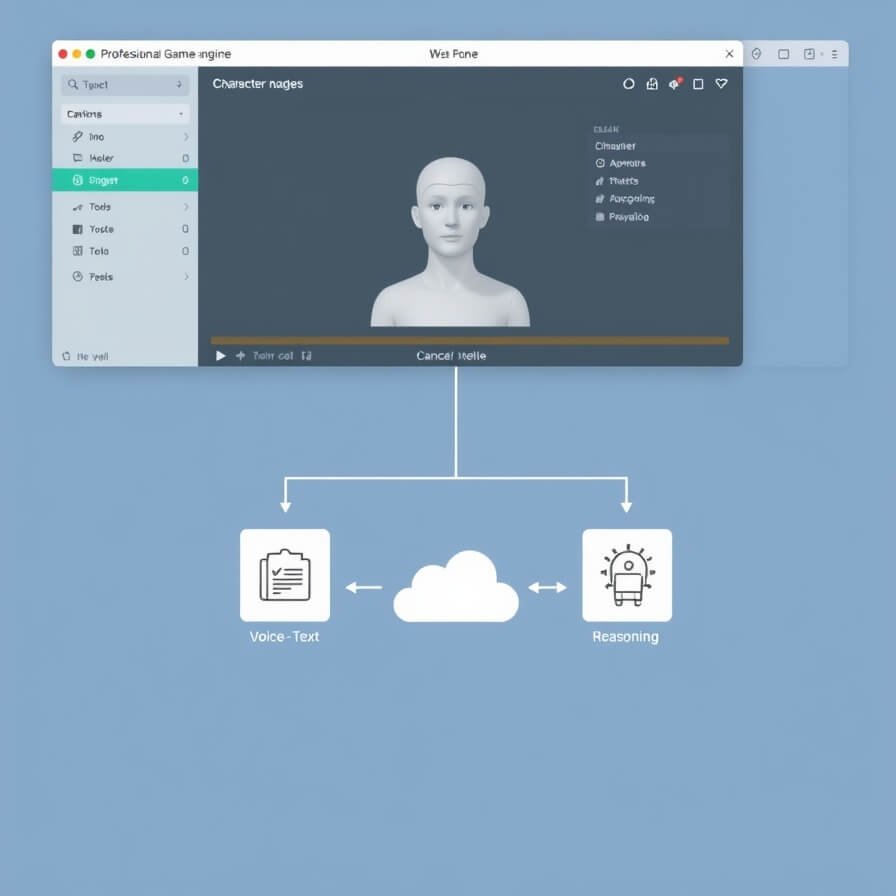
The core technology manages the entire stack of conversational AI. It handles the speech-to-text, the LLM reasoning, and the text-to-speech synchronization. It means your developers don’t have to build a complex backend from scratch just to make an NPC hold a conversation.
For creators, this is a massive shift. You define the personality, the backstory, and the goals of your character, and the system handles the heavy lifting of real-time interaction. It turns a silent asset into a proactive participant in the player’s journey.
Key Features of Convai for NPC and Character
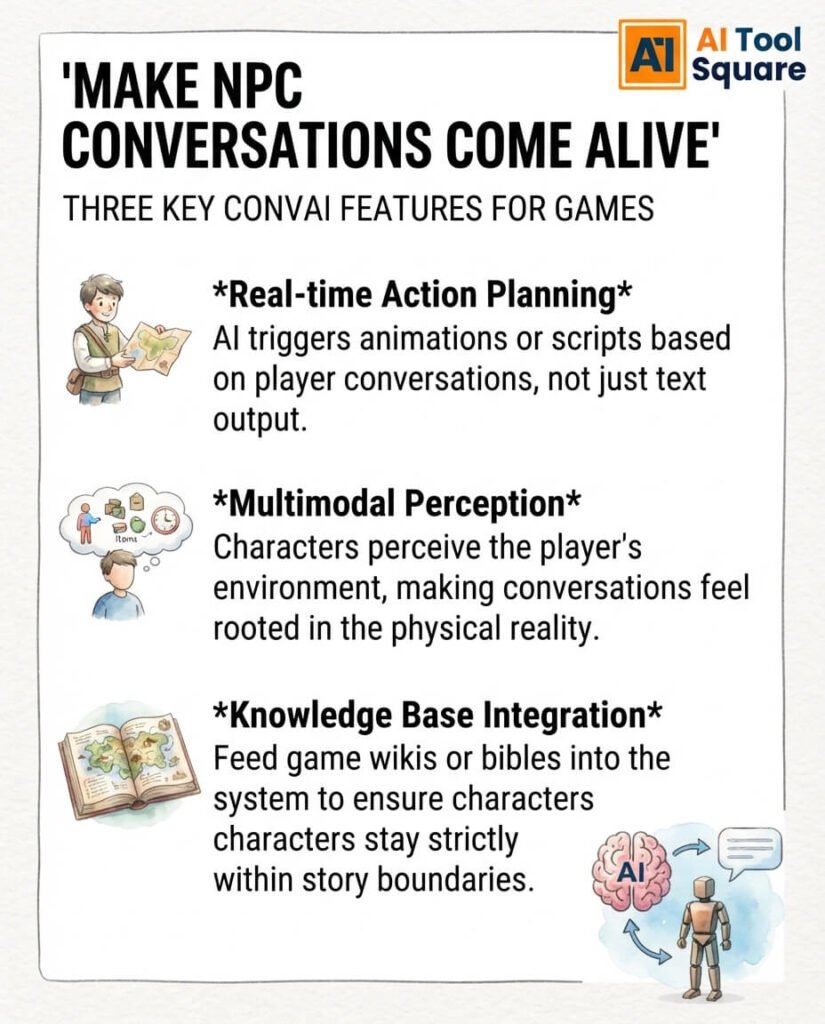
- Real-time Action Planning: Most NPC and Character tools simply spit out text. Convai allows characters to perform actions based on the conversation. If a player asks a character to show them a map, the AI can trigger an animation or a script to hand over an item. It bridges the gap between talking and doing.
- Multimodal Perception: Characters aren’t blind. They can perceive the player’s environment. They know when a player is standing near them, what items are in the room, and what time of day it is. This makes the conversation feel rooted in the physical reality of the game, rather than floating in a void.
- Knowledge Base Integration: You don’t want your NPC to hallucinate lore that doesn’t exist. You can feed your game’s bible or wiki into the system. This keeps the character strictly within the boundaries of your story, ensuring they sound exactly like the world-building demands.
Benefits of Using Convai for Gaming and Entertainment
The primary benefit is efficiency. Manually scripting every dialogue branch for an open-world game is a nightmare. It creates thousands of lines of code that become brittle the moment you change a quest line. With AI-driven conversations, you define the character’s motivation and let the AI handle the branching logic.
This approach saves hundreds of hours of production time. Instead of hiring writers to cover every possible question a player might ask, you hire writers to define the character’s voice and intent. The AI manages the permutations, allowing you to scale your game world without scaling your script size.
Quality increases because the interactions become personal. Players have different playstyles. One player might be aggressive, while another is inquisitive. An AI-powered character adapts to these inputs. The dialogue becomes unique to the player, which naturally increases replayability. People return to games where they feel their choices and words matter.
Finally, it reduces overhead. You no longer need to record thousands of lines of dialogue for every possible interaction. Using high-quality AI text-to-speech synthesis, you can generate natural-sounding voices for infinite dialogue lines, keeping your storage costs low and your content fresh.
Pricing & Plans
The platform offers tiered plans, including a starting point for developers who want to test the technology. Usually, this involves a free tier or a limited trial that allows for testing within an engine environment without needing to commit capital immediately.
Premium plans scale based on usage. Since you are processing natural language and generating audio, pricing is often tied to “credits” or “tokens.” This is standard for API-based services. It protects you because you only pay for the volume your game actually uses.
When comparing this to the cost of human voice actors and studio time for every minor NPC, the math is simple. If you are a mid-sized studio, the cost per interaction is pennies compared to the thousands of dollars required for traditional, static VO pipelines.
Always review the current documentation for specific limits on API calls. If your game expects millions of concurrent users, you need to plan for the consumption cost. For indie developers and startups, the entry point is low, making it a viable way to differentiate a project without massive funding.
Hands-On Experience / Use Cases
Consider a detective RPG. In a standard setup, the player picks from a list of three questions. The NPC gives a static response. With this tool, the player uses their microphone to actually ask the detective for clues. The NPC analyzes the request, checks its knowledge base, and responds accordingly.
If the player is rude, the detective might refuse to talk. If the player brings up a clue found in a previous level, the detective might acknowledge that specific item. It makes the world feel interconnected and alive, forcing the player to think about their words.
Another use case involves training simulations. A corporate training module can feature an intelligent customer service persona. Trainees interact with the character to resolve conflicts. The AI provides an objective analysis of how the trainee handled the situation, turning a game-like environment into a high-utility educational tool.
Horror games also benefit. Imagine a survivor hiding in a closet. Instead of a pre-recorded scream, the monster outside is listening to the player’s microphone. If the player breathes too loudly or talks, the monster responds to the noise. This use of audio-to-intelligence creates a level of tension that static games cannot achieve.
Who Should Use Convai?

Indie game developers are the primary target. If you are a small team trying to build a massive, immersive world, you need tools that multiply your productivity. This is how you punch above your weight class.
Narrative designers who want to stop writing “choose your own adventure” loops will find this a breath of fresh air. It allows for a more fluid style of storytelling that puts the player’s curiosity in the driver’s seat.
VR and AR creators should pay attention. When you are inside a headset, immersion is fragile. Robotic dialogue ruins the illusion. Bringing interactive, smart characters into VR spaces is the next frontier of the medium, and this tool is positioned to lead that charge.
Educational and simulation companies are also prime users. Any project that requires a user to talk to a synthetic entity to learn, practice, or explore will benefit from the real-time processing capabilities offered here.
How to Make Money Using Convai
The best way to make money is to offer “Conversational Design” services to other studios. Many developers know they need AI in their games but have no idea how to set it up. You can become the bridge between their engine and the AI platform.
Another path is to build hyper-niche games. Create a game focused entirely on conversation and personality, like a virtual therapist or an investigative mystery. These games sell on the strength of their unique mechanics, which you can now build in a fraction of the time.
You can also create asset packs. Build a “Pre-Configured Intelligent NPC Kit” for the Unity or Unreal marketplaces. Sell the logic, the base prompts, and the character setups. Other developers will pay to skip the setup phase, and you get a recurring revenue stream from your digital assets.
- Consulting for Studios: Offer to integrate the API into existing projects for indie studios. Many teams have legacy code and need a specialist to handle the AI layer.
- Character Design Agency: Focus on writing the “Personalities” for NPCs. You aren’t just a writer; you are a prompt engineer for virtual people. Clients pay for characters that don’t break character and provide high-quality responses.
- Educational Content Creator: Teach others how to use the tool. Start a channel or build a course on how to integrate high-end AI into game engines. People are desperate for tutorials on how to make this stuff work.
Limitations and Considerations
The technology is impressive, but it is not magic. It still requires prompt engineering. If you feed the system garbage instructions, you will get garbage output. You must spend time iterating on the character’s constraints and personality to get consistent results.
Latency is the biggest challenge. Because the system relies on cloud-based processing, there is a delay between the player’s speech and the character’s response. You need to design your game so that this “thinking time” feels like part of the character’s personality, rather than a laggy connection.
Data privacy is another factor to consider. Since you are processing voice and text data, ensure your implementation complies with the privacy standards required for your target audience. Always keep the user informed about how their data is being handled.
Finally, do not rely on it for every single interaction. Some things should be hand-crafted. Use the AI for the heavy lifting of open-ended conversation, but keep the critical plot-advancing moments scripted to ensure the narrative stays on track.
Final Thoughts
The era of static dialogue is over. If you want your projects to stand out in a crowded market, you need to embrace tools that bring interactivity to the forefront. This platform is a shortcut to professional-grade conversational systems.
It cuts the busywork, enhances the player experience, and allows for stories that were previously impossible to tell. If you are serious about building the next generation of games, you have to look at how you are handling your virtual citizens.
Do not wait for your competitors to do it first. Start small, integrate the technology into a single character or a prototype level, and see the difference for yourself. The tools are ready. The question is whether you are willing to evolve your workflow.
Visit the official Convai website
Frequently Asked Questions
1. What is Convai used for?
It is used to give characters in games the ability to speak, listen, and reason in real-time, moving away from pre-written dialogue trees.
2. Is Convai free?
There are tiered plans available. It typically offers a free tier for small-scale testing, with paid options for higher usage volumes.
3. How does Convai compare to other AI tools?
It is designed specifically for integration with 3D game engines, whereas most AI tools are designed for web chatbots or text generation tasks.
4. Can beginners use Convai?
Yes, though it helps to have a basic understanding of game engine environments like Unity or Unreal Engine to get the most out of the platform.
5. Does the content created by Convai meet quality and optimization standards?
Yes, it is designed for high-quality synthetic speech and logical reasoning, though developers should always curate the prompt inputs to ensure quality.
6. Can I make money with Convai?
Yes, through consulting, game development, or creating and selling intelligent character assets to other developers.
7. How to make money with Convai?
You can offer integration services to indie studios, build conversational games, or sell character-personality kits on game asset marketplaces.