
Discover the top AI sentiment analysis tools to understand customer emotions, improve service, and boost your business. Get happier customers today!
Unlocking Customer Happiness with AI Sentiment Analysis Tools
Listen, if you’re not paying attention to what your customers are *really* feeling, you’re leaving money on the table. We’re not talking about just surveys; we’re talking about getting deep into their actual words, their tone, their sentiment. That’s where AI sentiment analysis tools come into play. These aren’t just fancy gadgets; they’re essential business weapons for anyone serious about customer satisfaction and, let’s be honest, profitability. I’ve seen businesses completely turn around by simply understanding the emotional pulse of their customer base, and it all starts with the right Sentiment Analysis strategy.
You see, most businesses think they know what their customers want. They run a few polls, read some reviews, and call it a day. Big mistake. What you need is a systematic, data-driven approach to truly grasp the underlying emotions driving customer feedback. That’s precisely what the best AI sentiment analysis tools offer. They sift through mountains of data – social media comments, support tickets, email interactions – and pull out the nuanced feelings, the subtle cues that humans often miss. This isn’t just about identifying ‘positive’ or ‘negative’; it’s about understanding the intensity, the specific aspects triggering those emotions, and what you can do about it to create happier customers.
Table of Contents
- What Are the Best Sentiment Analysis Tools?
- Top AI Sentiment Analysis Tools (Detailed Reviews)
- Feature Comparison
- Pricing Breakdown
- Real-World Use Cases
- Who Should Use Each Tool?
- How to Choose the Right Tool
- Making Money with These Tools
- Common Limitations
- Final Verdict and Recommendations
- Frequently Asked Questions
What Are the Best Sentiment Analysis Tools?
Alright, let’s cut to the chase. If you’re serious about customer feedback, you need the right arsenal. The “best” AI sentiment analysis tools aren’t one-size-fits-all; they depend on your specific needs, your budget, and the kind of data you’re working with. But generally speaking, we’re looking for accuracy, scalability, integration capabilities, and ease of use. You don’t want a tool that requires a PhD to operate, nor do you want one that misses the point entirely when a customer is clearly fuming. It needs to be precise and actionable.
Many businesses overlook the power of these tools, treating them as an optional extra rather than a core component of their customer strategy. This is a massive oversight. Imagine being able to predict customer churn before it happens, or identify product features that are consistently causing frustration, all by analysing the sentiment in their feedback. That’s not magic; that’s just smart use of AI sentiment analysis tools. They provide a quantitative lens on something inherently qualitative, allowing you to make data-backed decisions that actually move the needle on customer satisfaction and retention. Without this, you’re essentially flying blind, hoping for the best.
The market is full of options, each promising the world. But I’ve sifted through the noise to bring you the ones that actually deliver. We’re talking about tools that provide granular insights, not just broad strokes. They can pick up on sarcasm, irony, and the subtle shifts in tone that convey true emotion. This level of sophistication is what separates the contenders from the pretenders. So, when you’re looking for AI sentiment analysis tools, remember, accuracy and actionable insights are king. Don’t settle for anything less if you want to make a real impact on your customer experience and ultimately, your bottom line.
Top AI Sentiment Analysis Tools (Detailed Reviews)
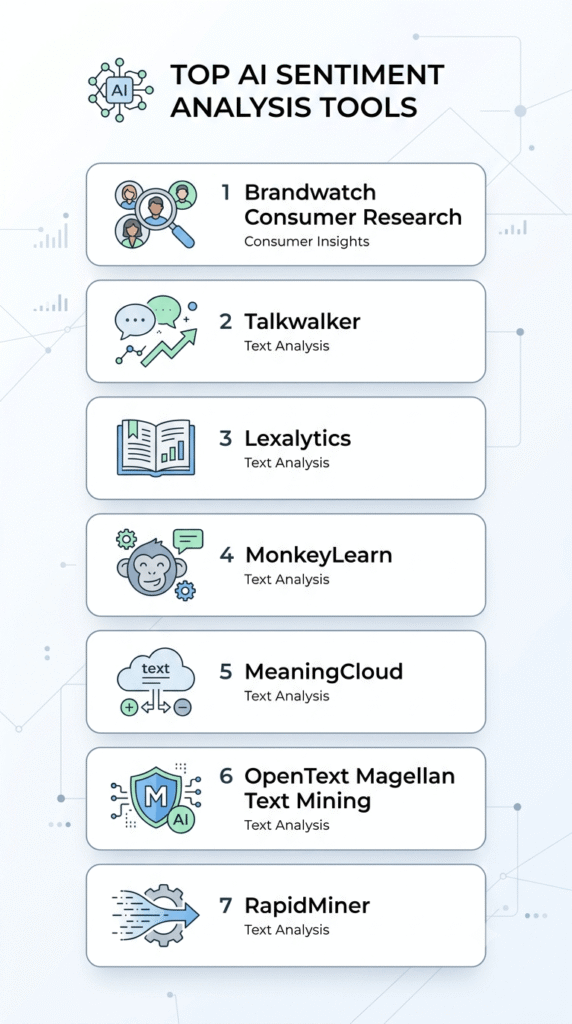
Now, let’s get into the specifics. These are the AI sentiment analysis tools that have proven their worth, the ones that can actually make a difference to your business. We’ll break down what makes each one tick, its strengths, and where it might fall short. Remember, the goal here is to find the perfect fit for *your* operation, not just pick the flashiest option. Each of these AI sentiment analysis tools offers something unique, so pay attention to the details.
Choosing the right tool is a strategic decision. You’re investing in a system that will help you understand your customers better than ever before. This means looking beyond just the headline features and digging into the nuances of their sentiment detection, their language support, and how easily they integrate with your existing systems. A powerful tool that sits in isolation is a waste of money. The best AI sentiment analysis tools become an integral part of your customer feedback loop, providing continuous, real-time insights that inform everything from product development to marketing messaging. Let’s face it, your customers are talking, and these tools help you truly listen. We are talking about genuine improvement in Chatbots and Customer Support.
Each review will give you a clear picture of what to expect, helping you make an informed decision. I’ve focused on usability, depth of analysis, and overall value. Because at the end of the day, you want results. You want happier customers, reduced churn, and a clearer path to growth. These AI sentiment analysis tools are designed to deliver exactly that. So, let’s get into the nitty-gritty and see which one is the right fit for your business to finally start getting ahead in the customer experience game.
Brandwatch Consumer Research – AI sentiment analysis tools Review
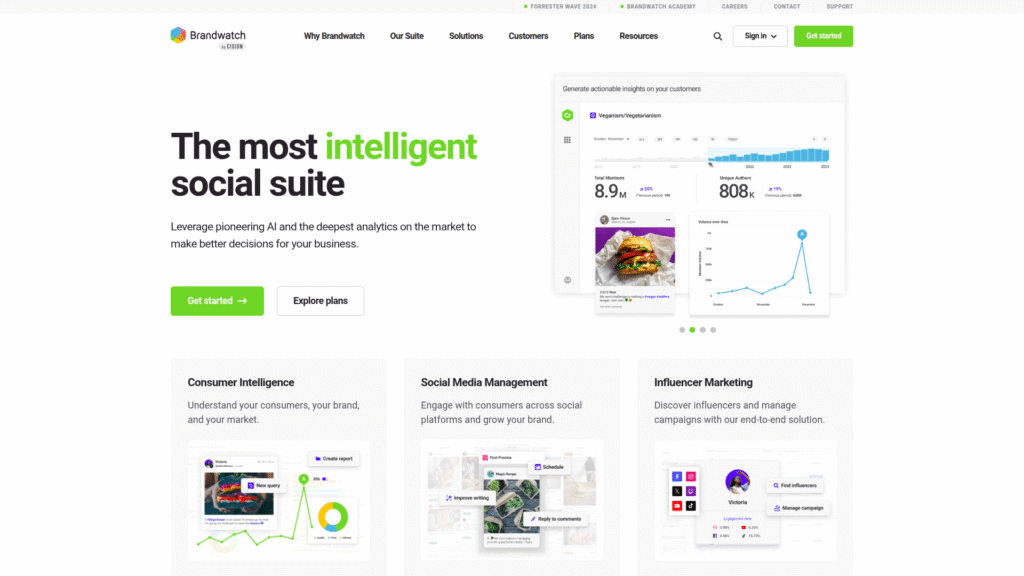
Brandwatch Consumer Research is a powerhouse for social listening and sentiment analysis, offering deep insights into public opinion. It excels at tracking brand mentions, campaign performance, and industry trends across a vast array of online sources. The platform uses advanced AI sentiment analysis tools to classify mentions as positive, negative, or neutral, with the ability to detect nuances like sarcasm and irony. This makes it incredibly valuable for reputation management and understanding the broader market sentiment around your brand. Their topic modelling features allow for even deeper exploration of key themes driving sentiment.
Features:
- Extensive social listening across billions of sources.
- Advanced AI sentiment analysis with sarcasm and irony detection.
- Topic modelling and trend analysis.
- Demographic insights and audience segmentation.
- Real-time alerts and customisable dashboards.
- Benchmarking against competitors.
Pricing:
Brandwatch offers custom pricing based on specific needs and data volume. It is generally considered an enterprise-level solution.
Pros:
- Exceptional depth and breadth of data sources.
- Highly accurate and nuanced sentiment detection.
- Robust reporting and visualisation tools.
Cons:
- Can be costly for smaller businesses.
- Steeper learning curve due to extensive features.
Visit official Brandwatch website
Talkwalker – AI sentiment analysis tools Review
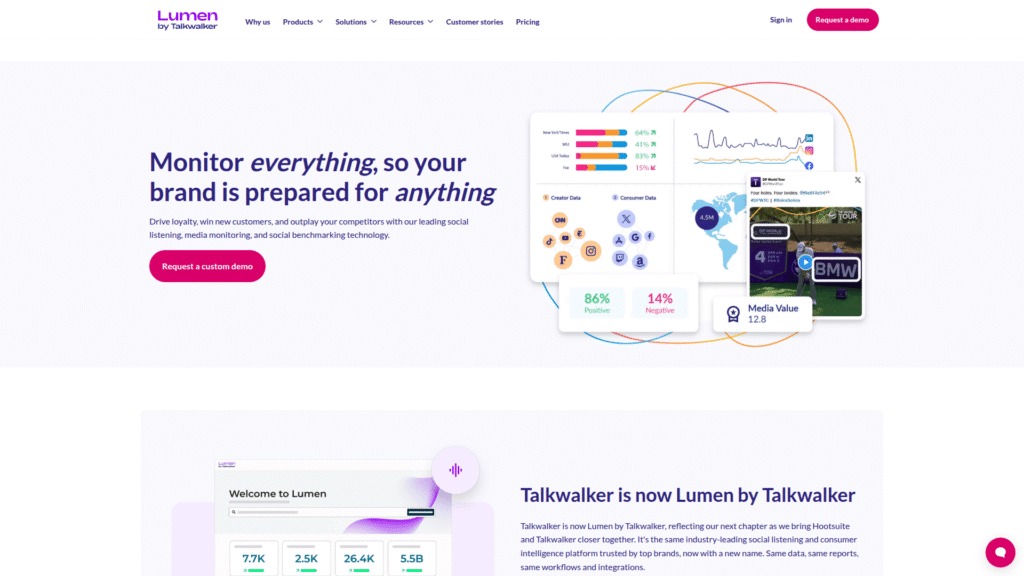
Talkwalker is another leading social listening platform that integrates powerful AI sentiment analysis tools. It’s particularly strong in visual analytics, allowing you to track sentiment associated with images and videos, not just text. Talkwalker provides comprehensive data coverage, including social media, news, blogs, and forums. Its AI capabilities enable precise sentiment scoring and the identification of emotional drivers behind mentions. The platform is designed for both proactive brand monitoring and reactive crisis management, offering real-time alerts and sophisticated reporting features. It’s one of the more versatile AI sentiment analysis tools out there.
Features:
- Broad data coverage, including visual analytics.
- Advanced AI sentiment analysis and emotion detection.
- Crisis detection and real-time alerts.
- Audience insights and influencer identification.
- Customisable dashboards and reporting.
Pricing:
Talkwalker offers tailored pricing, typically catering to mid-market and enterprise clients. You’ll need to contact them for a custom quote.
Pros:
- Strong visual sentiment analysis capabilities.
- Excellent for crisis management and real-time monitoring.
- User-friendly interface despite extensive features.
Cons:
- May be out of budget for small businesses.
- Setup can require some initial effort.
Visit official Talkwalker website
Lexalytics – AI sentiment analysis tools Review
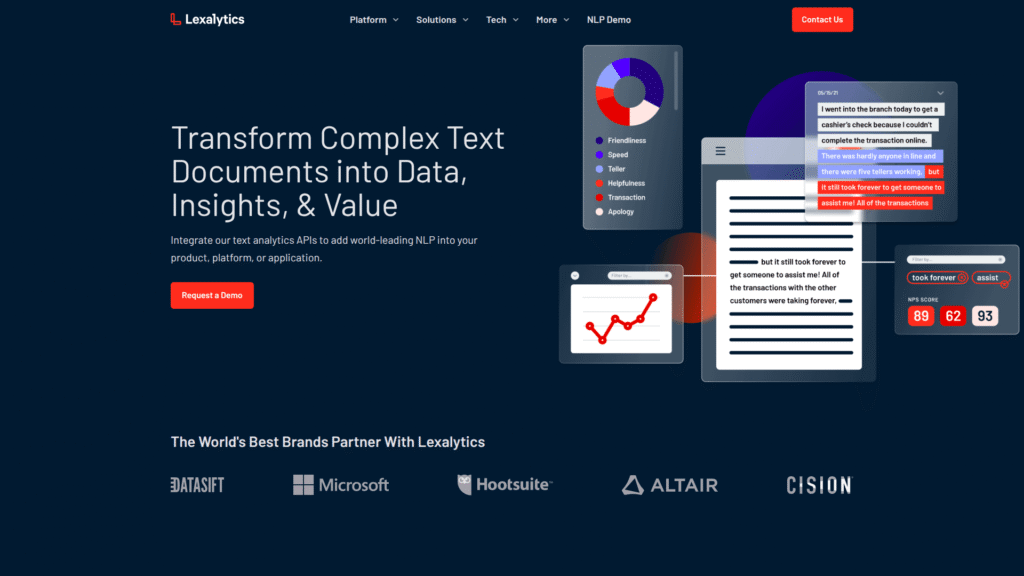
Lexalytics is a robust text analytics engine that offers highly configurable AI sentiment analysis tools. Unlike some platforms that provide a full social listening suite, Lexalytics focuses specifically on text analysis, making it a powerful backend for developers and data scientists. It can process vast amounts of unstructured text data from various sources, including surveys, call centre transcripts, and internal documents. Its sentiment analysis is highly customisable, allowing users to train models for industry-specific jargon and nuanced emotional detection. These AI sentiment analysis tools are for those who need deep, granular control.
Features:
- Highly configurable text and sentiment analysis engine.
- Supports over 20 languages.
- Industry-specific sentiment models.
- Entity extraction, theme detection, and summarisation.
- API-first approach for seamless integration.
Pricing:
Lexalytics offers various pricing tiers, including API usage-based models, and enterprise solutions. Pricing is generally custom and depends on data volume and specific needs.
Pros:
- Exceptional customisation and precision for sentiment analysis.
- Powerful for large-scale text data processing.
- Flexible for integration into existing systems.
Cons:
- Requires technical expertise for full utilisation.
- Not a standalone end-user platform for social listening.
Visit official Lexalytics website
MonkeyLearn – AI sentiment analysis tools Review
MonkeyLearn provides a user-friendly platform for custom text analysis, including powerful AI sentiment analysis tools. It stands out for its no-code machine learning approach, allowing users to build and train custom classifiers and extractors without writing a single line of code. This makes it highly accessible for businesses of all sizes, from small teams to large enterprises. You can easily feed it customer reviews, emails, or support tickets, and it will quickly classify sentiment, extract keywords, and identify common themes. It’s one of the most accessible AI sentiment analysis tools for customisation.
Features:
- No-code platform for custom text classification and extraction.
- Pre-built and customisable AI sentiment analysis models.
- Integrations with popular tools (e.g., Zendesk, Excel).
- API access for developers.
- Real-time processing.
Pricing:
MonkeyLearn offers a free plan for limited usage, with paid plans starting at around $299 per month for more extensive analysis and features. Enterprise pricing is also available.
Pros:
- Very easy to use and set up, even for non-technical users.
- Highly flexible for custom sentiment models.
- Affordable options for small to medium businesses.
Cons:
- May not have the same breadth of social listening data as enterprise platforms.
- Accuracy depends on the quality of training data for custom models.
Visit official MonkeyLearn website
MeaningCloud – AI sentiment analysis tools Review
MeaningCloud offers a suite of cloud-based text analytics APIs and plug-ins, with a strong focus on AI sentiment analysis tools. It’s designed to be highly versatile, supporting multiple languages and offering various sentiment analysis models, including general, topic-specific, and financial sentiment. MeaningCloud can process text from diverse sources and is often praised for its ability to extract opinions and attitudes towards specific entities within text. Its modular design allows users to pick and choose the exact functionality they need, making it a flexible choice for developers and businesses looking for targeted text analysis. These AI sentiment analysis tools are perfect for flexible integration.
Features:
- Multiple sentiment analysis models (general, topic, financial).
- Multi-language support.
- Named entity recognition and concept extraction.
- Text classification and summarisation.
- API and plug-ins for popular applications (e.g., Excel, RapidMiner).
Pricing:
MeaningCloud offers a free plan for limited API calls, with paid plans starting from €99 per month. Enterprise solutions are also available with custom pricing.
Pros:
- Flexible and modular API-based approach.
- Good value for money, especially for smaller businesses and developers.
- Accurate entity-level sentiment analysis.
Cons:
- Requires some technical understanding for API integration.
- User interface for non-developers could be more intuitive.
Visit official MeaningCloud website
OpenText Magellan Text Mining – AI sentiment analysis tools Review
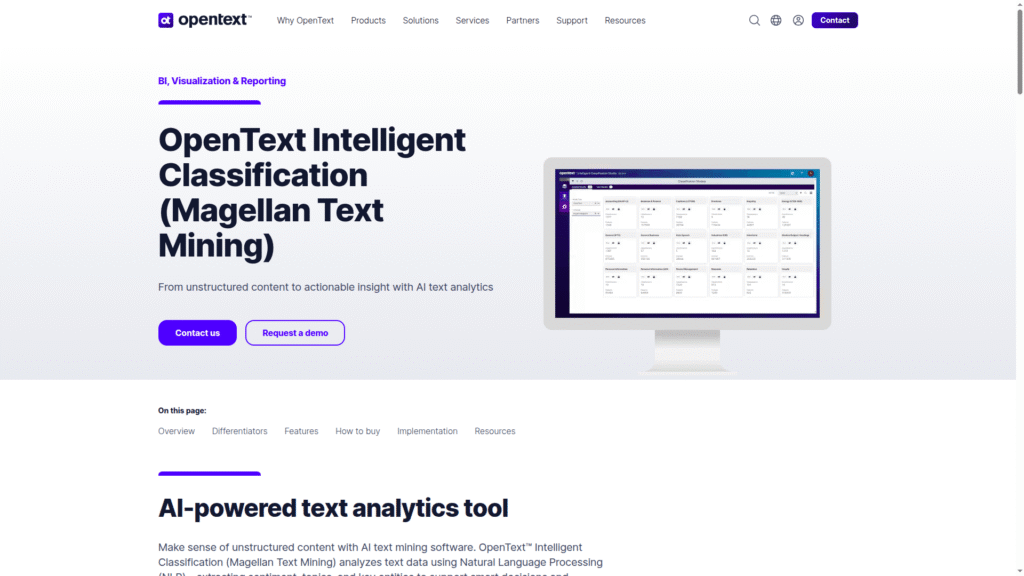
OpenText Magellan Text Mining is an enterprise-grade solution that provides comprehensive text analytics capabilities, including advanced AI sentiment analysis tools. It’s designed to handle massive volumes of unstructured data, often from internal enterprise sources like customer service interactions, email archives, and internal documents. The platform uses sophisticated natural language processing (NLP) and machine learning algorithms to uncover insights, identify trends, and understand the underlying sentiment. It’s particularly suited for organisations with complex data environments and significant data governance needs. These AI sentiment analysis tools are built for enterprise scale.
Features:
- Enterprise-level text analytics and AI sentiment analysis.
- Scalable for vast volumes of unstructured data.
- Integration with other OpenText products.
- Advanced NLP for entity extraction, theme detection, and classification.
- Comprehensive reporting and visualisation.
Pricing:
OpenText solutions are typically enterprise-level, with custom pricing based on deployment, data volume, and specific feature sets. You’ll need to contact their sales team for a quote.
Pros:
- Extremely powerful for large, complex datasets.
- Highly secure and robust for enterprise environments.
- Deep integration capabilities with other enterprise systems.
Cons:
- Significant investment required, not suitable for small businesses.
- Requires specialised technical expertise to implement and manage.
Visit official OpenText website
RapidMiner – AI sentiment analysis tools Review
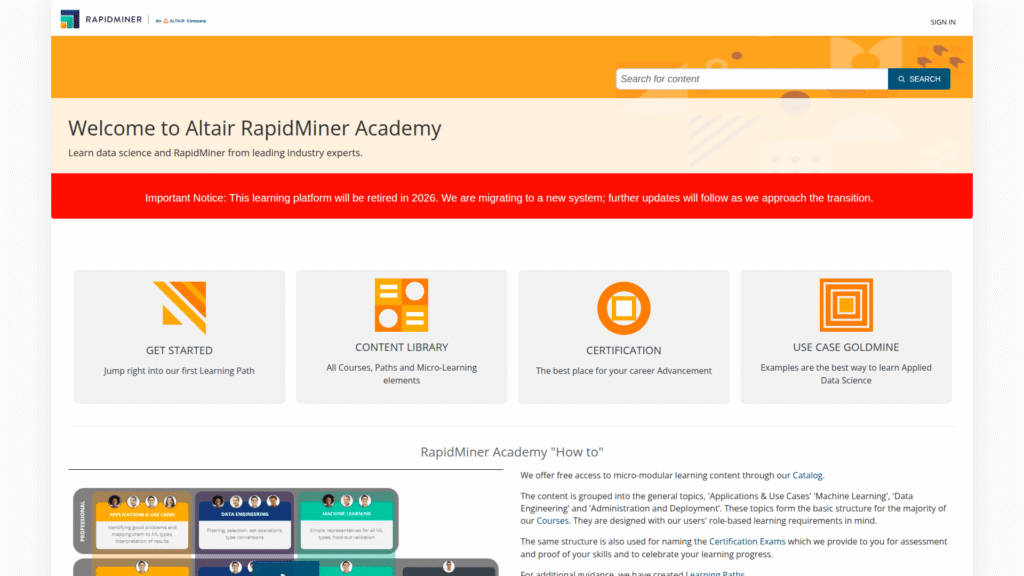
RapidMiner is a comprehensive data science platform that includes powerful AI sentiment analysis tools as part of its broader machine learning capabilities. It’s an end-to-end solution for data preparation, model building, and deployment, offering both visual workflow design and coding options. For sentiment analysis, RapidMiner allows users to build and train custom models using various algorithms, making it highly flexible for specific use cases. It excels at integrating sentiment analysis into larger predictive analytics projects, such as predicting customer churn based on feedback sentiment. These AI sentiment analysis tools are for the data scientist.
Features:
- Full data science platform with visual workflow designer.
- Customisable AI sentiment analysis models.
- Extensive data preparation and machine learning capabilities.
- Integrations with various data sources and databases.
- Deployment and operationalisation of models.
Pricing:
RapidMiner offers a free edition for personal use, with commercial licenses starting at various tiers depending on features and user count. Enterprise pricing is custom.
Pros:
- Highly flexible for building custom sentiment models.
- Integrates sentiment analysis into broader data science workflows.
- Powerful for advanced users and data scientists.
Cons:
- Can be complex for beginners without data science experience.
- Full potential requires a deeper understanding of machine learning.
Visit official RapidMiner website
Feature Comparison
When you’re sifting through AI sentiment analysis tools, the features are where the rubber meets the road. It’s not just about getting a ‘positive’ or ‘negative’ label; it’s about the granularity of the insights. Do you need aspect-based sentiment, where the tool tells you what specific features of your product or service are driving emotions? Or are you content with a general overview? The more detailed the analysis, the more actionable your insights will be. Some tools excel at real-time social media monitoring, while others are built for deep dives into internal customer feedback databases. Understanding these distinctions is crucial.
Consider the data sources each tool can handle. Are you primarily looking at social media, or do you need to analyse customer support tickets, email conversations, or survey responses? Some AI sentiment analysis tools are superstars at processing public online data, giving you a pulse on brand perception. Others are designed to integrate seamlessly with your CRM or customer service platforms, providing insights into individual customer interactions. The breadth of data integration directly impacts the comprehensiveness of your sentiment analysis. Don’t limit yourself by choosing a tool that can’t speak to all your data sources.
Scalability and customisation are also massive factors. Can the tool grow with your business? Can you train it to understand your specific industry jargon, product names, or unique customer language? Generic sentiment models can miss important nuances in specialised contexts. The best AI sentiment analysis tools offer options to fine-tune their models, ensuring higher accuracy for your specific needs. This adaptability is key for long-term value. Without the ability to customise, you risk getting insights that are broadly correct but lack the specific detail needed to make impactful changes. It’s about getting the exact insights you need, not just general trends, and that requires intelligent AI sentiment analysis tools.
Pricing Breakdown
Let’s talk money, because let’s be real, budget is always a factor. Pricing for AI sentiment analysis tools can vary wildly, from free tiers for limited usage to custom enterprise solutions that can run into thousands per month. Generally, you’ll find pricing models based on data volume (how many mentions, documents, or API calls you make), the number of users, and the specific features included. Don’t just look at the headline price; consider the total cost of ownership, including potential integration costs and the need for technical expertise to set up and maintain the system. A cheap tool that requires significant in-house development might end up being more expensive in the long run.
Many of the more advanced AI sentiment analysis tools, especially those geared towards enterprise social listening, operate on a custom pricing model. This means you’ll need to engage with their sales team to get a quote tailored to your specific requirements, such as the number of data sources you want to monitor, the volume of data, and the level of support you need.
While this can seem daunting, it often ensures you only pay for what you actually use and need. For smaller businesses or those just starting out with sentiment analysis, look for tools with clear, tiered pricing plans or even free trials that allow you to test the waters before committing financially. There are plenty of AI sentiment analysis tools designed to scale.
It’s important to align the tool’s cost with the potential return on investment. If an AI sentiment analysis tool helps you reduce customer churn by even a small percentage, or enables you to identify a critical product flaw early, the savings and increased revenue can easily justify the expense. Don’t be penny-wise and pound-foolish when it comes to understanding your customers. The insights gained from effective AI sentiment analysis tools can directly impact your bottom line, so view it as an investment, not just another cost. Always balance the features you need against what you can realistically afford to ensure you get the best value.
Real-World Use Cases
Okay, so how do businesses actually *use* these AI sentiment analysis tools to make more money and keep customers happy? It’s not just theoretical; these tools are driving real results across industries. Imagine a restaurant chain monitoring social media for comments about new menu items. By quickly identifying negative sentiment around a particular dish, they can pull it or tweak the recipe before it causes widespread customer dissatisfaction. That’s direct, actionable insight saving reputation and future revenue. Or consider an e-commerce brand analysing product reviews. They can pinpoint exactly which features customers love or hate, guiding product development and marketing messages.
Customer service departments are perhaps the biggest beneficiaries. Think about automatically routing urgent or negative feedback to senior agents for immediate resolution. This proactive approach, powered by AI sentiment analysis tools, prevents escalations and turns potentially unhappy customers into loyal advocates. Call centres can use these tools to analyse transcripts, identifying common pain points or areas where agents need more training. This isn’t just about efficiency; it’s about improving the quality of every customer interaction, making customers feel heard and valued. It’s about getting ahead of the curve with smart AI sentiment analysis tools.
Marketing teams also leverage AI sentiment analysis tools heavily. They use them to understand public perception of campaigns, monitor brand health, and even identify emerging trends or competitive threats. Knowing what people are saying, and how they feel about it, allows for more targeted messaging and more effective campaign adjustments. Product managers use sentiment data to prioritise feature requests, ensuring they’re building what customers truly want. From crisis management to strategic planning, these AI sentiment analysis tools are invaluable for making data-driven decisions that directly impact customer satisfaction and profitability. The applications are practically endless once you start truly listening.
Who Should Use Each Tool?
Choosing the right AI sentiment analysis tools depends heavily on your specific role and business size. If you’re a large enterprise with complex data needs and a dedicated data science team, tools like OpenText Magellan Text Mining or Lexalytics will offer the scalability and customisation you require. These are for organisations that need to integrate sentiment analysis deep into their existing data infrastructure and have the technical resources to manage it.
For marketing professionals, brand managers, and PR teams, platforms like Brandwatch Consumer Research and Talkwalker are ideal. These AI sentiment analysis tools provide extensive social listening capabilities, allowing you to monitor brand health, track campaigns, and manage reputation across a vast array of public data sources. They’re designed for real-time insights and comprehensive reporting, perfect for understanding public sentiment and responding quickly to trends or crises.
Small to medium-sized businesses, or teams within larger organisations looking for agile and user-friendly solutions, should consider MonkeyLearn or MeaningCloud. These AI sentiment analysis tools offer a great balance of power and accessibility, allowing you to build custom sentiment models without extensive coding knowledge. They’re perfect for analysing customer reviews, survey responses, and internal feedback, providing actionable insights without the enterprise-level price tag or complexity. Even if you’re a solopreneur, these accessible AI sentiment analysis tools can give you an edge.
How to Choose the Right Tool
Picking the right AI sentiment analysis tools isn’t a trivial decision; it’s an investment in your customer understanding. First, define your objectives. What specific problems are you trying to solve? Are you trying to reduce churn, improve product features, enhance customer service, or monitor brand reputation? Your goals will dictate the features you need. If you’re focused on social media, you’ll need robust listening capabilities. If it’s internal feedback, integration with your CRM or helpdesk is crucial. Don’t get distracted by shiny features you won’t use; focus on what solves your actual business problems with AI sentiment analysis tools.
Next, consider your data sources. List all the places where customer feedback resides: social media, emails, chat logs, surveys, call transcripts, forums, product reviews. Ensure the AI sentiment analysis tools you evaluate can ingest and process data from all these critical sources. A tool that only handles social media will leave you blind to valuable insights hidden in your internal communication channels. The more comprehensive the data input, the more holistic your understanding of customer sentiment will be, allowing you to make truly informed decisions.
Finally, evaluate ease of use and integration. Will your team be able to adopt and effectively use the tool without extensive training or technical support? Look for intuitive interfaces, clear reporting, and straightforward integration options with your existing tech stack. A powerful tool that sits unused because it’s too complex is a waste of resources. Prioritise a solution that fits seamlessly into your workflow and empowers your team to gain actionable insights quickly. The best AI sentiment analysis tools are those that blend into your operation, becoming an indispensable part of your strategy, not a separate project.
Making Money with These Tools
Let’s talk about the real reason you’re here: making money. AI sentiment analysis tools aren’t just for ‘feeling good’ about customers; they’re direct profit drivers. Imagine you identify a recurring negative sentiment about your product’s onboarding process. By fixing that, you reduce customer churn. Less churn equals more recurring revenue, simple as that. Or perhaps you discover a strong positive sentiment around a niche feature your competitors don’t offer. You can then leverage that in your marketing, attracting new customers who specifically value that unique selling proposition. This is about optimising your entire customer journey for maximum profitability, using AI sentiment analysis tools as your guide.
These tools allow you to be proactive instead of reactive. Instead of waiting for customers to churn and then scrambling to understand why, you can identify dissatisfaction early and intervene. This saves acquisition costs and builds long-term customer loyalty. By understanding exactly what customers love, you can double down on those strengths, turning happy customers into brand advocates who bring in new business through word-of-mouth. Think about how much a strong brand reputation is worth – these AI sentiment analysis tools are your early warning system and your growth accelerator all in one.
Furthermore, by pinpointing customer pain points, you can guide product development to create features that truly solve problems, leading to higher adoption rates and increased customer lifetime value. Optimising customer support based on sentiment analysis can lead to faster resolution times and improved satisfaction scores, reducing operational costs and boosting your brand image. Every decision, from product design to marketing messaging, can be informed by sentiment data, ensuring you’re always aligned with what your customers actually want and need. That alignment, my friend, is where the real money is made with AI sentiment analysis tools.
Common Limitations
Look, no tool is perfect, and AI sentiment analysis tools have their quirks. The biggest challenge is often context. Sarcasm and irony are notoriously difficult for AI to detect accurately. A customer might say, “Oh, brilliant, my internet went down again,” and a basic tool might flag that as positive because of “brilliant.” Humans understand the underlying frustration, but AI needs advanced training and algorithms to catch these nuances. This is why some tools offer sarcasm detection, but it’s still an evolving science. Don’t expect 100% perfection, especially with highly nuanced language.
Another limitation is domain-specific language. What’s negative in one industry might be neutral or even positive in another. For instance, “bug” in software development is a problem, but “bug” in a natural history context is just a creature. Generic AI sentiment analysis tools might struggle with these distinctions unless they’ve been specifically trained on relevant data. This is where the customisation options offered by tools like MonkeyLearn or Lexalytics become incredibly valuable, allowing you to fine-tune the model to your unique vocabulary and context. Without proper training, you might get misclassifications that lead to inaccurate insights, which can be worse than no insights at all.
Finally, data volume and quality can also be limitations. If you don’t have enough data, or if your data is messy and inconsistent, even the best AI sentiment analysis tools will struggle to provide meaningful insights. Garbage in, garbage out, as they say. Ensuring clean, relevant data is a prerequisite for accurate analysis. Also, multi-language support can vary significantly. If your customer base is global, ensure the tool you choose supports all the languages you need with comparable accuracy. Don’t assume all languages are treated equally. Always be aware of these limitations to manage your expectations and get the most out of your chosen AI sentiment analysis tools.
Final Verdict and Recommendations
So, what’s the bottom line? For large enterprises needing comprehensive social listening and deep analytics, Brandwatch Consumer Research and Talkwalker are top-tier choices. Their extensive data coverage and advanced AI sentiment analysis tools make them indispensable for reputation management and market intelligence. Just be prepared for an investment.
Developers and data scientists requiring highly customisable and API-first solutions will find Lexalytics and MeaningCloud to be powerful allies. These tools offer the flexibility to build bespoke sentiment analysis workflows and integrate them into existing applications, provided you have the technical know-how. RapidMiner also shines here for its broader data science capabilities.
For small to medium businesses or teams seeking user-friendly, no-code options with good customisation, MonkeyLearn is a standout. It offers an excellent balance of power and ease of use, making it accessible for a wider range of users to start leveraging AI sentiment analysis tools without a steep learning curve. The key is to match the tool to your specific needs, budget, and technical capabilities.
Ultimately, the best AI sentiment analysis tools are the ones that provide you with actionable insights that lead to happier customers and a healthier bottom line. Don’t just pick one because it’s popular; pick one because it solves your specific problems and fits seamlessly into your operations. That’s how you truly win. Invest in understanding your customers, and the returns will follow, guaranteed. These AI sentiment analysis tools aren’t a luxury; they’re a necessity for anyone serious about customer-centric growth.
Frequently Asked Questions
What is sentiment analysis?
Sentiment analysis is the automated process of identifying and extracting subjective information from text, determining the emotional tone behind a piece of writing, whether it’s positive, negative, or neutral.
How accurate are AI sentiment analysis tools?
The accuracy of AI sentiment analysis tools varies depending on the tool, the complexity of the language, and the quality of the training data. While modern tools are highly advanced, they can sometimes struggle with sarcasm, irony, or highly nuanced contexts, often achieving 70-90% accuracy in general cases.
Can sentiment analysis detect emotions other than positive, negative, and neutral?
Yes, many advanced AI sentiment analysis tools can go beyond basic positive/negative/neutral classifications to detect specific emotions like joy, anger, sadness, fear, and surprise, providing a more granular understanding of customer feelings.
What types of data can AI sentiment analysis tools process?
AI sentiment analysis tools can process a wide range of text data, including social media posts, customer reviews, survey responses, emails, chat transcripts, news articles, and internal documents.
Is it possible to customise sentiment analysis models for specific industries?
Absolutely. Many of the best AI sentiment analysis tools allow users to train and customise models with industry-specific data and terminology, significantly improving accuracy for niche contexts.
What are the benefits of using AI sentiment analysis tools for businesses?
The benefits include improved customer satisfaction, reduced churn, enhanced brand reputation, better product development, more effective marketing campaigns, and proactive customer service.
What’s the difference between rule-based and machine learning sentiment analysis?
Rule-based sentiment analysis uses predefined rules, lexicons, and linguistic patterns to classify sentiment, while machine learning sentiment analysis uses algorithms trained on large datasets to learn patterns and make predictions. Machine learning approaches are generally more adaptable and accurate for complex language, particularly within advanced AI sentiment analysis tools.
And that’s the playbook. These AI sentiment analysis tools are your secret weapon for happy customers and a thriving business.