
Discover how Consensus transforms Medical Research by providing evidence-based answers instantly. Stop wasting time and start making data-driven decisions today.
Why Consensus Is a Game-Changer in Medical Research
You have a massive problem. The sheer volume of scientific papers is exploding. You need the truth, but you are drowning in data. Searching through thousands of databases is a nightmare. It takes forever. You end up exhausted, confused, and still unsure if you have the right answer.
Most people in Healthcare and Medical are working harder, not smarter. They read abstracts for hours. They hunt for P-values. They hope they didn’t miss a critical study that contradicts their entire premise. This manual slog is the biggest bottleneck in your productivity.
Consensus changes the game. It is an AI-powered search engine that doesn’t just give you links. It gives you answers based on peer-reviewed research. It cuts the fluff. It gives you the “what” and the “why” in seconds. It is the shortcut you have been waiting for.
What is Consensus?
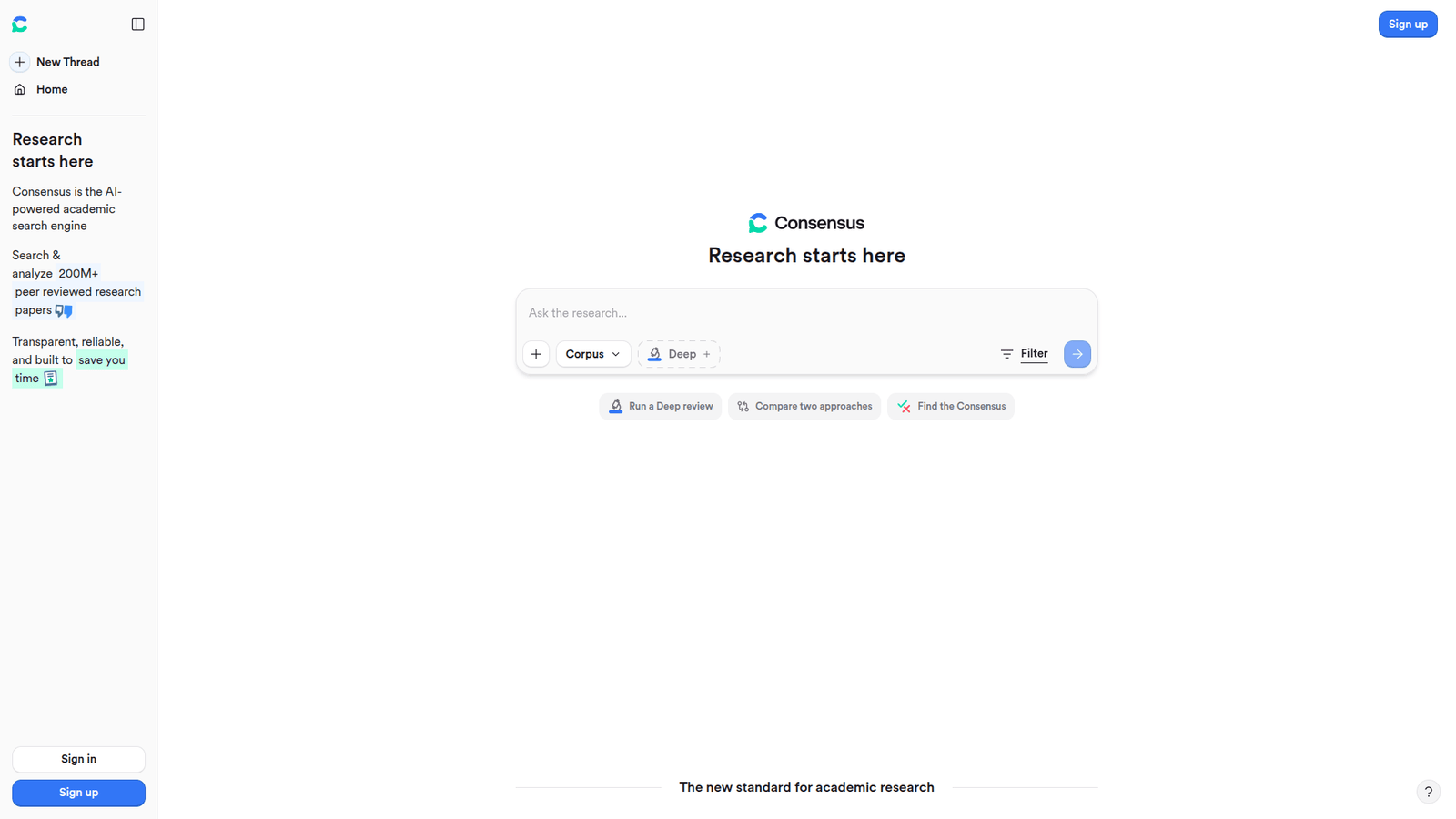
Consensus is a search engine built on top of scientific literature. It uses AI to pull data directly from peer-reviewed papers. You ask a question, and it provides a summary backed by citations.
Standard search engines give you marketing sites, blog posts, and random opinions. They prioritize SEO keywords, not scientific rigor. Consensus ignores the noise. It only looks at the “good stuff”—vetted, peer-reviewed studies.
The target audience is anyone who needs evidence. If you are a doctor, a grad student, a clinician, or a health policy analyst, this tool is designed for you. It bridges the gap between massive databases like PubMed and your need for speed.
Think of it as having a research assistant who has read every paper in existence. You ask, “Does X cause Y?” and the assistant points to the papers that prove or disprove it. No bias. No marketing jargon. Just data.
Key Features of Consensus for Medical Research
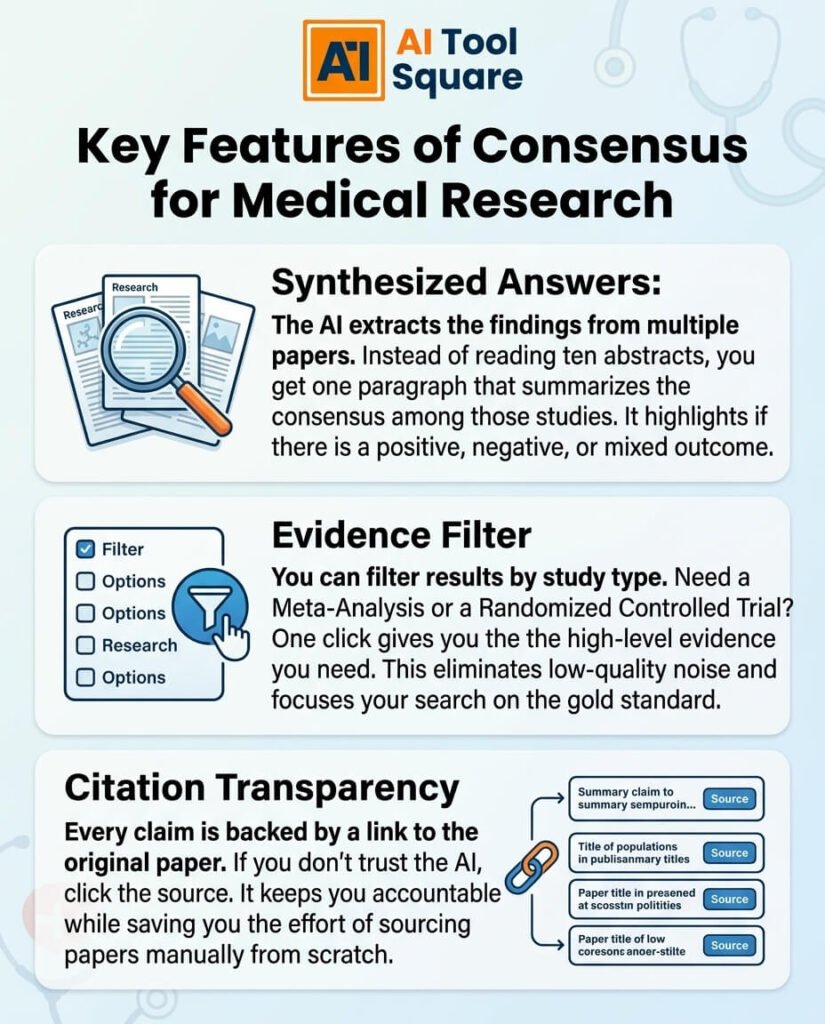
- Synthesized Answers: The AI extracts the findings from multiple papers. Instead of reading ten abstracts, you get one paragraph that summarizes the consensus among those studies. It highlights if there is a positive, negative, or mixed outcome.
- Evidence Filter: You can filter results by study type. Need a Meta-Analysis or a Randomized Controlled Trial? One click gives you the high-level evidence you need. This eliminates low-quality noise and focuses your search on the gold standard.
- Citation Transparency: Every claim is backed by a link to the original paper. If you don’t trust the AI, you click the source. It keeps you accountable while saving you the effort of sourcing papers manually from scratch.
Benefits of Using Consensus for Healthcare and Medical
Time is your most limited resource. When you spend hours chasing references, you aren’t providing care or advancing science. Consensus hands that time back to you. You can do in five minutes what previously took five hours.
Quality improvement is the next big win. Human error is common when reviewing literature. Fatigue leads to missed details. The AI doesn’t get tired. It captures findings consistently, ensuring that your conclusions are based on the complete picture rather than the last three papers you happened to skim.
You also gain confidence. Making a clinical or policy recommendation is high stakes. When you use Consensus, you can instantly pull up the weight of the evidence. You aren’t guessing. You are proving your point with hard, searchable facts.
Consistency is built into the workflow. Whether it is 8:00 AM or 11:00 PM, the system operates at the same speed. It removes the mental friction that stops you from starting deep dives. You can quickly validate a hunch before committing to a full-scale review.
Pricing & Plans

Consensus offers a free tier that allows users to test the search capabilities. This is enough to see if it fits into a daily routine. You get enough credits to handle basic queries and see how the synthesis works.
The premium plans unlock higher-tier features. These include unlimited queries, deeper insights, and advanced filtering. For professionals who handle massive projects, the cost is trivial compared to the salary cost of manual research labor.
There is no fluff in their pricing model. You pay for access to high-quality data processing. Compared to paying for individual database subscriptions or hiring a research assistant, the monthly investment pays for itself in the first week of saved hours.
Hands-On Experience / Use Cases
A clinical researcher needs to know the impact of a specific drug on a rare condition. Instead of manually scanning 500 papers on a database, the researcher enters the specific drug name and condition into Consensus. The tool aggregates the results from the past decade of studies.
Within seconds, the researcher identifies a clear trend: the drug shows promise in small trials but lacks evidence in large-scale reviews. This allows the researcher to pivot their study design immediately. They save months of wasted effort by knowing the current state of literature before they even design an experiment.
Another use case involves a health policy analyst writing a brief. The analyst needs to support a claim about wellness programs in corporate settings. They use Consensus to generate a summary of evidence regarding employee health outcomes. They cite the top five papers directly in their report. The final product is rigorous, credible, and completed before the end of the morning.
Teams use this to streamline literature reviews during project kickoffs. By centralizing the search process, everyone in the group has access to the same foundational knowledge. This eliminates debates based on anecdotal evidence and keeps the team focused on what the science actually says.
Who Should Use Consensus?

This tool fits anyone whose work hinges on evidence. Doctors who want to keep up with the latest protocols for patients should look here. They can check if new treatments have enough backing before suggesting them.
Medical students are prime candidates. They face a mountain of information and need to filter it for exams and clinical rotations. Using this tool helps them learn the “state of the art” without drowning in old, outdated textbook chapters.
Academic writers and journalists who cover science are also in the sweet spot. They need to ensure accuracy and avoid being duped by biased sources. This tool acts as an immediate fact-checker. It keeps their work honest.
Startups in the health sector use this to vet ideas. Before investing in a product, they use it to ensure there is a scientific basis for their claims. It reduces risk. If you cannot find evidence for your idea, you should know that before you start building.
How to Make Money Using Consensus
Efficiency is a product. You can sell your speed. If you are a consultant or researcher, you can offer literature review services that are cheaper than the traditional route but higher quality. Your clients get faster results at a lower cost, and you maximize your hourly profit by spending less time per project.
You can create specialized evidence reports. Charge companies or clinics for a “state of the field” analysis. Because the tool does the heavy lifting, you can produce these reports on-demand. Clients pay for the answer, not the hours spent reading.
- Evidence-Based Content Creation: Many health websites need high-quality content but lack the budget for full-time scientists. You can provide this service by generating accurate, well-cited articles using Consensus.
- Clinical Briefing Services: Private clinics often struggle to stay current with emerging treatments. You can offer a subscription service where you provide a monthly summary of new research in their specific field.
- Grant Writing Support: Grant applications require a deep, convincing literature review. You can offer a specialized service to help researchers strengthen their grant applications by quickly gathering the most impactful citations.
Limitations and Considerations
The tool is only as good as the underlying data. If there is no research on a topic, it cannot invent answers. It will tell you there is limited evidence. This is a benefit, but some users expect magic where none exists.
It is not a substitute for critical thinking. The tool summarizes findings, but it does not replace the human ability to evaluate the quality of a specific study. Always review the linked papers. The AI might miss context that a human expert would notice immediately.
There is a learning curve for formulating the right questions. You get out what you put in. If your search query is vague, the answer will be generic. Master the art of asking precise, clinical questions to get the most accurate, high-impact results.
Final Thoughts
Consensus is a tool for people who value results. You stop wasting time on manual searches. You stop relying on intuition. You get access to the best science in a format that works for your workflow.
Don’t overcomplicate your research. Use the right tools to get the work done. The future of evidence-based work is automated, fast, and accessible. You are either using these tools or you are falling behind your competitors.
Check the official site, set up an account, and run your first search today. The clarity you gain will make you wonder how you ever managed without it.
Visit the official Consensus website
Frequently Asked Questions
1. What is Consensus used for?
Consensus is used to search for scientific research and receive instant, synthesized answers backed by peer-reviewed papers. It replaces manual searching with AI-driven discovery.
2. Is Consensus free?
Consensus provides a free tier for basic searching. Premium plans are available for users who need unlimited access and advanced analytical features.
3. How does Consensus compare to other AI tools?
While standard AI tools can hallucinate or scrape general web data, Consensus restricts its source pool to verified, peer-reviewed scientific papers, making it significantly more reliable for technical work.
4. Can beginners use Consensus?
Yes. The interface is intuitive and designed to be user-friendly. You do not need a background in data science to use it effectively.
5. Does the content created by Consensus meet quality and optimization standards?
The content produced by the tool is based on scientific evidence. It is highly optimized for accuracy and relevance to professional queries in scientific and medical domains.
6. Can I make money with Consensus?
Yes. By using the tool to increase your research speed, you can offer faster, high-quality services like literature reviews, clinical briefs, and grant writing to clients.
7. How to make money with Consensus?
You can offer professional services such as evidence-based content writing, monthly research reports, or grant application support, charging a premium for the time you save by using AI for the heavy lifting.