
Unlock powerful Sentiment Analysis with IBM Watson NLU for chatbots and customer support. Boost efficiency and gain insights today!
IBM Watson NLU Is Built for Chatbots and Customer Support – Here’s Why
The game has changed. Businesses everywhere are scrambling to keep up with the relentless pace of customer expectations. In the trenches of customer service and the dynamic world of chatbots and customer support, one thing is crystal clear: understanding your customer is non-negotiable.
But how do you *really* understand them? Not just what they say, but what they *mean*? What’s the underlying emotion driving their feedback? This is where the real magic happens, and where tools like IBM Watson NLU step onto the stage.
If you’re still sifting through thousands of customer reviews, support tickets, or social media mentions with a fine-tooth comb, you’re leaving money on the table. Worse, you’re probably missing critical insights that could save you from a PR disaster or unlock a new revenue stream.
IBM Watson NLU isn’t just another piece of tech jargon. It’s a powerful engine designed to cut through the noise and deliver actionable intelligence. And when it comes to grasping the emotional pulse of your audience, its capabilities in sentiment analysis are a total game-changer.
Forget guesswork. Forget manual overload. It’s time to get smart about how you listen.
Table of Contents:
- What is IBM Watson NLU?
- Key Features of IBM Watson NLU for Sentiment Analysis
- Benefits of Using IBM Watson NLU for Chatbots and Customer Support
- Pricing & Plans
- Hands-On Experience / Use Cases
- Who Should Use IBM Watson NLU?
- How to Make Money Using IBM Watson NLU
- Limitations and Considerations
- Final Thoughts
- Frequently Asked Questions
What is IBM Watson NLU?
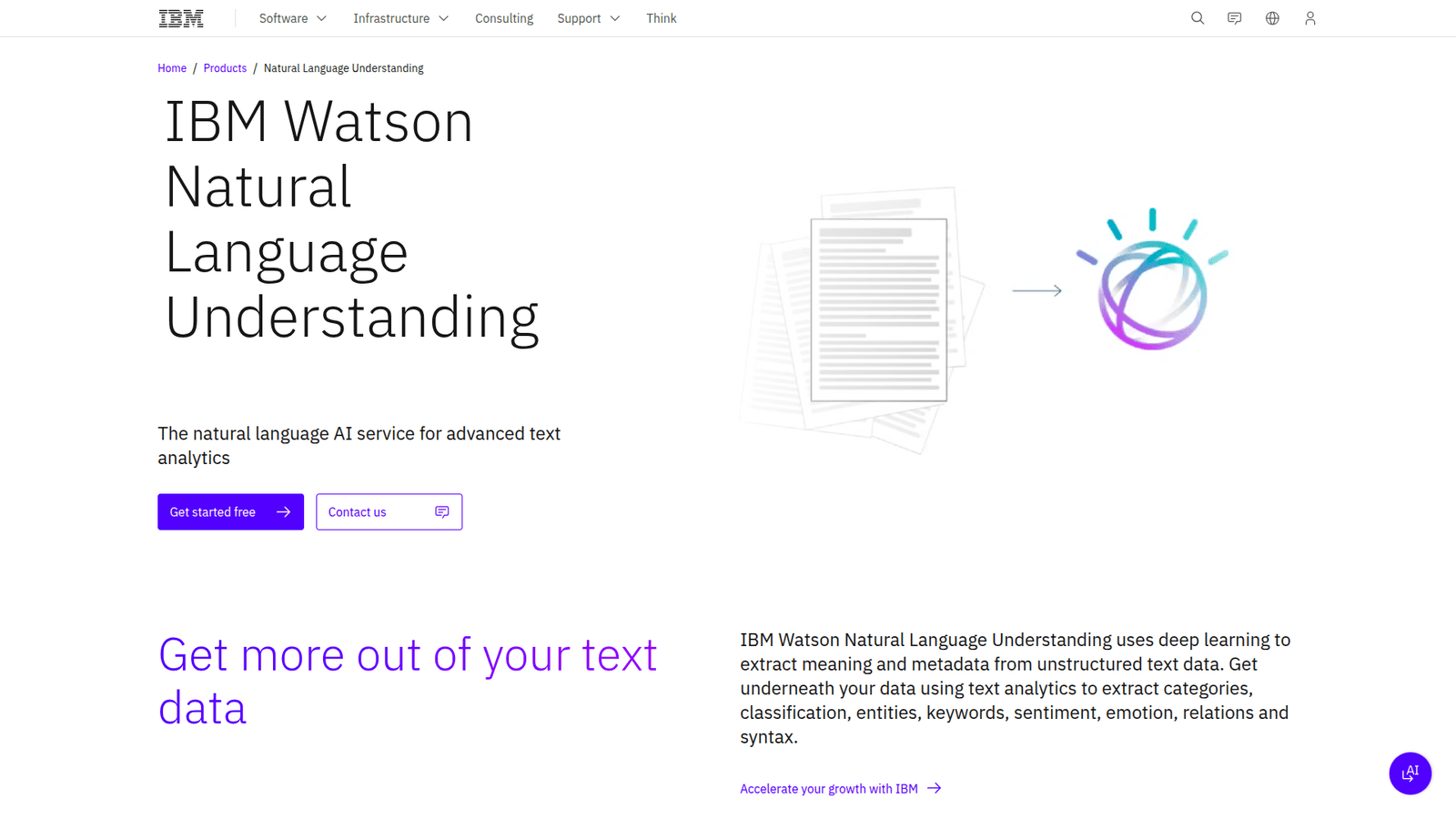
IBM Watson Natural Language Understanding (NLU) is a cloud-based service that analyzes text to extract metadata and insights that go beyond simple keyword matching.
Think of it as an advanced text decoder. It doesn’t just read words; it understands the relationships between them, the context, and the underlying meaning. This makes it incredibly powerful for businesses that deal with a lot of unstructured text data.
Its core function is to process vast amounts of text and identify key elements like entities (people, places, organisations), keywords, categories, concepts, and, crucially for this discussion, emotions and sentiments.
The target audience for this tool isn’t just tech wizards. It’s for anyone who needs to make sense of language: marketers trying to gauge public opinion, product managers wanting to understand user feedback, customer support teams aiming to improve service, and content creators looking to understand their audience better.
In essence, IBM Watson NLU helps you extract valuable, actionable information from text, turning raw data into strategic advantage.
Key Features of IBM Watson NLU for Sentiment Analysis
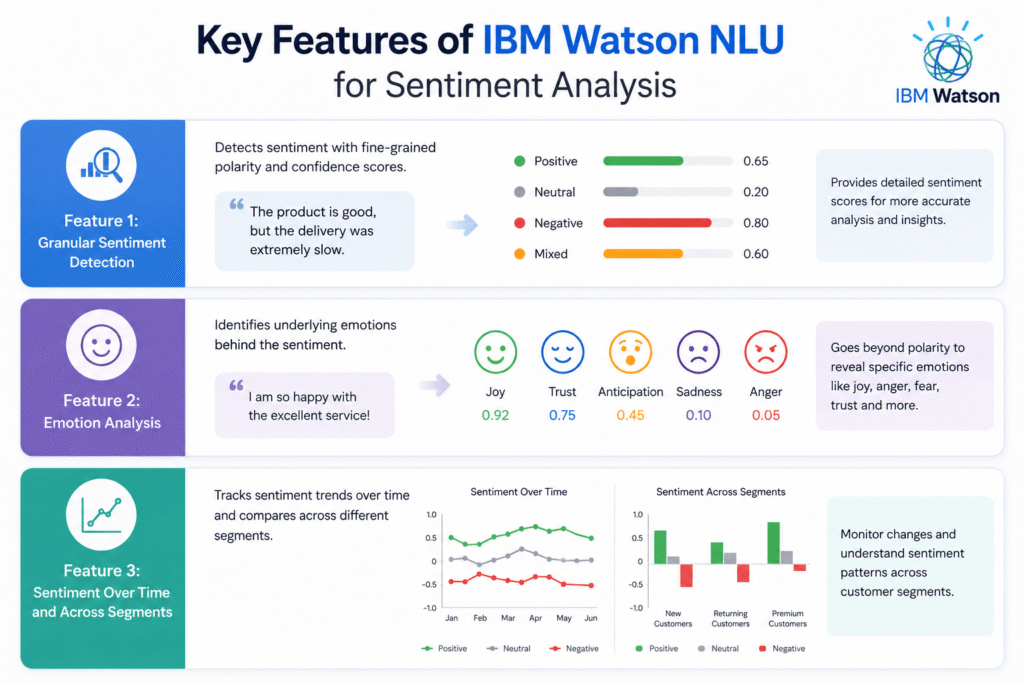
When you’re in the trenches of customer interactions, understanding the ‘why’ behind a comment is as important as the ‘what’. IBM Watson NLU’s sentiment analysis capabilities are designed precisely for this.
Feature 1: Granular Sentiment Detection
This isn’t about a simple “thumbs up” or “thumbs down.” Watson NLU can dissect text to identify the sentiment towards specific entities or keywords within a larger piece of content. For example, in a product review mentioning both “battery life” and “customer service,” it can tell you the sentiment towards each independently.
This granular approach is vital for sentiment analysis because it moves beyond broad statements to pinpoint exact areas of customer satisfaction or dissatisfaction. It allows you to address specific pain points rather than making general, often ineffective, changes.
Feature 2: Emotion Analysis
Beyond positive or negative sentiment, Watson NLU can detect a range of human emotions. Think anger, joy, sadness, disgust, fear, and surprise. This adds a much deeper layer to understanding customer feedback.
Knowing that a customer is not just unhappy, but *angry* about a delayed delivery, provides a different imperative for your support team than if they were merely disappointed. This emotional intelligence helps tailor responses and de-escalate situations more effectively.
Feature 3: Sentiment Over Time and Across Segments
IBM Watson NLU allows for the aggregation and analysis of sentiment data over time. This means you can track how customer feelings evolve in response to product updates, marketing campaigns, or service changes.
Furthermore, by integrating with other data sources, you can segment sentiment analysis by customer demographics, product lines, or support channels. This allows for highly targeted improvements. For instance, you might discover that younger customers express more frustration with your app’s interface, while older customers are more concerned about billing.
Benefits of Using IBM Watson NLU for Chatbots and Customer Support
Let’s cut to the chase. How does this actually make your life, and your business, better? Especially if you’re knee-deep in managing chatbots and customer support operations.
First, **massive time savings**. Manually reading and categorizing thousands of customer comments is a soul-crushing, time-sucking endeavour. Watson NLU does this in seconds. This frees up your valuable human resources to focus on high-level problem-solving and proactive customer engagement, rather than rote analysis.
Second, **quality improvement**. When you can rapidly identify what’s making customers happy or, more importantly, what’s making them furious, you can fix it. This leads to better products, more efficient processes, and ultimately, happier, more loyal customers. Think reduced churn, higher Net Promoter Scores (NPS), and more positive online reviews.
Third, **proactive problem-solving**. Instead of waiting for a flood of complaints to signal an issue, sentiment analysis can flag emerging negative trends early. This allows your team to get ahead of problems before they snowball into a full-blown crisis.
Fourth, **enhanced chatbot performance**. For businesses using AI-powered chatbots, understanding the sentiment behind user queries is crucial. Watson NLU can feed this sentiment data back into your chatbot logic, enabling it to respond more empathetically and effectively. A bot that can detect frustration can route a user to a human agent faster or offer a more conciliatory tone.
Finally, **deeper customer understanding**. Sentiment analysis provides insights that go beyond transactional data. It helps you understand the emotional drivers of customer behaviour, enabling more effective marketing, product development, and customer relationship management.
Pricing & Plans
IBM Watson NLU operates on a pay-as-you-go model, which is a significant advantage for businesses of all sizes. There’s no massive upfront investment.
You can start with a free tier, which is perfect for individuals, small teams, or for testing the waters. This free tier typically offers a certain number of free NLU transactions per month. It’s a solid way to explore the capabilities without any financial commitment.
Beyond the free tier, IBM offers various pricing plans based on your usage. You’re charged based on the number of API calls you make and the specific features you utilize. This consumption-based pricing means you only pay for what you use, scaling up or down as your needs change.
Compared to some enterprise-level AI solutions that require substantial long-term contracts and hefty monthly fees, IBM Watson NLU’s flexible pricing makes it accessible. It’s a far cry from needing to “break the bank” to access powerful AI capabilities for sentiment analysis or other natural language processing tasks.
For most small to medium-sized businesses, the cost associated with moderate usage of IBM Watson NLU is highly competitive, especially when you consider the value derived from improved customer insights and operational efficiencies.
Hands-On Experience / Use Cases
Imagine a large e-commerce company. They receive thousands of customer reviews daily across their website and social media. Manually processing this feedback to understand customer satisfaction with specific products, delivery services, or the overall shopping experience is practically impossible at scale.
A marketing analyst team using IBM Watson NLU can set up a system to automatically feed these reviews into the NLU service. The tool identifies entities like product names, brand mentions, and shipping providers. Crucially, it assigns a sentiment score (positive, negative, neutral) and even detects emotions to each mention.
The team can then quickly see that while “Product X” has a generally positive sentiment, there’s a surge of negative comments specifically mentioning “packaging damage.” This allows them to alert the logistics team to investigate packaging issues immediately, preventing further customer dissatisfaction.
Another scenario involves a software-as-a-service (SaaS) provider. They monitor support tickets and in-app feedback. Using Watson NLU, they can analyze the sentiment of tickets related to specific features. If they see a cluster of negative sentiment and keywords like “bug,” “crash,” or “frustrating” linked to their new reporting module, they know that feature needs urgent attention from the development team.
Furthermore, a social media manager can use Watson NLU to monitor brand mentions online. They can identify not just when their brand is mentioned, but how. A wave of angry tweets about a recent policy change can be flagged in real-time, allowing the PR team to craft an appropriate response or statement before the sentiment spreads further.
For a company running chatbots and customer support, this means integrating sentiment scores into their bot’s decision-making. If a customer expresses high frustration, the bot can be programmed to escalate the conversation to a human agent immediately, rather than trying to resolve it with generic FAQs, thus improving the customer journey.
Who Should Use IBM Watson NLU?
The beauty of IBM Watson NLU lies in its versatility. It’s not a niche tool for a select few. If your business involves processing text and needing to understand the underlying meaning and emotion, this tool is relevant.
Content Marketers and Agencies: They can use it to understand audience sentiment towards specific content types, campaigns, or brand messaging. This allows for the creation of more resonant and effective marketing materials.
Small Businesses: Especially those with limited budgets and manpower, can leverage Watson NLU to gain customer insights that were previously out of reach. Understanding customer feedback without hiring a large team is a massive win.
Customer Support Managers: This is a no-brainer. Identifying unhappy customers, common pain points, and trends in feedback is essential for improving service quality and reducing churn.
Product Managers and Developers: Gathering and analysing user feedback on new features or products is critical for iteration. Watson NLU can highlight specific areas of concern or delight, guiding development priorities.
Social Media Teams: Monitoring brand perception, tracking campaign sentiment, and identifying potential PR crises in real-time is invaluable. It allows for quicker, more informed responses.
Anyone involved in Chatbot Development: Integrating sentiment analysis can make chatbots more human-like and effective, improving user experience and satisfaction.
Essentially, if you have text data and need to extract meaningful insights, especially regarding customer opinion and emotion, IBM Watson NLU is a strong contender.
How to Make Money Using IBM Watson NLU
This isn’t just about improving your own business; it’s about creating new revenue streams. Businesses that master sentiment analysis can offer valuable services to others.
Service 1: Sentiment Analysis Consulting for Businesses
Many companies know they *should* be analysing customer feedback, but they lack the expertise or the tools. You can offer services to set up and manage IBM Watson NLU for them. This includes configuring the tool, interpreting the results, and providing actionable reports.
You can position yourself as a sentiment analysis specialist, helping clients understand their customers better and improve their products or services. This could be on a project basis or a recurring retainer model.
Service 2: Enhanced Chatbot and Customer Support Optimization
For businesses focused on chatbots and customer support, you can offer specialised optimisation services. This involves using Watson NLU to analyse the sentiment within customer interactions handled by chatbots or human agents.
You can then provide insights on how to improve chatbot responses, identify agent training needs based on sentiment trends, and recommend workflow adjustments to enhance overall customer satisfaction. This service directly addresses a core business need: better customer relationships.
Service 3: Market Research and Brand Reputation Management
Offer comprehensive market research reports powered by sentiment analysis. This could involve analysing competitor reviews, social media buzz around industry trends, or gauging public perception of a brand or product launch.
Your service would be to deliver deep dives into market sentiment, helping clients make informed strategic decisions. For brand reputation management, you could monitor online conversations and alert clients to emerging negative trends, offering proactive solutions to mitigate damage.
Consider this: A freelance consultant starts by offering basic sentiment analysis reports for small businesses using the free tier of Watson NLU. As they build a portfolio and demonstrate value, they can onboard larger clients, charging higher fees for more complex integrations and ongoing analysis. They could even build a niche service focused solely on analysing sentiment in user-generated content for gaming companies or app developers.
Limitations and Considerations
While IBM Watson NLU is a powerful tool, it’s not a magic wand. To get the most out of it, you need to be aware of its limitations.
Accuracy Isn’t 100%: Natural language is complex and nuanced. Sarcasm, irony, cultural context, and even typos can sometimes trip up AI. While Watson NLU is sophisticated, it’s not infallible. Human oversight is often necessary, especially for critical decisions.
Context is King: The tool analyses text provided. If the text lacks context, the analysis might be skewed. For example, a highly critical review of a fictional product in a story might be misinterpreted as a real-world product complaint if not properly identified as fiction.
Requires Setup and Integration: While user-friendly for its capabilities, integrating Watson NLU into existing workflows or applications requires some technical know-how or the help of a developer. It’s not a plug-and-play solution for every scenario without initial configuration.
Interpretation is Key: The tool provides data. Understanding what that data means in the context of your business and translating it into actionable strategies is a human skill. You still need analysts who can interpret sentiment scores, identify patterns, and recommend effective solutions.
Cost at Scale: While the pay-as-you-go model is flexible, high-volume usage can become expensive. Businesses need to monitor their API calls and usage to manage costs effectively, especially if dealing with massive datasets.
Learning Curve: Although designed to be accessible, mastering all the features and understanding how to fine-tune the analysis for specific use cases might require some learning and experimentation.
Final Thoughts
In the fast-paced world of business, especially in areas like chatbots and customer support, understanding your audience’s sentiment isn’t a luxury; it’s a necessity. Manual analysis is slow, expensive, and prone to error.
IBM Watson NLU offers a robust, scalable, and intelligent solution for diving deep into text data. Its advanced sentiment analysis capabilities, coupled with emotion detection and granular entity analysis, provide unparalleled insights.
Whether you’re looking to improve customer satisfaction, refine your product development, enhance your chatbot’s empathy, or even build new revenue streams by offering sentiment analysis services, Watson NLU equips you with the power to do so.
Don’t get left behind. Start leveraging the power of AI to truly understand what your customers are saying, and more importantly, how they’re feeling.
Visit the official IBM Watson NLU website to explore its potential for your business.
Frequently Asked Questions
1. What is IBM Watson NLU used for?
IBM Watson NLU is used to analyse text and extract metadata and insights, including entities, keywords, categories, concepts, and sentiment. It helps businesses understand unstructured text data more effectively.
2. Is IBM Watson NLU free?
IBM Watson NLU offers a free tier for testing and limited usage. Beyond that, it operates on a pay-as-you-go pricing model based on usage and features accessed.
3. How does IBM Watson NLU compare to other AI tools?
IBM Watson NLU is known for its sophisticated natural language processing capabilities, offering granular sentiment analysis, emotion detection, and entity extraction. It competes with other cloud-based NLP services, often standing out for its enterprise-grade features and IBM’s robust infrastructure.
4. Can beginners use IBM Watson NLU?
Yes, beginners can use IBM Watson NLU. While some technical understanding is needed for deep integration, the core features and the free tier allow individuals to explore its capabilities and extract basic insights without extensive programming knowledge.
5. Does the content created by IBM Watson NLU meet quality and optimization standards?
IBM Watson NLU doesn’t “create” content in the way a generative AI tool does. It *analyzes* existing text. The quality and optimization of the insights derived depend on the input text and how effectively the user interprets and applies the extracted information.
6. Can I make money with IBM Watson NLU?
Absolutely. By offering consulting services, market research reports, or specialised optimisation for chatbots and customer support, you can create revenue streams using IBM Watson NLU.
7. How to make money with IBM Watson NLU?
You can make money by offering sentiment analysis consulting, optimising chatbot and customer support interactions based on sentiment data, or providing market research and brand reputation management services powered by IBM Watson NLU’s insights.