
The landscape of Data Analysis and Business Intelligence is evolving at warp speed, thanks to AI. Businesses are drowning in data, yet starving for actionable insights. The challenge isn’t collecting data; it’s making sense of it quickly and efficiently.
Traditional methods are slow, complex, and require a deep bench of technical talent. This is where innovative tools step in, democratising data access and analysis.
One such tool making waves is ThoughtSpot. It promises to put the power of data directly into the hands of everyday business users, stripping away the complexity.
But what exactly is ThoughtSpot, and how does it revolutionise the way you interact with your data, especially when it comes to asking questions?
This is especially true for Natural Language Data Querying. Imagine asking your data questions in plain English and getting immediate, accurate answers. That’s the promise. Let’s break down how ThoughtSpot delivers on this.
ThoughtSpot revolutionises Data Analysis & BI with Natural Language Data Querying. Ask any question, get instant answers. Unlock your data’s potential today!
Why ThoughtSpot Is a Game-Changer in Natural Language Data Querying
Table of Contents
- What is ThoughtSpot?
- Key Features of ThoughtSpot for Natural Language Data Querying
- Benefits of Using ThoughtSpot for Data Analysis and Business Intelligence
- Pricing & Plans
- Hands-On Experience / Use Cases
- Who Should Use ThoughtSpot?
- How to Make Money Using ThoughtSpot
- Limitations and Considerations
- Final Thoughts
- Frequently Asked Questions
What is ThoughtSpot?
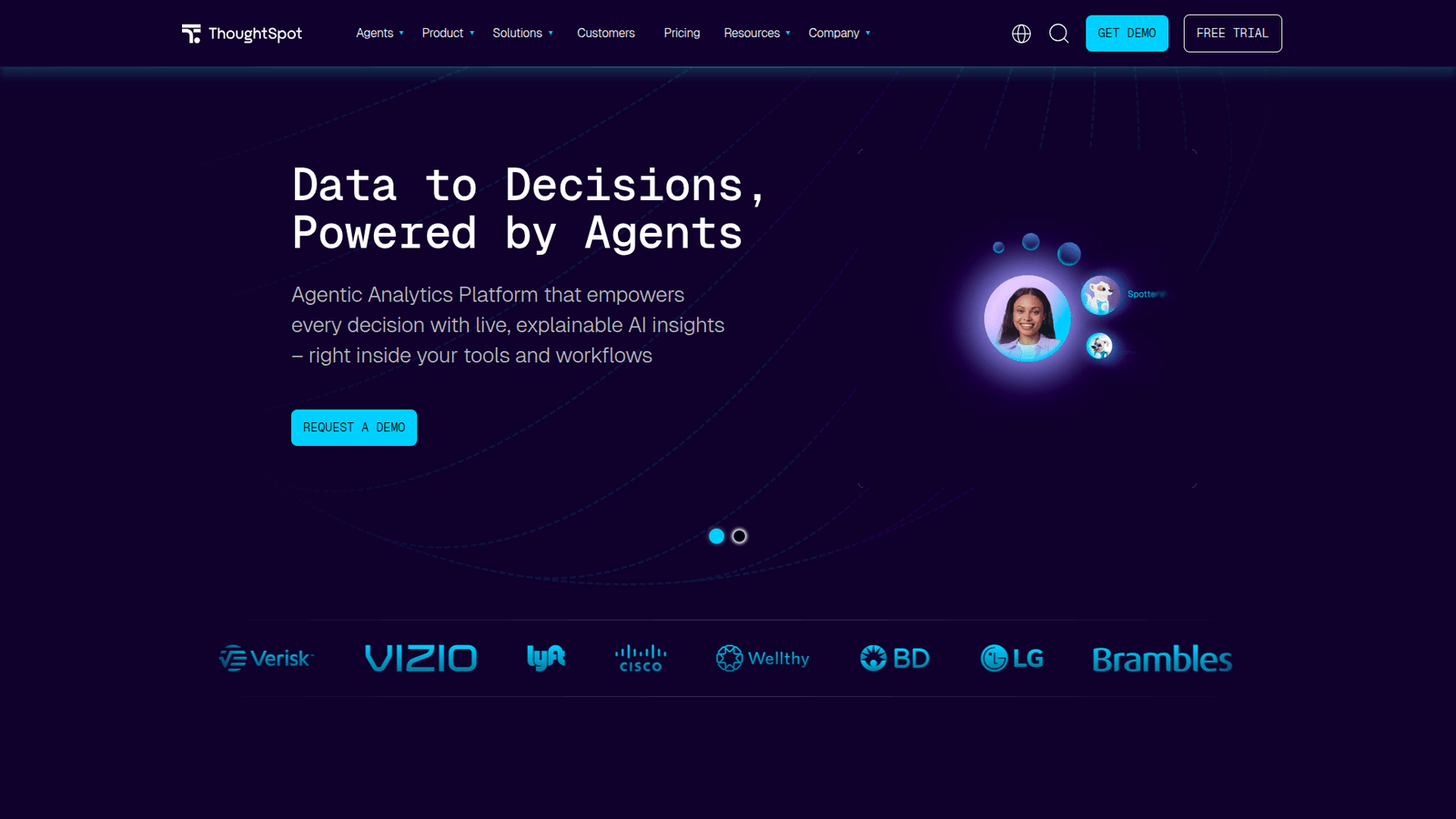
ThoughtSpot is an AI-powered analytics platform designed to make data insights accessible to everyone in an organisation, regardless of their technical background.
Think of it as a search engine for your business data. Instead of building complex dashboards or writing SQL queries, you can simply type your questions in plain language.
The core idea behind ThoughtSpot is to empower business users – from sales reps to marketing managers to executives – to explore their data and uncover critical insights without needing a data scientist on speed dial.
It bridges the gap between raw data and decision-making by allowing users to ask questions like “What were our top-selling products last quarter in the North East region?” and get instant answers presented in clear, visual formats.
This democratisation of data is crucial in today’s fast-paced business environment where agility and informed decisions are paramount. It shifts the focus from data preparation to data interpretation and action.
The platform’s intelligent engine understands context and intent, enabling users to drill down, filter, and analyse data dynamically. It’s built for speed and ease of use, removing the traditional barriers to data exploration.
Key Features of ThoughtSpot for Natural Language Data Querying
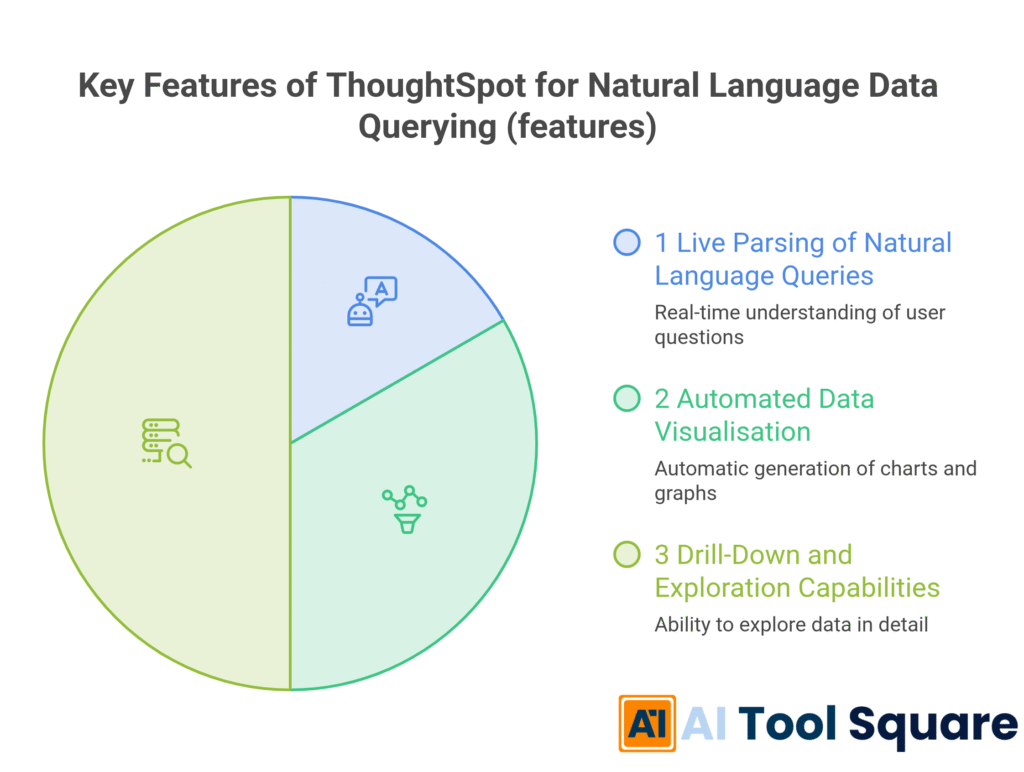
Live Parsing of Natural Language Queries
This is where ThoughtSpot truly shines. It’s engineered to understand your questions asked in everyday language. You don’t need to learn specific syntax or keywords.
You can type questions like “Show me total revenue by month for Q3” or “Compare customer acquisition cost across marketing channels last year.” The AI parses this, understands the entities (revenue, month, Q3, customer acquisition cost, marketing channels, year), and the relationships between them.
This feature drastically reduces the learning curve for data analysis. Instead of a lengthy onboarding process for new tools or complex training sessions, users can start asking questions from day one.
The accuracy and responsiveness of this natural language processing are key. ThoughtSpot aims to minimise ambiguity, ensuring that when you ask a question, you get the data you actually intended to query. This direct interaction makes data exploration feel intuitive, almost like having a conversation with your data.
Automated Data Visualisation
Once your natural language query is understood, ThoughtSpot doesn’t just spit out numbers. It intelligently selects the most appropriate way to visualise your data.
Based on the type of data and the question asked, it will automatically generate charts, graphs, tables, or other visualisations that best represent the insights. For example, a question about trends over time will likely result in a line chart, while a comparison of categories might yield a bar chart.
This automation saves users the time and effort of manually selecting chart types and configuring them. It ensures that the insights are presented clearly and effectively, making them easier to understand and act upon.
The system learns from user interactions, further refining its ability to choose the most impactful visual representation for different types of data and queries. This means that as more people use the platform, the visualisations become even more effective.
Drill-Down and Exploration Capabilities
Getting an answer is often just the first step. Users frequently need to dig deeper into the data to understand the ‘why’ behind the numbers.
ThoughtSpot allows for seamless drill-down capabilities directly from the initial results. If a user sees a spike in sales for a particular region, they can instantly click on that data point to explore what products or customer segments contributed to that spike.
This interactive exploration is powered by the same natural language engine. Users can refine their queries on the fly by asking follow-up questions like “Show me this for only our enterprise clients” or “What was the average deal size in that period?”.
This iterative process of asking, visualising, and drilling down is crucial for uncovering granular insights and understanding the nuances of business performance. It empowers users to become their own data detectives, uncovering patterns and anomalies without relying on IT to generate new reports.
Benefits of Using ThoughtSpot for Data Analysis and Business Intelligence
The adoption of AI tools in Data Analysis and Business Intelligence isn’t just about staying current; it’s about gaining a competitive edge. ThoughtSpot brings a suite of tangible benefits that can reshape how businesses operate.
One of the most significant advantages is the **immense time savings**. Traditionally, extracting specific data points or creating custom reports could take hours, if not days, involving IT or dedicated analysts.
With ThoughtSpot, users can ask a question and receive an answer in seconds. This speed allows for much faster decision-making. Instead of waiting for a report, a business leader can get an immediate answer during a meeting and pivot strategy accordingly.
This also leads to **improved data quality and accuracy**. When complex queries are handled by a robust, AI-driven engine, the chances of human error in calculation or interpretation are significantly reduced.
Furthermore, ThoughtSpot **democratises data access**. It breaks down the silos that often exist between data teams and the rest of the business. Marketers, sales teams, product managers, and operations staff can all access and analyse the data relevant to their roles without needing to be data experts.
This empowerment fosters a more data-driven culture across the entire organisation. When more people can easily access and understand data, more informed decisions are made at all levels.
The **reduction in IT burden** is another critical benefit. By enabling self-service analytics, ThoughtSpot frees up valuable IT and data science resources. These teams can then focus on more strategic initiatives, such as data governance, advanced analytics modelling, or developing new data sources, rather than spending their time on repetitive report requests.
Finally, ThoughtSpot promotes **greater agility and responsiveness**. Businesses can react faster to market changes, identify emerging trends, and spot potential issues before they become major problems. This adaptability is key to thriving in today’s competitive environment.
Pricing & Plans

Understanding the investment required for any software is crucial. ThoughtSpot offers a tiered pricing model, generally tailored to the needs and scale of different organisations.
While there isn’t a perpetual “free” plan in the traditional sense for full-featured enterprise use, ThoughtSpot often provides options for demonstration or limited trials. These allow potential users to experience the platform’s capabilities firsthand before committing.
The primary offerings are typically structured around user roles and feature sets, often categorised into editions like ThoughtSpot Standard and ThoughtSpot Enterprise. These plans are usually subscription-based, billed annually.
The cost is influenced by factors such as the number of users, the type of users (e.g., creators who build analyses versus consumers who simply view them), and the advanced features required. Enterprise-grade security, advanced governance, and integrations with complex data ecosystems are typically part of higher tiers.
Compared to other business intelligence platforms that might require extensive consulting for setup and customisation, ThoughtSpot’s self-service model can offer a more predictable cost of ownership over time. The emphasis on ease of use means that less dedicated technical support is needed for day-to-day operations.
For organisations looking to scale their data analysis capabilities without a proportional increase in headcount, ThoughtSpot’s pricing model can represent a strategic investment in efficiency and data-driven decision-making. Direct engagement with their sales team is usually necessary to get a precise quote based on specific organisational requirements.
Hands-On Experience / Use Cases
Consider a retail company looking to understand its sales performance across different product categories and geographic locations. A sales manager wants to know which product lines are underperforming in the Southern region over the last six months.
Instead of requesting a report from the analytics team, the sales manager can log into ThoughtSpot and type: “Show me total sales by product category for the Southern region for the last 6 months.”
ThoughtSpot instantly returns a clear bar chart showing sales for each category in that region. The manager notices that “Electronics” sales are significantly lower than expected.
Curious, the manager then asks a follow-up question directly on the chart: “Drill down to see the top 5 selling products within Electronics for this period.”
The chart updates, revealing that a specific model of smart TV is the main contributor to the low performance. This insight might prompt a conversation about inventory, marketing campaigns, or competitor pricing for that particular product.
Another scenario involves a marketing team analysing the effectiveness of their latest campaign. A marketing analyst could ask: “What is the customer acquisition cost for users acquired through the ‘Summer Sale’ campaign on social media compared to email?”
ThoughtSpot would generate a comparison, potentially a side-by-side bar chart, showing the CAC for each channel. If social media appears to have a higher CAC, the team can then ask: “Show me the engagement metrics for users acquired via social media during the campaign.”
This allows them to quickly identify if specific ad creatives or targeting parameters were less effective, enabling them to optimise future campaigns based on real-time data.
Teams in finance can use it to ask: “What is the variance between budgeted and actual expenses for the R&D department this fiscal year?” This provides immediate visibility into financial performance without needing complex spreadsheet manipulation.
The common thread in these use cases is the ability for non-technical users to perform sophisticated data analysis on demand, leading to faster, more informed actions.
Who Should Use ThoughtSpot?

ThoughtSpot is built for a broad spectrum of users across an organisation, but it particularly benefits those who need data insights to do their jobs effectively but lack deep technical data skills.
Business Analysts and Department Heads: These individuals are responsible for the performance of their teams and departments. They need to monitor KPIs, identify trends, and make strategic decisions. ThoughtSpot allows them to get answers without waiting for IT.
Sales Teams: Sales professionals can use ThoughtSpot to track their pipeline, analyse customer behaviour, identify cross-selling opportunities, and understand sales performance by region, product, or representative. This helps them close more deals.
Marketing Professionals: Marketers can analyse campaign performance, understand customer segmentation, measure ROI on marketing spend, and identify new audience opportunities. This leads to more effective and efficient marketing strategies.
Executives and Senior Leadership: High-level decision-makers need a clear, up-to-date view of the business. ThoughtSpot provides them with the ability to ask high-level questions and get immediate answers, enabling them to steer the company with confidence.
Operations and Supply Chain Managers: These roles can use ThoughtSpot to monitor inventory levels, track logistics, identify bottlenecks in processes, and optimise operational efficiency.
Anyone in a Data-Driven Role: Even those with some technical aptitude can benefit from the speed and ease of use. ThoughtSpot complements traditional BI tools by providing a quick, intuitive layer for data exploration.
Essentially, any role that relies on understanding business performance and making data-informed decisions can significantly benefit from ThoughtSpot’s capabilities. It empowers individuals to move beyond guesswork and rely on facts derived directly from their company’s data.
How to Make Money Using ThoughtSpot
ThoughtSpot’s power lies in its ability to unlock data insights for businesses. This capability directly translates into opportunities for individuals and agencies to generate revenue, either by offering services related to the platform or by leveraging its efficiency gains.
Offering Data Analysis and BI Consulting Services
Businesses that struggle with their data, or those who simply want to leverage their data more effectively, are prime candidates for consulting services. An individual or agency proficient in ThoughtSpot can offer to set up the platform for clients, connect their data sources, and train their employees.
They can also provide ongoing support, helping clients build custom dashboards, develop advanced queries, and interpret complex data sets. The ability to use natural language querying means consultants can onboard clients faster and empower them to manage their own data exploration after the initial setup.
This service model capitalises on the demand for data literacy and the adoption of AI tools in Data Analysis and Business Intelligence. Clients pay for expertise, implementation, and ongoing guidance that translates into tangible business improvements.
Providing Custom Report and Insight Generation
Even with a tool as intuitive as ThoughtSpot, some businesses may not have the internal resources or time to create the specific reports or analyses they need. This presents an opportunity to offer bespoke report generation services.
Using ThoughtSpot, you can quickly generate detailed reports on specific business metrics, market trends, customer behaviour patterns, or operational efficiencies. You can then sell these pre-packaged insights or offer custom report creation on a per-project basis.
For example, you could offer a “Quarterly Sales Performance Report for Retailers” or a “Customer Churn Analysis for SaaS Companies,” all powered by your ability to quickly query and visualise data within ThoughtSpot.
The speed of ThoughtSpot means you can turn around these requests much faster than traditional methods, allowing you to take on more clients and increase your revenue potential.
Enhancing Business Efficiency for Clients
Another approach is to focus on how ThoughtSpot can directly improve a client’s bottom line through increased efficiency. If a client is spending significant time and resources on manual data analysis or custom report development, you can offer to implement ThoughtSpot to streamline these processes.
The value proposition here is clear: by adopting ThoughtSpot, the client saves money on analyst time, reduces the risk of errors, and gains faster access to critical information, leading to better-informed decisions and potentially higher revenues or lower costs.
You can quantify this value. For instance, demonstrating how ThoughtSpot reduces a specific reporting task from 10 hours per week to 1 hour per week for a client, and then charging a fee that represents a fraction of those saved hours, is a compelling business case.
This service is particularly attractive to small to medium-sized businesses that may not have the budget for a full-time data analyst but need sophisticated data insights to compete.
A business owner in the e-commerce space could integrate ThoughtSpot to get instant answers on customer lifetime value, conversion rates by traffic source, and average order value. By becoming proficient, they can use this information to optimise marketing spend, improve customer retention strategies, and identify high-value product opportunities, directly increasing their profit margins. The efficiency gained from not needing to wait for external reports or complex internal analyses translates directly into more time for strategic growth activities.
Limitations and Considerations
While ThoughtSpot is a powerful tool, it’s not a magic bullet, and understanding its limitations is key to successful implementation.
One primary consideration is **data quality**. ThoughtSpot’s AI can only work with the data it’s given. If the underlying data sources are inaccurate, incomplete, or inconsistently formatted, the insights generated will be flawed.
Ensuring robust data governance and clean data pipelines is crucial before or during ThoughtSpot implementation. Garbage in, garbage out, as the saying goes.
Another point is the **learning curve for query formulation**, even with natural language. While it’s far simpler than SQL, users still need to learn how to phrase questions effectively to get the precise answers they want.
Ambiguity in language can sometimes lead to unexpected results, requiring users to refine their queries. Teaching users best practices for asking questions is an important part of adoption.
ThoughtSpot’s automated visualisation is generally excellent, but there might be instances where a user requires a highly bespoke or complex visual representation that goes beyond the tool’s automatic capabilities.
While the platform is designed for self-service, complex data modelling or integration with very niche data sources might still require assistance from data engineers or IT specialists.
Finally, the **cost** can be a barrier for very small businesses or startups with extremely limited budgets. While it offers significant ROI, the subscription fees are geared towards organisations that see data analytics as a strategic imperative.
It’s important to view ThoughtSpot as a powerful component of a broader data strategy, rather than a standalone solution for all data challenges.
Final Thoughts
ThoughtSpot is fundamentally changing the game for businesses looking to harness the power of their data. Its strength lies in making sophisticated data analysis accessible through the simple act of asking questions in plain language.
For any organisation aiming to be more data-driven, the ability to quickly gain insights is no longer a luxury but a necessity. ThoughtSpot delivers this speed and accessibility, empowering every user to explore their data without the need for technical expertise.
The benefits – from rapid decision-making and improved data literacy to reduced IT burden and increased agility – are substantial. While considerations around data quality and user training are important, they are manageable with a strategic approach.
If you’re currently struggling with slow reporting cycles, a backlog of data requests, or a general lack of data insights across your teams, ThoughtSpot is definitely worth exploring.
The next step? Consider a demo or a trial to see firsthand how natural language data querying can transform your organisation’s approach to business intelligence.
Visit the official ThoughtSpot website
Frequently Asked Questions
1. What is ThoughtSpot used for?
ThoughtSpot is an AI-powered analytics platform that allows users to ask questions of their business data in plain language and receive instant answers. It’s used for data discovery, business intelligence, and making data-driven decisions across an organisation.
2. Is ThoughtSpot free?
ThoughtSpot does not offer a perpetual free plan for its full enterprise features. However, they often provide free trials or demonstration opportunities for potential customers to experience the platform’s capabilities before making a purchase.
3. How does ThoughtSpot compare to other AI tools?
Compared to other AI tools, ThoughtSpot’s primary differentiator is its focus on natural language data querying and its ability to deliver answers and visualisations directly to business users without coding or complex report building. It emphasises ease of use for self-service analytics.
4. Can beginners use ThoughtSpot?
Yes, ThoughtSpot is specifically designed for beginners. Its natural language interface means that users do not need to have any technical data skills or knowledge of complex query languages like SQL to start exploring their data.
5. Does the content created by ThoughtSpot meet quality and optimization standards?
ThoughtSpot creates data visualisations and insights, not textual content like articles. The quality of the insights depends on the quality of the underlying data. For optimal results, the data should be clean and well-structured. It focuses on analytical accuracy and clarity of presentation.
6. Can I make money with ThoughtSpot?
Yes, you can make money with ThoughtSpot by offering consulting services to businesses that need help implementing and utilising the platform, providing custom report generation, or demonstrating how ThoughtSpot can improve a company’s operational efficiency and profitability.
7. How to make money with ThoughtSpot?
To make money with ThoughtSpot, you can become a consultant to help businesses implement and leverage the platform, offer services to create tailored data analyses and reports for clients, or focus on helping companies reduce their data analysis costs and time through ThoughtSpot’s self-service capabilities.