
AutoGen simplifies Agent Development, enabling faster, more effective AI solutions. Build robust AI agents with less effort, boosting your productivity and profits. Ready to redefine your workflow?
AutoGen Simplifies Even Complex Agent Development
AI isn’t just a buzzword anymore. It’s the engine driving innovation, especially in the exciting space of AI agents.
Everyone’s talking about how these intelligent systems are changing the game.
But here’s the kicker: building them? That’s where things get tricky.
Agent development often feels like untangling a ball of yarn while wearing oven mitts. It’s slow, it’s painful, and honestly, it can sap all your motivation.
Many people hit roadblocks. They get stuck in the weeds of complex coding, endless debugging, and trying to get different AI models to play nice.
What if I told you there’s a tool out there that fixes most of these headaches? A tool designed to make agent development not just bearable, but actually efficient and, dare I say, enjoyable?
Enter AutoGen.
This isn’t just another piece of software; it’s a paradigm shift for anyone serious about creating powerful AI agents.
It helps you bypass the usual grind, letting you focus on the bigger picture.
If you’re ready to ditch the frustration and level up your agent creation process, stick around. We’re about to unpack how AutoGen does exactly that.
Table of Contents
- What is AutoGen?
- Key Features of AutoGen for Agent Development
- Benefits of Using AutoGen for AI Agents
- Pricing & Plans
- Hands-On Experience / Use Cases
- Who Should Use AutoGen?
- How to Make Money Using AutoGen
- Limitations and Considerations
- Final Thoughts
- Frequently Asked Questions
What is AutoGen?
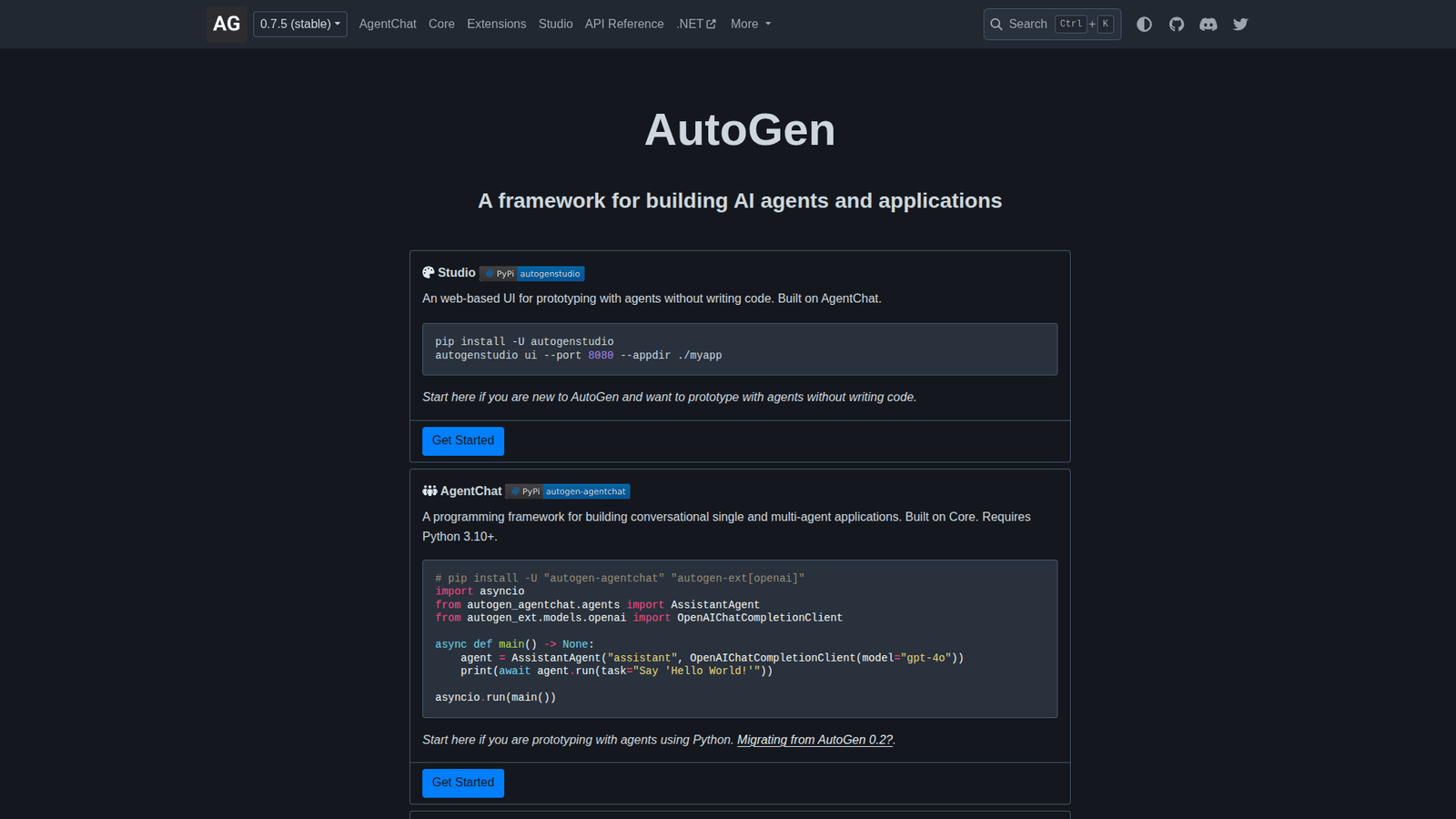
AutoGen is an open-source framework developed by Microsoft. It’s built to simplify the creation and orchestration of multi-agent conversations. Think of it as a toolkit that lets you build AI agents that can talk to each other, collaborate, and solve tasks together.
It’s not just a single AI model. Instead, it’s a framework that allows different large language models (LLMs), tools, and even human input to interact seamlessly. This means you can design complex workflows where multiple AI personas work in concert.
The core idea is to enable “conversable agents.” These agents can exchange messages, propose actions, and even critique each other’s output. This mirrors how a team of humans might work on a project.
For anyone involved in Agent Development, this is huge. It removes a ton of the low-level coding needed to get agents communicating. You define their roles, their goals, and their capabilities, and AutoGen handles the conversation flow.
You can assign different roles to your agents. One might be a “coder,” another a “reviewer,” and a third an “analyst.” They then work through a problem, passing information back and forth until a solution is reached.
AutoGen supports a wide range of LLMs, including OpenAI’s GPT models and various open-source alternatives. This flexibility means you’re not locked into one vendor. You can pick the best tool for the job.
It also allows for the integration of custom tools. So, if your agent needs to fetch data from a database or run a specific script, you can easily plug that in. It’s about empowering your agents with the right capabilities.
The target audience? Developers, researchers, and innovators who are serious about building sophisticated AI agents. If you’re tired of piecing together disparate systems and want a unified approach, AutoGen is a strong contender. It simplifies what used to be a very complex process.
In essence, AutoGen helps you move from theoretical agent design to practical, working solutions much faster. It’s about making AI collaboration accessible and powerful.
Key Features of AutoGen for Agent Development
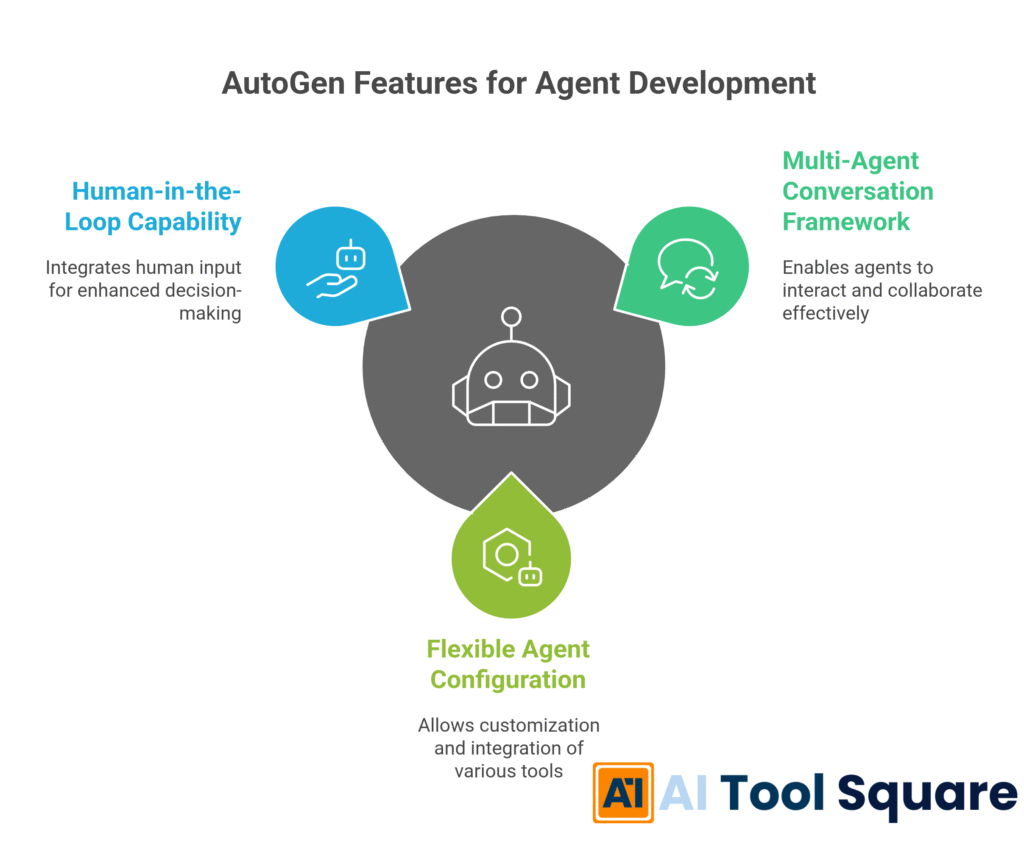
Feature 1: Multi-Agent Conversation Framework
This is where AutoGen shines. It provides a robust framework for orchestrating conversations between multiple AI agents. Imagine building a team of specialists, each with a unique role and expertise. AutoGen lets you define these roles and set up structured dialogues.
For example, you could have an agent act as a “product manager” outlining a task, another as a “developer” writing code, and a third as a “tester” verifying the output. They communicate naturally, passing messages and code snippets. This vastly simplifies complex Agent Development workflows. You don’t need to manually manage message passing; AutoGen handles the routing and context.
This feature means less boilerplate code for you and more focus on the agent’s actual logic. It reduces the overhead of getting multiple AI components to interact meaningfully.
Feature 2: Flexible Agent Configuration and Tool Integration
AutoGen isn’t prescriptive about which AI model you use. It supports various LLMs, from powerful proprietary models to open-source alternatives. This flexibility is a game-changer. You can select the best model based on your specific task, budget, or privacy needs.
Beyond LLMs, it also allows for easy integration of external tools. Does your agent need to search the web, run a Python script, or access an API? AutoGen makes it straightforward to equip your agents with these capabilities.
This means your agents aren’t just talkers; they’re doers. They can execute real-world actions, making them far more valuable for practical applications. You can build agents that not only plan but also execute the plan.
Feature 3: Human-in-the-Loop Capability
Sometimes, an AI agent needs a little human wisdom. AutoGen is designed with this in mind. It allows for seamless human intervention in the conversation flow. You can configure an agent to pause and ask for human input when it encounters an ambiguous situation or needs a critical decision.
This “human-in-the-loop” feature is crucial for reliability and safety. It prevents agents from going completely off the rails and ensures that complex or sensitive tasks are handled correctly.
It also provides a powerful debugging mechanism. You can observe the agent’s thought process and intervene if something isn’t right. This makes iterating on and refining your AI agents much simpler and safer. It’s about finding the sweet spot between automation and control.
Benefits of Using AutoGen for AI Agents
Let’s talk brass tacks. Why should you care about AutoGen?
First, time savings. This is massive. Agent development used to be a slog. Hours spent on getting different parts of your AI to talk to each other. Debugging communication errors. It was painful. AutoGen cuts through that.
It handles the complex orchestration, so you spend less time on plumbing and more time on the actual intelligence of your agents. This means faster prototyping and quicker deployment.
Next up, quality improvement. When agents can collaborate effectively, they can tackle more complex problems with higher accuracy. Imagine an AI team that reviews its own work, corrects errors, and refines its output.
This collaborative approach, powered by AutoGen, leads to more robust and reliable solutions. It’s like having a built-in quality assurance team for your AI.
It also helps in overcoming creative blocks. When you’re building a complex agent, it’s easy to get stuck. How should this part interact with that part? What’s the best way to structure this dialogue?
AutoGen provides a framework that gives you a starting point. It helps you conceptualize and build multi-agent systems without getting bogged down in the minute details. It frees up your mental energy for higher-level design.
Another major benefit is increased efficiency. By automating the communication and task delegation between agents, you can achieve results that would otherwise require significant manual effort. This isn’t just about saving time; it’s about doing more with less.
You can spin up agents for different sub-tasks, and AutoGen will coordinate their efforts. This parallel processing capability boosts overall productivity for your AI agents projects.
Finally, there’s the benefit of scalability. As your AI agent needs grow, AutoGen can scale with you. Adding new agents or capabilities becomes a matter of configuration rather than a complete architectural overhaul.
This means your solutions can evolve and adapt without hitting a ceiling. It’s a future-proof approach to building intelligent systems. These benefits combine to give you a serious edge in agent development.
Pricing & Plans

This is where AutoGen delivers a knockout punch for many developers. AutoGen itself is an open-source framework.
What does that mean for your wallet? It means the core framework, the entire code, and its capabilities are completely free to use. You can download it, install it, and start building without paying a penny for the software itself.
There’s no subscription fee to Microsoft for using AutoGen. No premium version of AutoGen to unlock core features. This is huge for individuals, startups, and even large enterprises looking to innovate without licensing costs.
However, it’s important to understand where costs might come in. AutoGen uses Large Language Models (LLMs) to power its agents. These LLMs are often provided by third-party services like OpenAI, Anthropic, or Hugging Face.
When your AutoGen agents make calls to these LLMs, you’ll incur costs based on the API usage. This is typically charged per token (the units of text processed). The more complex the tasks your agents perform, and the more conversations they have, the higher these API costs might be.
So, while AutoGen itself is free, the underlying AI models it leverages usually aren’t. It’s a “bring your own LLM” kind of deal.
This model offers immense flexibility. You can start with cheaper, smaller models for prototyping and switch to more powerful, albeit pricier, models for production. You control your LLM budget.
Compared to some other AI agent platforms that offer a unified (and often expensive) package including both the framework and the underlying AI, AutoGen’s approach is incredibly cost-effective for those who want granular control.
It empowers you to choose the best LLM provider and pricing tier for your specific Agent Development needs, rather than being locked into a single vendor’s pricing structure.
For those comfortable with a bit of setup, this open-source nature means significant savings and unparalleled freedom in building your AI agents. You manage the infrastructure and the LLM API keys.
Hands-On Experience / Use Cases
Let me tell you, diving into AutoGen for the first time was eye-opening. I’d spent way too much time stitching together scripts and APIs to get simple AI tasks done. With AutoGen, the whole process felt… streamlined.
My first real test was building a simple code generation and review agent system. I wanted to see if AutoGen could simplify a common developer workflow.
I set up two agents: a “Coder” and a “Reviewer.” The Coder’s job was to write Python code based on a prompt. The Reviewer’s job was to check that code for errors, suggest improvements, and ensure it met certain criteria.
The prompt was something like: “Write a Python function to calculate the nth Fibonacci number, and ensure it’s efficient.”
I configured AutoGen to let these two agents converse. The Coder would propose code, and the Reviewer would either approve it or send back feedback, prompting the Coder to revise.
What happened was pretty incredible. The Coder quickly drafted a function. The Reviewer immediately pointed out that it was an inefficient recursive solution and suggested an iterative approach. The Coder then rewrote the function.
This back-and-forth continued, with the Reviewer even suggesting adding docstrings and type hints. Within minutes, I had a well-written, efficient, and documented Fibonacci function, all generated through this AI conversation.
The usability was surprisingly intuitive for an open-source framework. Setting up agents involves defining their role, their LLM configuration (I used OpenAI’s GPT-4 for this experiment), and any tools they could use. AutoGen handles the messaging queue and context management.
Another use case that sprang to mind was automated data analysis. Imagine an “Analyst” agent receiving a dataset and a question, then collaborating with a “Data Scientist” agent. The Data Scientist could write and execute Python scripts to process the data, while the Analyst interprets the results and provides a summary.
The results were compelling. This wasn’t just individual agents spitting out text. It was a genuine collaborative effort. The agents learned from each other, corrected mistakes, and produced a much higher quality output than any single agent could have done alone.
For Agent Development, this means you can tackle much more sophisticated problems. You can break down complex tasks into smaller, manageable pieces, assign them to different AI personas, and let AutoGen orchestrate the solution. It’s like having a team of expert virtual employees at your fingertips, making the development of AI agents much more effective.
Who Should Use AutoGen?

Okay, so AutoGen sounds powerful, but is it for everyone? Not quite. Let’s break down who really stands to gain.
First up, AI Developers and Engineers. If you’re currently building AI applications, especially those requiring multiple AI models to interact, AutoGen is a no-brainer. It simplifies the complex orchestration, letting you focus on the logic, not the plumbing. It’s perfect for streamlining Agent Development.
Next, Researchers and Academics in AI. AutoGen provides an excellent sandbox for experimenting with multi-agent systems, collaborative AI, and human-AI interaction. Its open-source nature means you can dive deep into the code, modify it, and push the boundaries of what’s possible.
Startups and Innovators looking to build cutting-edge AI products should also pay attention. The ability to quickly prototype and deploy sophisticated multi-agent applications without huge upfront costs is a massive advantage. It helps you get to market faster with powerful AI capabilities.
Companies building internal automation tools. Many businesses have complex processes that could be automated with AI. AutoGen allows you to design specialized agents that work together to handle tasks like customer support triage, data pipeline management, or even complex report generation.
Consultants specializing in AI solutions. If you’re building custom AI solutions for clients, AutoGen gives you a versatile framework to deliver highly tailored, collaborative AI agents. It expands the types of problems you can solve and the value you can offer.
Anyone looking to enhance their existing AI workflows. Maybe you’re already using individual LLMs, but they feel siloed. AutoGen can act as the glue that connects them, enabling them to work as a unified team. This improves efficiency and outcome quality.
It’s important to note: AutoGen is primarily a developer tool. It requires a decent understanding of Python and some familiarity with AI concepts and LLMs. It’s not a no-code solution for casual users.
If you’re willing to get your hands a little dirty with code, the payoff for building advanced AI agents is immense. It transforms how you approach complex AI challenges, making previously difficult tasks much more achievable.
How to Make Money Using AutoGen
Alright, let’s talk about the real reason many of us get into this: making money. AutoGen isn’t just a cool tech toy; it’s a powerful business enabler. Here’s how you can leverage it for profit.
Service 1: Custom AI Agent Development and Consulting
This is the most direct path. Businesses are hungry for custom AI solutions, but many lack the in-house expertise. You can step in as an AutoGen expert.
Offer services to design, build, and deploy multi-agent systems tailored to a client’s specific needs. For example, a small e-commerce business might need an agent team for automated customer support, inventory management, and marketing content generation.
You could build an AutoGen setup where one agent monitors customer inquiries, another drafts responses, and a third reviews them before sending. This saves the client massive labour costs. Charge a project fee, or even a retainer for ongoing maintenance and improvements.
Service 2: Building and Selling Pre-packaged Agent Solutions
Instead of purely custom work, identify common business problems that AutoGen can solve, and create ready-to-deploy agent packages. Think of niche-specific solutions.
For instance, you could build an “Automated Legal Document Reviewer” package. This might involve agents that scan contracts, identify key clauses, flag risks, and summarise findings. Lawyers and legal firms would pay good money for such a tool that dramatically reduces manual review time.
Another example: a “Social Media Content Generator” package for marketing agencies. Agents collaborate to research trends, draft posts, generate images (via other AI tools), and schedule content. Sell these as subscriptions or one-time licenses.
Service 3: Training and Workshops
The demand for AutoGen skills is growing, but the supply of experts isn’t keeping pace. You can position yourself as a trainer.
Offer online courses, workshops, or private corporate training sessions on “Mastering AutoGen for Agent Development.” Teach developers and AI enthusiasts how to effectively use the framework, build complex agent teams, and integrate external tools.
You could even focus on advanced topics, like “Optimizing Multi-Agent Conversations for Cost-Effectiveness” or “Building Human-in-the-Loop Systems with AutoGen.” Charge per participant or per company for these valuable learning experiences.
Case Study Example: How “AI Workflow Solutions” Makes £5k/month Using AutoGen for Agent Development
Meet Sarah, the founder of AI Workflow Solutions. She identified a gap in the market for automated marketing research. Using AutoGen, she built a suite of interconnected agents:
- A “Market Researcher” agent that scrapes industry news and trends.
- A “Competitor Analyst” agent that reviews competitor strategies.
- A “Content Strategist” agent that synthesises this data into actionable content ideas and outlines.
Sarah offers this as a monthly subscription service to marketing agencies and small businesses. Clients get weekly reports generated by her AutoGen team, providing them with fresh, targeted content ideas and competitive insights.
By leveraging AutoGen’s collaborative capabilities, Sarah’s small team can deliver high-value, bespoke research faster and cheaper than traditional agencies, pulling in over £5,000 a month in recurring revenue. This shows the power of AI agents when developed strategically.
Limitations and Considerations
No tool is perfect, and AutoGen is no exception. While it’s incredibly powerful, there are a few things you need to keep in mind before you jump all in.
First, accuracy and hallucination. Remember, AutoGen orchestrates LLMs. LLMs, by their nature, can sometimes “hallucinate” or provide factually incorrect information. While multi-agent conversations can help mitigate this (agents can fact-check each other), it’s not a foolproof solution.
You’ll always need some level of human oversight, especially for critical applications. The output from your AI agents needs to be verified.
Next, there’s a learning curve. AutoGen is an open-source framework, which means it requires some technical proficiency. You need to be comfortable with Python, command-line interfaces, and understanding how to configure AI models.
It’s not a drag-and-drop visual builder. If you’re completely new to coding or AI, there will be a ramp-up period. But the investment in learning is well worth it for the power you unlock.
Resource consumption and costs are another factor. While AutoGen itself is free, the LLM calls it makes are not. Complex multi-agent conversations can generate a lot of tokens, which translates to higher API costs from providers like OpenAI.
You need to design your agent conversations efficiently to keep costs in check. It’s about smart prompt engineering and thoughtful agent design.
Debugging complex multi-agent systems can be challenging. When you have several agents talking, figuring out exactly why a conversation went off the rails can be tricky. AutoGen provides tools and logs to help, but it’s still more involved than debugging a single script.
The open-source nature means you’re largely responsible for your own support, though the community is growing and very helpful.
Finally, state management and context window limitations. LLMs have finite context windows. In long, complex conversations, agents might “forget” earlier parts of the discussion if not managed carefully.
While AutoGen helps manage this, thoughtful design is still required to ensure agents maintain context effectively throughout their Agent Development workflow. You might need strategies like summarisation or memory modules for very extended interactions.
These aren’t deal-breakers, but they are important considerations. Understanding these limitations helps you design more robust and effective AutoGen solutions.
Final Thoughts
So, what’s the bottom line with AutoGen? It’s a game-changer. Seriously.
If you’re in the trenches of Agent Development, trying to build intelligent systems that go beyond simple prompts, AutoGen needs to be in your toolkit. It takes the pain out of multi-agent orchestration, letting your AI components collaborate like a dream team.
I’ve seen firsthand how it accelerates development, improves output quality, and unlocks possibilities that felt too complex before. It gives you the power to create truly dynamic and effective AI agents.
Yes, there’s a learning curve, and you need to be mindful of LLM costs and potential hallucinations. But these are manageable challenges. The freedom and capability you gain from an open-source, flexible framework like AutoGen far outweigh these considerations.
My recommendation? Don’t just read about it. Get your hands dirty.
Start with a simple project, maybe a code generation and review system like my example, or a data analysis assistant. You’ll quickly see its power.
If you’re ready to stop wrangling individual LLMs and start building truly collaborative AI teams, AutoGen is your next step. It’s not just hype; it’s the real deal for anyone serious about the future of AI.
Visit the official AutoGen website
Frequently Asked Questions
1. What is AutoGen used for?
AutoGen is used for building and orchestrating multi-agent conversations. It helps developers create AI systems where multiple AI agents, and even humans, can collaborate to solve complex tasks, generate code, analyse data, and automate workflows. It simplifies the communication and coordination between these intelligent agents, making Agent Development more efficient.
2. Is AutoGen free?
Yes, the AutoGen framework itself is open-source and completely free to use. However, it relies on Large Language Models (LLMs) from third-party providers (like OpenAI’s GPT models) to power its agents. You will incur costs for the API usage of these underlying LLMs, which are typically charged per token. So, while the framework is free, the “fuel” for your agents comes with a cost.
3. How does AutoGen compare to other AI tools?
AutoGen stands out by providing a robust framework specifically designed for multi-agent collaboration. Unlike many single-purpose AI tools or individual LLMs, AutoGen focuses on the orchestration of multiple agents, allowing them to communicate, critique, and collectively solve problems. It offers more flexibility and control over agent interaction compared to some black-box AI platforms. It integrates with various LLMs and external tools, giving you immense customisation options for your AI agents.
4. Can beginners use AutoGen?
AutoGen is primarily a developer tool. While accessible, it requires some familiarity with Python programming and basic AI concepts. It’s not a no-code solution. Beginners willing to learn Python and delve into AI development will find it incredibly rewarding, but there is a learning curve involved to effectively configure and use the framework.
5. Does the content created by AutoGen meet quality and optimization standards?
The quality and optimization standards of content created by AutoGen depend heavily on the underlying LLMs used, the agents’ configurations, and the specific prompts. By leveraging multi-agent conversations, AutoGen can significantly enhance quality through self-correction and peer review among agents. However, human oversight is often necessary to ensure the content fully meets specific quality, accuracy, and optimization standards, especially for critical applications.
6. Can I make money with AutoGen?
Absolutely. AutoGen is a powerful tool for generating income. You can offer services like custom AI agent development for businesses, create and sell pre-packaged agent solutions for specific industries, or provide training and workshops on how to use AutoGen effectively. Its ability to automate complex tasks and improve efficiency makes it a valuable asset for various business models.
7. How to make money with AutoGen?
To make money with AutoGen, focus on solving real-world business problems. You can develop custom multi-agent systems for clients, helping them automate complex workflows like customer support, data analysis, or content creation. Alternatively, build niche-specific agent solutions (e.g., a legal document reviewer) and sell them as products or subscriptions. Another profitable avenue is to offer training and consulting services to individuals and companies wanting to learn and implement AutoGen. The efficiency gains and problem-solving capabilities of AutoGen make it a strong tool for various monetisation strategies.