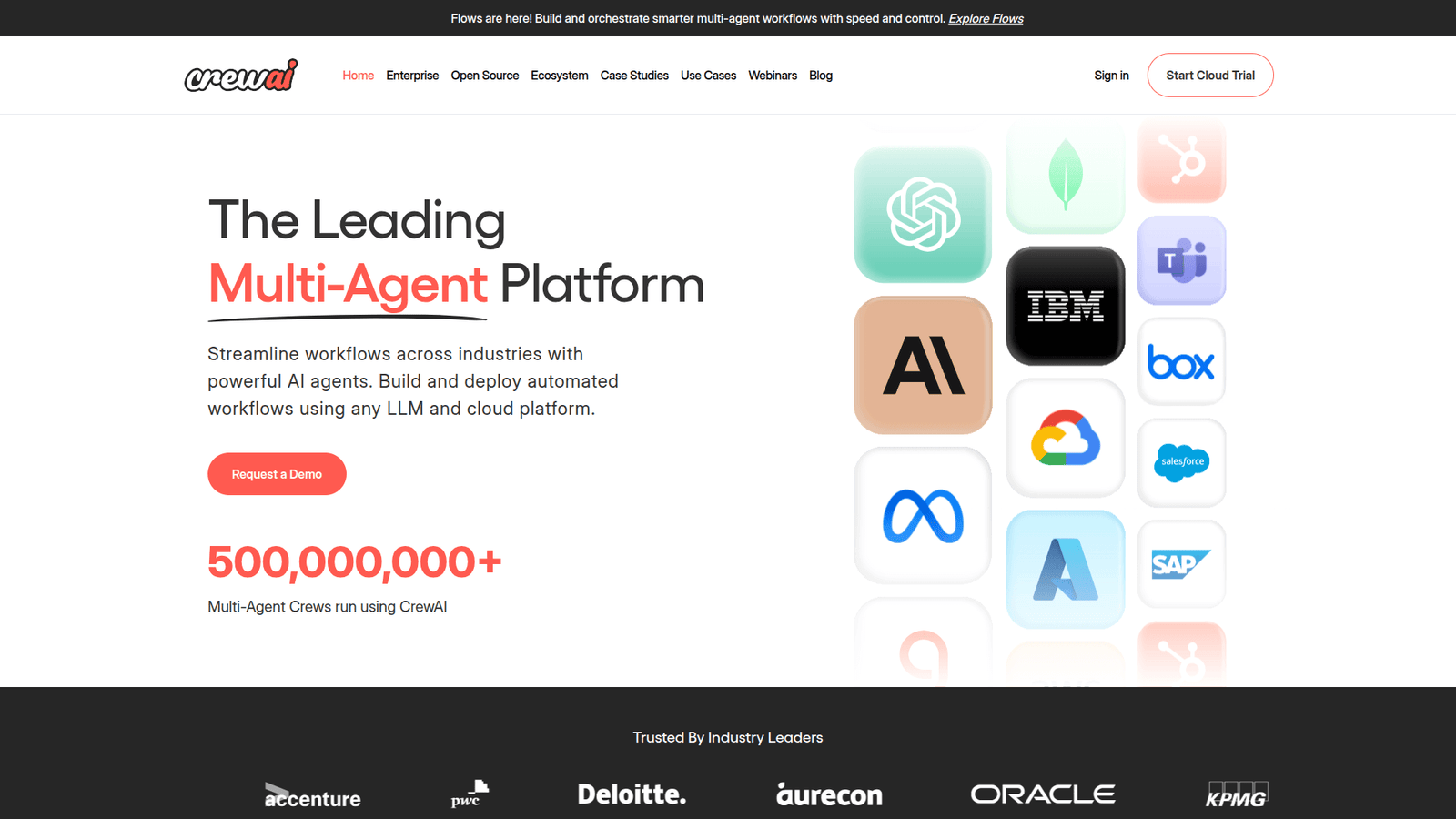

CrewAI redefines Agent Development, making complex AI solutions accessible. Boost your efficiency and output with smart, collaborative agents. Ready to build better AI? Get started with CrewAI today!
Why CrewAI Is a Smart Choice for Agent Development
Ever feel like you’re wrestling with a hydra every time you try to build an AI agent? One head gets chopped off, two more pop up. It’s a mess.
The AI Agents space is booming. Everyone wants to talk about multi-agent systems. But few talk about the grunt work.
That’s where CrewAI steps in. It’s not just another tool. It’s a complete shift.
I’ve seen the struggles firsthand. Hours spent debugging agent communication. Endless loops trying to get them to collaborate effectively.
It’s exhausting. And it’s not scalable.
But what if you could streamline that entire process? What if you could build sophisticated Agent Development workflows with ease?
That’s the promise of CrewAI. And it delivers.
This isn’t just theory. We’re talking about real-world impact. More efficient development cycles. Better performing agents. And ultimately, more value for you and your projects.
If you’re serious about agent development, you need to pay attention. This tool changes the game.
Stick around. I’ll show you why CrewAI is quickly becoming a must-have in the AI toolkit.
What is CrewAI?
CrewAI is an open-source framework. It’s designed specifically for orchestrating multi-agent systems. Think of it as a conductor for an orchestra of AI agents.
It lets you assign roles, define goals, and manage the interactions between various AI agents. All in a structured, efficient way.
Before it, building complex Agent Development scenarios was a nightmare. You’d spend more time managing communication protocols than actually building intelligent behaviour.
CrewAI changes that. It provides a robust, intuitive layer for managing agents. This means you can focus on the logic, not the plumbing.
The target audience? Developers, researchers, and businesses. Anyone serious about building sophisticated AI agent applications. From automating complex workflows to creating dynamic AI assistants.
It’s built with Python. This makes it accessible to a wide range of developers. The community support is growing rapidly.
What makes it stand out is its emphasis on collaboration. Agents don’t just act independently. They work together. They share information. They delegate tasks.
This collaborative approach is where the real power lies. It enables the creation of truly intelligent systems. Systems that can tackle problems too complex for a single agent.
Imagine a team of experts, all working on a single problem. Each with their own specialty. That’s what CrewAI helps you create, but with AI.
It’s not just about running agents. It’s about building a crew. A crew that can achieve shared goals.
This tool is essential for anyone looking to push the boundaries of AI agents. It simplifies the most challenging aspects of multi-agent design.
It’s about making advanced AI accessible. And practical.
Key Features of CrewAI for Agent Development
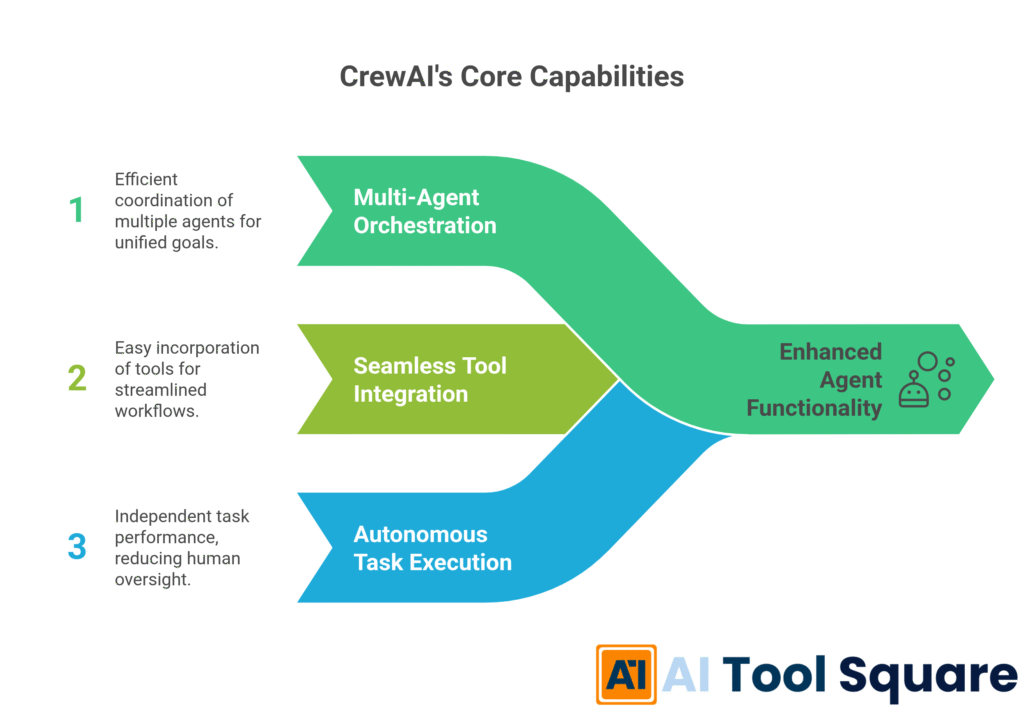
CrewAI brings several powerful features to the table. These are designed to make your Agent Development journey smoother and more effective.
Multi-Agent Orchestration
This is the core of CrewAI. It allows you to define a “crew” of AI agents. Each agent can have a specific role, goal, and backstory. This contextualises their actions and decisions.
Imagine a marketing team. You have a researcher, a copywriter, and an editor. CrewAI lets you define these roles for your AI agents.
They can then collaborate on a shared task. The researcher finds data. The copywriter uses that data. The editor refines the output.
CrewAI manages the flow of information between them. It ensures tasks are handed off seamlessly. This removes a massive headache for developers.
Without proper orchestration, agents often work in silos. They don’t communicate effectively. This leads to redundant work and poor outcomes.
CrewAI prevents this. It builds a structured environment for interaction. This means more coherent, higher-quality results.
It also handles complex dependencies. If one agent needs input from another, it ensures that sequence is followed correctly.
This feature alone makes it a game-changer. It elevates agent development from individual tasks to a truly collaborative process.
You’re not just building agents. You’re building teams.
Seamless Tool Integration
AI agents are only as good as the tools they can use. CrewAI makes it easy to integrate external tools. This expands your agents’ capabilities significantly.
Want your agent to browse the web? Connect it to a search API. Need it to generate images? Hook it up to DALL-E or Stable Diffusion.
The framework provides a simple way to define these tools. Agents can then decide when and how to use them based on their tasks and goals.
This means your agents aren’t confined to what they “know.” They can actively seek out and process new information. They can interact with the outside world.
Think about a research agent. It can use a web search tool to gather information. Then, it can use a summarisation tool to condense its findings.
This level of integration is crucial. It transforms agents from simple chatbots into powerful problem-solvers.
It also makes your agents more adaptable. New tools emerge constantly. CrewAI lets you plug them in without rebuilding your entire agent system.
This future-proofs your AI Agents. It ensures they remain relevant and powerful as technology evolves.
It’s about giving your agents the right tools for the job. And making that process dead simple.
Autonomous Task Execution
CrewAI agents don’t just wait for instructions. They can independently execute tasks to achieve their assigned goals. This is true autonomy.
Once you define a task and assign it to an agent, it takes over. The agent will determine the best steps to complete that task.
It leverages its role, goal, and available tools. It makes decisions. It acts. All without constant human oversight.
For example, give a content creator agent the goal “write a blog post about CrewAI.” It might autonomously research, outline, draft, and revise.
It manages the entire workflow. This frees you up to focus on higher-level strategy. You define the “what,” and CrewAI agents figure out the “how.”
This level of automation is incredibly powerful. It accelerates Agent Development and deployment.
It also allows for more dynamic and responsive systems. Agents can react to new information or changing conditions on their own.
This feature reduces the need for constant human intervention. It makes AI agents truly scalable and efficient.
It’s about setting the direction. Then letting your intelligent crew navigate the journey.
Benefits of Using CrewAI for AI Agents
Using CrewAI for your AI Agents projects isn’t just a nice-to-have. It’s a strategic advantage. It tackles some of the biggest pain points in agent development head-on.
First, it delivers massive time savings. Before it, orchestrating multiple agents involved writing complex state machines and intricate communication protocols from scratch. That’s hundreds of hours gone. CrewAI provides a framework that handles all of that. You define roles, goals, and tasks. The framework manages the complex interactions. This cuts development time significantly. You can build and deploy sophisticated agents much faster.
Next, it dramatically improves quality and consistency. When agents work in isolation, their outputs can be inconsistent. With it, agents collaborate. They build upon each other’s work. The “editor” agent can refine the “writer” agent’s output. This multi-stage review process leads to higher quality, more coherent results. Errors are caught earlier. Outputs are more polished.
It also helps in overcoming creative blocks and complex problems. Some problems are too big for a single agent or a simple script. CrewAI lets you break down complex challenges into smaller, manageable tasks. Each task is then assigned to a specialized agent. This modular approach allows for more innovative solutions. It mirrors how human teams tackle difficult projects. It helps you design solutions you might not have envisioned with a single-agent approach.
The framework also promotes scalability and maintainability. As your agent system grows, managing individual agents becomes impossible. CrewAI provides a structured way to add new agents or modify existing ones. Because agents are modular and role-defined, changes in one agent are less likely to break the entire system. This makes your agent infrastructure more robust and easier to expand. It prepares you for future growth.
Finally, it boosts development efficiency. By abstracting away the complexities of inter-agent communication and task management, CrewAI lets developers focus on core agent logic. This means less boilerplate code. More focus on intelligence. It makes the entire development process more enjoyable and productive. You get to build cool stuff, not just infrastructure.
These benefits translate directly to better outcomes. Faster deployments, higher quality outputs, and a more robust AI infrastructure. If you’re serious about agent development, CrewAI gives you an unfair advantage.
Pricing & Plans
One of the best aspects of CrewAI is its accessibility: it’s an open-source framework. This means the core functionality of it is completely free to use. You can download it, experiment with it, and deploy it in your projects without any licensing fees.
This open-source nature is a huge benefit for developers and businesses. It removes the initial cost barrier often associated with powerful AI tools. You can start building sophisticated Agent Development systems today, using your existing infrastructure.
However, “free” doesn’t mean “without cost.” While CrewAI itself is free, you will incur costs for the underlying services it connects to. For example, if your agents use OpenAI’s GPT models, you’ll pay OpenAI for API calls. The same goes for other LLM providers (like Anthropic, Google) or external tools (like search APIs, image generation services).
Think of CrewAI as the operating system for your AI agents. The operating system is free, but the applications you run on it and the internet service you use still cost money.
There isn’t a “premium version” of CrewAI in the traditional sense, offered by the CrewAI project itself. Instead, the premium aspects come from your choice of Large Language Models (LLMs) and integrated third-party services. High-tier LLMs offer better performance and context windows, but come with higher API costs.
When comparing CrewAI to alternatives, it’s unique because it focuses on orchestration rather than being a standalone, all-in-one AI content generation platform. Many commercial AI tools charge monthly subscriptions for specific functionalities (e.g., content writing, image generation). CrewAI doesn’t do that. It lets you integrate the best of breed for each component.
This modular approach means you pay for what you use on the backend, rather than a fixed fee. This can be more cost-effective for smaller projects or for those with fluctuating needs. It also provides flexibility to switch LLM providers if a better or cheaper option emerges.
The total cost will depend entirely on your usage patterns and the specific integrations you choose. For a hobbyist or small project, costs can be very low. For enterprise-level deployments with heavy API usage, costs will scale. But you have full control over those costs, as you select your providers.
In essence, CrewAI is a powerful, free framework that empowers you to build paid-for solutions. It’s a smart choice for those who want control and flexibility over their AI infrastructure.
Hands-On Experience / Use Cases
Let me tell you about a personal project where CrewAI truly shined. I wanted to build an automated research and content generation system for a niche topic. Something that could scan the web, summarise findings, and then draft a blog post.
Before CrewAI, this would have been a tangled mess of Python scripts, API calls, and conditional logic. Debugging would be a nightmare.
With CrewAI, I set up a crew:
First, a Researcher Agent. Its role: “Expert in deep web searches and data extraction.” Goal: “Gather comprehensive, up-to-date information on [Niche Topic].” It had access to a web search tool.
Next, a Summariser Agent. Its role: “Skilled in condensing complex information into clear, concise summaries.” Goal: “Produce actionable insights and key takeaways from research findings.”
Finally, a Content Creator Agent. Its role: “Professional blogger and engaging storyteller.” Goal: “Draft a compelling blog post using the summarised research, tailored for a specific audience.”
I defined the tasks. The researcher would kick things off. Its output would feed directly into the summariser. The summariser’s output would then become the input for the content creator.
The usability was surprisingly straightforward. Defining agents with their roles, goals, and tools felt intuitive. The YAML configuration was clean. The Python API was easy to pick up.
The results were impressive. The Researcher Agent effectively scoured various sources. The Summariser Agent condensed thousands of words into bullet points and key paragraphs, flagging crucial data.
Then, the Content Creator Agent took over. It produced a surprisingly coherent and well-structured blog post draft. It wasn’t perfect, of course. No AI is. But it was a solid 80% there.
The editing process was minimal compared to starting from scratch. I refined a few sentences, checked some facts, and added my human touch. What would have taken me an entire day, or even longer, was reduced to a couple of hours.
This isn’t just about speed. It’s about efficiency and reducing mental load. The agents handled the laborious parts. I focused on strategy and refinement. It felt like I had a team of dedicated assistants working around the clock.
Other use cases? Imagine an AI Agents customer support crew. One agent triages the query. Another searches the knowledge base. A third drafts a personalised response. All working in concert.
Or a project management crew. Agents for task delegation, progress tracking, and report generation. The possibilities for Agent Development are vast.
CrewAI truly empowers you to build these complex, collaborative AI systems. It turns daunting multi-agent problems into manageable, even enjoyable, projects.
Who Should Use CrewAI?
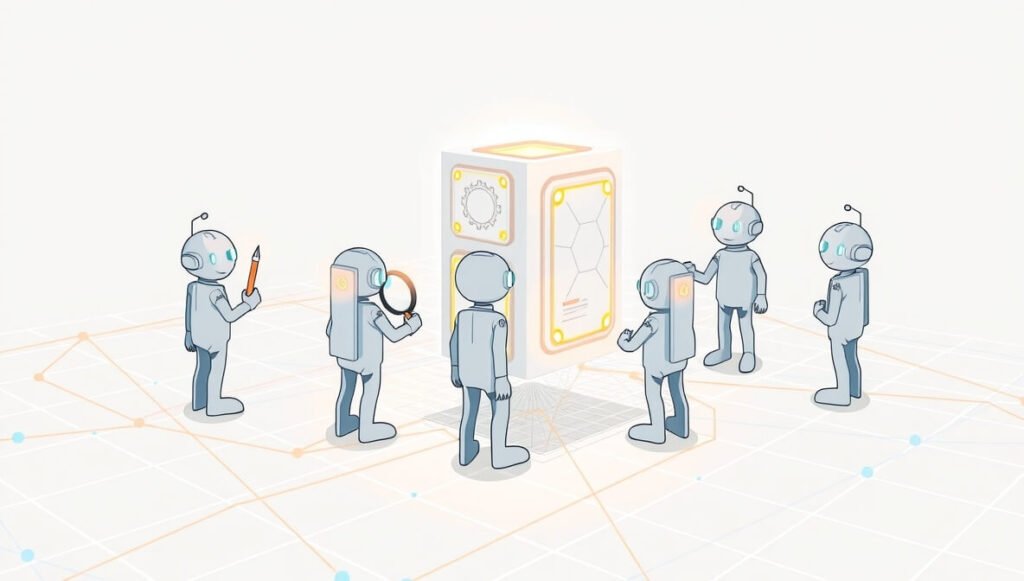
CrewAI isn’t for everyone. It’s for those who are serious about pushing the boundaries of what AI can do. If you’re simply looking for a one-click content generator, this isn’t it. But if you’re building sophisticated AI solutions, CrewAI is your blueprint.
AI Developers and Engineers: This is your primary audience. If you’re building multi-agent systems, experimenting with agentic workflows, or integrating complex AI logic into applications, CrewAI provides the structure you need. It reduces boilerplate code and lets you focus on the intelligence.
Researchers in AI and Machine Learning: For academics and corporate researchers exploring new architectures for AI collaboration, CrewAI offers a flexible framework. It’s perfect for testing hypotheses on agent interaction, delegation, and problem-solving strategies. It’s an excellent tool for advancing the field of AI Agents.
Tech-Savvy Entrepreneurs and Startups: If your business idea relies on automated, intelligent workflows, CrewAI can be a foundational technology. Think about services that require complex data analysis, automated customer interactions, or dynamic content creation at scale. It allows you to build powerful prototypes and MVPs quickly.
Consultants and Agencies Specialising in AI: Offering custom AI solutions to clients? CrewAI can be a key part of your toolkit. It enables you to develop bespoke AI agent systems tailored to specific business needs, from automating internal processes to creating unique customer-facing AI products. It makes complex Agent Development projects more manageable.
Educators and Students Learning AI: For those teaching or learning about advanced AI concepts, especially multi-agent systems, CrewAI is an excellent practical tool. It provides a hands-on way to understand how individual AI components can work together to achieve higher-level goals.
Businesses Looking for Advanced Automation: Any business struggling with complex, repetitive tasks that require nuanced decision-making can benefit. Instead of brute-force automation, CrewAI allows for intelligent automation. This can be in areas like market research, lead qualification, report generation, or content planning.
In short, if you’re moving beyond single-prompt interactions with AI and into designing intelligent, collaborative systems, CrewAI is built for you. It’s for those who want to build, not just use, advanced AI.
How to Make Money Using CrewAI
CrewAI isn’t just a powerful development tool; it’s a launchpad for new income streams. The open-source nature means you can build solutions without initial software costs, then charge for your expertise and the value you create. Here’s how you can monetise your skills with CrewAI:
Offering AI Agent Consulting Services
Businesses are struggling to understand and implement AI agents. They know the hype, but they lack the technical know-how. This is where you step in.
You can offer consulting services. Help companies identify where multi-agent systems can solve their problems. This involves understanding their current workflows, pinpointing inefficiencies, and designing a CrewAI-based solution.
Your expertise in CrewAI allows you to map out agent roles, define goals, and suggest tool integrations. You’re essentially selling strategic guidance. “How can AI agents make your sales process 2x faster?”
Charge for your time, your strategic insights, and the blueprints you create. This often leads to follow-on development contracts.
Building Custom AI Agents for Businesses
This is the most direct route. Companies often have unique problems that off-the-shelf AI tools can’t solve. They need tailored solutions. With CrewAI, you can build exactly that.
Imagine a real estate agency needing an agent crew to monitor new listings, analyse market trends, and automatically generate property descriptions. You can build this for them.
You define the agents (e.g., a “Market Analyst,” a “Listing Monitor,” a “Copywriter”). You integrate the necessary tools (MLS database, LLMs for content generation). You build the tasks and orchestrate the crew.
You charge for the development project. This can range from a few hundred to thousands of pounds, depending on complexity. The key is delivering a solution that provides clear ROI for the client.
Think about an e-commerce store. They might need an AI Agents crew to manage inventory updates, respond to customer service inquiries, and even suggest new product ideas based on market data.
The beauty of CrewAI is its flexibility. You’re not confined to one type of agent. You can build diverse teams for diverse business needs.
Developing Automation Solutions
Many businesses are drowning in manual, repetitive tasks. CrewAI can automate these tasks intelligently. This goes beyond simple robotic process automation (RPA).
You can create agent crews that automate complex data analysis, report generation, email triage, social media content scheduling, or even basic coding tasks.
Consider a small marketing agency. They could use a CrewAI system to automate keyword research, content brief creation, and initial ad copy generation. This frees up their human team for higher-level strategy and client interaction.
You can sell these automation solutions as a service or as a one-off project. The value proposition is clear: save time, reduce errors, and increase operational efficiency for your clients.
Case Study Example: How Sarah Makes £2,500/Month Using CrewAI for Agent Development
Sarah, a freelance developer, saw a gap in the market. Small to medium-sized businesses (SMBs) struggled with their online presence. They couldn’t afford a full marketing team but needed consistent, quality content.
She built a “Content Creation Crew” using CrewAI. This crew consisted of a “Market Research Agent” (browses Google Trends, competitor blogs), a “SEO Optimiser Agent” (suggests keywords, meta descriptions), and a “Blog Post Writer Agent” (drafts engaging content).
Sarah offered this as a monthly content subscription service. For £500 a month per client, her CrewAI system would generate 4 high-quality blog post drafts, complete with SEO suggestions and a call to action. She just needed to review and lightly edit each post.
With just five clients, Sarah was making £2,500 a month. Her actual work per post was minimal – perhaps 30 minutes of human oversight. The bulk of the heavy lifting was done by her CrewAI agents. She scaled her offering and saved clients money compared to hiring a full-time content writer.
This illustrates the power: CrewAI allows you to productise complex AI capabilities. You create the intelligent system once, and then you can sell its output or service multiple clients with minimal ongoing effort. It’s about leveraging AI for scalable value creation in Agent Development.
Limitations and Considerations
No tool is a silver bullet, and CrewAI is no exception. While powerful, it comes with its own set of limitations and considerations you need to be aware of before diving in.
The first major point is accuracy and hallucination. Your CrewAI agents are only as good as the Large Language Models (LLMs) they use. LLMs can and do hallucinate, meaning they generate plausible-sounding but incorrect information. While multi-agent systems can cross-verify, it doesn’t eliminate the risk entirely. You’ll still need human oversight to fact-check critical outputs. Don’t blindly trust everything your crew produces.
Next, there’s the editing and refinement needs. As with any AI-generated content or solution, the output from a CrewAI system often requires human editing and refinement. It’s excellent for generating drafts, initial analyses, or first-pass solutions. But for polished, client-ready work, expect to spend time finessing. Think of it as a powerful assistant, not a replacement for human creativity and judgment.
Then, we have the learning curve. While CrewAI simplifies multi-agent orchestration, it’s not a no-code tool. You need solid Python programming skills. Understanding concepts like agent roles, goals, tasks, and process flows is essential. There’s a learning investment required to effectively design, implement, and debug your agent crews. It’s less steep than building from scratch, but it’s there.
Computational resources and cost are also factors. Running multiple AI agents, especially with powerful LLMs, can consume significant computational resources. Each agent interaction, each tool call, translates to API usage. This can quickly add up, especially for complex tasks or large-scale deployments. You need to monitor your LLM API usage carefully to manage costs.
Debugging and observability can also be tricky. When you have multiple agents interacting, tracing errors or understanding why an agent made a particular decision can be challenging. CrewAI offers logging, but disentangling complex multi-agent interactions requires patience and systematic debugging approaches. It’s a distributed system, after all.
Finally, consider the ethical implications. As you build more autonomous and influential AI agents, you need to consider biases in the data they were trained on, the potential for misuse, and the impact of their actions. Designing responsible AI Agents is paramount, and CrewAI provides the framework, but the ethical responsibility lies with you, the developer.
CrewAI is a fantastic tool for Agent Development. But like any advanced technology, it demands a thoughtful and informed approach. Understand its strengths, but also be realistic about its current limitations.
Final Thoughts
So, where do we stand with CrewAI? It’s clear this isn’t just another flashy AI tool. It’s a foundational shift in how we approach Agent Development.
CrewAI delivers on its promise. It simplifies the complex. It makes building collaborative AI agents not just possible, but practical. It takes the pain out of multi-agent orchestration, letting you focus on the intelligence, not the plumbing.
I recommend CrewAI without hesitation for anyone serious about building sophisticated AI agent systems. If you’re a developer, a researcher, or a business looking to leverage advanced AI for automation and problem-solving, this tool is indispensable.
It’s an investment in your skills and your projects. The learning curve is there, but the payoff is immense. You’ll build more powerful, more robust, and more efficient AI solutions than you thought possible.
The value proposition is simple: save time, boost quality, and unlock new possibilities for AI automation.
My advice? Dive in. Experiment with it. Build a small crew for a problem you’re facing. See firsthand how it transforms your workflow.
The future of AI Agents is collaborative. CrewAI is your guide to building that future, one intelligent crew at a time.
Visit the official CrewAI website
Frequently Asked Questions
1. What is CrewAI used for?
CrewAI is used for orchestrating multi-agent AI systems. It helps developers define roles, goals, and tasks for multiple AI agents, enabling them to collaborate on complex problems like research, content creation, and automated workflows.
2. Is CrewAI free?
Yes, CrewAI is an open-source framework, meaning its core functionality is free to use. However, you will incur costs for the underlying Large Language Models (LLMs) and external tools (like search APIs) that your agents integrate and utilise.
3. How does CrewAI compare to other AI tools?
CrewAI stands out by focusing on multi-agent orchestration. While other AI tools might generate content or provide single-agent solutions, CrewAI provides a framework for multiple agents to work together collaboratively, managing their communication and task delegation effectively. It’s about building teams of AI, not just individual AI components.
4. Can beginners use CrewAI?
CrewAI is best suited for users with some programming experience, specifically in Python. While it simplifies complex multi-agent Agent Development, it’s not a no-code tool and requires an understanding of basic AI concepts and development practices.
5. Does the content created by CrewAI meet quality and optimization standards?
CrewAI can generate high-quality drafts and initial content, especially when paired with powerful LLMs and integrated tools. However, outputs often require human review and editing to ensure factual accuracy, meet specific quality standards, and apply final optimisation for tone or SEO. It’s a powerful assistant, not a fully autonomous content creator for polished final pieces.
6. Can I make money with CrewAI?
Absolutely. You can leverage CrewAI to offer AI agent consulting services, build custom AI agent solutions for businesses, or develop automated systems for specific industry needs. Its open-source nature means you can build valuable services without significant upfront software costs, charging clients for your expertise and the solutions you create.
7. How to make money with CrewAI?
You can make money with CrewAI by building and selling custom AI agent crews tailored to specific business needs (e.g., automated market research, content generation, customer support triage). Another avenue is offering consulting services to businesses looking to implement multi-agent AI solutions or providing ongoing management and maintenance for deployed CrewAI systems.