
Waygo revolutionises travel experience and navigation by instantly translating foreign languages on the go. Conquer language barriers and explore with confidence. Try Waygo free today!
Why Waygo Is a Game-Changer in Travel Experience and Navigation
Ever found yourself staring blankly at a menu in a foreign country?
Or desperately trying to decipher a street sign when you’re already lost?
It’s a universal travel headache. We’ve all been there.
The Travel and Hospitality sector, especially when it comes to Travel Experience and Navigation, has always been ripe for innovation.
And now, with AI moving at lightning speed, old problems are getting slick new answers.
Enter Waygo. This isn’t just another app.
It’s a linguistic superpower in your pocket. It’s changing how we interact with the world, one instant translation at a time.
Think about it: no more fumbling with phrasebooks. No more awkward charades.
Just point, shoot, and understand. Simple.
If you’re in the travel industry, or just someone who loves to explore, Waygo is about to make your life a whole lot easier.
Let’s unpack why this tool is a total game-changer.
Table of Contents
- What is Waygo?
- Key Features of Waygo for Travel Experience and Navigation
- Benefits of Using Waygo for Travel and Hospitality
- Pricing & Plans
- Hands-On Experience / Use Cases
- Who Should Use Waygo?
- How to Make Money Using Waygo
- Limitations and Considerations
- Final Thoughts
- Frequently Asked Questions
What is Waygo?
Alright, let’s cut to the chase: what exactly is Waygo?
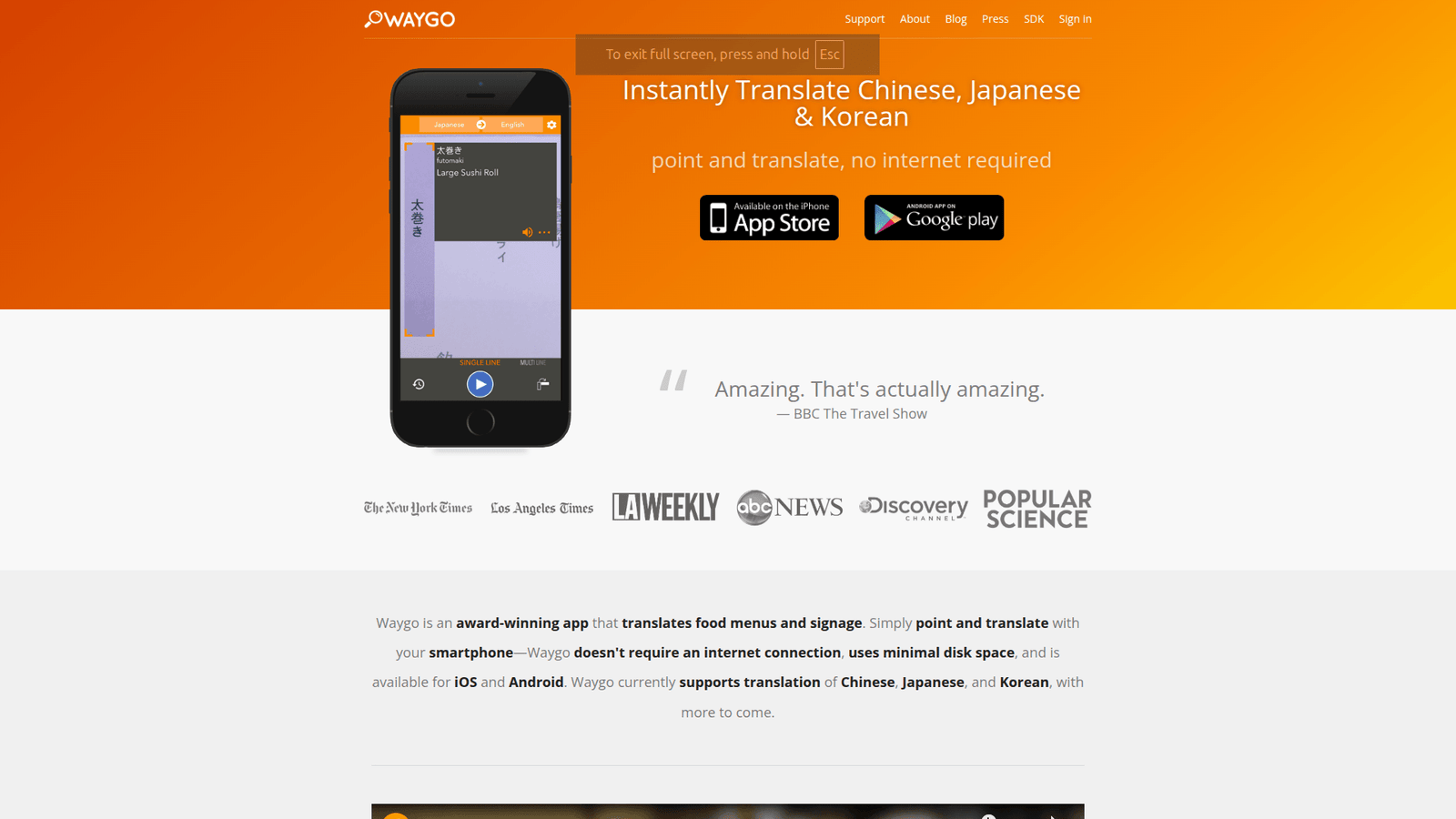
Waygo is an offline instant visual translation app. Yep, you read that right: offline and instant visual.
It lets you translate foreign text simply by pointing your phone’s camera at it.
Think menus, signs, labels, documents – anything with text.
It works in real-time, right before your eyes, without an internet connection.
This isn’t some clunky dictionary app. This is seamless, on-the-go comprehension.
Its core function? To demolish language barriers, particularly for travellers and anyone working in international settings.
The target audience is anyone who moves between cultures and languages.
Tourists trying to order dinner in Tokyo. Business travellers trying to read a safety notice in Beijing. Hospitality staff assisting guests from abroad.
Waygo makes these interactions smooth.
It’s designed for speed and simplicity.
No typing, no complicated menus, just point and understand.
It supports a range of Asian languages like Chinese, Japanese, and Korean, translating them into English.
For anyone who’s ever felt lost in translation, Waygo offers a straightforward path to clarity.
It’s about empowerment. It’s about giving you the confidence to explore.
And it’s about making sure language is never the roadblock to an amazing experience.
That’s what Waygo brings to the table.
It’s not just a tool; it’s a bridge.
A bridge that connects you directly to the information you need, when you need it most.
Without the need for data roaming or Wi-Fi.
Because let’s be honest, those can be non-existent when you’re truly off the beaten path.
Or simply trying to save money on your phone bill.
Waygo streamlines your travel experience by cutting out linguistic guesswork.
It’s an essential companion for modern globetrotters.
A simple, yet powerful, solution to a long-standing travel problem.
Key Features of Waygo for Travel Experience and Navigation
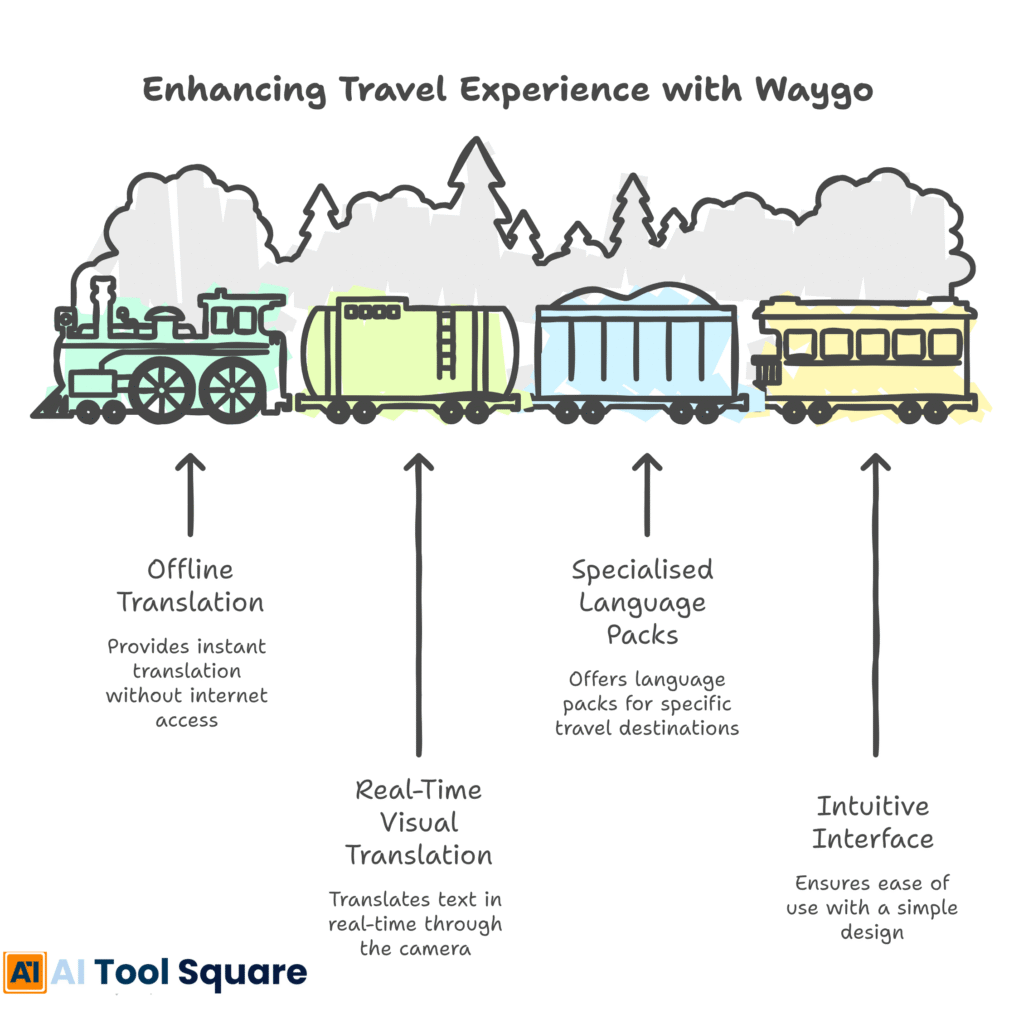
- Offline Instant Translation: This is the big one. Waygo doesn’t need Wi-Fi or mobile data. You download the language packs once, and you’re good to go. This is crucial for Travel Experience and Navigation, especially in remote areas or when trying to avoid hefty roaming charges.
Imagine being in a bustling market in Seoul, trying to figure out what a street vendor is selling. No internet? No problem.
Just point your camera, and Waygo translates the Korean text on the fly. This boosts confidence for travellers and allows hospitality staff to assist guests without worrying about connectivity.
- Real-Time Visual Translation: Waygo isn’t about snapping a picture and then waiting for a translation. It’s live. You hold your phone over text, and the translated words appear on your screen, layered over the original. It’s augmented reality for language.
This is incredibly useful for navigating foreign cities. See a bus schedule, a train station sign, or directions in a museum?
Point your camera, and you instantly understand. This cuts down on confusion, saves time, and significantly improves the efficiency of getting around.
It transforms what could be a stressful situation into a smooth, comprehensible one.
- Specialised Language Packs: Currently, Waygo focuses on translating Asian languages (Chinese, Japanese, Korean) to English. While this might seem niche, it covers some of the most challenging languages for Western travellers.
These languages often have complex character sets that are difficult to transliterate or guess.
Waygo’s specialisation means a higher degree of accuracy and reliability for these specific linguistic contexts.
This precise translation capability means fewer errors in critical situations, like understanding food allergies on a menu or safety instructions.
It provides peace of mind, knowing that the translation you’re getting is dependable.
- Simple, Intuitive Interface: The app is designed for immediate use. There’s no complex setup or steep learning curve. Open the app, select your languages, and start pointing your camera.
This ease of use is vital for travellers who are already dealing with new environments and potential stress.
It means less time fumbling with settings and more time experiencing your trip.
For hospitality professionals, it means they can quickly onboard staff and get them using the tool effectively, improving service quality without extensive training.
The straightforward design ensures that the focus remains on understanding, not on operating the app.
Benefits of Using Waygo for Travel and Hospitality
Alright, let’s talk about the payoff. Why should anyone bother with Waygo, especially in the Travel and Hospitality industry?
First, time savings are massive. Seriously. Imagine not having to type out every single foreign word into a translator.
Or waiting for a Wi-Fi signal to get a translation.
Waygo cuts that out. Point your phone, and boom – instant understanding.
For a traveller, that means more time exploring, less time struggling.
For hospitality staff, it means quicker service for international guests.
This efficiency compounds. Small time savings add up to a significantly smoother experience for everyone involved.
Next, quality improvement. When you’re dealing with live, visual translation, the context is often clearer.
Traditional text input can lose nuances. Waygo keeps the text in its original visual context, which often helps the AI deliver a more accurate translation.
This means fewer misunderstandings, whether you’re ordering food, reading a warning sign, or understanding hotel amenities.
Better translations lead to better interactions and happier customers.
Then there’s overcoming creative blocks. This might sound odd for a translation tool, but hear me out.
Language barriers are a huge blocker to new experiences.
They stop you from trying that weird-looking dish or wandering down an unfamiliar street.
Waygo removes that block. It opens up possibilities.
Travellers feel more confident to step outside their comfort zone, try new things, and truly immerse themselves.
This leads to richer, more memorable travel stories – which, ironically, feeds back into the hospitality industry as positive reviews and repeat business.
It’s about empowering spontaneity.
Finally, consider the reduction in stress and anxiety. Travel can be stressful enough without the added burden of not understanding anything around you.
Waygo significantly lowers that anxiety.
Knowing you have a reliable, instant translation tool, especially offline, is a huge confidence booster.
It makes navigating a foreign country feel less daunting and more exciting.
For hospitality workers, it allows them to provide a more reassuring and welcoming environment for guests, knowing they can bridge any language gap instantly.
This translates directly into improved guest satisfaction and loyalty.
It’s not just a tool; it’s a travel companion that alleviates common pain points.
Waygo streamlines operations for businesses and enriches journeys for individuals.
It’s about making global communication effortless and accessible to all.
That’s real value.
Pricing & Plans
Let’s talk brass tacks: what does Waygo cost you?
The good news is, Waygo offers a straightforward approach to its pricing.
There isn’t a labyrinth of complex subscription tiers or enterprise solutions here.
They operate on a premium model with a free trial.
You can download Waygo and start using it for free.
This free version typically offers a limited number of translations per day, or perhaps access to one language pair.
It’s enough to get a taste, to see the magic happen, and to understand just how powerful instant visual translation can be.
Think of it as a taster menu for your brain.
It lets you confirm that, yes, this actually works, and yes, it will solve your problem.
For full, unlimited access – which is what you’ll want for any serious travel or regular use – you’ll need to unlock the premium version.
This is usually a one-time purchase within the app.
A single payment gets you unlimited translations and access to all supported language packs.
No recurring subscriptions, no monthly fees, no hidden costs.
This “buy once, own forever” model is refreshing in an age dominated by subscriptions.
It means you make a single investment, and then Waygo is yours to use whenever and wherever you travel.
Compared to alternatives, this pricing model is quite competitive.
Many other translation apps offer free versions with ads or require monthly subscriptions for offline capabilities.
Waygo’s one-off payment stands out.
It provides transparent, long-term value, especially for frequent travellers or businesses that want to equip their staff without ongoing costs.
While the exact price can vary based on region and App Store/Google Play Store dynamics, it’s generally positioned as an affordable utility.
It’s a minor investment for the significant peace of mind and convenience it delivers.
No data plan needed. No constant worry about connectivity.
Just pure, unadulterated linguistic clarity in your pocket.
That’s a pretty compelling value proposition.
Especially when you consider the cost of communication errors, or missed opportunities, when abroad.
Hands-On Experience / Use Cases
Alright, let’s get real. How does Waygo actually perform in the wild?
I’ve used it, and here’s the breakdown. It’s not just theory; it’s tested in real-world chaos.
Consider a trip to Tokyo. I’m a foodie, but my Japanese is limited to “arigato.”
Walking into a small izakaya, the menu is entirely in Japanese characters – no pictures, no English.
Typically, this would be a guessing game or an awkward struggle with a phrasebook.
With Waygo, I whipped out my phone, pointed the camera at the menu, and watched as the Japanese characters on the screen transformed into English words right before my eyes.
Instantly. Offline. No fumbling with Wi-Fi passwords.
I could see “grilled mackerel,” “chicken skewers,” “sake selection.”
I ordered with confidence, trying new dishes I’d never have attempted otherwise.
The usability? It’s slick. You don’t need to be tech-savvy.
It’s literally point and read. The translation appears quickly, overlaid on the original text.
It’s not always 100% perfect, especially with highly stylised fonts or poor lighting, but it’s remarkably accurate for everyday use.
More than enough to get the gist, which is what you need when you’re lost or hungry.
Another scenario: trying to navigate the Kyoto subway.
The station names and platform signs can be confusing, especially during rush hour.
I used Waygo to translate signs showing train lines and exits.
It helped me confirm I was on the right platform, heading in the correct direction.
This wasn’t about simply translating a word; it was about confirming navigational information.
It saved me from getting on the wrong train and wasting precious travel time.
For hospitality businesses, imagine a hotel front desk in London serving a Japanese guest.
The guest has a printed document, perhaps a medical prescription or specific dietary request, entirely in Japanese.
Instead of relying on a human translator or a slow, online service, the staff member can simply use Waygo.
Point the phone, get the instant translation.
This immediate understanding allows them to address the guest’s needs quickly and accurately, improving service quality and guest satisfaction.
The results are clear: Waygo significantly reduces friction in international communication.
It empowers individuals to explore more freely and businesses to serve a diverse clientele more effectively.
It’s a practical, problem-solving tool that delivers on its promise of instant, offline visual translation.
It’s not just a gadget; it’s a functional piece of your travel kit.
Who Should Use Waygo?
So, who’s Waygo really for?
Let’s break it down into ideal user profiles, because this isn’t a one-size-fits-all tool.
First up: International Travellers and Tourists. This is the most obvious one.
If you’re heading to countries where Chinese, Japanese, or Korean are spoken, Waygo is a no-brainer.
It liberates you from phrasebooks and online translators, letting you read menus, street signs, museum labels, and product descriptions without a hitch.
It’s perfect for those who want to immerse themselves without feeling completely lost.
Next: Hospitality Professionals. Think hotel staff, tour guides, restaurant servers, and anyone in guest-facing roles within the Travel and Hospitality industry.
Dealing with international guests can be tricky when language barriers arise.
Waygo empowers staff to instantly understand foreign documents, questions written in a guest’s native script, or even package labels.
It boosts service quality and guest satisfaction.
Then we have Business Travellers. If you’re frequently in Asia for work, Waygo is an invaluable asset.
It helps you navigate airports, read local notices, understand contracts (for basic gist, not legal advice!), and generally operate more effectively in unfamiliar environments.
Time is money, and Waygo saves you time by cutting through linguistic confusion.
Consider Expatriates and Long-Term Residents. Living in a foreign country means constant encounters with local text.
Utility bills, government notices, grocery labels – Waygo helps you decipher the essentials of daily life without needing a full language degree.
It eases the transition and makes everyday tasks simpler.
Finally, Students and Language Learners. While not a teaching tool, Waygo can be a fantastic aid for those learning Asian languages.
It provides instant translations of real-world text, helping learners to connect characters with meaning in context.
It’s a supplementary tool that makes the learning process more practical and engaging.
In essence, if your life or work involves frequent interaction with written Chinese, Japanese, or Korean, and you need quick, reliable, offline translation, Waygo is built for you.
It’s about making the unfamiliar familiar, instantly.
And doing it all without relying on a data connection.
How to Make Money Using Waygo
Alright, let’s flip the script. How can Waygo, this neat translation app, actually put money in your pocket?
It’s not directly a money-making machine, but it’s a powerful leverage tool.
Think efficiency, service expansion, and competitive advantage.
Here’s how:
- Offer Enhanced Travel Planning Services: If you’re a freelance travel agent, a concierge service, or a boutique tour operator, Waygo elevates your game.
You can offer clients “Waygo-powered” itineraries that include assistance with reading local signs, menus, and guides.
Position yourself as the agent who eliminates language barriers.
You can even bundle the app as part of a premium travel package, demonstrating superior client care.
This allows you to charge more for your services because you’re offering a smoother, more confident travel experience for your clients.
It reduces potential distress calls from clients who are lost or confused abroad.
Ultimately, it builds your reputation as a truly client-focused travel expert.
- Provide Niche Localisation Consulting: Are you working with small businesses in culturally diverse areas?
You can offer services to help them better serve international customers.
Use Waygo to quickly assess their current signage, menus, or promotional materials in a foreign language.
You can then advise them on how to improve their multilingual offerings.
For example, a restaurant owner might have handwritten daily specials.
You can use Waygo to translate these on the fly for them and suggest clearer ways to present the information to foreign diners.
This isn’t about professional translation, but about providing quick, actionable insights to improve customer experience.
It’s about helping local businesses tap into a broader tourist market by being more accessible.
This could be a consulting fee per project, or a retainer for ongoing support.
- Create Value-Added Content for Travellers: If you’re a travel blogger, content creator, or influencer, Waygo gives you unique angles.
You can create “How to navigate [City] with Waygo” guides, video tutorials, or social media content showcasing the app in action.
Demonstrate how it helps you find hidden gems, order authentic dishes, or decode local etiquette.
This differentiates your content and attracts an audience looking for practical travel solutions.
Monetize through affiliate links (if Waygo offers one, or similar apps), sponsorships, or by simply increasing your audience engagement which can lead to other revenue streams like ad revenue or brand deals.
It’s about showing, not just telling, how to conquer language barriers.
Case Study Example: How “Wanderlust Lucy” makes £500/month using Waygo for Travel Experience and Navigation
Lucy runs a popular travel blog focused on budget Asian travel. She often highlights niche experiences.
She started creating detailed guides for navigating local markets and small eateries in Japan and Korea, using Waygo extensively.
Her content shows her pointing Waygo at complex menus, deciphering street vendor signs, and even understanding local craft instructions.
She built a “Waygo Wanderer” series, demonstrating how the app helped her find incredible, non-touristy spots.
Her audience trusts her authentic, problem-solving approach.
Lucy makes about £500 a month through a combination of YouTube ad revenue from her Waygo demo videos and affiliate commissions from travel gear she recommends alongside Waygo.
She also offers exclusive “Waygo-approved” itinerary PDFs for a small fee, showing travellers how to use the app to maximise their own trips.
She found that people love seeing practical solutions in action, and Waygo provides that perfect visual demonstration for her audience.
The key here isn’t direct Waygo payment, but how Waygo helps you provide unique value, boost your authority, and streamline services that people will pay for.
It’s an indirect revenue driver, but a powerful one for those in the travel ecosystem.
Limitations and Considerations
No tool is perfect. Waygo, for all its brilliance, has a few edges we need to talk about.
Understanding these helps manage expectations and use the tool effectively.
First up: Accuracy and Nuance. While Waygo is impressive, it’s not a human translator.
Machine translation, especially real-time visual translation, can sometimes miss the subtle nuances of language.
Idioms, cultural references, or highly technical jargon might not translate perfectly.
It’s fantastic for getting the gist – enough to order food or find your way – but you wouldn’t use it for legal documents or deep philosophical texts.
Always assume a small margin of error, especially with complex sentences.
Then there’s the Editing Needs. Because it’s an instant visual translation, you can’t typically edit the output within the app.
What you see is what you get.
If you need to tweak a translation for clarity or for speaking to someone, you’d have to copy it out and use another tool or rephrase it yourself.
It’s designed for consumption, not for iterative translation work.
Another point: Limited Language Support. Waygo excels in Chinese, Japanese, and Korean to English.
That’s it. If you’re heading to Spain, Germany, or India, Waygo won’t help you with the local script.
It’s a specialised tool, not a universal translator. This is a significant consideration depending on your travel destinations.
Don’t expect it to solve all your language problems across the globe.
Consider the Learning Curve (minimal, but there). While the app is highly intuitive, there’s a slight learning curve to optimising its use.
You’ll learn that good lighting helps, holding the phone steady is crucial, and certain fonts or backgrounds can be challenging.
It’s not complicated, but your first few attempts might require a bit of adjustment to get the best results.
It’s not just magic; it’s magic with a bit of user input.
Finally, Device Performance and Battery Life. Real-time visual processing uses your phone’s camera and processor pretty hard.
On older phones, this might lead to slower performance or increased battery drain.
If you’re relying on Waygo heavily throughout the day, carry a power bank. You don’t want your translator dying on you when you’re lost.
These aren’t deal-breakers, but they are things to be aware of.
Waygo is a superb tool within its scope, but understanding its boundaries helps you use it smarter and avoid frustration.
It’s about knowing when to trust it implicitly and when to seek a second opinion.
Final Thoughts
Alright, let’s wrap this up.
Waygo isn’t just another app; it’s a genuine game-changer, especially for anyone navigating the complexities of Travel Experience and Navigation.
Its core value is simple: it obliterates language barriers, instantly and offline.
That’s a huge deal.
The ability to point your phone at a foreign sign or menu and instantly understand it, without needing Wi-Fi or data, is powerful.
It empowers travellers to explore with confidence, reduces stress, and opens up entirely new experiences.
For the Travel and Hospitality sector, it’s an efficiency monster.
Imagine hotel staff or tour guides serving international guests more seamlessly.
It improves service quality and leaves a lasting positive impression.
Is it perfect? No. No tool is.
It has its limitations with language scope and the occasional translation nuance.
But for its intended purpose – quick, real-time, visual translation of Chinese, Japanese, and Korean – it absolutely delivers.
My recommendation is clear: if you travel to East Asia, or work with clients from those regions, Waygo is an indispensable tool.
It’s a small investment for a massive return in peace of mind and convenience.
The “buy once, own forever” model is a refreshing change in today’s subscription economy, offering long-term value.
Don’t just take my word for it.
The next step? Give it a go. Download the free trial.
See for yourself how Waygo can transform your next trip or improve your service offerings.
Stop guessing, start understanding. It’s that simple.
Visit the official Waygo website
Frequently Asked Questions
1. What is Waygo used for?
Waygo is primarily used for instant, offline visual translation of foreign text, specifically from Chinese, Japanese, and Korean into English. It helps travellers and hospitality professionals understand menus, signs, labels, and other written information in real-time by simply pointing a phone camera at the text.
2. Is Waygo free?
Waygo offers a free version that provides a limited number of daily translations or access to a specific language pair. For unlimited use and access to all supported languages, there is a premium version, typically available as a one-time in-app purchase rather than a recurring subscription.
3. How does Waygo compare to other AI tools?
Waygo stands out due to its offline capability and real-time visual translation, especially for Asian languages. While other AI tools like Google Translate also offer camera translation, Waygo’s ability to function without an internet connection is a significant advantage for travellers seeking dependable communication in remote areas or to avoid roaming charges.
4. Can beginners use Waygo?
Yes, Waygo is designed with a very intuitive and user-friendly interface. There’s virtually no learning curve; you simply open the app, select your languages, and point your camera. This makes it ideal for beginners and those who need quick, hassle-free translations on the go.
5. Does the content created by Waygo meet quality and optimization standards?
Waygo provides translations that are generally accurate and clear enough for practical understanding in travel and everyday situations. While it may not capture every linguistic nuance for highly complex or sensitive documents, it meets the “quality” standard of providing immediate, actionable comprehension. For “optimization standards,” such as SEO or marketing copy, it serves as a robust initial tool for understanding foreign text, but human review would be needed for perfectly optimised content.
6. Can I make money with Waygo?
Yes, indirectly. Waygo can help you make money by enhancing services like travel planning or localisation consulting, allowing you to charge higher fees for improved client experiences. It also empowers content creators to generate unique travel guides or video demonstrations, increasing audience engagement and opening avenues for ad revenue or sponsorships.