
Blue Yonder streamlines your Supply Chain Optimization, slashing costs and boosting efficiency for retailers. Unlock peak performance. Start optimizing today!
Blue Yonder Is Built for E-commerce and Retail – Here’s Why
Alright, let’s talk business.
The game has changed.
AI isn’t just a buzzword anymore, especially in the world of E-commerce and Retail.
It’s the engine driving efficiency, predicting demand, and slashing costs.
And if you’re not paying attention to how tools like Blue Yonder are reshaping Supply Chain Optimization, you’re already behind.
This isn’t about fancy tech. It’s about making more money, faster, with less headache.
Blue Yonder? It’s a serious contender.
It’s built for the realities of modern commerce.
If you run an online store or a brick-and-mortar chain, you know the grind.
Inventory piling up, missed sales, shipping nightmares.
It all hits your bottom line.
But what if you could foresee these issues?
What if you could make precise, data-driven moves?
That’s where Blue Yonder comes in.
This isn’t some abstract concept. This is about real impact.
We’re going to break down exactly what Blue Yonder does, why it matters, and how it can seriously upgrade your entire operation.
No fluff. Just facts and actionable insights.
Get ready to rethink your supply chain.
Table of Contents
- What is Blue Yonder?
- Key Features of Blue Yonder for Supply Chain Optimization
- Benefits of Using Blue Yonder for E-commerce and Retail
- Pricing & Plans
- Hands-On Experience / Use Cases
- Who Should Use Blue Yonder?
- How to Make Money Using Blue Yonder
- Limitations and Considerations
- Final Thoughts
- Frequently Asked Questions
What is Blue Yonder?
Alright, let’s cut to the chase.
Blue Yonder isn’t just another software. It’s an AI-powered supply chain platform.
Think of it as the brain behind smarter logistics, inventory, and forecasting.
It helps companies, especially those in E-commerce and Retail, predict what customers will buy.
It tells you where to stock items, and how to get them there efficiently.
This isn’t about guesswork; it’s about data.
Blue Yonder pulls in massive amounts of information. Sales history, market trends, even weather patterns.
Then, it uses artificial intelligence and machine learning to make sense of it all.
Its core function is to streamline every part of the supply chain. From manufacturing to the customer’s doorstep.
The goal? Reduce waste, improve delivery times, and ultimately, boost profits.
It targets businesses that are sick of inefficiencies.
Retailers dealing with out-of-stock items, e-commerce giants struggling with returns, logistics companies fighting rising fuel costs.
Blue Yonder offers a suite of tools. Each one addresses a specific pain point in the supply chain.
It’s not a magic bullet, but it’s a powerful microscope and a precise scalpel for your operations.
The target audience is any business that moves products.
If you’ve got inventory, suppliers, and customers, you’re in its wheelhouse.
It helps you make smarter decisions. Decisions that directly impact your bottom line.
Key Features of Blue Yonder for Supply Chain Optimization
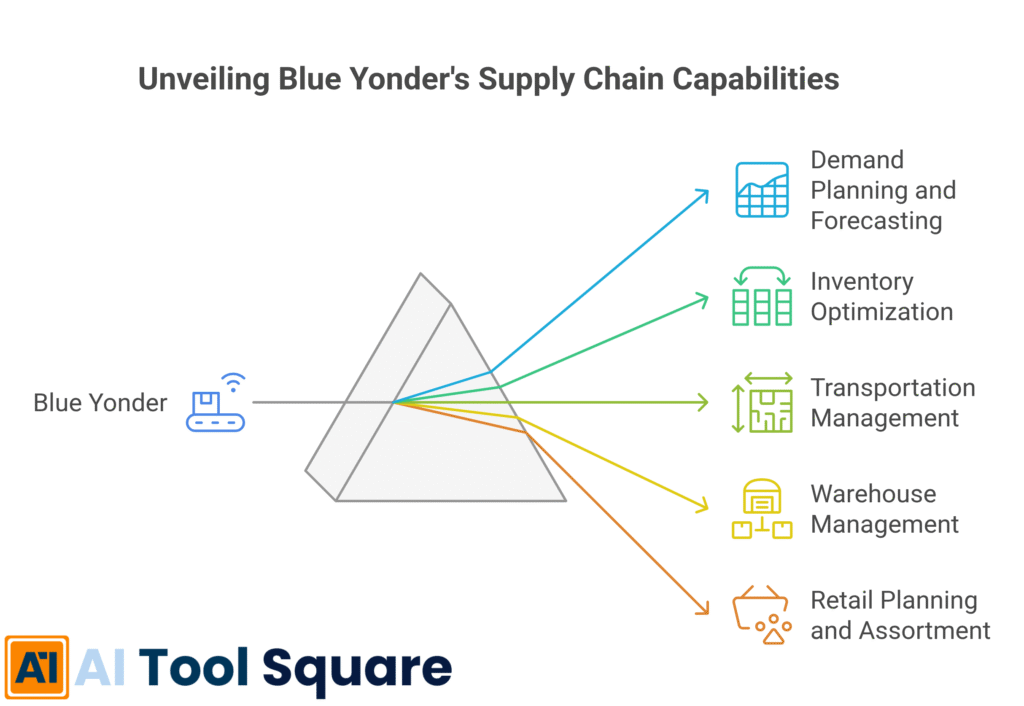
- Demand Planning and Forecasting:
This is huge. Blue Yonder uses AI to predict future demand with remarkable accuracy.
No more guessing games about how many widgets to order.
It looks at historical sales, promotional campaigns, economic indicators, even social media sentiment.
This means less overstocking, which ties up cash and warehouse space.
It also means fewer stockouts, which leads to lost sales and unhappy customers.
For E-commerce and Retail, this is non-negotiable.
Accurate forecasts directly translate into better inventory management and higher fill rates.
It’s about having the right product, in the right place, at the right time. Every time.
- Inventory Optimization:
Once you know what to expect, Blue Yonder tells you how much to keep.
This feature is about finding the sweet spot. Enough stock to meet demand, but not so much it becomes a liability.
It considers lead times, supplier reliability, and storage costs.
It even accounts for product lifecycles and seasonality.
For businesses, this means significant savings. Less money tied up in stagnant inventory.
Reduced risk of obsolescence, especially for fashion or tech products.
It’s about making your working capital work harder.
This isn’t just about numbers; it’s about freeing up resources you can reinvest elsewhere.
It truly helps with effective Supply Chain Optimization by ensuring capital efficiency.
- Transportation Management:
Getting products from A to B sounds simple, but it’s a logistical minefield.
Blue Yonder’s transportation management system (TMS) optimizes routes, modes, and carriers.
It looks for the fastest, most cost-effective way to move goods.
This includes everything from last-mile delivery for e-commerce orders to international freight.
The real-world benefit? Lower shipping costs, faster delivery times, and improved customer satisfaction.
Imagine cutting your fuel expenses by 10% or reducing delivery delays by half. That’s real money.
It also helps manage carrier relationships and ensures compliance with regulations.
This feature is crucial for maintaining competitive delivery speeds and pricing.
- Warehouse Management:
Warehouses are complex ecosystems. Blue Yonder brings order to the chaos.
It optimizes everything inside the warehouse. Picking paths, storage locations, labour allocation.
This means faster order fulfilment and fewer errors.
It helps manage labour efficiently, reducing overtime and improving productivity.
Imagine your workers spending less time searching for items and more time shipping them.
The result is a smoother operation, reduced operational costs, and happier employees.
It’s about making your existing warehouse infrastructure work smarter, not just harder.
- Retail Planning and Assortment:
This feature is specifically for retailers. It helps decide what products to stock and where.
It considers store-specific demand, local trends, and customer demographics.
This avoids the one-size-fits-all approach that often leads to unsold inventory in some stores and empty shelves in others.
The benefit? Maximised sales per square foot. Better merchandising decisions.
It also helps with promotional planning, ensuring campaigns are targeted and effective.
This means higher sales, better customer experience, and a stronger brand image.
It ensures your retail space is always optimised for maximum profit.
Benefits of Using Blue Yonder for E-commerce and Retail
Let’s break down the real perks.
It’s not just about flashy AI; it’s about tangible gains.
First, time savings. You cut out so much manual work.
Forecasting, inventory counts, route planning – all that stuff used to take hours, if not days.
Now, Blue Yonder crunches the numbers in minutes.
This frees up your team to focus on strategy, not spreadsheets.
Next, quality improvement. Decisions are no longer gut feelings.
They’re backed by mountains of data and sophisticated algorithms.
This means fewer errors, more accurate predictions, and better execution across the board.
The quality of your supply chain operations goes way up.
Then there’s overcoming creative blocks.
Alright, “creative blocks” might sound odd for a supply chain tool.
But think about it: if your team is constantly putting out fires, they can’t innovate.
Blue Yonder handles the repetitive, complex tasks, clearing the path for strategic thinking.
It empowers your team to find new ways to serve customers or optimise processes, rather than just reacting.
The financial impact is significant. Reduced costs are a primary driver.
Less inventory waste, lower shipping expenses, more efficient labour.
These savings go straight to your bottom line.
Simultaneously, you’ll see increased revenue.
Fewer stockouts mean more sales. Faster deliveries mean happier, returning customers.
Better product assortment means higher conversion rates in your stores.
For E-commerce and Retail businesses, this dual punch of cost reduction and revenue growth is a game-changer.
It creates a leaner, more responsive operation that can adapt to market shifts.
This leads to a sustainable competitive advantage.
Ultimately, Blue Yonder means you can serve your customers better.
That’s the goal, right? Happy customers, healthy business.
Pricing & Plans
Alright, let’s talk money.
Blue Yonder isn’t one of those “try it free forever” tools.
This is enterprise-level software. It’s built for serious businesses with serious supply chain needs.
Because of its complexity and customisation, Blue Yonder doesn’t typically publicise standard pricing tiers on their website.
It’s not a subscription you sign up for with a credit card online.
Their pricing model is usually based on a few key factors.
The modules you need, for starters. Do you just need demand forecasting, or the full suite including warehouse and transportation management?
The scale of your operations also matters. How many transactions? How many warehouses? How many users?
Implementation services are also a significant part of the cost.
Integrating such a powerful system into your existing ERP and other platforms requires expertise.
So, what does this mean for you?
You’ll need to engage directly with their sales team.
They’ll conduct an assessment of your specific business requirements.
Then, they’ll put together a tailored proposal.
This approach ensures you only pay for what you need.
It also ensures the system is configured to deliver maximum value for your unique challenges.
Is it expensive? Compared to a basic SaaS tool, yes.
But compare it to the cost of inefficient operations.
The losses from stockouts, overstock, missed deliveries, and manual errors.
Those hidden costs can dwarf the investment in a tool like Blue Yonder.
It’s about ROI. The savings and revenue growth it can unlock are often substantial.
Alternatives? Sure, there are other players in the Supply Chain Optimization space.
SAP, Oracle, Kinaxis, E2open – these are competitors with similar, broad offerings.
Each has its strengths, but Blue Yonder often stands out for its deep AI capabilities.
And its strong focus on the retail and consumer goods sectors.
If you’re a mid-to-large E-commerce and Retail business, this is a serious investment worth exploring.
Don’t expect a free trial, but do expect a detailed consultation.
Hands-On Experience / Use Cases
Alright, let’s get into how this thing actually plays out.
Imagine you’re a major E-commerce and Retail brand.
Think about the holiday rush, Black Friday, Cyber Monday.
Historically, this meant teams working overtime, frantic phone calls, and always feeling like you were reacting.
With Blue Yonder, it changes.
Let’s take a use case: Seasonal Demand Spike Prediction.
A large electronics retailer used Blue Yonder’s demand forecasting module.
They were able to predict the sales of specific TV models and gaming consoles with incredible accuracy leading up to Christmas.
The system pulled in sales data from previous years. It also factored in current marketing spend.
It even considered broader economic indicators and competitor promotions.
The AI identified subtle patterns that human analysts missed.
What happened? They pre-ordered the exact right amount of inventory.
Fewer expensive last-minute air freight shipments. Less money sitting in warehouses post-holiday.
Their stockout rate dropped by 15% during the peak season.
Customer satisfaction scores went up because products were actually available.
Another example: Optimising Last-Mile Delivery for Fresh Produce.
A grocery chain delivering online orders faced a challenge: keeping produce fresh and delivery costs low.
Blue Yonder’s transportation management system (TMS) stepped in.
It wasn’t just about finding the shortest route.
It optimised routes considering traffic, delivery time windows, and even refrigeration requirements.
The system dynamically rerouted drivers based on real-time conditions.
If a road was closed, it suggested an alternative instantly.
The result was a 20% reduction in fuel costs.
And a significant drop in late deliveries.
More importantly, customer complaints about spoiled produce almost disappeared.
From a usability standpoint, Blue Yonder has a steep learning curve, no doubt.
It’s not an app you download and figure out in an hour.
But for the specific, highly trained professionals using it daily, the interface is powerful and efficient.
The dashboards are rich with data and offer deep insights.
It takes commitment to integrate and train your team.
But once it’s humming, the results speak for themselves.
It means confident decisions. Every single time.
Who Should Use Blue Yonder?
So, is Blue Yonder for everyone?
Definitely not.
This isn’t a tool for a small Etsy shop.
It’s for businesses that have reached a certain scale and complexity.
First up: Mid to Large-Sized E-commerce Businesses.
If you’re shipping thousands of orders daily, managing multiple warehouses, and dealing with a global supplier network, this is for you.
The sheer volume of data and the need for precision make Blue Yonder invaluable.
Next: Retail Chains with Multiple Stores and Omnichannel Operations.
Whether you have 50 stores or 500, managing inventory across physical locations and online channels is a nightmare without advanced tools.
Blue Yonder helps unify this, preventing stockouts in one store while another has excess.
Think about click-and-collect, ship-from-store, and seamless returns. Blue Yonder powers these.
Also, Manufacturers and Wholesalers Supplying Retailers.
If you’re on the other side, feeding products into the retail ecosystem, Blue Yonder is equally relevant.
Accurate forecasting of retailer demand means you can optimise your production schedules.
This minimises your own inventory holding costs and improves lead times for your customers.
Logistics and 3PL (Third-Party Logistics) Providers.
If your business is literally moving goods for others, Blue Yonder’s transportation and warehouse management modules are powerful.
They allow you to offer superior service, lower costs for your clients, and run a more profitable operation yourself.
Finally, Businesses Facing Significant Supply Chain Complexity.
This could be due to a wide product assortment, international sourcing, perishable goods, or highly volatile demand.
If you’re constantly struggling with disruptions, Blue Yonder provides the visibility and intelligence to navigate them.
In short, if your supply chain is a headache that’s costing you serious money and customer loyalty, Blue Yonder is a solution worth exploring.
It’s for those ready to invest in serious Supply Chain Optimization for long-term growth.
How to Make Money Using Blue Yonder
Alright, this is where it gets interesting.
You don’t just “use” Blue Yonder. You leverage it to print money.
It’s about efficiency, competitive advantage, and ultimately, a healthier bottom line.
- Service 1: Reduce Operational Costs Directly
This is the most obvious one, but it’s often underestimated.
Blue Yonder slashes waste. Less dead stock means less money tied up in inventory.
Optimised routes mean lower fuel consumption and fewer driver hours.
Efficient warehouse management means lower labour costs and faster throughput.
Every pound saved on operations is a pound earned. This isn’t theoretical; it’s measurable.
These savings directly boost your profit margins on every single sale.
- Service 2: Increase Sales Through Improved Availability and Customer Satisfaction
Fewer stockouts mean more sales. Simple as that.
If a customer wants to buy, and you have it, they buy. If not, they go elsewhere.
Blue Yonder’s forecasting ensures you have products when and where customers want them.
Faster, more reliable deliveries also boost customer loyalty.
Happy customers become repeat customers, and they tell others. This creates a positive feedback loop.
The lifetime value of a customer goes up, directly impacting your revenue.
- Service 3: Offer Premium Delivery Services and Differentiated Experiences
With an optimised supply chain, you can offer services competitors can’t.
Think same-day delivery, precise two-hour delivery windows, or highly flexible return options.
These aren’t just perks; they’re competitive differentiators.
You can charge a premium for these services, or use them to attract and retain high-value customers.
This allows you to move beyond competing solely on price.
It’s about providing superior value, which translates into higher margins and a stronger market position.
Case Study Example: How “Apex Appliances” Increased Profits by 18%
Apex Appliances, a national electronics retailer, was struggling with seasonal demand spikes.
They’d either overstock on flat-screen TVs before the holidays, leading to huge markdowns in January.
Or they’d run out of popular kitchen gadgets, losing sales.
They integrated Blue Yonder for demand forecasting and inventory optimisation.
Over 12 months, the AI’s predictions reduced forecast errors by 25%.
This meant they could precisely order and distribute stock to their regional warehouses and stores.
They cut excess inventory by 15%, freeing up millions in working capital.
Crucially, they slashed stockouts on their top 100 products by 30%.
The combination of reduced waste and increased fulfilled sales boosted their net profit by a staggering 18% in the first year.
They weren’t just saving money; they were capitalising on every sales opportunity.
Limitations and Considerations
No tool is a silver bullet, and Blue Yonder is no exception.
It’s powerful, but it has its considerations.
First, the learning curve is steep.
This isn’t an intuitive app you master in an afternoon.
It’s an enterprise system with deep functionality.
Expect significant training for your team, and a ramp-up period before you see full proficiency.
Secondly, implementation is complex and resource-intensive.
Integrating Blue Yonder with your existing ERP, WMS, CRM, and other systems is a major project.
It requires dedicated IT resources, consultants, and a clear project plan.
It’s not a plug-and-play solution; it’s a strategic infrastructure investment.
Then there’s data accuracy.
Blue Yonder is only as good as the data you feed it.
If your historical sales data is messy, incomplete, or inaccurate, the AI’s predictions will suffer.
You need robust data governance and clean data streams for optimal results.
Garbage in, garbage out, as they say.
Also, cost. We touched on this in pricing.
The initial investment and ongoing maintenance can be substantial.
It’s a commitment, not a casual purchase.
This means it’s primarily for larger businesses where the ROI justifies the expense.
Finally, requires ongoing management and expertise.
It’s not “set it and forget it.”
Your team will need to monitor outputs, adjust parameters, and stay updated with new features.
You’ll need professionals who understand both supply chain principles and how to wield the software.
It’s a powerful tool, but it demands skilled hands to truly unlock its potential.
Don’t underestimate the internal effort required to make it succeed.
Final Thoughts
Alright, let’s wrap this up.
Blue Yonder isn’t just another piece of software. It’s a strategic asset.
For E-commerce and Retail businesses grappling with complex supply chains, it offers clarity and control.
It takes the guesswork out of demand forecasting, optimises inventory to the nth degree, and streamlines every step from warehouse to customer.
The value proposition is clear: reduce costs, boost sales, and improve customer satisfaction.
These aren’t small wins; they’re foundational shifts that can redefine your profitability.
Yes, there’s a significant investment required – in capital, in integration, and in training your team.
But for businesses operating at scale, the return on that investment can be immense.
It’s about making confident decisions, backed by AI and real-time data.
No more shooting in the dark. No more reacting to problems you could have foreseen.
My recommendation? If your business is feeling the squeeze of an inefficient supply chain.
If you’re leaving money on the table due to stockouts or excess inventory.
And if you’re ready to commit to a serious upgrade.
Then Blue Yonder is absolutely worth a deep dive.
It’s not for the faint of heart, but the rewards are substantial.
Don’t just manage your supply chain; master it.
Next step: Get on a call with their team. Understand how it fits YOUR specific business.
It could be the smartest move you make this year.
Visit the official Blue Yonder website
Frequently Asked Questions
1. What is Blue Yonder used for?
Blue Yonder is primarily used for Supply Chain Optimization across various industries, with a strong focus on E-commerce and Retail. It provides AI-powered solutions for demand forecasting, inventory management, transportation, and warehouse operations.
2. Is Blue Yonder free?
No, Blue Yonder is not a free tool. It is an enterprise-level software suite requiring a significant investment. Pricing is typically customised based on the specific modules needed, the scale of operations, and implementation services.
3. How does Blue Yonder compare to other AI tools?
Blue Yonder stands out due to its deep specialisation in supply chain management and its advanced AI and machine learning capabilities. While other AI tools might offer broader business intelligence or automation, Blue Yonder is specifically built to solve complex supply chain challenges, often competing with giants like SAP and Oracle in this niche.
4. Can beginners use Blue Yonder?
Blue Yonder has a steep learning curve and requires professional expertise to implement and operate effectively. It’s designed for experienced supply chain professionals and requires significant training, making it less suitable for individual beginners or small businesses without dedicated resources.
5. Does the content created by Blue Yonder meet quality and optimization standards?
Blue Yonder doesn’t create “content” in the traditional sense like text or images. Instead, it generates highly optimised plans, forecasts, and operational insights. These outputs are designed to meet stringent industry standards for accuracy, efficiency, and strategic planning, directly leading to optimised business processes and improved quality metrics.
6. Can I make money with Blue Yonder?
Absolutely. By optimising your supply chain, Blue Yonder directly helps you make money. This happens through significant cost reductions (less waste, lower logistics expenses), increased revenue (fewer stockouts, higher customer satisfaction), and the ability to offer premium services that differentiate your business.