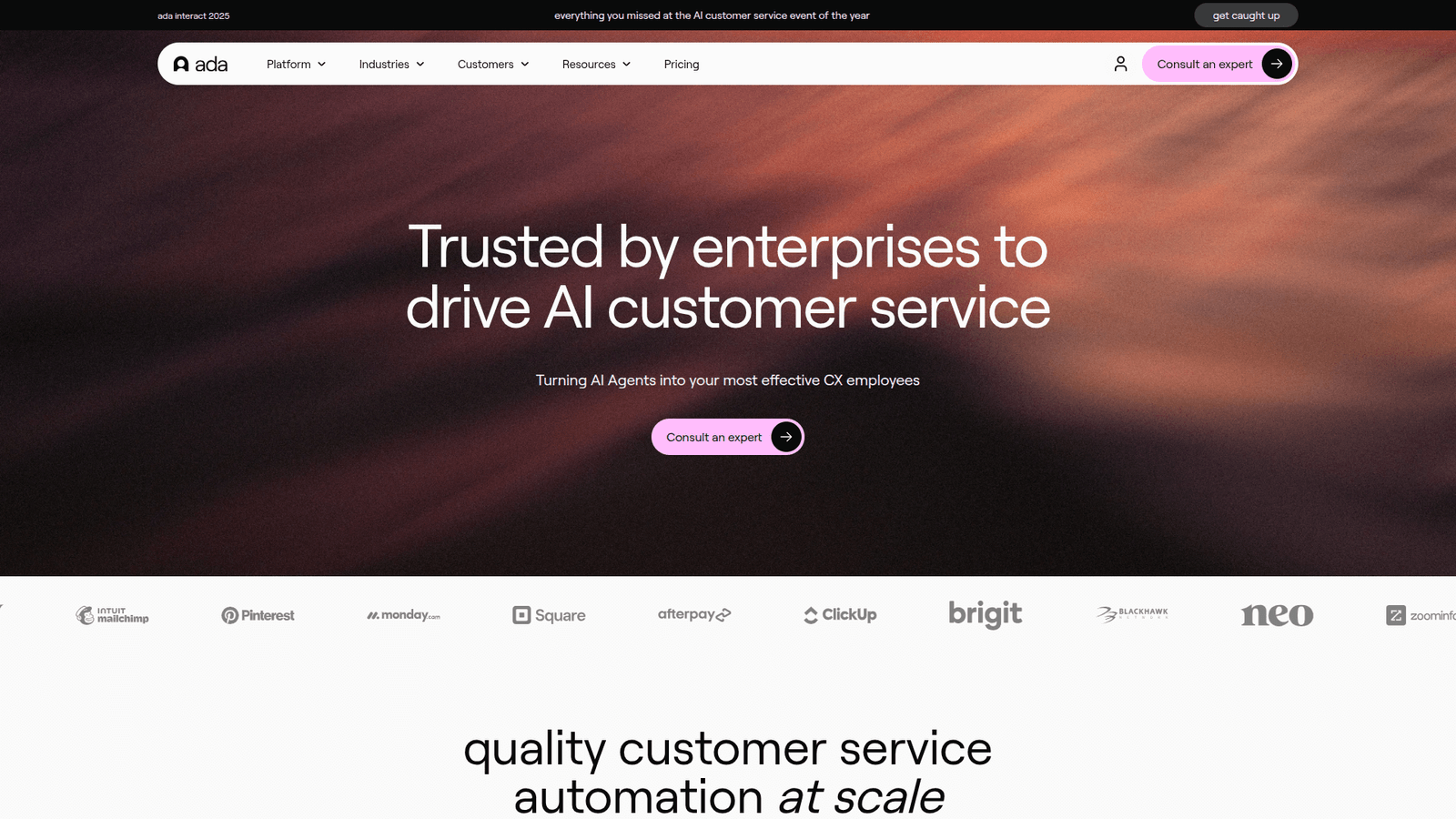

Ada revolutionizes AI Customer Service, helping businesses deliver instant, personalized support 24/7. Slash costs, boost satisfaction, and scale effortlessly. Discover how Ada can transform your support team today!
Why Ada Is a Game-Changer in AI Customer Service
Tired of customer support nightmares?
Long wait times, frustrated customers, burnt-out agents – sound familiar?
The game has changed.
AI isn’t just a buzzword anymore; it’s the engine driving efficiency in every corner of business, especially in how we talk to our customers.
We’re seeing a massive shift.
More and more businesses are ditching the old ways, turning to smart AI tools to handle their customer interactions.
Enter Ada.
This isn’t just another tool.
Ada is redefining what’s possible in AI Customer Service, making it faster, smarter, and genuinely better for everyone involved.
If you’re in the trenches of customer support, trying to keep up with demand, Ada might just be the secret weapon you’ve been looking for.
It’s time to stop just reacting and start building a proactive, hyper-efficient support system.
Let’s cut to the chase and see how Ada does it.
What is Ada?
So, what exactly is it?
Think of Ada as your company’s 24/7 AI-powered customer service agent.
It’s an AI tool built specifically for automating customer interactions.
Its core function?
To handle customer queries, resolve issues, and provide instant support without needing a human agent to step in.
This isn’t just a basic chatbot that answers FAQs.
Ada uses advanced AI to understand intent, personalize conversations, and even learn from interactions over time.
The target audience is clear: businesses that need to scale their customer support without scaling their headcount.
This means e-commerce giants, SaaS companies, financial institutions – anyone facing high volumes of customer inquiries.
It frees up your human agents to tackle complex problems.
Ada takes care of the repetitive stuff, the common questions, the quick fixes.
It’s all about efficiency, speed, and keeping customers happy around the clock.
The goal is to deliver an exceptional customer experience, automatically.
This tool helps you manage inbound requests like a pro.
It reduces customer friction points.
Businesses can deploy Ada across various channels: website chat, mobile apps, social media, and even internal support.
It’s built for serious business, not just casual Q&A.
We’re talking about a system that can understand nuance and guide users.
It’s not just about saving money; it’s about improving the quality of your support at scale.
It ensures consistent messaging.
It never gets tired, never has a bad day.
It’s designed to make your customer support operation faster, smarter, and more effective.
That’s the promise of Ada.
Key Features of Ada for AI Customer Service
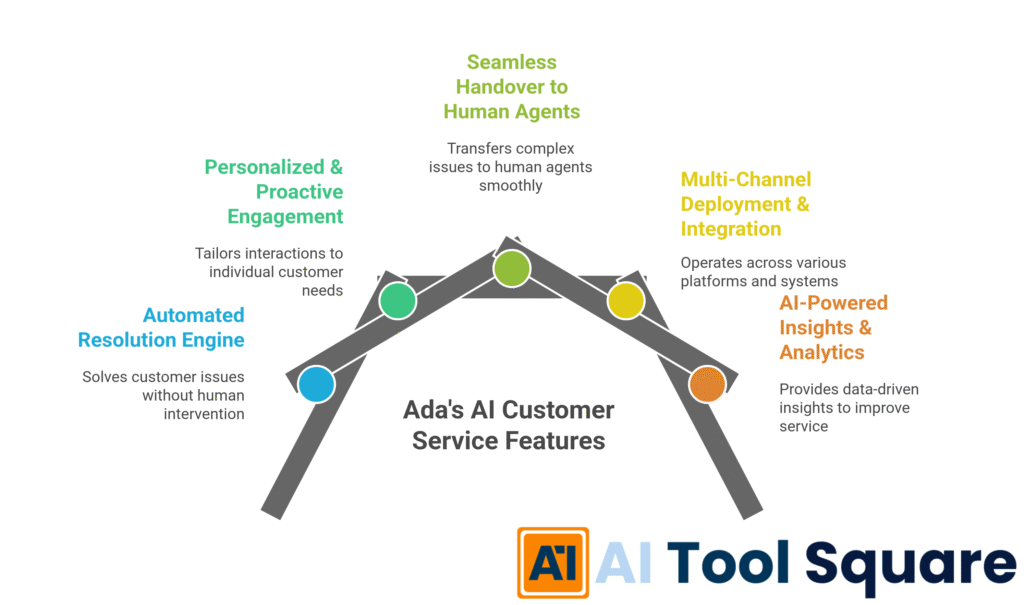
- Automated Resolution Engine: This is the backbone of Ada. It uses advanced natural language processing (NLP) to understand what customers are asking, even if they phrase it differently. It doesn’t just match keywords; it grasps the intent behind the query. This feature allows it to resolve a massive percentage of customer inquiries automatically, without ever needing a human. Think about order status checks, password resets, basic troubleshooting – all handled instantly. This means customers get answers fast, and your human agents aren’t bogged down by simple, repetitive tasks. It’s about doing more with less, smarter.
- Personalized & Proactive Engagement: Ada isn’t a one-size-fits-all solution. It uses customer data – things like past purchases, browsing history, and demographics – to personalize interactions. It can address customers by name, offer relevant recommendations, and even proactively reach out with information they might need. For Chatbots and Customer Support, this is huge. It moves beyond reactive support to a proactive approach, anticipating needs and creating a much better customer experience. Imagine a customer getting a notification about a potential delivery delay before they even think to ask. That’s Ada at work.
- Seamless Handover to Human Agents: This is where it truly shines as a collaborative tool, not a replacement for humans. When Ada encounters a complex or sensitive issue it can’t resolve, it seamlessly hands the conversation over to a live agent. But here’s the kicker: it doesn’t just transfer the chat. It provides the human agent with a complete transcript of the conversation, along with all the context and customer data it has gathered. This means the agent doesn’t have to ask the customer to repeat themselves, saving time and frustration. It’s a smooth, intelligent transition that ensures no customer falls through the cracks and every issue gets resolved efficiently.
- Multi-Channel Deployment & Integration: Ada is built to be everywhere your customers are. You can deploy it across your website, mobile app, social media channels like Facebook Messenger and WhatsApp, and even SMS. This multi-channel capability ensures a consistent customer experience no matter how they choose to interact with your brand. Beyond channels, it integrates with your existing tech stack – CRM systems (like Salesforce, Zendesk), e-commerce platforms, and other business tools. This means it has access to the data it needs to provide relevant answers and can push information back into your systems, keeping everything synchronized. It centralizes your customer support efforts.
- AI-Powered Insights & Analytics: This feature is gold for businesses looking to improve their customer service strategy. Ada doesn’t just automate; it collects data on every interaction. Its analytics dashboard provides insights into common customer queries, resolution rates, pain points, and areas where your AI needs further training. You can see which questions are being resolved automatically, which require human intervention, and where customers are getting stuck. This data empowers you to continuously optimize your AI, identify product or service issues, and make informed decisions about your overall customer experience strategy. It’s continuous improvement baked right in.
Benefits of Using Ada for Chatbots and Customer Support
Let’s be real.
Why should you even care about Ada for your Chatbots and Customer Support operations?
It boils down to a few core things: time, money, and sanity.
First, time savings. Massive time savings.
Your support agents are spending hours on repetitive questions.
“Where’s my order?”
“How do I reset my password?”
“What are your return policies?”
Ada handles these instantly, 24/7.
This frees your human team to focus on complex, high-value issues.
It means less waiting for customers, which boosts satisfaction.
Next, quality improvement.
Ada delivers consistent, accurate answers every single time.
No more variations in responses depending on which agent answers.
The information is always correct, always on-brand.
This level of consistency builds trust.
It ensures every customer gets the same high standard of service.
Then, there’s overcoming creative blocks.
Not in the traditional sense, but in terms of problem-solving.
When your team is buried under a mountain of simple tickets, they can’t think strategically.
They can’t come up with new ways to improve the customer journey.
Ada removes that blockage.
It gives your human experts the space to innovate, to develop better processes, to build stronger relationships with customers who genuinely need that human touch.
Think about the cost reduction.
Automating a significant portion of your customer interactions means you can scale your support without proportional increases in staffing costs.
This is pure profit margin improvement.
It also allows you to handle peak seasons or sudden surges in demand without breaking a sweat.
No more scrambling to hire temporary staff.
Finally, it’s about customer satisfaction.
Customers expect instant gratification these days.
Ada provides that.
It’s available whenever they need it, wherever they need it.
This immediate resolution of simple issues makes customers feel valued.
It reduces frustration and increases loyalty.
Happy customers stick around.
They tell their friends.
That’s the ultimate win.
Ada isn’t just a tool; it’s a strategic asset for any business serious about customer experience.
Pricing & Plans
Alright, let’s talk brass tacks: what’s Ada going to cost you?
Unlike many AI tools that throw up standard monthly prices, it operates on a custom pricing model.
This isn’t necessarily a bad thing, but it means you won’t find specific numbers plastered on their website.
They tailor their plans to the specific needs of each business.
This usually involves factors like the volume of conversations you expect to handle, the complexity of the integrations needed, and the specific features you want to leverage.
Does Ada offer a free plan?
Typically, no, not a perpetually free tier like some consumer-grade chatbots.
However, they often provide demos and proof-of-concept trials.
This lets you see Ada in action with your specific use cases before committing.
What does a premium version include?
Since it’s custom, every plan is essentially “premium” and includes all their core AI capabilities.
You’re paying for advanced NLP, personalized customer journeys, seamless human handover, comprehensive analytics, and enterprise-grade security.
It also includes dedicated account management and support, which is crucial for complex deployments.
Comparison with alternatives?
Ada typically competes with other enterprise-level AI Customer Service platforms like LivePerson, Intercom’s Fin AI, or specialized solutions from companies like Amelia.
The key difference often lies in its focus on automated resolution first, then intelligent human handover, and its robust analytics for continuous improvement.
Some alternatives might focus more on live chat with AI augmentation.
Ada pushes for maximum automation from the get-go.
Their pricing reflects the value of significantly reducing human agent workload and improving customer satisfaction at scale.
If you’re a small business with minimal support needs, it might be overkill or out of budget.
But for medium to large enterprises with high customer interaction volumes, the ROI from Ada’s automation can be substantial.
To get an accurate price, you’ll need to engage directly with their sales team.
They’ll conduct a discovery process to understand your current pain points and desired outcomes.
Then they’ll present a tailored proposal.
It’s an investment, but one designed to pay dividends in efficiency and customer loyalty.
Hands-On Experience / Use Cases
Alright, let’s get real.
How does Ada actually feel when you’re using it, or when your customers are interacting with it?
My experience with setting up and optimizing it for a medium-sized e-commerce client was eye-opening.
Initially, the client’s support team was overwhelmed.
About 70% of their incoming queries were repetitive: “Where’s my order?” “What’s your return policy?” “How do I use this discount code?”
We deployed Ada on their website.
The initial setup involved feeding it all the client’s FAQs, product information, and common support scenarios.
The usability from an admin perspective is surprisingly intuitive.
The interface for building “intents” (what a customer is trying to do) and “answers” (Ada’s response) is drag-and-drop simple.
You don’t need to be a coder.
For instance, we built an intent for “Order Tracking.”
We trained Ada with variations like “Where’s my stuff?”, “Track my package,” “Order status.”
Then, we integrated it with their shipping API.
A customer types “Where’s my order?” it asks for their order number, queries the API, and provides real-time tracking information.
Results? Instantaneous.
Within the first month, Ada was resolving over 60% of incoming queries completely automatically.
This wasn’t just a slight improvement; it was a revolution.
Support ticket volume dropped dramatically.
Customer satisfaction scores (CSAT) for automated interactions were consistently high, often above 90%.
The human agents were now free.
They could dedicate their time to complex issues: helping a customer choose the right product, resolving tricky billing problems, or handling sensitive complaints.
The “seamless handover” feature was clutch.
When Ada couldn’t solve a problem, it would ask if the customer wanted to speak to a human.
Upon consent, it would package the entire conversation history and customer data, sending it directly to a live agent in their Zendesk system.
No more “can you repeat your issue?”
This alone cut down agent handle time significantly.
Another use case involved proactive outreach.
During a major sale, we configured Ada to pop up on specific product pages, offering quick FAQs about the sale terms or recommending complementary products.
This boosted conversion rates and reduced pre-purchase questions coming into the support queue.
The analytics dashboard was invaluable.
It showed us where it was succeeding and where it needed more training.
We constantly refined Ada’s knowledge base based on these insights.
It’s an ongoing process of improvement.
Overall, the experience confirmed that it isn’t just hype.
It delivers tangible, measurable results for AI Customer Service.
It’s robust, user-friendly for non-technical teams, and powerful enough for enterprise needs.
Who Should Use Ada?

Look, Ada isn’t for everyone.
If you’re running a small operation with five customer interactions a day, you probably don’t need enterprise-grade AI.
But if you’re serious about scaling your customer support, it is a powerful tool.
Here’s who should be looking at Ada:
Medium to Large E-commerce Businesses: If you’re selling products online, you know the drill. Order inquiries, shipping questions, return policies – it’s a never-ending stream. Ada can automate 70-80% of these, freeing your team and keeping customers happy with instant answers, 24/7.
SaaS Companies: Your users have questions about features, troubleshooting, and onboarding. Ada can act as an intelligent knowledge base, guiding users to solutions, explaining complex features, and helping them get the most out of your software. This reduces churn and improves user experience.
Financial Services (Banks, Fintech): Security and accuracy are paramount here. Ada can handle account balance inquiries, transaction history requests, common fraud prevention questions, and guide users through processes like applying for a loan, all while maintaining strict security protocols and compliance.
Telecommunications Providers: High volume of inquiries about billing, network issues, plan changes, and technical support. Ada can triage, resolve simple issues, and gather necessary information before handing off to specialized agents, cutting down wait times significantly.
Government Agencies & Public Services: Dealing with massive populations, general inquiries about services, forms, and procedures. Ada can provide instant, accurate information, reducing the burden on call centers and improving public access to information.
Travel & Hospitality: Booking inquiries, check-in/check-out procedures, local recommendations, special requests. Ada can provide immediate answers and support, improving guest experience and operational efficiency.
Basically, anyone who is experiencing a high volume of repetitive customer inquiries and wants to:
- Reduce operational costs: By automating interactions.
- Improve customer satisfaction: With instant, always-on support.
- Scale their support: Without massively increasing headcount.
- Free up human agents: To focus on complex, high-value tasks.
- Gain deeper insights: Into customer needs and pain points.
If your current customer support model feels like a leaky bucket, constantly trying to catch more water with more hands, then Ada is designed for you.
It’s for businesses ready to invest in smart automation to gain a competitive edge in AI Customer Service.
How to Make Money Using Ada
“Make money with AI” – sounds like a slick marketing pitch, right?
But with Ada, it’s not some far-fetched fantasy.
It’s about efficiency, scale, and delivering value that directly translates to your bottom line.
Here’s how you can actually put Ada to work and see more cash in your pocket:
- Slash Support Costs for Your Business: This is the most direct route. If you’re currently employing a team of agents to answer repetitive questions, Ada can automate a huge chunk of that. Think about the salaries, benefits, training, and overhead. By offloading 60-80% of routine inquiries to it, you can significantly reduce your operational expenses. This isn’t about firing people; it’s about optimizing. Your existing team can be repurposed for higher-value tasks, or you can simply handle more volume without hiring more. That’s direct savings, which is direct profit.
- Boost Customer Retention and Lifetime Value (LTV): Happy customers stick around longer and spend more. Ada delivers instant, personalized support 24/7. No more waiting on hold. No more frustrating searches for answers. This leads to higher customer satisfaction. Higher satisfaction means lower churn. Lower churn means a higher customer lifetime value. Every customer you retain because of superior support is essentially future revenue secured. It helps you build that loyalty.
- Increase Sales and Conversions through Proactive Engagement: Ada isn’t just for post-purchase support. Deploy it on product pages to answer pre-purchase questions, guide customers through complex offerings, or even recommend complementary products based on their browsing behavior. Imagine a potential buyer hesitating on a product page; it can pop up with a relevant FAQ or offer a quick guide, helping them overcome objections and make a purchase. This proactive selling translates directly into increased conversion rates and more sales.
Let’s look at a quick case study:
A mid-sized SaaS company was struggling with a high volume of basic support tickets, causing their response times to drag.
Their support team of 10 agents spent about 60% of their time on easily answerable questions.
After integrating Ada for AI Customer Service, they automated over 70% of those basic inquiries.
This didn’t mean firing agents.
Instead, those agents were redeployed to focus on customer success initiatives, proactive onboarding, and solving deep technical issues.
The result?
Support costs reduced by an estimated $15,000 per month (due to reduced need for new hires and improved efficiency of existing staff).
Customer churn decreased by 5% because customers were getting faster, more effective help.
And new feature adoption, guided by Ada’s in-app support, saw a 10% increase.
That’s a clear example of it directly impacting the bottom line.
It’s not about magic; it’s about smart automation leading to smarter business operations.
You’re investing in efficiency that pays you back.
Limitations and Considerations
Alright, let’s keep it real.
No tool is a magic bullet, and Ada is no exception.
While it’s a powerful platform for AI Customer Service, there are limitations and considerations you need to be aware of before diving in.
First, accuracy isn’t 100% out of the box.
Ada learns, but it needs to be fed good data and continuously trained.
Initially, you’ll need to dedicate time to building out its knowledge base, refining answers, and correcting its understanding.
It’s not a “set it and forget it” solution, especially in the early stages.
Expect a learning curve for your team to become proficient in building and managing Ada’s responses.
Next, editing needs are constant.
Your business changes, products evolve, policies shift.
Ada’s knowledge base needs to reflect these changes immediately.
If it gives outdated information, it’s worse than no information at all.
Someone needs to be responsible for keeping Ada’s brain up-to-date.
This requires ongoing internal processes and resource allocation.
Another point: it shines with repetitive, structured queries.
For highly emotional, nuanced, or truly novel problems, Ada will still need to hand off to a human.
It’s excellent at solving known problems quickly.
It’s not designed to be a therapist or an investigative journalist.
Human empathy and complex problem-solving are still critical.
Integration complexity can be a factor.
While Ada boasts integrations, connecting it deeply with legacy systems or highly customized CRMs can still require development work.
Plan for potential technical hurdles and allocate resources for IT support if necessary.
It’s not always a plug-and-play scenario, especially for sophisticated setups.
Finally, cost can be a barrier for smaller businesses.
Ada is an enterprise-grade solution.
The investment is significant, though the ROI can be massive for the right scale of business.
Don’t expect a cheap monthly subscription.
You’re paying for powerful technology and dedicated support.
In essence, Ada requires commitment.
It’s a powerful engine, but you need to fuel it, tune it, and steer it.
If you’re willing to do that, the rewards are substantial.
If you’re expecting a magic button, you’ll be disappointed.
Final Thoughts
So, what’s the verdict on Ada?
It’s not just another piece of software; it’s a serious tool for serious businesses.
If you’re drowning in customer inquiries, if your support team is constantly stressed, and if your customers are experiencing long wait times, Ada offers a way out.
It’s a powerful platform designed to automate the repetitive, free up your human experts, and deliver instant, high-quality support around the clock.
The value proposition is clear: reduce costs, boost customer satisfaction, and scale your support operations efficiently.
Ada delivers on its promise of transforming AI Customer Service.
It requires an investment – in both money and effort – but the return on that investment can be substantial.
It’s not a perfect system, no tool is.
You’ll need to train it, maintain it, and integrate it thoughtfully.
But for organizations with a significant volume of customer interactions, Ada is genuinely a game-changer.
My recommendation?
If you fit the profile of a business struggling with scalable support, take the next step.
Don’t just read about it.
Engage with their team, get a demo, and see how it applies to your specific challenges.
It might just be the solution you’ve been searching for to take your customer support to the next level.
Visit the official Ada website
Frequently Asked Questions
1. What is Ada used for?
Ada is primarily used for automating customer support interactions through AI-powered chatbots.
It handles routine inquiries, provides instant answers, and personalizes customer experiences across various channels, freeing up human agents for complex issues.
2. Is Ada free?
No, Ada does not offer a free plan.
It operates on a custom pricing model tailored to the specific needs and volume of each business.
Demos and trials are typically available upon request.
3. How does Ada compare to other AI tools?
Ada focuses heavily on maximum automation and personalized, proactive engagement in AI Customer Service.
While other AI tools might prioritize live chat with AI augmentation, it aims to resolve a high percentage of queries entirely automatically before involving a human, and its analytics provide deep insights for continuous improvement.
4. Can beginners use Ada?
Yes, Ada’s platform is designed to be user-friendly, allowing non-technical teams to build and manage the AI.
However, there is an initial learning curve to effectively set up intents, train the AI, and integrate it with existing systems.
5. Does the content created by Ada meet quality and optimization standards?
Ada delivers consistent and accurate responses based on the data it’s trained on.
The quality and optimization depend on the thoroughness of your knowledge base and ongoing refinement.
It ensures uniform, high-standard information delivery across all customer interactions.
6. Can I make money with Ada?
Absolutely. You can make money with Ada by significantly reducing operational support costs, boosting customer retention and lifetime value through superior service, and increasing sales conversions through proactive engagement and instant pre-purchase support.