ElevenLabs vs Murf AI: Which Voice Generator Fits You?
Choose ElevenLabs if you want the widest choice of voices and languages, expressive models and a low entry price. Choose Murf AI if you want a voiceover studio built around presentations, e-learning and fine control of pitch, speed and pronunciation. In the ElevenLabs vs Murf AI question, the deciding factors are usually language coverage, how you plan to use the audio, and whether you need an API. Both are covered below using each company’s own pages. Neither has been tested by us, and both companies’ quality claims are theirs.
Quick comparison
| ElevenLabs | Murf AI | |
|---|---|---|
| Voices | Voice Library of 17,000+ voices (the page gives several figures, up to 20,000+) | 200+ voices |
| Languages | 90+ for speech generation, depending on the model | 35+ |
| Free plan | 10,000 credits a month (about 10 minutes of speech), no commercial licence | About 10 minutes of voice generation, no commercial licence, no downloads |
| Cheapest paid plan | Starter: $1 for the first month, then $6 a month | See Murf’s pricing page |
| Voice cloning | Instant cloning from Starter, professional cloning from Creator | Cloning in 20+ languages; Murf points to sales or a trial rather than listing plan limits |
| Editor | Studio, for audiobooks and podcasts | Studio, with pitch, speed, intonation and a pronunciation library |
| API | Text to Speech API with streaming and SDKs | Falcon text-to-speech API, listed at $0.01 per minute |
| Extras | Dubbing, sound effects, music, voice design | AI dubbing in 20+ languages, integrations with Canva, Google Slides, PowerPoint and Adobe Captivate |
ElevenLabs
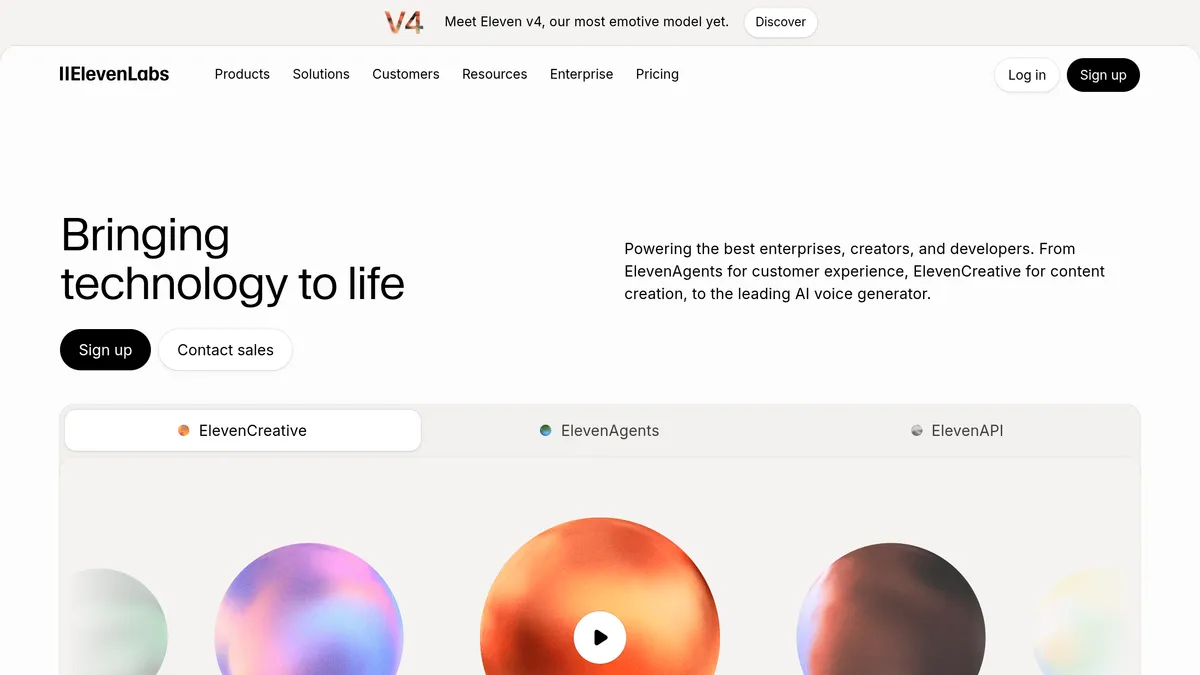
ElevenLabs sells one credit pool that covers text to speech, dubbing, music and more. Text to speech costs about one credit per character, so a plan’s credits roughly equal minutes of speech.
Voices and models. The company’s documentation lists several generations of model. Eleven v4 is described as its most emotive and supports 90+ languages. Eleven v3 handles 70+ languages and uses audio tags such as [softly] or [laughs] to steer delivery. Multilingual v2 covers 29 languages and is described as the most stable choice for long-form content. Flash v2.5 supports 32 languages and is built for speed, with a median latency of about 100 ms according to the docs. The docs note that Flash does not normalise numbers by default, so phone numbers, dates and currencies may not read clearly; Multilingual v2 handles them better.
Cloning and design. Instant Voice Cloning starts on the Starter plan. Professional Voice Cloning starts on Creator, with one professional clone listed, rising to 3 on Scale and 10 on Business.
Where it stops. The free plan has no commercial licence, so you need at least Starter to use the audio in monetised or client work. Credits roll over on paid plans for up to two months, but unused credits are lost on downgrade or cancellation. For a fuller breakdown, see our ElevenLabs review.
Murf AI
Murf is positioned as a voiceover studio first. Its homepage lists 200+ voices across 35+ languages, a custom pronunciation library and control over pitch, speed and intonation. Use cases it names include e-learning, podcasts, advertising, audiobooks, gaming and accessibility.
Integrations. Murf lists apps and integrations for Canva, Google Slides, PowerPoint and Adobe Captivate. That matters if your voiceovers go straight into slide decks or training modules.
Voice cloning and dubbing. Murf’s voice cloning page says you can clone voices in 20+ languages, dialects and accents, and its dubbing product translates video and audio into 20+ languages. The cloning page does not state which plan includes cloning or any usage limits, so confirm that with Murf before you count on it.
Ethics and licensing. Murf says its voices are created with permission from professional voice actors who earn royalties each time their voices are used. Its FAQ states that commercial rights come with paid plans, that the free plan does not include a commercial licence, and that voices can only be downloaded on paid plans.
API. For developers Murf promotes Falcon, a text-to-speech API for voice agents, with latency under 100 ms and a price of $0.01 per minute, according to its homepage. Murf also publishes its own benchmark claiming its voices won on naturalness eight times out of ten in blind tests. That is Murf’s own result, not an independent one.
Head to head
Voice choice and languages. ElevenLabs is far ahead on paper: tens of thousands of library voices and 90+ languages against 200+ voices and 35+ languages. If you need less common languages or a huge range of accents, this decides it. If you only need a handful of polished English or major-language voices, Murf’s smaller catalogue is enough.
Expressiveness. ElevenLabs puts emotion and audio tags at the centre of its newer models. Murf focuses on manual control of pitch, speed and pronunciation. Which approach sounds better depends on your script and voice, and neither company’s claims replace listening to your own sample. Both offer a free plan, so you can do that at no cost.
Workflow. Murf’s presentation and e-learning integrations make it the more natural fit for slide decks and training. ElevenLabs is the more general tool, with dubbing, music, sound effects and an API in the same credit pool.
Cloning. Both support it. ElevenLabs states which plan unlocks each type and how many professional clones you get. Murf’s page is vaguer about plan requirements.
Developers. Both have APIs. ElevenLabs offers streaming, SDKs and several models with documented latencies. Murf’s Falcon is priced per minute and aimed at voice agents.
Pricing
Prices below are as of November 2026; check the official pages before buying.
ElevenLabs (pricing page):
| Plan | Price | Credits a month | About |
|---|---|---|---|
| Free | $0 | 10,000 | 10 minutes |
| Starter | $1 first month, then $6 a month | 30,000 | 30 minutes |
| Creator | $11 first month, then $22 a month | 121,000 | 121 minutes |
| Pro | $99 a month | 600,000 | 600 minutes |
| Scale | $299 a month | 1,800,000 | 1,800 minutes |
| Business | $990 a month | 6,000,000 | 6,000 minutes |
Annual billing means paying for 10 months instead of 12. Every paid plan includes a commercial licence.
Murf AI (pricing page): the free plan gives about 10 minutes of voice generation with no downloads and no commercial licence, per Murf’s FAQ. The paid plan prices and allowances load dynamically on Murf’s pricing page, and third-party sites quote different figures, so this article does not repeat them. Check Murf’s page for current numbers, then compare the cost per finished minute against ElevenLabs’ table above.
Which to choose
- Narration for YouTube, shorts or podcasts, on a budget: ElevenLabs Starter is a low-cost paid entry at $6 a month after the first month, and the licence is included.
- Voiceovers for presentations, training or e-learning: Murf’s integrations and manual voice controls suit this best.
- Many languages or unusual accents: ElevenLabs, because of the larger language list.
- Audiobooks or long-form content: ElevenLabs documents Multilingual v2 as its most stable model for long-form content; Murf also names audiobooks as a use case.
- A developer building a voice agent: compare ElevenLabs’ Flash models with Murf’s Falcon on latency and cost for your own volume.
For a wider view, our guide to the best AI voice generators covers more options.
FAQ
Is ElevenLabs better than Murf?
ElevenLabs offers more voices and languages and publishes its plan prices openly. Murf offers presentation integrations and manual controls. “Better” depends on your use case.
Can I use ElevenLabs or Murf for commercial work?
Not on the free plans. ElevenLabs includes a commercial licence from Starter, and Murf says commercial rights come with its paid plans.
Do both let me clone my voice?
Yes. ElevenLabs offers instant cloning on Starter and professional cloning from Creator. Murf offers cloning in 20+ languages; confirm the plan requirements with Murf.