

Are you looking to supercharge your business communication? These 7 powerful WhatsApp automation tools are about to become your new best friends, helping you streamline customer support and drive sales effortlessly. Get ready to discover the top WhatsApp automation tools that will change your game.
Unleash Your Potential: 7 Powerful WhatsApp Automation Tools You’ll Absolutely Love
Listen up, entrepreneurs, business owners, and anyone tired of manually messaging customers. If you’re still stuck in the stone age of customer communication, you’re leaving money on the table. We’re talking about WhatsApp here – a platform with billions of users. Ignoring its potential for automation is like having a gold mine and only digging with a spoon. It’s time to get serious. I’m going to lay out the 7 powerful WhatsApp automation tools that will seriously level up your business, making your customer interactions smoother, faster, and way more profitable. You want more time, more sales, and happier customers? These WhatsApp automation tools are your ticket.
Table of Contents
- What Are the Best WhatsApp and Messenger Automation Tools?
- Top 7 WhatsApp and Messenger Automation Tools (Detailed Reviews)
- Feature Comparison
- Pricing Breakdown
- Real-World Use Cases
- Who Should Use Each Tool?
- How to Choose the Right Tool
- Making Money with These Tools
- Common Limitations
- Final Verdict and Recommendations
- Frequently Asked Questions
What Are the Best WhatsApp and Messenger Automation Tools?
Alright, let’s cut to the chase. What exactly are these magical WhatsApp automation tools everyone is raving about? Simply put, they are software solutions designed to automate various aspects of your communication on WhatsApp, and often other messaging platforms too. Think about it: sending automated replies, scheduling messages, managing broadcasts, segmenting your audience, and even running full-blown chatbot conversations without lifting a finger.
These tools aren’t just about saving time; they’re about optimizing your customer journey, from initial inquiry to post-purchase support. If you’re still manually typing out every single response, you’re burning precious time and resources that could be spent growing your business. The best WhatsApp automation tools act as your virtual assistant, working 24/7 to keep your customers engaged and informed.
They ensure consistency in your messaging, reduce response times to near-instant, and help you handle a massive volume of conversations without needing a huge team. We’re talking about efficiency, scalability, and ultimately, more profit. The goal here is to make your business run like a well-oiled machine, and these WhatsApp automation tools are key components. Consider them essential infrastructure for any business looking to dominate its market through superior customer engagement. Understanding these tools is the first step towards truly automating your communication strategy.
Top 7 WhatsApp and Messenger Automation Tools (Detailed Reviews)
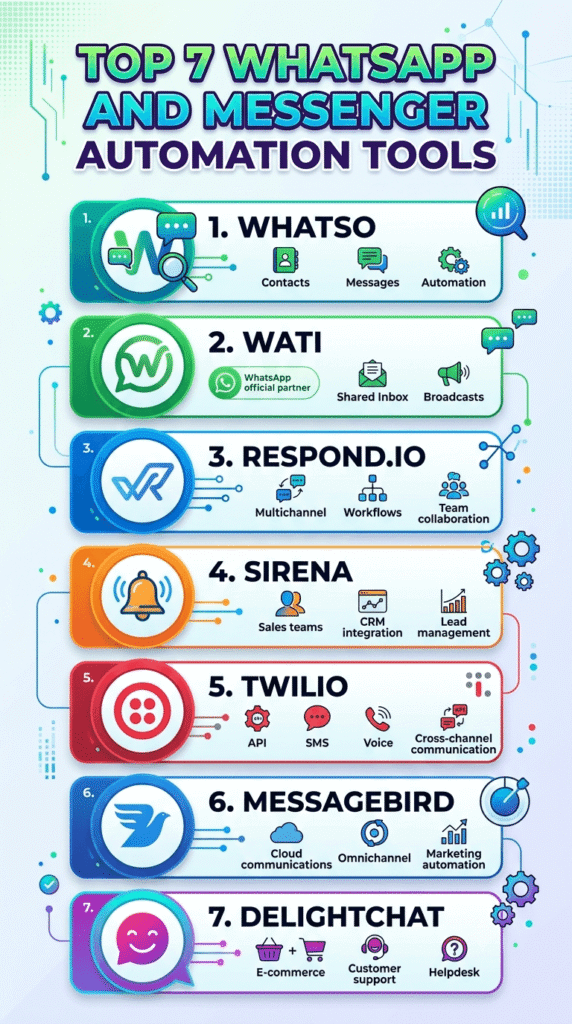
1. Whatso – WhatsApp Automation Tools Review
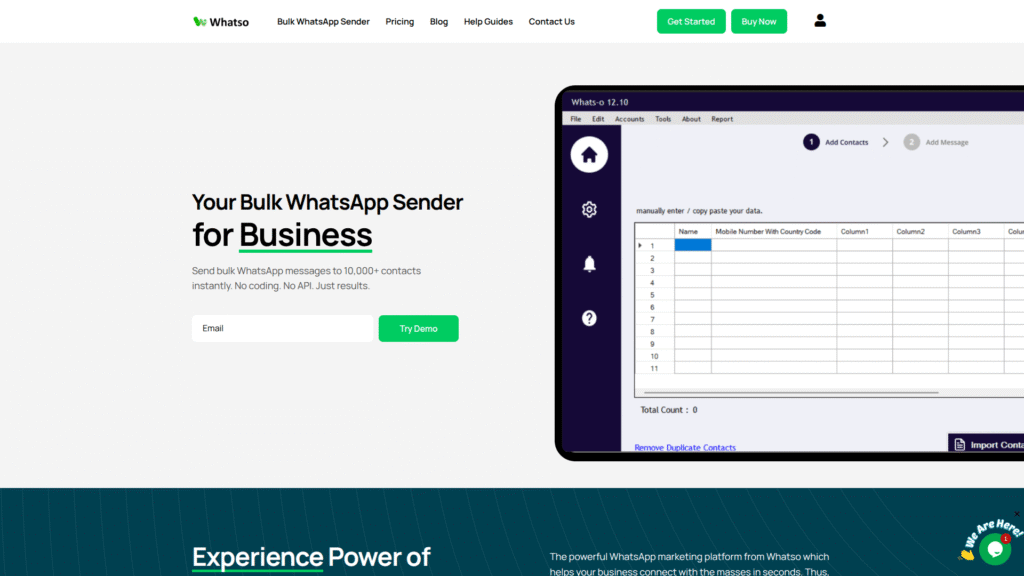
Whatso positions itself as an all-in-one WhatsApp marketing and automation platform. It’s designed for businesses that want to reach a broad audience and manage conversations efficiently. This platform offers features like bulk messaging, chatbot creation, and contact management, aiming to streamline your WhatsApp operations. If you’re serious about scaling your outreach, Whatso provides a robust set of WhatsApp automation tools to help you get there.
Features:
- Bulk WhatsApp Sender: Send messages to thousands of contacts in one go.
- Chatbot Builder: Create rule-based chatbots for automated responses and FAQs.
- Contact Management: Organize and segment your customer lists.
- Message Scheduling: Plan your messages to go out at optimal times.
- Customizable Templates: Design branded messages for various campaigns.
- Analytics and Reporting: Track message delivery, opens, and engagement.
Pricing:
Whatso typically offers tiered pricing plans based on the number of messages or contacts, often with a free trial available. Exact pricing details are usually found on their website, with monthly or annual subscription options.
Pros:
- Strong focus on bulk messaging and marketing.
- User-friendly interface for building chatbots.
- Comprehensive reporting features.
Cons:
- Some advanced features might require a higher-tier plan.
- Reliance on WhatsApp API might have specific setup requirements.
2. Wati – WhatsApp Automation Tools Review
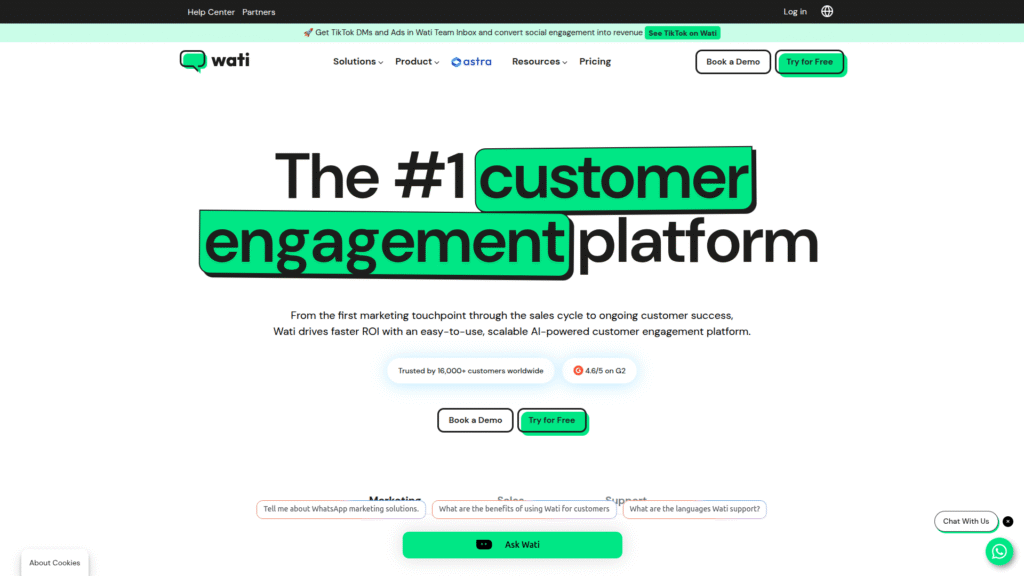
Wati (WhatsApp Team Inbox) is built for businesses that need to manage a high volume of customer interactions on WhatsApp. It provides a shared team inbox, making it easy for multiple agents to collaborate on customer support. Wati is more than just a sender; it’s a complete solution for customer engagement and support, leveraging the power of WhatsApp automation tools to centralize communication. This platform is perfect for teams looking to improve their response times and streamline their customer service workflow.
Features:
- Shared Team Inbox: Collaborate with your team on WhatsApp conversations.
- No-Code Chatbot Builder: Create interactive chatbots without programming knowledge.
- Broadcast and Bulk Messaging: Send targeted messages to segments of your audience.
- CRM Integration: Connect with your existing customer relationship management systems.
- Automated Notifications: Send order confirmations, shipping updates, and more.
- Templates and Quick Replies: Standardize responses for common queries.
Pricing:
Wati offers various pricing plans, typically starting with a basic plan for small teams and scaling up for larger enterprises, often based on the number of agents and conversations. Annual subscriptions usually provide cost savings.
Pros:
- Excellent for team collaboration and shared inbox management.
- Robust chatbot capabilities.
- Strong focus on customer support and engagement.
Cons:
- Can be more expensive for very small businesses.
- Setup process might require some technical understanding.
3. Respond.io – WhatsApp Automation Tools Review
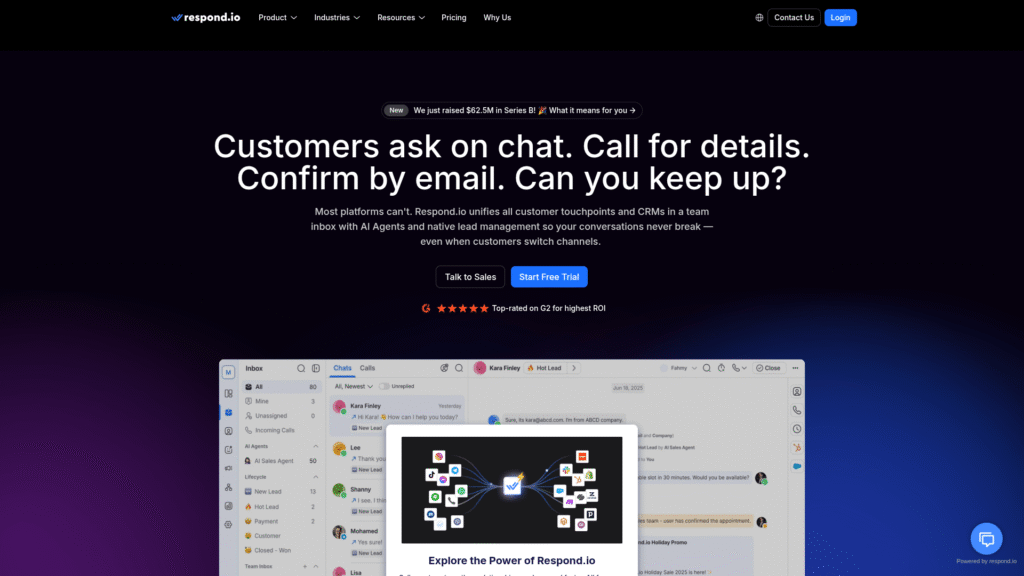
Respond.io is a powerful customer conversation management platform that integrates multiple messaging channels, including WhatsApp. It’s designed for businesses that want to unify their customer communication and automate workflows across various platforms. With Respond.io, you’re not just getting WhatsApp automation tools; you’re getting a comprehensive solution for omnichannel support and engagement. It helps businesses centralize all customer interactions, ensuring no message goes unanswered and every customer receives timely support.
Features:
- Omnichannel Inbox: Manage conversations from WhatsApp, Facebook Messenger, Instagram, and more.
- Automated Workflows: Build custom automation rules for routing, tagging, and responding.
- AI Chatbot Builder: Create sophisticated chatbots for advanced customer interactions.
- Broadcasts and Campaigns: Launch targeted marketing campaigns across channels.
- Analytics and Reporting: Gain insights into team performance and customer satisfaction.
- CRM and E-commerce Integrations: Connect with your existing business tools.
Pricing:
Respond.io typically offers tiered pricing based on features, number of users, and monthly active contacts. They usually have a free trial to explore their capabilities before committing to a plan.
Pros:
- Exceptional for omnichannel communication management.
- Highly customizable automation workflows.
- Advanced AI chatbot capabilities.
Cons:
- Might be overkill for businesses only needing WhatsApp automation.
- Higher pricing tiers can be a significant investment.
Visit official Respond.io website
4. Sirena – WhatsApp Automation Tools Review
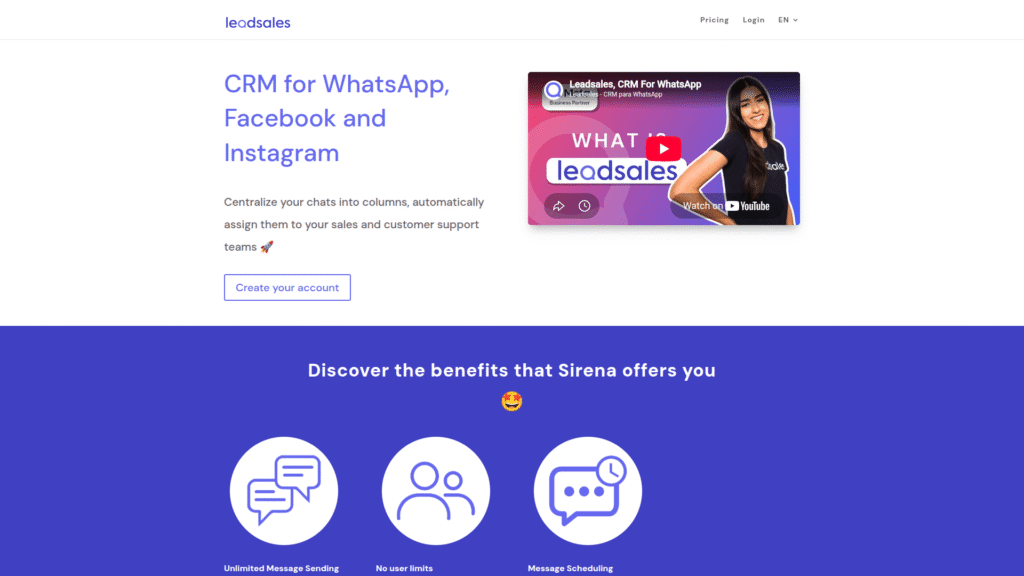
Sirena focuses on sales and customer service automation specifically for WhatsApp. It’s a solution that helps businesses manage leads, qualify prospects, and close deals more efficiently through automated communication. If your primary goal is to supercharge your sales pipeline via WhatsApp, Sirena provides a specialized set of WhatsApp automation tools tailored to that objective. It’s particularly strong for businesses with a sales team that needs to handle a high volume of inquiries and nurture leads effectively. They understand that every message can be a potential sale, and their tools are designed to maximize that potential.
Features:
- Lead Qualification: Automate the process of identifying and qualifying leads.
- Team Inbox for Sales: Collaborate on sales conversations and assign leads.
- Automated Follow-ups: Schedule follow-up messages to nurture prospects.
- CRM Integration: Seamlessly integrate with popular CRM systems.
- Quick Replies and Templates: Speed up response times with pre-written messages.
- Analytics for Sales Performance: Track conversion rates and team productivity.
Pricing:
Sirena typically offers plans based on the number of users and the scale of automation required, often with various tiers for small to large sales teams. They often provide personalized quotes based on specific business needs.
Pros:
- Strong emphasis on sales automation and lead management.
- Designed specifically for sales teams.
- Good integration with CRM systems.
Cons:
- Less focused on broader marketing automation.
- May have a steeper learning curve for users new to sales automation.
5. Twilio – WhatsApp Automation Tools Review
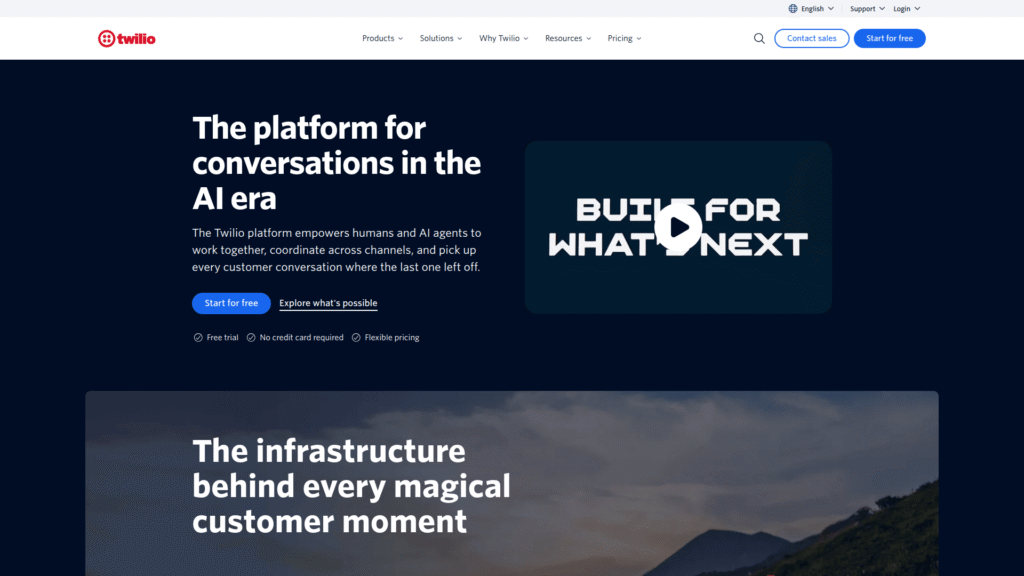
Twilio is a powerful cloud communications platform that allows developers to programmatically make and receive phone calls, send and receive text messages, and perform other communication functions. When it comes to WhatsApp automation tools, Twilio provides the underlying API infrastructure that many other platforms build upon. It’s for businesses that need highly customizable and scalable communication solutions, often with in-house development teams. If you have specific, complex automation needs and the technical know-how, Twilio gives you the raw power to build exactly what you want. It’s less of an out-of-the-box solution and more of a toolkit for creating bespoke communication systems.
Features:
- Programmable WhatsApp API: Build custom WhatsApp messaging applications.
- Multi-channel Communication: Integrate SMS, voice, and video alongside WhatsApp.
- Advanced Security Features: Ensure data privacy and compliance.
- Scalable Infrastructure: Handle massive volumes of messages.
- Extensive Documentation and Support: Resources for developers.
- Global Reach: Send messages to users worldwide.
Pricing:
Twilio operates on a pay-as-you-go model, where you only pay for the services you use (messages sent, calls made, etc.), plus any associated monthly numbers or services.
Pros:
- Extremely flexible and customizable.
- Highly scalable for businesses of all sizes.
- Pay-as-you-go pricing can be cost-effective for low usage.
Cons:
- Requires technical expertise to implement and manage.
- Not an out-of-the-box solution for non-developers.
6. MessageBird – WhatsApp Automation Tools Review
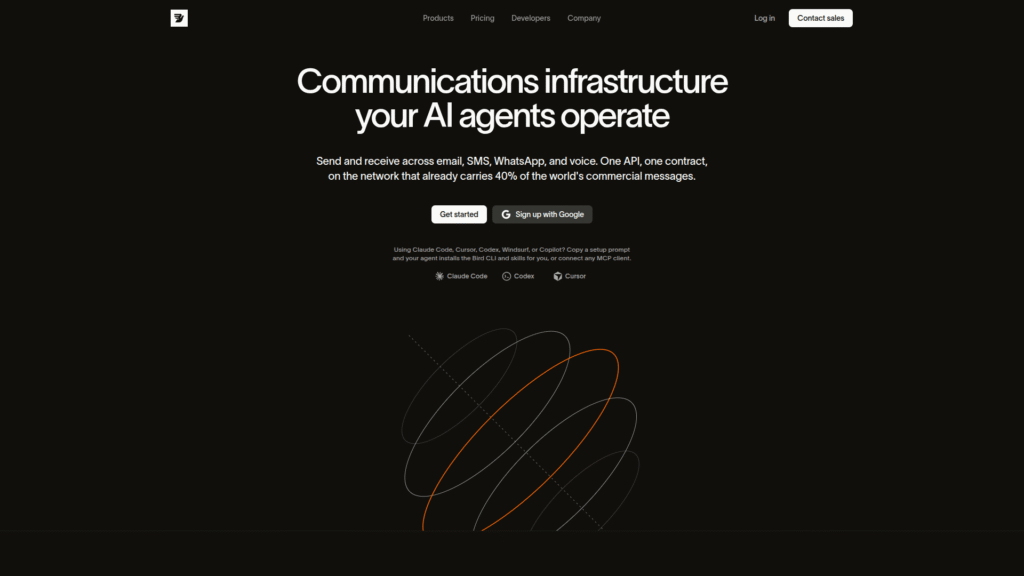
MessageBird is another comprehensive cloud communications platform that offers a suite of tools for customer engagement, including robust WhatsApp automation capabilities. It aims to help businesses connect with their customers across various channels in a unified and automated way. MessageBird provides a balance between developer-friendly APIs and user-friendly applications, making it accessible for a wider range of businesses. They are committed to streamlining Chatbots and Customer Support by offering powerful communication solutions that integrate seamlessly. The goal is to make customer interactions as smooth and efficient as possible, and their WhatsApp automation tools play a big part in that.
Features:
- WhatsApp Business API Access: Connect your business to WhatsApp.
- Flow Builder: Visually create automated workflows and chatbots.
- Omnichannel Inbox: Manage conversations from WhatsApp, SMS, voice, and more.
- Campaigns and Broadcasts: Send targeted messages to your audience.
- Integrations: Connect with CRM, e-commerce, and other business tools.
- Analytics and Reporting: Monitor campaign performance and customer engagement.
Pricing:
MessageBird offers a combination of pay-as-you-go pricing for messaging and subscription plans for platform features like Flow Builder and Inbox. Pricing varies based on usage and selected features.
Pros:
- Good balance of API flexibility and user-friendly tools.
- Comprehensive omnichannel capabilities.
- Scalable for businesses of various sizes.
Cons:
- Pricing can become complex with multiple services.
- Some advanced features may still require technical input.
Visit official MessageBird website
7. DelightChat – WhatsApp Automation Tools Review
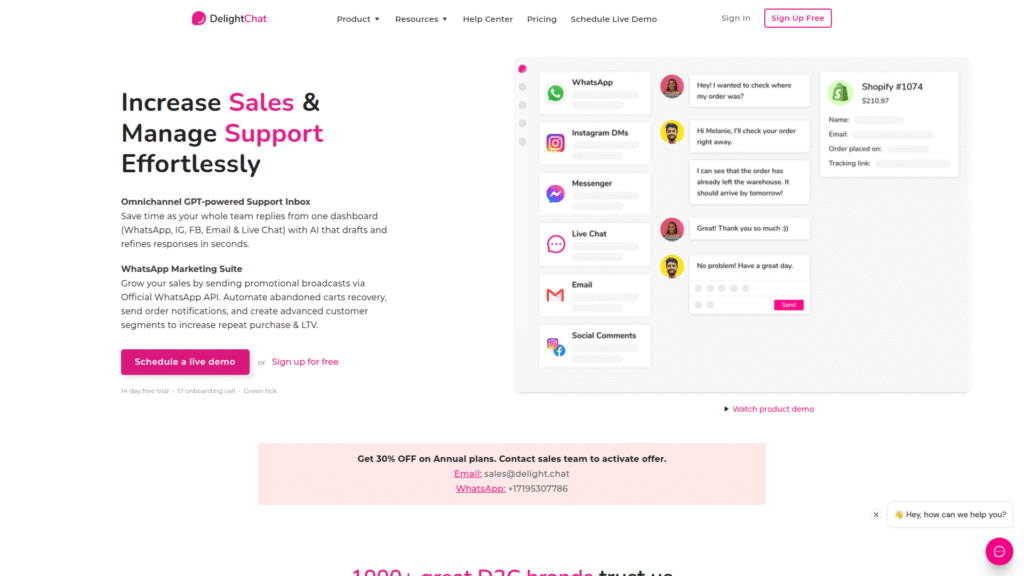
DelightChat is designed specifically for e-commerce businesses looking to manage customer support and marketing on WhatsApp and other channels. It combines a shared inbox with marketing automation features, making it a powerful tool for online stores. If you’re running an e-commerce business and want to centralize your customer communication while driving sales through automated campaigns, DelightChat’s WhatsApp automation tools are specifically built for you. They understand the unique needs of online retailers and offer solutions that directly address those pain points, from abandoned cart recovery to order updates, leveraging the power of WhatsApp and Messenger Automation to boost sales and customer satisfaction.
Features:
- Shared Inbox for E-commerce: Manage WhatsApp, Instagram, Facebook, and email conversations.
- Automated Order Updates: Send shipping notifications, delivery confirmations, and more.
- Abandoned Cart Recovery: Automate messages to recover lost sales.
- WhatsApp Marketing Campaigns: Run promotions and send newsletters.
- Integration with Shopify and other E-commerce Platforms: Seamless data sync.
- Pre-built Templates for E-commerce: Quickly respond to common queries.
Pricing:
DelightChat typically offers tiered pricing plans, often based on the number of conversations or contacts, with features tailored for e-commerce businesses. A free trial is usually available.
Pros:
- Highly specialized for e-commerce businesses.
- Excellent integrations with popular e-commerce platforms.
- Focus on driving sales and customer loyalty.
Cons:
- Less suitable for non-e-commerce businesses.
- Might lack some broader automation features found in general platforms.
Visit official DelightChat website
Feature Comparison
When you’re evaluating these WhatsApp automation tools, it’s not just about what they *can* do, but what they do *best*. Some platforms are absolute beasts for broad marketing campaigns, while others are surgical instruments for razor-sharp customer support. For instance, if you’re drowning in customer inquiries and need a battalion of agents collaborating, Wati and Respond.io are going to be your heavy hitters with their shared inbox features.
They’re built for teamwork and high-volume conversations, ensuring no customer falls through the cracks. On the other hand, if your primary hustle is e-commerce and you’re bleeding sales from abandoned carts, DelightChat is practically purpose-built for you, offering specialized features like automated recovery messages and direct Shopify integration. These are not generic WhatsApp automation tools; they are highly specialized solutions.
Then you have the big guns like Twilio and MessageBird. These aren’t just WhatsApp automation tools; they’re entire communication platforms. If you have a development team and you need to build a bespoke communication system from the ground up, integrating WhatsApp with SMS, voice, and video, these platforms provide the underlying APIs and infrastructure. They offer unparalleled flexibility and scalability but come with the requirement of technical expertise.
For businesses looking for robust, out-of-the-box marketing capabilities, Whatso excels with its bulk sending and campaign management features, perfect for blasting out promotions. Sirena, meanwhile, is laser-focused on sales, helping teams manage leads and automate follow-ups to close deals faster. The key takeaway here is to match the tool’s core strength with your business’s most pressing need. Don’t buy a Ferrari if you just need to pick up groceries. Understand the nuances of each of these WhatsApp automation tools to make an informed decision for your business’s specific requirements.
Pricing Breakdown
Alright, let’s talk money. Because at the end of the day, even the most powerful WhatsApp automation tools need to fit your budget. The pricing models for these platforms vary significantly, and understanding them is crucial to avoid sticker shock. You’ll typically see a few common approaches. Many tools, like Wati and Respond.io, use a tiered subscription model, where the cost increases with the number of active contacts, team members, or advanced features you unlock. This can be great for scalability – you only pay for what you use as your business grows. However, if your contact list explodes overnight, so can your bill. It’s important to project your growth and understand the thresholds.
Then you have the usage-based models, most prominently seen with Twilio and, to some extent, MessageBird. Here, you pay per message sent, per minute of voice call, or per any other specific action. This can be incredibly cost-effective for businesses with fluctuating volumes or those just starting out with low usage. However, if you suddenly launch a massive campaign, your costs can add up quickly. It requires careful monitoring and budgeting.
Platforms like DelightChat often have pricing geared towards their specific niche, like e-commerce, and might offer plans based on order volume or specific integrations. My advice? Don’t just look at the starting price. Dig into what’s included in each tier, understand the limitations, and consider potential overage charges. Factor in the cost of setting up, potential development work (especially with API-driven tools), and the ongoing maintenance. The goal is to find WhatsApp automation tools that deliver maximum value without gutting your profit margins. Do the math, always.
Real-World Use Cases
Imagine this: You’re a booming e-commerce store. Every day, customers are hitting you up on WhatsApp asking, “Where’s my order?” or “Can I get a refund?” If you’re still manually responding to each one, you’re losing hours, energy, and probably some of your sanity. Enter DelightChat. With its specialized WhatsApp automation tools, you can set up automated responses for common queries, send proactive shipping updates, and even recover abandoned carts with a perfectly timed message. You’re not just saving time; you’re converting browsers into buyers and making your existing customers feel valued, all without lifting a finger. That’s real-world impact, right there. It’s about leveraging these WhatsApp automation tools to solve actual business problems.
Or perhaps you run a service-based business, like a coaching program or a consulting firm. You’re constantly onboarding new clients, scheduling appointments, and sending reminders. Manual tasks, all of them. But with a platform like Wati or Respond.io, you can automate your client onboarding flow. Imagine a welcome message, a link to your calendar, and a series of introductory messages, all delivered automatically after a client signs up. Your clients get a seamless, professional experience, and you get your time back to focus on delivering your core service. Even sales teams can benefit massively.
Sirena allows sales reps to quickly qualify leads and send automated follow-ups, ensuring no hot prospect goes cold. These aren’t theoretical advantages; these are concrete examples of how WhatsApp automation tools are being used right now to drive efficiency, improve customer satisfaction, and ultimately, increase revenue across diverse industries. The point is, if you have repetitive communication tasks, there’s a WhatsApp automation tool designed to make them disappear.
Who Should Use Each Tool?
Choosing the right WhatsApp automation tool is like picking the right weapon for a specific battle. You wouldn’t bring a butter knife to a sword fight, would you? So let’s break down who benefits most from each of these powerhouses. If you’re an e-commerce brand, especially one using Shopify, DelightChat is practically a no-brainer. It’s built for your world, handling order updates, abandoned carts, and customer support with precision. It’s not just a tool; it’s an extension of your online store.
For large customer support teams, particularly those juggling multiple channels, Respond.io and Wati are your champions. Their shared inboxes and advanced routing capabilities are designed for collaboration and high-volume conversations. They ensure your customers get quick, consistent support, no matter who’s on shift. If you’re a marketing-focused business looking to blast out promotions, run campaigns, and manage a vast contact list, Whatso is your go-to. It’s built for scale and direct communication. Now, for the tech-savvy crowd, the innovators, and businesses with very specific, complex communication needs, Twilio and MessageBird are the ultimate playgrounds.
If you have developers on staff and want to build a truly custom solution, integrating WhatsApp into your proprietary systems, these are the platforms that provide the raw power and flexibility. Finally, if you’re a sales-driven organization that needs to qualify leads, nurture prospects, and close deals through WhatsApp, Sirena is your specialist. Each of these WhatsApp automation tools has its niche, and aligning that niche with your business’s core activities is the secret to unlocking their full potential. Don’t just pick one; pick the right one.
How to Choose the Right Tool
Alright, so you’ve seen the heavy hitters. Now, how do you actually pick the WhatsApp automation tools that are going to make you money instead of just costing you money? It comes down to a few critical questions you need to ask yourself. First, what’s your core problem? Are you drowning in customer support queries? Losing sales to abandoned carts? Struggling to manage leads?
Identify your biggest pain point, and let that guide your search. If customer support is your bottleneck, lean towards tools with robust shared inboxes and ticketing features like Wati or Respond.io. If it’s sales, then Sirena might be your best bet. If it’s e-commerce, look no further than DelightChat. Don’t try to solve every problem with one tool unless that tool is specifically designed for multi-faceted challenges.
Second, consider your team’s technical expertise. Do you have developers who can build custom solutions with APIs like Twilio or MessageBird? Or do you need a no-code, drag-and-drop interface that anyone on your team can master in an afternoon? The ease of implementation and ongoing management is a massive factor. Third, what’s your budget, and what’s your expected return on investment? Don’t just look at the monthly fee; think about the time saved, the sales gained, and the improved customer satisfaction.
The right WhatsApp automation tools will pay for themselves many times over. Fourth, scalability. As your business grows, will the tool grow with you, or will it become a bottleneck? Look for flexible pricing plans and robust infrastructure. Finally, integrations. Does it play nicely with your existing CRM, e-commerce platform, or other essential business software? A tool that doesn’t integrate seamlessly can create more headaches than it solves. Be ruthless in your evaluation; these WhatsApp automation tools are an investment, and you deserve a return.
Making Money with These Tools
Let’s be brutally honest: you’re not just buying WhatsApp automation tools for fun. You’re buying them to make more money. And they absolutely can. The most direct way is through increased efficiency. Think about the hours your team spends manually answering repetitive questions. Automate those, and suddenly those hours are freed up to focus on higher-value tasks, like closing deals or developing new products. That’s a direct cost saving and a reallocation of resources that impacts your bottom line. It’s about doing more with less, which is the cornerstone of profitability.
Beyond efficiency, these WhatsApp automation tools are revenue generators. Automated abandoned cart recovery messages can bring back lost sales that would have otherwise vanished into the ether. Proactive customer support and quick responses lead to higher customer satisfaction, which translates into repeat business and positive word-of-mouth – the cheapest and most effective form of marketing. Targeted marketing campaigns, segmented lists, and personalized promotions sent via WhatsApp can drive impulse purchases and increase average order values.
Imagine launching a flash sale directly to your most engaged customers and seeing immediate returns. These tools also allow you to scale your communication without scaling your team proportionally. You can handle thousands of conversations with a fraction of the staff, dramatically increasing your operational leverage. Whether it’s through direct sales, improved customer retention, or simply freeing up valuable human capital, the right WhatsApp automation tools are not an expense; they are an investment in your business’s financial growth. It’s about leveraging technology to multiply your efforts and maximize your profits.
Common Limitations
Alright, let’s get real. While these WhatsApp automation tools are powerful, they aren’t magic wands that solve every problem instantly. There are limitations, and smart operators acknowledge them. First, the WhatsApp Business API itself has rules and restrictions. You can’t just spam people. There are guidelines for message templates, opt-ins, and proactive communication. Failing to adhere to these can get your account flagged or even banned. So, while the tools provide the mechanism, you still need to play by WhatsApp’s rules. That’s a fundamental constraint you can’t ignore, regardless of how advanced your WhatsApp automation tools are.
Second, the “human touch” factor. While chatbots and automated responses are incredibly efficient for routine queries, there will always be situations that require a real person. Complex issues, emotional customer service scenarios, or highly personalized sales conversations often benefit from human interaction. Over-automating can sometimes lead to customer frustration if they feel like they’re stuck in a loop with a bot. The best WhatsApp automation tools offer a seamless handover to live agents for these specific cases.
Third, integration challenges. While many tools boast extensive integrations, the reality can sometimes be trickier. Data silos or compatibility issues between different software platforms can require custom development or workarounds, adding to your time and cost. Finally, the “set it and forget it” mentality is a trap. Automation isn’t a one-time setup; it requires continuous monitoring, optimization, and adaptation. Your customer needs evolve, your products change, and your automation flows need to keep pace. These WhatsApp automation tools are incredibly effective, but they demand ongoing attention to stay sharp and deliver maximum value.
Final Verdict and Recommendations
So, what’s the final word on these WhatsApp automation tools? They are absolutely essential for any business looking to compete effectively in today’s market. Period. You cannot afford to ignore the power of automated, personalized communication on a platform with billions of users. My top recommendation comes with a caveat: the “best” tool isn’t a one-size-fits-all answer. It’s the one that perfectly aligns with your specific business model and current challenges.
If you’re an e-commerce brand, hands down, DelightChat is going to give you the fastest ROI and the most tailored features. Its focus on abandoned carts, order updates, and seamless Shopify integration makes it an undisputed champion in that niche. For larger businesses with extensive customer support needs and multiple communication channels, Respond.io offers unparalleled versatility and team collaboration features. It’s an investment, but one that pays dividends in streamlined operations.
If you’re looking for robust sales automation and lead management through WhatsApp, Sirena stands out with its specialized approach for sales teams. And for those with the technical chops and a need for ultimate customization, Twilio remains the gold standard, offering the building blocks to create anything you can imagine. For general marketing and bulk messaging, Whatso provides a strong, user-friendly option. Wati offers a great balance for growing teams needing a shared inbox and chatbot capabilities, while MessageBird bridges the gap between raw API power and more user-friendly applications.
Don’t get stuck in analysis paralysis. Pick the tool that directly addresses your most pressing need, implement it, and start seeing the results. These WhatsApp automation tools are here to make your life easier and your business more profitable. It’s time to stop debating and start automating. You’ll thank me later.
Frequently Asked Questions
What are WhatsApp Automation Tools?
WhatsApp automation tools are software solutions designed to automate various communication tasks on WhatsApp, such as sending automated replies, scheduling messages, managing broadcasts, and creating chatbots to interact with customers. These tools aim to streamline customer support, marketing, and sales processes for businesses.
Are WhatsApp automation tools legal?
Yes, WhatsApp automation tools are legal as long as they comply with WhatsApp’s Business Platform Policy and local data privacy regulations (like GDPR). Businesses must obtain proper opt-ins from users before sending automated messages and adhere to best practices to avoid spamming.
Can I send bulk messages with these WhatsApp Automation Tools?
Many WhatsApp automation tools, such as Whatso and Wati, offer bulk messaging capabilities. However, these must be done through the official WhatsApp Business API to ensure compliance with WhatsApp’s policies and avoid account suspension. Sending unsolicited bulk messages is against WhatsApp’s terms of service.
How do WhatsApp chatbots work?
WhatsApp chatbots work by using pre-programmed rules or AI to understand and respond to customer queries automatically. They can provide instant answers to FAQs, guide users through processes, gather information, and even escalate conversations to live agents when needed. Many WhatsApp automation tools include a no-code chatbot builder.
What’s the difference between WhatsApp Business App and WhatsApp Business API?
The WhatsApp Business App is a free app designed for small businesses, offering basic features like quick replies and business profiles. The WhatsApp Business API, on the other hand, is for medium to large businesses and requires a third-party solution (like the WhatsApp automation tools discussed) to access advanced features such as bulk messaging, shared inboxes, and chatbot integration.
Can these WhatsApp Automation Tools integrate with my CRM?
Yes, many advanced WhatsApp automation tools, including Respond.io, Wati, and Sirena, offer integrations with popular CRM systems. This allows businesses to sync customer data, track conversations, and manage leads more effectively, creating a unified view of customer interactions.
Are WhatsApp Automation Tools suitable for small businesses?
Absolutely. While some high-end platforms might be more complex, many WhatsApp automation tools offer affordable plans and user-friendly interfaces suitable for small businesses looking to improve their customer communication, save time, and scale their operations efficiently. Starting with a tool that fits your current needs and budget is key.